Concentration camps

The War Relocation Authority (WRA) oversaw construction of ten concentration camps in sparsely populated and isolated areas. Between June and October 1942, Japanese Americans were transferred from the "assembly centers" to the larger camps. Housing approximately 120,000 people, the camps were designed to be self-contained communities, complete with hospitals, post offices, schools, warehouses, and residential areas. The WRA attempted to establish normalcy by setting up newspapers, a degree of self-government, sports leagues, and social events. But confinement, monotony, and harsh conditions exacerbated tensions between pro- and anti-camp administration residents and between the disempowered Issei and their U.S.-born Nisei children. At several centers, conflicts erupted into violence and at the Manzanar concentration camp the unrest resulted in fatal shootings. The WRA gradually granted work and school leave to those they considered "loyal." The last camp closed in March 1946.

World War II (283)
Concentration camps (2078)

Related articles from the Densho Encyclopedia :
Concentration Camps, U.S.A. (book), Gila River, Heart Mountain, Jerome, Manzanar, Minidoka, Poston (Colorado River), Psychological effects of camp, Rohwer, Sites of incarceration, Topaz, Tule Lake

Facilities
Format
Genre
Usage

Use <Ctrl> or (⌘) keys to select multiple terms

2078 items
Goro Sumida interviewed by Eric Saul, part 2 of 2 (ddr-densho-1007-1766)
av Goro Sumida interviewed by Eric Saul, part 2 of 2 (ddr-densho-1007-1766)
Sumida discusses his family, visiting his family at Rohwer, his impressions of camp, his time in basic training, war stories from Germany, the awards he received after the war, and whether he considers himself lucky. This interview was not conducted specifically for Loni Ding's work, rather for a book the Presidio was putting together. Partial transcript …
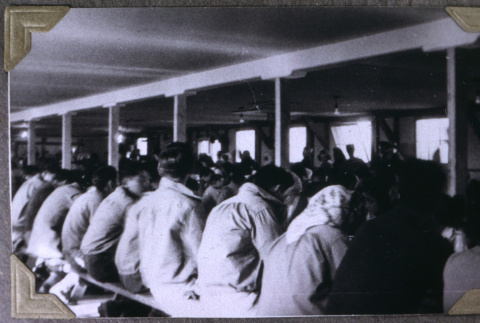
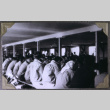
Camp mess hall (ddr-densho-1007-683)
img Camp mess hall (ddr-densho-1007-683)
Slide, created in September 1984. Image date unknown.
Interview with Frank Emi, part 1 of 6 (ddr-densho-1007-1792)
av Interview with Frank Emi, part 1 of 6 (ddr-densho-1007-1792)
Emi discusses resisting the draft, the difference between Nisei and Caucasians, Issei attitudes toward the draft, the attitudes of draft resisters, Heart Mountain as a "model" relocation camp, being arrested in camp by the FBI, awaiting trial in jail in Cheyenne and Laramie (in WY), his family's thoughts on him resisting the draft, and a fellow …
Interview with Harry Fukuhara, part 3 of 6 (ddr-densho-1007-1634)
av Interview with Harry Fukuhara, part 3 of 6 (ddr-densho-1007-1634)
Fukuhara discusses his relationship with the Mount family, his time in the Gila internment camp, volunteering for the military from camp, his time in military language school, and the possibility of being captured by the Japanese military. Video ends at 19:49. Original title: 119, II SJ #25, 8-17-85, Fukuhara, Harry's house. Interview continues at ddr.densho.org/ddr-densho-1007-1635/
Interview with Clarence Matsumura, part 5 of 5 (ddr-densho-1007-1773)
av Interview with Clarence Matsumura, part 5 of 5 (ddr-densho-1007-1773)
Matsumura discusses being discharged from the military, moving to Minneapolis, working for Lew Bonn Company, attending the University of Minnesota, being ordered to report for duty in 1949, his difficulty talking about Dachau, his thoughts on war and America's role in international politics, the importance of fighting for what is right, his efforts against discrimination at …
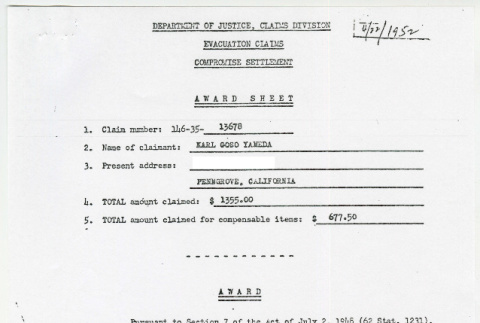
Evacuation claims settlement (ddr-densho-1007-893)
doc Evacuation claims settlement (ddr-densho-1007-893)
Awarded to Karl Yoneda. Only a small portion of the claim was fulfilled.
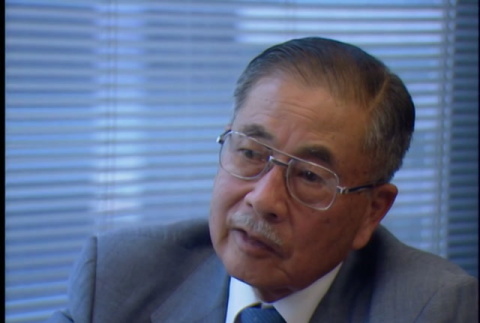
Interview with Yukio Kawamoto, part 3 of 8 (ddr-densho-1007-1547)
av Interview with Yukio Kawamoto, part 3 of 8 (ddr-densho-1007-1547)
Kawamoto discusses serving in the MIS while his parents were interned, draft resistance, and his attitude toward the US during the war. Video starts at 0:56. Loni Ding can be heard asking questions behind the camera. Original title: 99, II NY #31, Channel #1 Audio Kawamoto. Interview continues at ddr.densho.org/ddr-densho-1007-1548/
Interview with Kazuko Iijima, part 3 of 4 (ddr-densho-1007-1533)
av Interview with Kazuko Iijima, part 3 of 4 (ddr-densho-1007-1533)
Iijima discusses the 442nd, mentions volunteers from Topaz and Fred Korematsu. Also discusses her husband, who she married in camp and who later joined the 442nd. Video starts at 0:56. Loni Ding can be heard asking questions behind the camera. Original title: 38, II NY #17, 6-85, Kazuko Iijima. Interview continues at ddr.densho.org/ddr-densho-1007-1534/
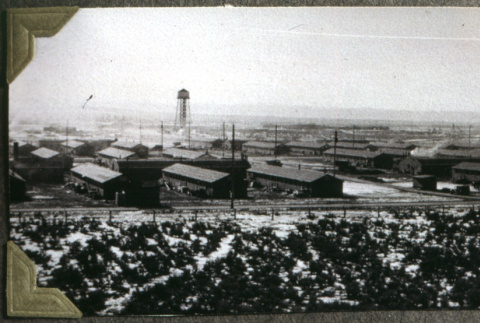
Minidoka buildings (ddr-densho-1007-698)
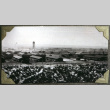
img Minidoka buildings (ddr-densho-1007-698)
Slide, created in September 1984. Case reads "T. Matsui"
Interview with Hugh Nozawa, part 3 of 3 (ddr-densho-1007-1715)
av Interview with Hugh Nozawa, part 3 of 3 (ddr-densho-1007-1715)
Nozawa discusses being court-martialed for refusing to serve in the military while the internment camps were operating, the long fight for honorable discharge after the fact, and his reasons for trying to hard to reverse the dishonorable discharge given to Nisei who refused to serve. Original title: 222, II JA #54, Hugh Nozawa, Sun. Feb. 2
Interview with Yukio Kawamoto, part 4 of 8 (ddr-densho-1007-1548)
av Interview with Yukio Kawamoto, part 4 of 8 (ddr-densho-1007-1548)
Kawamoto reads through a letter he wrote from the south Pacific to a camp newspaper in Topaz, talks about his service, and tells a few war stories. Also mentions the atomic bombs. Video starts at 0:59. Loni Ding can be heard asking questions behind the camera. Original title: 49, II NY #32, 6-85, Kawamoto. Interview continues …
Excerpt: Testimony of Karl R. Bendetsen (ddr-densho-1007-1834)
doc Excerpt: Testimony of Karl R. Bendetsen (ddr-densho-1007-1834)
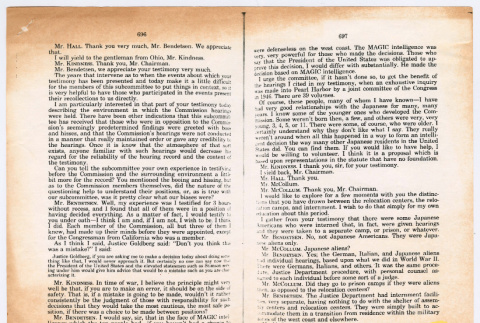
Karl R. Bendetsen's statement to the Commission on Wartime Relocation and Internment of Civilians defending the argument that incarceration of Japanese Americans was a national security matter which he believed was supported by wartime intelligence, known as MAGIC. He also disputes claims of harm and prison-like living conditions in the camps.
Interview with Nobuo Yamashita, part 3 of 5 (ddr-densho-1007-1778)
av Interview with Nobuo Yamashita, part 3 of 5 (ddr-densho-1007-1778)
Yamashita discusses why his parents didn't want him to go to college, joining his family's produce business, meeting his wife in Manzanar, his service in the Philippines, interrogating prisoners of war, seeing American prisoners who came out of Santo Tomas, the selfishness of weathy Japanese people in Korea, and not getting any promotions or furlough in …
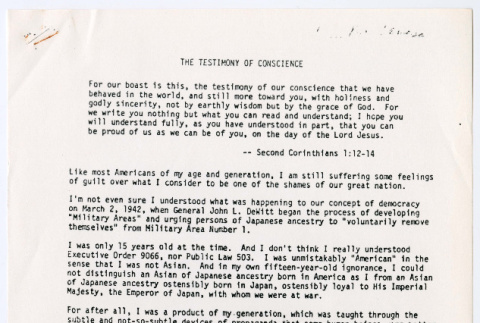
Testimony of Conscience (ddr-densho-1007-1855)
doc Testimony of Conscience (ddr-densho-1007-1855)
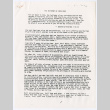
This document is a transcript of a sermon given by Charles Z. Smith at the Blaine Memorial United Methodist Church in Seattle, Washington on July 28, 1974. Smith was not of Japanese descent nor incarcerated during World War II in a concentration camp, but during his law career he advocated for immigrant rights and opposed Executive …
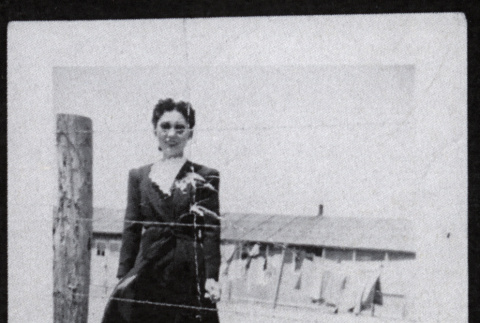
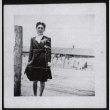
Woman behind barbed wire at Amache (ddr-densho-545-57)
img Woman behind barbed wire at Amache (ddr-densho-545-57)
Included annotation: Loneliest Days, Me at Birmingham Hospital & She in Amache Colorado.
Interview with John Aiso, part 5 of 5 (ddr-densho-1007-1578)
av Interview with John Aiso, part 5 of 5 (ddr-densho-1007-1578)
Aiso discusses loyalty to the US, his family's internment at Manzanar, his (and the Nisei's in general) response to Pearl Harbor, and his role in the military. Video starts at 0:26. Loni Ding can be heard asking questions behind the camera. Interview ends at 18:30; rest of tape is b-roll of Aiso reading. Original title: 75, …
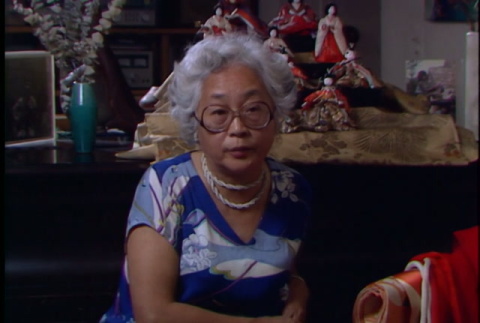
Interview with Kazuko Iijima, part 1 of 4 (ddr-densho-1007-1531)
av Interview with Kazuko Iijima, part 1 of 4 (ddr-densho-1007-1531)
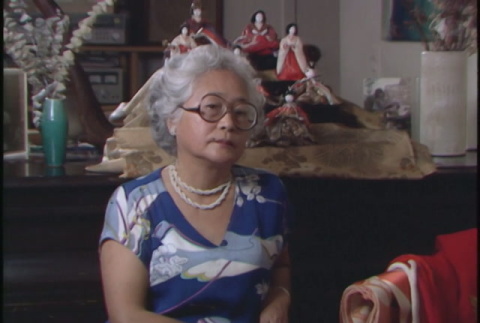
Iijima discusses Hinamatsuri dolls, her childhood in Oakland, the Buddhist church, evacuation, internment at Topaz, and her mother. Video starts at 0:56. Loni Ding can be heard asking questions behind the camera. Original title: 36, II NY #15, 6-85, Kazuko Iijima. Interview continues at ddr.densho.org/ddr-densho-1007-1532/
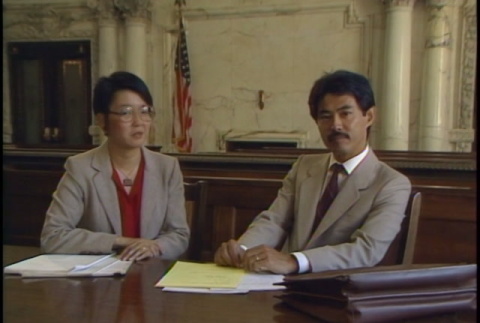
San Francisco Courthouse footage, part 7 of 10; interview with Dale Minami and Karen Kai, part 3 of 5 (ddr-densho-1007-1628)
av San Francisco Courthouse footage, part 7 of 10; interview with Dale Minami and Karen Kai, part 3 of 5 (ddr-densho-1007-1628)
Sansei lawyers Karen Kai and Dale Minami discuss the stakes of the Korematsu case, why redress legislation took so long, the difficulty camp survivors had talking about their experiences, and the role of Sansei in the fight for redress. Video starts at 0:43. Loni Ding can be heard asking questions behind the camera. Original title: 107, …
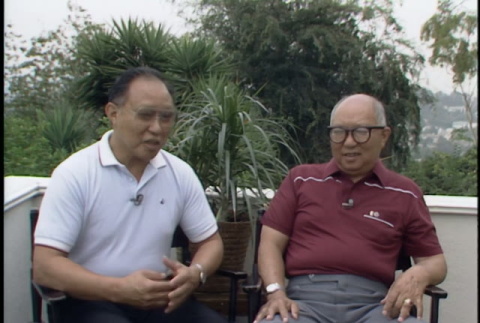
Interview with Harry and Ken Akune, part 2 of 6 (ddr-densho-1007-1590)
av Interview with Harry and Ken Akune, part 2 of 6 (ddr-densho-1007-1590)
Ken is on the left, Harry on the right. The two discuss growing up as Nisei, anti-Japanese sentiment in the US, their relationship with their mother, the difference between Japanese nationals and Japanese Americans, Pearl Harbor, their time in internment at Merced and Amache, and their decision to volunteer for the military. Video starts at 0:28. …
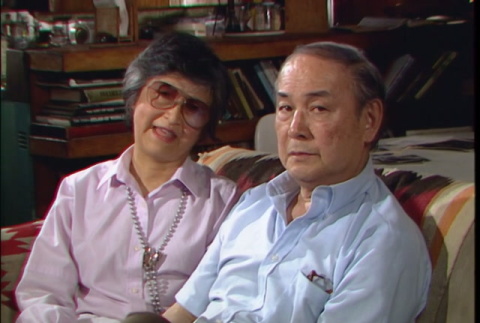
Interview with Chris and Ada Ishii (ddr-densho-1007-1569)
av Interview with Chris and Ada Ishii (ddr-densho-1007-1569)
The Ishiis discuss the difficulty of getting married and moving to the US (Ada is from China), Chris' time in camp, Ada meeting Chris' mother, and the first time the two met. Video starts at 0:52. Loni Ding can be heard asking questions behind the camera. Original title: 66, II NY #53, Chris & Ada Verite …
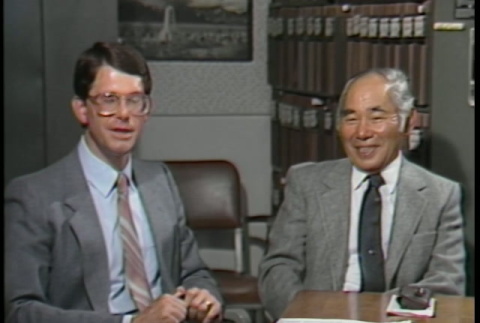
Interview with Paul Minerich, Tim Nomiyama, Masao Kataoka, and Kenjiro Hayakawa, part 8 of 8; interview with Gary and Grace Itano, part 1 of 6 (ddr-densho-1007-1805)
av Interview with Paul Minerich, Tim Nomiyama, Masao Kataoka, and Kenjiro Hayakawa, part 8 of 8; interview with Gary and Grace Itano, part 1 of 6 (ddr-densho-1007-1805)
From left to right: Minerich, Nomiyama, Kataoka, Hayakawa. Kataoka discusses his hopes for the future, his feelings on Abraham Lincoln, and sneaking a letter from Hugh Nozawa to President Roosevelt out of camp. Minerich discusses the hearings that had taken place shortly before this interview at the Pentagon. Nomiyama discusses how he felt after the hearings …
Interview with Jimmie Matsumura, part 2 of 4 (ddr-densho-1007-1606)
av Interview with Jimmie Matsumura, part 2 of 4 (ddr-densho-1007-1606)
Matsumura discusses his time teaching at the 4th Army Military Intelligence School in San Francisco, his experience with John Aiso, his trouble with white officers, the difficulties his students faced, visiting his family at Heart Mountain, and the conflicting feelings his Nisei students had about military service. Loni Ding can be heard asking questions behind the …
Interview with Barry Saiki, part 3 of 5 (ddr-densho-1007-1704)
av Interview with Barry Saiki, part 3 of 5 (ddr-densho-1007-1704)
Saiki discusses being relocated to the Rohwer camp, working as editor for the Rohwer Outpost newspaper, the social stigma around his Caucasian friends visiting in camp, his friend Elizabeth Homberger (sp?) and the work she did for the Nisei during the war, the reactions to military recruiters at Rohwer, and his reasons for not volunteering for …
Interview with John Fujii, part 2 of 2 (ddr-densho-1007-1692)
av Interview with John Fujii, part 2 of 2 (ddr-densho-1007-1692)
Fujii discusses being suspected as a Japanese spy while working for a newspaper, serving Japan and being interned in India during the war, his sympathy for Japan during the war, his brother's service in the US army, and his brother's attitude toward Japan. Video starts at 0:25. Loni Ding can be heard asking questions in the …
Interview with Yosh Nakayama, part 2 of 4 (ddr-densho-1007-1586)
av Interview with Yosh Nakayama, part 2 of 4 (ddr-densho-1007-1586)
Nakayama discusses his time in Japanese language school, speaking only Japanese at home, an instructor of his who did not understand why a Nisei student did not speak fluent Japanese, his father's arrest by the FBI, his family's evacuation from LA and internment in Manzanar, and his family's return to LA after the war. Video starts …
API