Temporary Assembly Centers

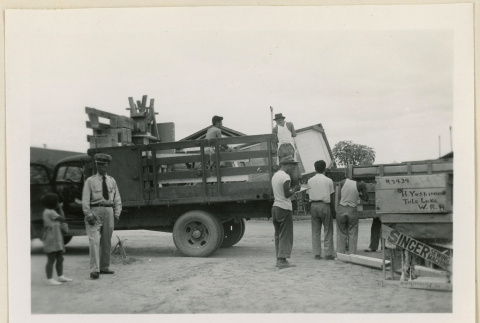
In spring 1942, the Wartime Civil Control Administration (WCCA) hastily prepared temporary "assembly centers" to house the individuals of Japanese ancestry who were removed from their homes after the signing of Executive Order 9066. The centers were surrounded by barbed-wire fences and patrolled by armed military police. People were housed in animal stalls and barracks with communal bathrooms and mess halls. After spending up to six months in the "assembly centers," Japanese Americans were moved inland to permanent concentration camps.

World War II (283)
Temporary Assembly Centers (254)

Related articles from the Densho Encyclopedia :
Assembly centers, Fresno (detention facility), Marysville (detention facility), Mayer (detention facility), Merced (detention facility), Owens Valley (detention facility), Parker Dam (detention facility), Pinedale (detention facility), Pomona (detention facility), Portland (detention facility), Puyallup (detention facility), Sacramento (detention facility), Salinas (detention facility), Santa Anita (detention facility), Sites of incarceration, Stockton (detention facility), Tanforan (detention facility), Tulare (detention facility), Turlock (detention facility)
Facilities
Format
Genre
Usage

Use <Ctrl> or (⌘) keys to select multiple terms
254 items
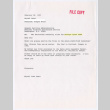
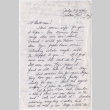
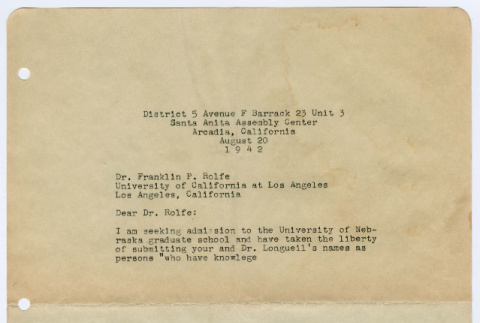
Letter from Joseph Ishikawa to Dr. Franklin Rolfe (ddr-densho-468-105)
doc Letter from Joseph Ishikawa to Dr. Franklin Rolfe (ddr-densho-468-105)
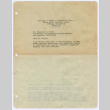
Typed draft letter to Dr. Rolfe. Letter on reverse appears to be from separate correspondence.
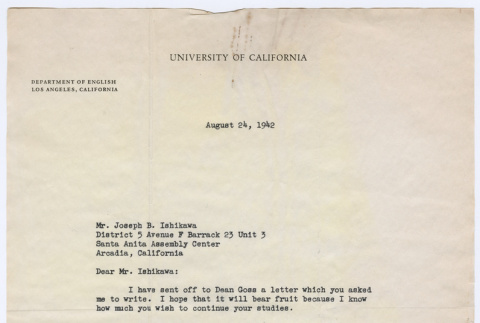
Letter from Alfred Longueil to Joseph Ishikawa (ddr-densho-468-111)
doc Letter from Alfred Longueil to Joseph Ishikawa (ddr-densho-468-111)
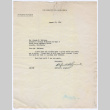
Letter confirming that Longueil sent a letter to Dr. Goss per Ishikawa's request.
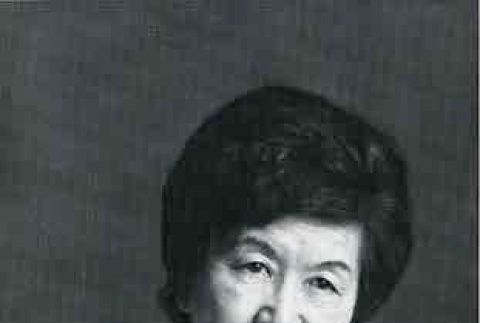
Lillie McCabe (ddr-csujad-29-19)
img Lillie McCabe (ddr-csujad-29-19)
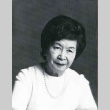
Photo of Lillie McCabe. Oral history audio and transcript are found in csufccop_jaoh_0030, csufccop_jaoh_0031, and csufccop_jaoh_0032. See this object in the California State Universities Japanese American Digitization project site: 1949_P03
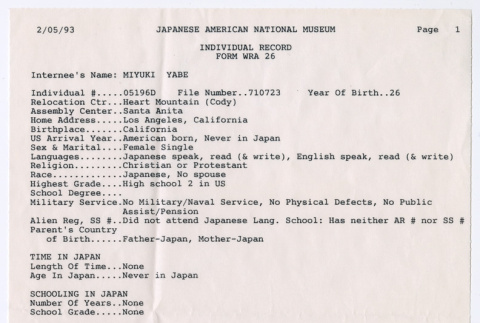
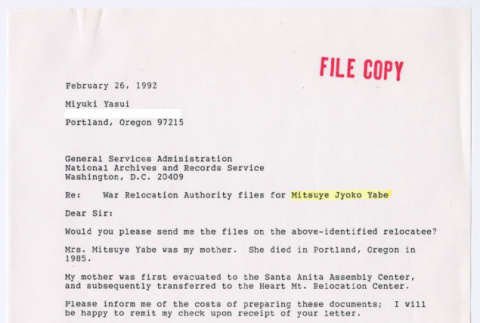
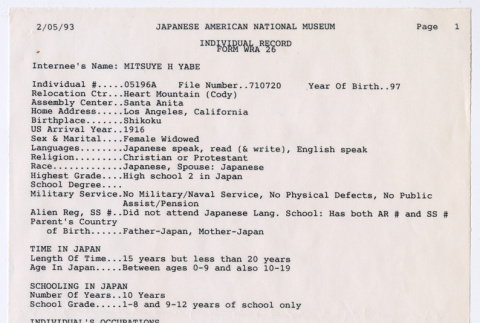
War Relocation Authority Case File for Mitsuye Yabe (ddr-ohs-1-74)
doc War Relocation Authority Case File for Mitsuye Yabe (ddr-ohs-1-74)
WRA - 26; WRA 156 - Request for Transportation of Property; Evacuee Property Report; War Relocation Authority Transportation Division Memorandums; WRA Basic Family Face Sheets; WRA Enlistee Service and Payment Record Cards; Alien Leave Permit; Permit for Evacuee to Return to a Relocation Center; Indefinite Leave Agreement; Evacuee File
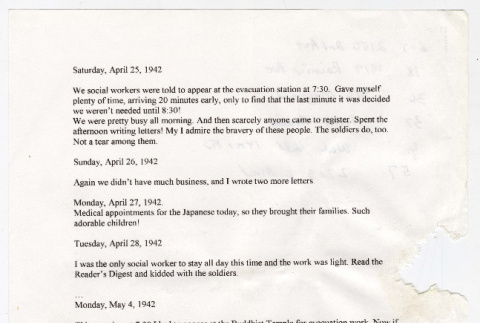
Transcript of portion of 1942 Diary (ddr-densho-549-4)
doc Transcript of portion of 1942 Diary (ddr-densho-549-4)
Select transcriptions of Lois Bennett's diary, which details her experience as a government social worker assisting with the forced removal of Japanese Americans.
1942 Diary (ddr-densho-549-6)
doc 1942 Diary (ddr-densho-549-6)
Personal diary of Lois Bennett that includes reflections on her experience as a government social worker assisting with the forced removal of Japanese Americans. Pages that did not have written entries were not included as part of the scan.
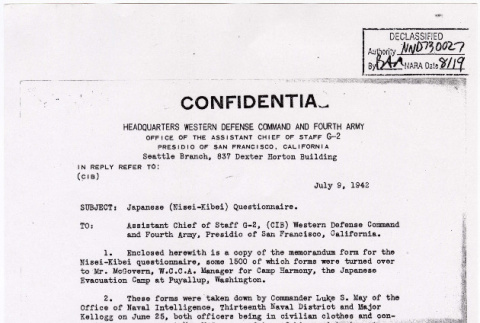
Nisei/Kibbei questionnaire (ddr-densho-122-896)
doc Nisei/Kibbei questionnaire (ddr-densho-122-896)
Draft questionaire to be given at Camp Harmony to start segregation process proposed by JACL. Was not used, or not successful.
Letter from Lily Abiko to Kimi Fujii (ddr-densho-433-6)
doc Letter from Lily Abiko to Kimi Fujii (ddr-densho-433-6)
Lily Abiko writes to Kimi Fujii with updates on discrimination she's encountered while apartment hunting, friends she has seen recently, and thoughts about the military draft. She also advises Kimi about concerns Kimi has about marriage and infertility.
Interview with George Nakamura, part 1 of 5 (ddr-densho-1007-1679)
av Interview with George Nakamura, part 1 of 5 (ddr-densho-1007-1679)
Nakamura discusses moving to Japan in 1955, growing up in Arroyo Grande, CA, evacuation, his time at Tulare and Gila River, volunteering for the military from camp, and camp attitudes toward volunteering. Loni Ding can be heard asking questions behind the camera. Original title: II JA #13, George Nakamura, Fri. Jan. 31. Interview continues at ddr.densho.org/ddr-densho-1007-1680/
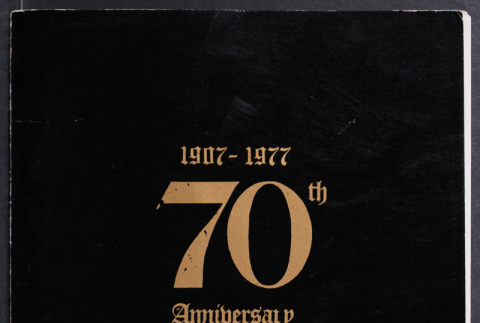
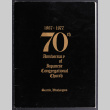
70th Anniversary of the Japanese Congregational Church (ddr-densho-474-53)
doc 70th Anniversary of the Japanese Congregational Church (ddr-densho-474-53)
The Japanese Congregational Church's 70th Anniversary book traces the history of JCC within the context of national and local events.
Interview with Barry Saiki, part 1 of 5 (ddr-densho-1007-1702)
av Interview with Barry Saiki, part 1 of 5 (ddr-densho-1007-1702)
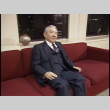
Saiki discusses growing up in Stockton, CA, attending UC Berkeley, Pearl Harbor, the start of evacuation and negative press about Nisei during that time, graduating from Berkeley in 1942, entering Stockton Assembly Center, and the arrest and incarceration of his father. Loni Ding can be heard asking questions behind the camera. Original title: II JA #41, …
Interview with Harry Fukuhara, part 2 of 6 (ddr-densho-1007-1633)
av Interview with Harry Fukuhara, part 2 of 6 (ddr-densho-1007-1633)
Fukuhara discusses working as a gardener, his employers (the Mounts) offering to adopt him, deciding to enter camp with his sister, his time in the Tulare assembly center and the Mounts visiting, Video starts at 0:40. Loni Ding can be heard asking questions behind the camera. Original title: 118, II SJ #24, 8-17-85, SJ, Harry's house. …
Interview with Barry Saiki, part 2 of 5 (ddr-densho-1007-1703)
av Interview with Barry Saiki, part 2 of 5 (ddr-densho-1007-1703)
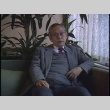
Saiki discusses his mother's reaction to his father's arrest and imprisonment, his time at Stockton Assembly Center, the attitudes of incarcerees at Stockton, the difficulty Nisei faced trying to find jobs at the time, and being relocated to the Rohwer camp. Loni Ding can be heard asking questions behind the camera. Original title: II JA #42, …
Interview with Henry (Hank) Gosho, part 1 of 3 (ddr-densho-1007-1768)
av Interview with Henry (Hank) Gosho, part 1 of 3 (ddr-densho-1007-1768)
Gosho discusses returning to Seattle from Japan before the war, his brothers being conscripted into the Japanese army, Pearl Harbor, his father's arrest by the FBI, assuming the Nisei wouldn't be evacuated, being relocated to Puyallup/Camp Harmony, realizing that he was a prisoner, his time at Minidoka, deciding early on to join the military, and the …
Interview with Clarence Matsumura, part 2 of 5 (ddr-densho-1007-1609)
av Interview with Clarence Matsumura, part 2 of 5 (ddr-densho-1007-1609)
Matsumura discusses growing up in Wyoming, his mother's cooking, moving to Los Angeles in 1936, getting his radio license, Pearl Harbor, evacuation to Pomona and Heart Mountain, his attempts to join the Navy, Air Force, Coast Guard and Marines, being drafted, his basic training in Fort Hood, TX, his deployment in Europe, and the Hollywood store …
Interview with Harry Fukuhara, part 1 of 6 (ddr-densho-1007-1632)
av Interview with Harry Fukuhara, part 1 of 6 (ddr-densho-1007-1632)
Fukuhara discusses growing up in Seattle and Auburn, WA, the time he spent in Hiroshima as a child, his time working before college, studying at Woodbury College in LA, his reaction to Pearl Harbor, evacuation, and entering the Tulare assembly center with his sister. Video starts at 0:50. Loni Ding can be heard asking questions behind …
Interview with Chris Ishii, part 4 of 7 (ddr-densho-1007-1558)
av Interview with Chris Ishii, part 4 of 7 (ddr-densho-1007-1558)
Ishii discusses his mother gaining US citizenship, returning to work at Disney after the war, other animation work, detention at Santa Anita, the L'il Neebo comic strip, the MIS gopher mascot, and his political beliefs. Video starts at 0:55. Loni Ding can be heard asking questions behind the camera. Original title: 57, II NY #42, 6-85, …
API