Draft resistance

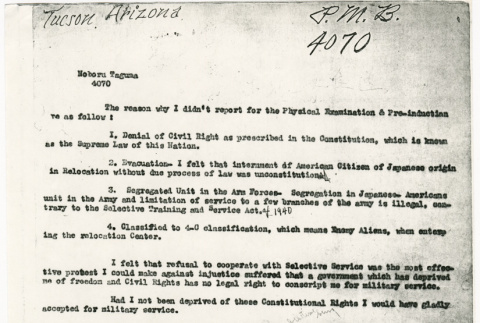
In 1944 the government reinstated the draft for Japanese Americans after suspending it in 1942 and began drafting men directly from the camps. This action angered many. At Heart Mountain concentration camp, Wyoming, resistance took the form of an organized movement calling itself the Fair Play Committee. Members demanded that their rights as citizens be restored before enlisting in the military. Eventually, sixty-three men from Heart Mountain refused induction and were sentenced to prison terms for draft evasion. In the other camps, disparate individuals made the decision to resist the draft. After being unfairly incarcerated for almost two years, they saw the draft as the final injustice. Ultimately, 267 men from all the concentration camps were convicted of evading the draft and most served time in prison. President Truman pardoned all of the resisters in 1947.

World War II (277)
Resistance and dissidence (97)
Draft resistance (393)

Related articles from the Densho Encyclopedia :
Draft resistance, Frank Emi, Gordon Hirabayashi, No-No Boy (book)
Facilities
Format
Genre
Usage

Use <Ctrl> or (⌘) keys to select multiple terms
393 items
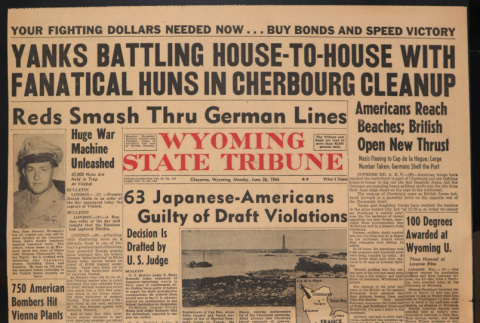
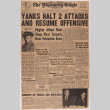
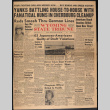
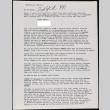
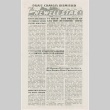
Front page of Wyoming Eagle (ddr-densho-122-787)
doc Front page of Wyoming Eagle (ddr-densho-122-787)
Article: Japs Say They Refused to Report for Army Because 'Rights Were Taken Away', including photo of defense attorneys Samuel Menin and Clyde Watts
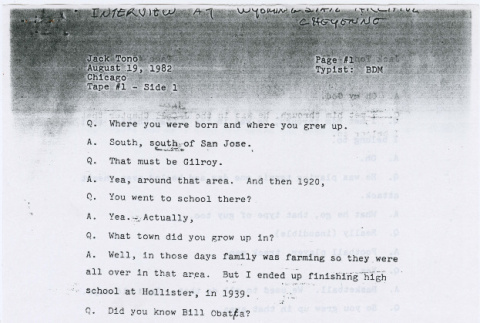
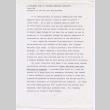
Interview with Jack Tono (ddr-densho-122-538)
doc Interview with Jack Tono (ddr-densho-122-538)
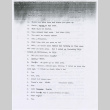
Transcript of taped interview, unknown interviewer, prison life, how the FPC formed, post-war life
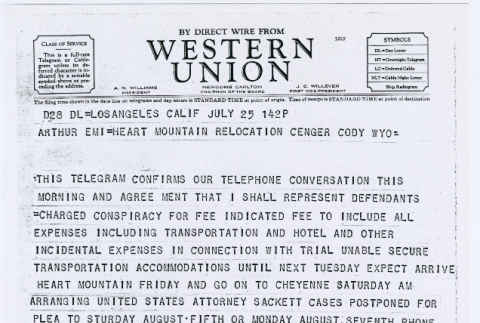
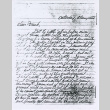
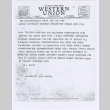
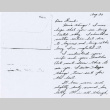
Correspondence between Arthur Emi and A.L. Wirin (ddr-densho-122-441)
doc Correspondence between Arthur Emi and A.L. Wirin (ddr-densho-122-441)
Retaining Wirin as attorney for the Heart Mountain resisters, fees and trial progress
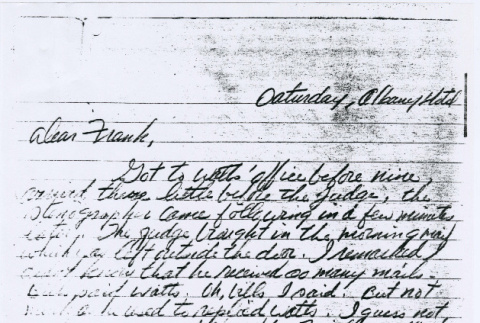
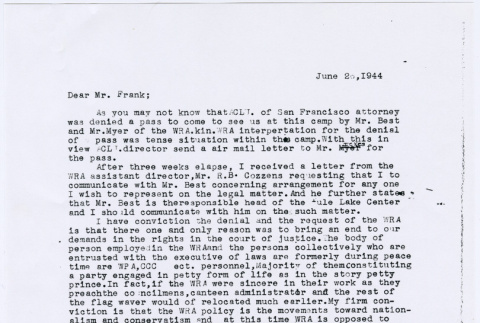
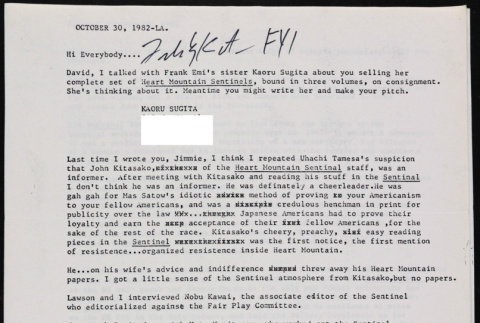
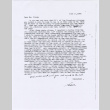
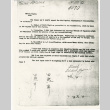
Letter to group, in care of David Ishii, from Frank Chin (ddr-densho-122-194)
doc Letter to group, in care of David Ishii, from Frank Chin (ddr-densho-122-194)
Notes on speakers and reactions to speakers on resisters in Wyoming, potential production projects related to resistance. Personal information redacted.
Letter from Lorraine to Kimi Fujii (ddr-densho-433-23)
doc Letter from Lorraine to Kimi Fujii (ddr-densho-433-23)
Lorraine writes to Kimi Fujii about her recent outings with friends.
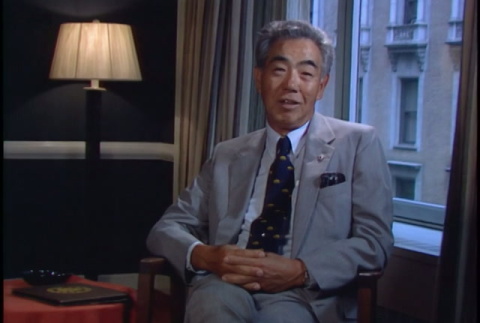
Interview with William Kochiyama, part 2 of 3 (ddr-densho-1007-1523)
av Interview with William Kochiyama, part 2 of 3 (ddr-densho-1007-1523)
Kochiyama discusses the 442nd, particularly the rescue of the Lost Battalion. Also talks about draft resisters. Loni Ding can be heard asking questions behind the camera. Video starts at 1:21. Original title: 28, II NY #7, 6-5-84. Interview continues at ddr.densho.org/ddr-densho-1007-1524/
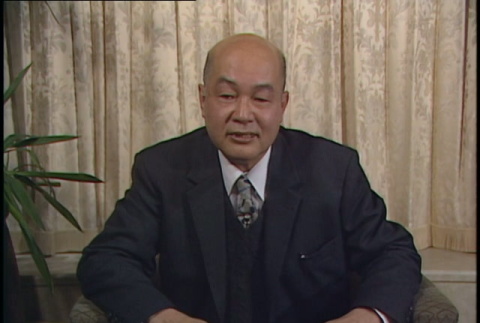
Interview with Gary and Grace Itano, part 2 of 6 (ddr-densho-1007-1806)
av Interview with Gary and Grace Itano, part 2 of 6 (ddr-densho-1007-1806)
Grace discusses working with her husband-to-be before the war, her husband asking for a divorce (knowing that he would be imprisoned for refusing to serve), her husband Henry's reasons for refusing to serve, her husband's family preventing him from going to college, trying and failing to live outside of camp in Arizona, evacuation and closing her …
Interview with Hugh Nozawa, part 1 of 3 (ddr-densho-1007-1713)
av Interview with Hugh Nozawa, part 1 of 3 (ddr-densho-1007-1713)
Nozawa discusses being born in Santa Monica, attending high school in Japan, being drafted, being court-martialed for refusing to complete training, recently getting honorable discharge, the discrimination he and other Nisei faced in the army, and President Roosevelt's visit to Fort Riley. Loni Ding can be heard asking questions behind the camera. Original title: 220, II …
Interview with Gary and Grace Itano, part 5 of 6 (ddr-densho-1007-1747)
av Interview with Gary and Grace Itano, part 5 of 6 (ddr-densho-1007-1747)
Gary discusses the legal efforts to reverse the charges of the DB Boys, his role in the hearings, and the reasons it took so long for the DB Boys to pursue legal action. Grace discusses why she buried her husband in Japan. Video starts at 0:51. Loni Ding can be heard asking questions behind the camera. …
Interview with Paul Minerich, Tim Nomiyama, Masao Kataoka, and Kenjiro Hayakawa, part 4 of 8 (ddr-densho-1007-1801)
av Interview with Paul Minerich, Tim Nomiyama, Masao Kataoka, and Kenjiro Hayakawa, part 4 of 8 (ddr-densho-1007-1801)
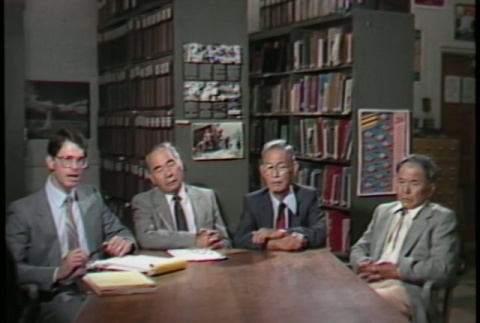
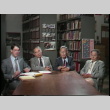
From left to right: Minerich, Nomiyama, Kataoka, Hayakawa. Nomiyama discusses waiting for an opportunity to take part in the war effort, joining company C at FortMcClellan in Alabama, wanting to be court martialed to have an opportunity to speak his mind, why he didn't want to serve in the Pacific, what he thought the war was …
Hollywood Judo Dojo footage, part 3 of 3; interview with Paul Minerich, Tim Nomiyama, Masao Kataoka, and Kenjiro Hayakawa, part 1 of 8 (ddr-densho-1007-1798)
av Hollywood Judo Dojo footage, part 3 of 3; interview with Paul Minerich, Tim Nomiyama, Masao Kataoka, and Kenjiro Hayakawa, part 1 of 8 (ddr-densho-1007-1798)
From start of tape until 3:00, footage of Frank Emi and Gary (last name unknown) sparring at the Hollywood Judo Dojo. Interview with (from left to right) Paul Minerich, Tim Nomiyama, Masao Kataoka and Kenjiro Hayakawa starts at 3:08. Nomiyama, Kataoka and Hayakawa were part of the "DB Boys", Nisei soldiers who were court-martialed for disobeying …
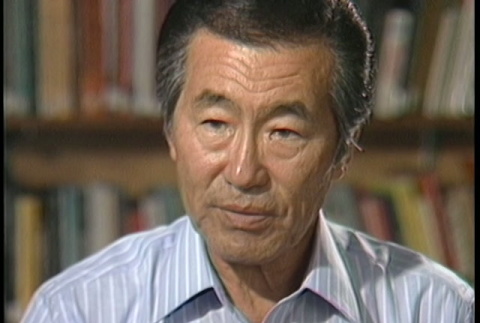
Interview with Frank Emi, part 1 of 6 (ddr-densho-1007-1792)
av Interview with Frank Emi, part 1 of 6 (ddr-densho-1007-1792)
Emi discusses resisting the draft, the difference between Nisei and Caucasians, Issei attitudes toward the draft, the attitudes of draft resisters, Heart Mountain as a "model" relocation camp, being arrested in camp by the FBI, awaiting trial in jail in Cheyenne and Laramie (in WY), his family's thoughts on him resisting the draft, and a fellow …
Interview with Hugh Nozawa, part 2 of 3 (ddr-densho-1007-1714)
av Interview with Hugh Nozawa, part 2 of 3 (ddr-densho-1007-1714)
Nozawa discusses the mistreatment of the Nisei during Roosevelt's visit to Fort Riley, a complaint he wrote to John J. McCloy afterwards, being punished for writing the letter without permission, the differences between Kibei and US-educated Nisei, growing up in Japan, being drafted while in Santa Monica, and being court martialed. Loni Ding can be heard …
Interview with Yukio Kawamoto, part 3 of 8 (ddr-densho-1007-1547)
av Interview with Yukio Kawamoto, part 3 of 8 (ddr-densho-1007-1547)
Kawamoto discusses serving in the MIS while his parents were interned, draft resistance, and his attitude toward the US during the war. Video starts at 0:56. Loni Ding can be heard asking questions behind the camera. Original title: 99, II NY #31, Channel #1 Audio Kawamoto. Interview continues at ddr.densho.org/ddr-densho-1007-1548/
Interview with Hugh Nozawa, part 3 of 3 (ddr-densho-1007-1715)
av Interview with Hugh Nozawa, part 3 of 3 (ddr-densho-1007-1715)
Nozawa discusses being court-martialed for refusing to serve in the military while the internment camps were operating, the long fight for honorable discharge after the fact, and his reasons for trying to hard to reverse the dishonorable discharge given to Nisei who refused to serve. Original title: 222, II JA #54, Hugh Nozawa, Sun. Feb. 2
Interview with Frank Emi, part 6 of 6; Hollywood Judo Dojo footage, part 1 of 3 (ddr-densho-1007-1745)
av Interview with Frank Emi, part 6 of 6; Hollywood Judo Dojo footage, part 1 of 3 (ddr-densho-1007-1745)
Interview continued from ddr.densho.org/ddr-densho-1007-1796/. Emi reads a bulletin from the Fair Play Committee. Starting at 8:41, Emi and Gary (last name unknown) discuss the history of Hollywood Judo Dojo and their experiences with judo. Last few minutes of tape are b-roll the dojo. Original title: 43B, II RES/PRO #7, Frank Emi, UCLA, 5-31-86, Judo Dojo …
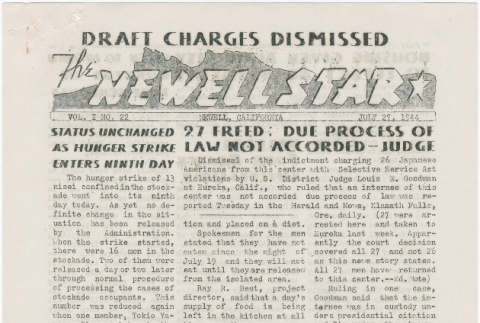
The Newell Star, Vol. I, No. 22 (July 27, 1944) (ddr-densho-284-28)
doc The Newell Star, Vol. I, No. 22 (July 27, 1944) (ddr-densho-284-28)
Selected article titles: "Status Unchanged as Hunger Strike Enters Ninth Day" (p. 1), "27 Freed; Due Process of Law Not Accorded--Judge" (pp. 1-2), "Obon Cancelled; Rites Held for Deceased Heroes" (p. 3), and "Bi-Ovum Babies Boost Births" (p. 4).
Interview with Harry Fukuhara, part 4 of 5 (ddr-densho-1007-1700)
av Interview with Harry Fukuhara, part 4 of 5 (ddr-densho-1007-1700)
Fukuhara discusses the possibility of meeting his brother (who was in the Japanese army) on the battlefield, the mental struggles soldiers faced in Japan, and his thoughts on draft resisters. Loni Ding can be heard asking questions behind the camera. Original title: 215, II JA #39, Harry Fukuhara, Sun. Feb. 2. Interview continues at ddr.densho.org/ddr-densho-1007-1701/
Interview with Arthur (Art) Morimitsu, part 6 of 6; interview with Harry Akune, part 1 of (ddr-densho-1007-1754)
av Interview with Arthur (Art) Morimitsu, part 6 of 6; interview with Harry Akune, part 1 of (ddr-densho-1007-1754)
Morimitsu discusses learning about the draft resisters after the war and his sympathy for draft resisters. Interview with Harry Akune starts at 3:58; Akune discusses his service with the 503rd Parachute Regimental Combat Team in the Philippines, the story of a jump gone wrong, his service on Corregidor Island, how he often served alone (versus most …
API