
2130 items
![Letter from Masao Okine to [Hatsuno] Hotty Okine, April 24, 1945 (ddr-csujad-5-76)](https://ddr.densho.org/media/cache/cf/f8/cff85d2dfb10970d55288e43d81b4958.jpg)




2130 items
doc
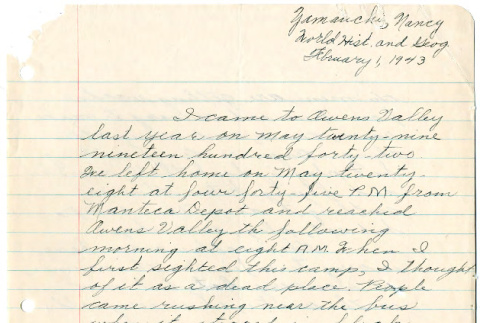
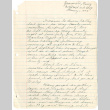
Assignment (ddr-csujad-48-29)
Assignment by Nancy Yamauchi for World History and Geography class taught by Mr. Harry Bentley Wells, a teacher at Manzanar High School. Nancy describes her arrival at Manzanar on May 29, 1942 and her transition into camp life. She notes that she has made many friends, but that people are becoming lazier as they cannot do …
doc
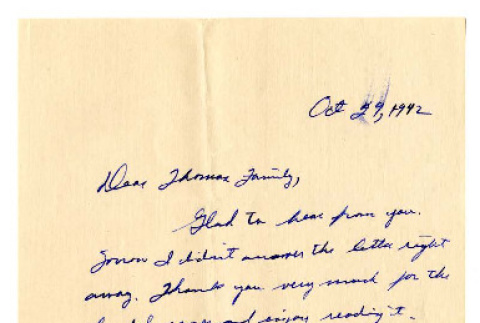
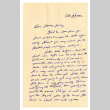
Letter from Usami Terada to Mr. and Mrs. A.W. Thomas, October 29, 1942 (ddr-csujad-4-15)
A letter from Usami Terada, an incarceree at the Rohwer incarceration camp, to Mr. and Mrs. A.W. Thomas in Lawndale, California. In the letter, he describes his life and the conditions of the Rohwer incarceration camp. He also describes the Japanese American soldiers visiting the camp: among the soldiers, he finds Sam Kita, one of his …
![Letter from Masao Okine to [Hatsuno] Hotty Okine, April 24, 1945 (ddr-csujad-5-76)](https://ddr.densho.org/media/cache/f0/c7/f0c709c382a534a1b09d37aa47ea7924.jpg)
doc
Letter from Masao Okine to [Hatsuno] Hotty Okine, April 24, 1945 (ddr-csujad-5-76)
A letter from Masao Okine in Fort Meade, Maryland, to his sister, Hatsuno Hotty Okine in the Rohwer incarceration camp, Arkansas. He encloses a dependency allotment form 620 in the letter and instructs Hatsuno to fill it out and talk to the Red Cross for assistance. He also asks her to send him a letter and …
doc
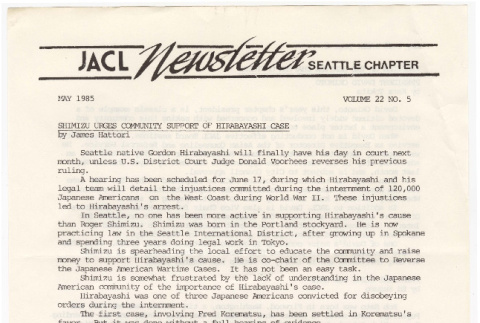
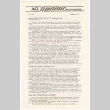
Seattle Chapter, JACL Reporter, Vol. XXII, No. 5, May 1985 (ddr-sjacl-1-347)
Newsletter covering the following topics: Hirabayashi Hearing scheduled for June 17. Note, Korematsu Hearing complete, with favorable outcome; bios on David Okimoto, Bob Sato; Senate Joint Memorial Bill 104 asks Congress and the President to enact CWRIC recommendations; Op Ed appears in Seattle Times opposing Redress, by three civilians using misinformation about ?Magic Cables? that has …
img
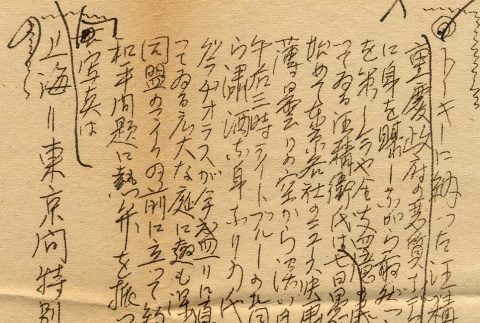
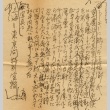
Clipping regarding Wang Jingwei (ddr-njpa-1-1101)
Caption on reverse [translation]: "Wang Jingwei Records Talkie. Wang Jingwei, who is braving the danger of assassins and [illegible] from the Chongqing government and boldly risking his life for the peace movement [illegible] . Four hundred million Chinese, recorded his first news movie for the Tokyo news companies at his home on the 7th. Looking stylish …
vh
Sumi Okamoto Interview (ddr-densho-1000-192)
Nisei female. Born January 7, 1920, in Seattle, Washington. Spent childhood in Spokane, Washington, where father worked for the Alaska Junk Company. Attended Irving Grade School and Lewis & Clark High School. Wedding took place on December 7, 1941, the day of Japan's attack on Pearl Harbor. Husband passed away in 1946, and Ms. Okamoto worked …
vh
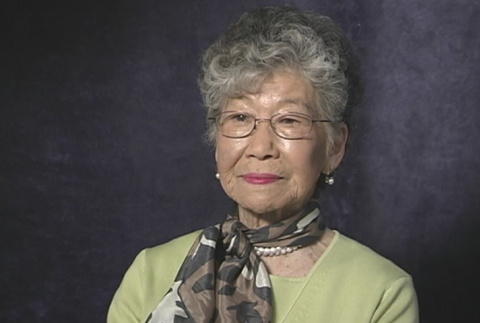
Arnold T. Maeda Interview (ddr-densho-1003-5)
Nisei male. Born July 17, 1926, in Santa Monica, California. Grew up in the Santa Monica area where parents ran a nursery business. During World War II, removed to the Manzanar concentration camp, California. After leaving camp, worked as a chick sexer, technical illustrator in the aerospace industry, and a life insurance salesman. Returned to California …

doc
Letter from John (Sohei) Hohri to Harold Landon (ddr-janm-18-9)
Letter from John (Sohei) Hohri to Harold Landon, dated August 5, 1942. In the upper left corner there is a drawing of two barracks, a power line, and mountains in the background. John writes about his time spent in Manzanar, the hot weather, and the monotony of camp life. He mentions that he has heard and …

doc
Letter from John (Sohei) Hohri to Harold Landon (ddr-janm-18-11)
Letter from John (Sohei) Hohri to Harold Landon, dated October 6, 1942. John writes about his life in Manzanar and the satisfaction he receives from teaching his Sunday school class. He writes that the average attendance for his class is about 40 boys from the ages of 12-14, and talks about the activities his Sunday school …
doc
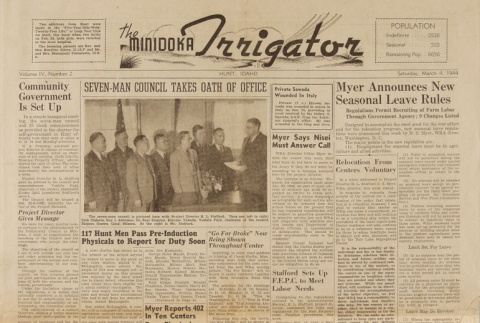
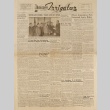
Minidoka Irrigator Vol. IV No. 2 (March 4, 1944) (ddr-densho-119-79)
Selected article titles: "Community Government Is Set Up" (p. 1), "117 Hunt Men Pass Pre-Induction Physicals to Report for Duty Soon" (p. 1), "Myer Reports 402 in Ten Centers Pass Physicals" (p. 1), "Nisei Infantryman Rescues Army Major" (p. 1), "18 Leave on Wed. for Crystal City" (p. 1), "'Go for Broke' Now Being Shown Throughout …
vh
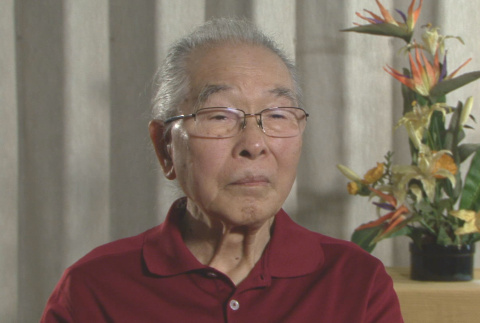
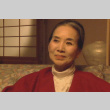
Fred Hirasuna Interview (ddr-densho-122-29)
Nisei male. Born February 11, 1908, in Lodi, California. Resettled voluntarily to Mankato, Minnesota, prior to mass removal. Resettled in central California in 1947. Member of the Japanese American Citizens League (JACL) since 1929. Became active in redress movement as fundraiser and lobbyist for Central California District Council of JACL. Mr. Hirasuna passed away on February …
vh
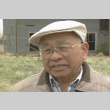
Michi Weglyn Interview (ddr-densho-122-22)
Nisei female, born November 29, 1926, in Stockton, California. Raised in Brentwood, California, before being incarcerated at Gila River, Arizona. Graduated from high school in the camp in 1944, and after being released, attended Mount Holyoke College. In the 1950s, worked as costume designer for the Perry Como Show television program. Researched and wrote the groundbreaking …
vh
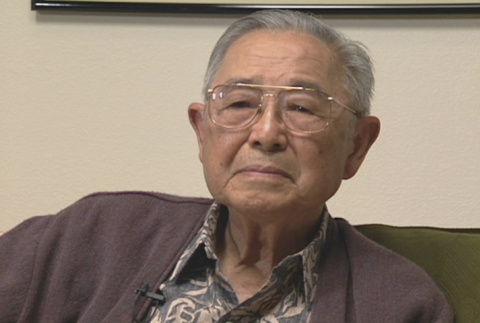
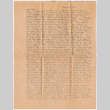
Paul Tsuneishi Interview (ddr-densho-122-24)
Nisei male, born April 16, 1923. Incarcerated at Heart Mountain concentration camp, Wyoming, and was drafted into the military at age eighteen. After World War II, served as a district governor for the Japanese American Citizens League (JACL) in Southern California. In his position with the JACL, sought to reconcile the Japanese American community with the …
doc
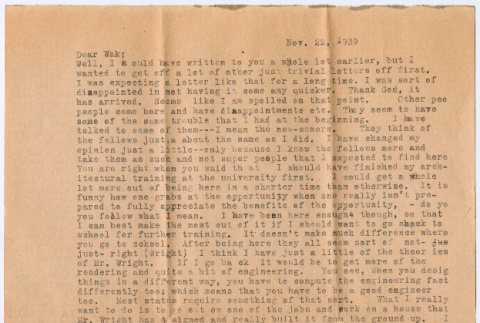
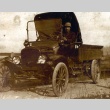
Letter from Kaneji Domoto to Wakako Domoto (ddr-densho-329-881)
Letter from Taliesin. Wak has said he should have finished his architectural studies at the university first before going to Taliesin and he agree. He thinks he would like to work for a contractor instead of going back to school or staying for a long time at Taliesin. "Somehow I want to live my own life. …
Collection
Tsubota Collection (ddr-densho-105)
The Tsubota collection consists of photographs from the personal family collection of Minoru "Min" Tsubota, who was interviewed by Densho in 2003. The photographs document Minoru's life growing up in Kent, Washington, through his incarceration at Tule Lake concentration camp, and finally through his military service.
Collection
gayle k. yamada Collection (ddr-densho-1004)
The gayle k. yamada Collection consists of interviews conducted by filmmaker gayle k. yamada for her 2003 documentary, Uncommon Courage: Patriotism and Civil Liberties. The interviews are typically not life histories, instead primarily focusing on the interviewees' World War II experiences in the Military Intelligence Service.

Collection
Toshiki Hamaoka Collection (ddr-janm-15)
Toshiki "Dick" Hamaoka was hired by an anthropologist and community worker to create watercolor sketches of life at Tule Lake concentration camp, rather than hiring a more expensive photographer. His 17 watercolor paintings and ink drawings are vibrant and detailed and show a different perspective than straightforward photographs.
vh
Roy H. Matsumoto Interview Segment 43 (ddr-densho-1000-153-43)
Jobs in camp
Although Mr. Matsumoto does not identify himself as a Kibei (American-born person of Japanese ancestry sent to Japan for formal education and socialization when young and later returned to the U.S.), some of his life experiences are similar to those who do identify themselves as such.
Collection
Kango Takamura Collection (ddr-manz-2)
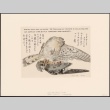
The Kango Takamura Collection contains 76 paintings and sketches Takamura created during his time at Santa Fe Internment Camp and Manzanar concentration camp. The artwork depicts daily life in the camps, including scenes of education, living conditions, agriculture, and more. The physical collection is maintained at UCLA Library Special Collections.
Collection
A. Shibayama Collection (ddr-densho-91)
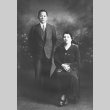
The A. Shibayama collection is comprised of photographs from the personal family collection of Art Shibayama, a Japanese Peruvian who was interviewed by Densho in 2003. The photos depict Art's life in prewar Peru, as well as his activities in Crystal City internment camp, Texas, and his military service in Europe.
Collection
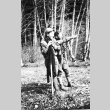
Mitsuoka Collection (ddr-densho-15)
The Mitsuoka collection, 1917-1940s, includes photographs of oyster farming in Washington State, canneries in Alaska, Japanese American Boy Scout troops on outings, and leisure activities such as skiing. Daily life at Minidoka concentration camp, Idaho, is also well-documented in photographs of cooking, doing laundry, and participating in sports.

Collection
Tsutomu and Ruth (Yamada) Matsumoto Collection (ddr-densho-432)
The Tsutomu and Ruth (Yamada) Matsumoto Collection contains letters written between Ruth Yamada Matsumoto and Matsuye Koike when they were in Santa Anita Assembly Center, Rohwer concentration camp, Fort Bismarck and Fort Missoula. There are also two of Ruth's photograph albums that record life in Japan and the United States.
img
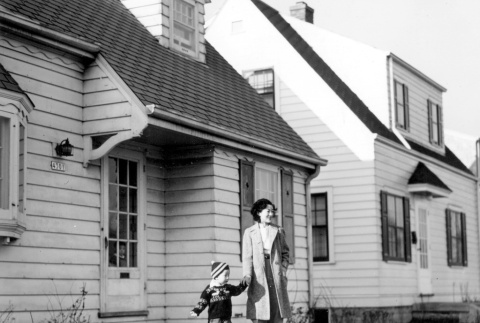
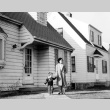
WRA resettlement image (ddr-densho-7-12)
Original WRA caption: When Mrs. Masumi Kaneko goes shopping, she likes to take her young 2-1/2-year-old son, Wayne, to the store with her. Here Mrs. Kaneko, comfortably dressed in a sport coat and slacks, is leaving her Milwaukee home to visit the nearby shopping center. The Kanekos live at 4301 with another Nisei family, Mr. and …
doc
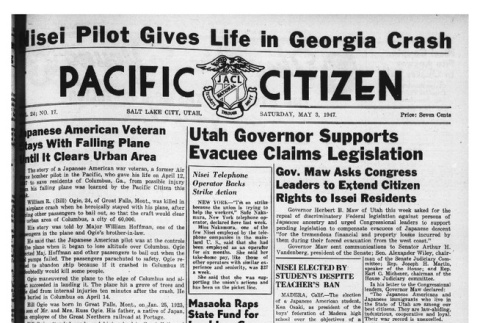
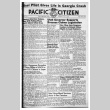
The Pacific Citizen, Vol. 24 No. 17 (May 3, 1947) (ddr-pc-19-18)
Selected article titles: "Nisei Pilot Gives Life in Georgia Crash. Japanese American Veteran Stays With Falling Plane Until It Clears Urban Area" (p. 1), "Utah Governor Supports Evacuee Claims Legislation. Gov. Maw Asks Congress Leaders to Extend Citizen Rights to Issei Residents" (p. 1), "Baldwin Announces Formation of Tokyo Office of JACL to Assist U.S. Citizens …
doc
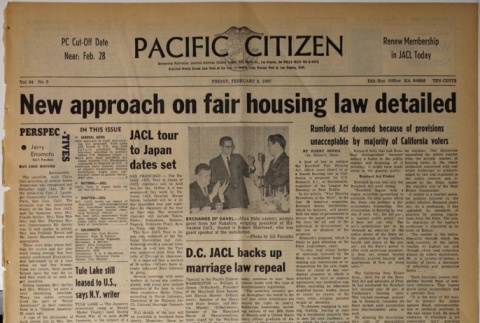
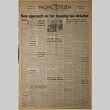
Pacific Citizen, Vol. 64, No. 5 (February 3, 1967) (ddr-pc-39-5)
Selected article titles: "New approach on fair housing law detailed: Rumford Act doomed because of provisions unacceptable by majority of California voters" (p. 1), "Tule Lake still leased to U.S., says N.Y. writer" (p. 1), "D.C. JACL backs up marriage law repeal" (p. 1), "Issei-Nisei success within one life span impresses Japan envoy" (p. 1), "San …