
5022 items

![Letter from Toshio Tamaoi [?] to Mrs. Seiichi Okine, December 1947 [in Japanese] (ddr-csujad-5-254)](https://ddr.densho.org/media/cache/b6/dd/b6dd9739227312bf4b11ad56065fb62d.jpg)
5022 items
doc
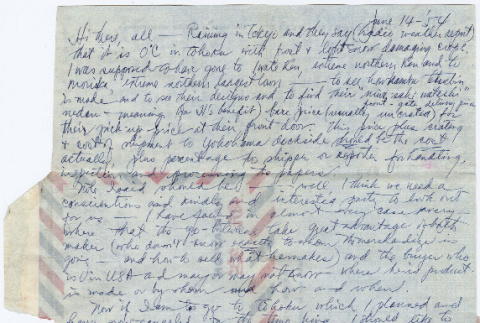
Letter from Tomoye to Henri Takahashi (ddr-densho-422-135)
She in running short of money, ask Henri what she should do, wait in Japan until the children come later for a visit, return to SF and attend merchandising fairs in NY and SF, asks if Henri can send money.
img
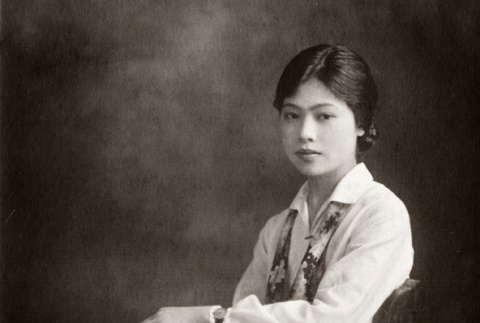
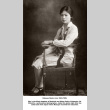
Portrait of Hatsuyo Ozeki (ddr-ajah-6-825)
Caption below photo: Hatsuyo Ozeki, circa 1924-1925. She is the Nisei daughter of Mataichi and Akino Ozeki of Alameda, CA. Mataichi, a professional photographer, made this photo right after she came back from Japan where Hatsuyo received her education.
img
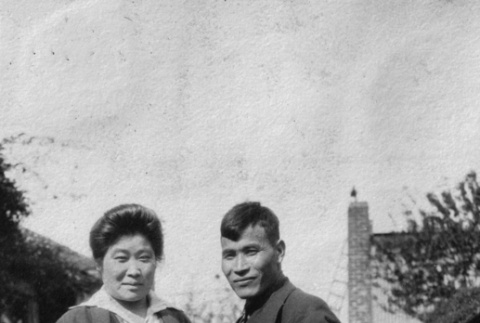
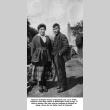
Natsuno and Kanjiro Inouye (ddr-ajah-6-453)
Caption below photo: Natsuno & Kanjiro Inouye of Alameda, CA, circa 1910s. Natsuno came from Japan to Washington state at age 17 with no money. She was sent as omiyage to Kanjiro for doing a favor for her father back in Fukuoka.
img
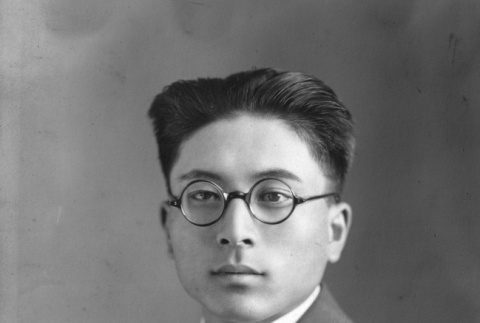
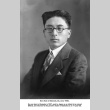
Portrait of Goro Sato (ddr-ajah-6-181)
Caption below photo: Goro Sato of Alameda, CA, circa 1930s. He was born in Alameda in 1907, sent to Japan as an infant to be raised (Kibei) and returned to his parent's home in Alameda as an 11 year old.
img
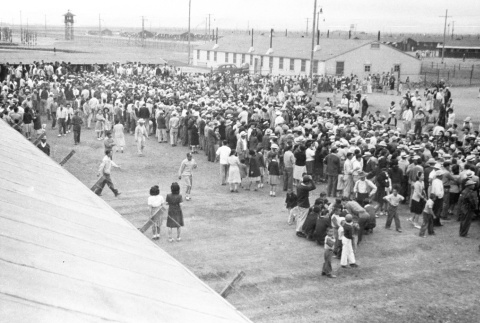
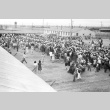
Hoshidan members leaving Tule Lake (ddr-densho-37-187)
Original WRA caption: Size of well-wishers diminished as the number of pro-Japan sympathizers sent to internment grew. Although 400 when leaving June 24, 1945, when this picture was taken, the send-off crowd was not nearly up-to-par.
Collection
Wada and Homma Family Collection (ddr-densho-157)
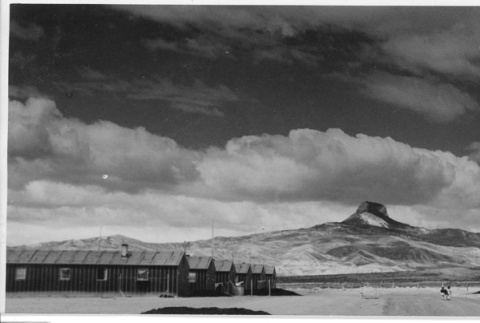
This collection consists of photographs and documents from the Wada and Homma families. Reverend Masahiko Wada was a Baptist minister in Japan and in the Gardena area of California before World War II. The collection includes photographs from the Heart Mountain concentration camp, Wyoming, and the Granada (Amache) concentration camp, Colorado.

Collection
Tsutomu and Ruth (Yamada) Matsumoto Collection (ddr-densho-432)
The Tsutomu and Ruth (Yamada) Matsumoto Collection contains letters written between Ruth Yamada Matsumoto and Matsuye Koike when they were in Santa Anita Assembly Center, Rohwer concentration camp, Fort Bismarck and Fort Missoula. There are also two of Ruth's photograph albums that record life in Japan and the United States.
vh
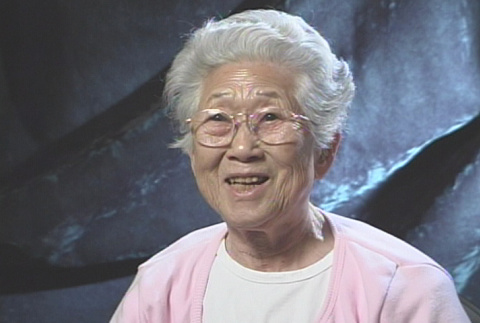
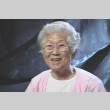
Tomiye Terasaki Interview Segment 2 (ddr-densho-1000-122-2)
Moving to Japan at age three, living in Fukuoka and Tokyo, Japan (Japanese language)
This interview was conducted in Japanese. It was translated so as to convey Mrs. Terasaki's way of speaking as closely as possible. For example, there are instances in which she makes some grammatical errors. These mistakes are conveyed through similar grammatical errors …
vh
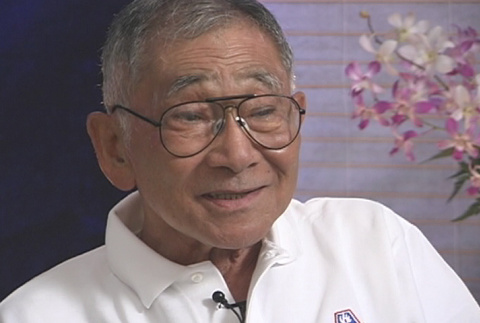
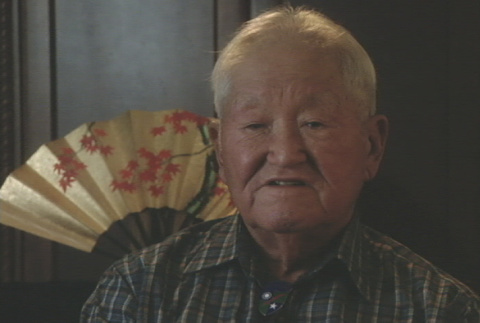
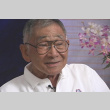
Rudy Tokiwa Interview II Segment 3 (ddr-densho-1000-92-3)
Expectations of life in Japan: "Nobody there is gonna say, 'You look different'"
This interview was conducted at the 1998 Americans of Japanese Ancestry Veterans National Convention, held in Honolulu, Hawaii.
vh
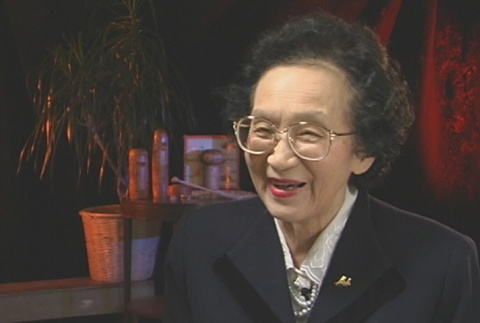
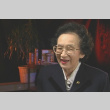
Mitsue Matsui Segment 7 (ddr-densho-1008-3-7)
Working for the Japanese Chamber of Commerce when Japan bombed Pearl Harbor
Members of the National Japanese American Historical Society (NJAHS) arranged for and conducted this interview in conjunction with Densho.
doc
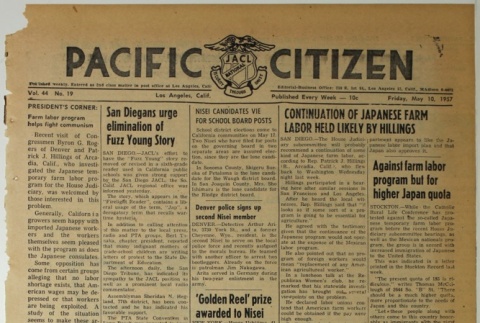
Pacific Citizen, Vol. 44, No. 19 (May 10, 1957) (ddr-pc-29-19)
Select article titles: "Continuation of Japanese Farm Labor Held Likely by Hillings" (p. 1); "San Diegans urge elimination of Fuzz Young Story" (p. 1); "'Golden Reel' prize awarded to Nisei" (p. 1); "Against farm labor program but for higher Japan quota" (p. 1); "Seven months remain for 'illegally admitted' aliens in U.S. to change status to …
![Letter from Toshio Tamaoi [?] to Mrs. Seiichi Okine, December 1947 [in Japanese] (ddr-csujad-5-254)](https://ddr.densho.org/media/cache/ad/12/ad12b703cc0cd04d6d9927307c4456ce.jpg)
doc
Letter from Toshio Tamaoi [?] to Mrs. Seiichi Okine, December 1947 [in Japanese] (ddr-csujad-5-254)
A letter from Toshio Tamaoi in Itsukaichi, Hiroshima, Japan to his uncle, Seiichi Okine. The letter is mailed by Kenjiro Okine. In the letter, he thanks Seiichi for the gifts and laments about the high inflation in post-war Japan. He also asks about Kimie Tanimoto who recently left for the U.S. and includes updates on his …
img
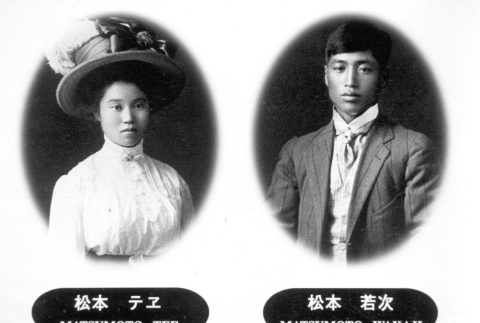
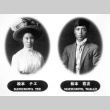
Portraits of Issei couple (ddr-densho-107-30)
Roy Matsumoto's mother, Tei Matsumoto, was the youngest daughter of a samurai, Shinjiro Kimura. Her elder brother, Koichi Kimura was Wakaji Matsumoto's (Roy's father's) classmate in school, and a second cousin. Tei managed the Matsumoto farm after Wakamatsu (Roy's grandfather) retired to Japan. Before WWII started, she went to Hiroshima, Japan, with her family. She escaped …
vh
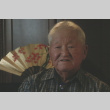
Roy Matsumoto Interview (ddr-densho-1004-9)
Nisei male. Born May 1, 1913, in Laguna, California. Lived in Japan from childhood through teenage years, before returning to the United States during high school. Incarcerated in the Santa Anita Assembly Center, California, and the Jerome concentration camp, Arkansas. Volunteered for the U.S. army in 1942, and was inducted in the Military Intelligence Service. Selected …
Collection
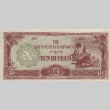
Grant Hirabayashi Collection (ddr-densho-127)
The Grant Hirabayashi Collection features five photographs and documents from the personal collection of Grant Hirabayshi, who was interviewed by Densho in 2006. The collection focuses on Mr. Hirabayashi's work as one of the famed Merrill's Marauders during World War II and as an interpreter and translator during the U.S. occupation of Japan.
doc
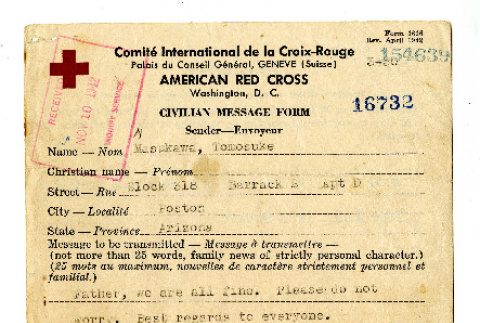
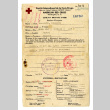
Messages between Tomosuke Masukawa in the Poston in Arizona and Hidetaro Myoren in Hiroshima, Japan, October 29, 1942-September 2, 1943 (ddr-csujad-38-545)
Messages exchanged between Tomosuke Masukawa at the Poston camp in Arizona and his father-in-law, Hidetaro Myoren, in Hiroshima, Japan. The original message informed Hidetaro of the safety of Tomosuke's family in the camp. The reply message informed of deaths of Hidetaro and Kazuko Myoren. The two messages were exchanged with the assistance of the Red Cross, …
doc
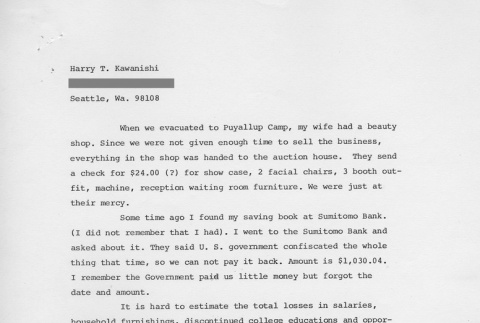
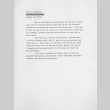
Testimony of Harry T. Kawanishi (ddr-densho-67-268)
Written testimony of Harry T. Kawanishi, born in Japan. Incarcerated in the Puyallup Assembly Center, Washington, and the Minidoka concentration camp, Idaho. This testimony was submitted for the CWRIC hearings in Seattle, Washington, September 9-11, 1981. Personal information excised by Densho.
doc
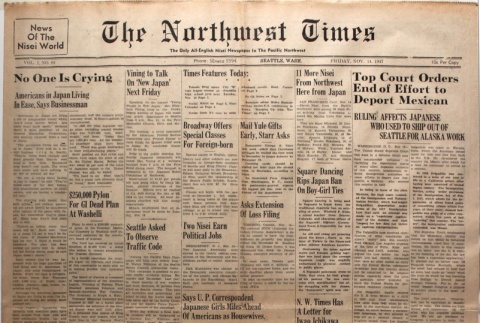
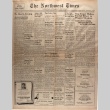
The Northwest Times Vol. 1 No. 84 (November 14, 1947) (ddr-densho-229-71)
"No One is Crying. Americans in Japan Living in Ease, Says Businessman" (p. 1), "Top Court Orders End of Effort to Deport Mexican. Ruling Affects Japanese Who Used to Ship Out of Seattle" (p. 1), "Obituaries: Manki Matsuno. Jiro Hirai" (p. 4).
doc
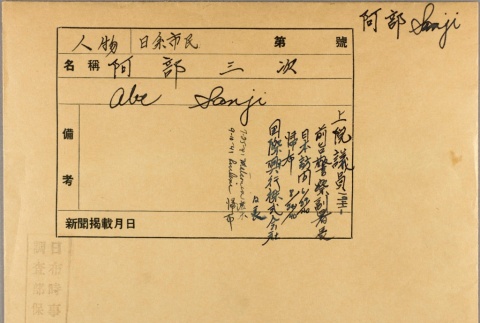
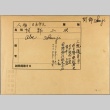
Envelope of Sanji Abe photographs (ddr-njpa-5-1)
Caption on front [translation]: "The Senator 1941. The former vice chief of the police department. visiting Japan 6/29/40. coming back 8/24/40. the president of international performance Inc. 7/25/41 – going to the U.S. 9/10/41 – coming back."
img
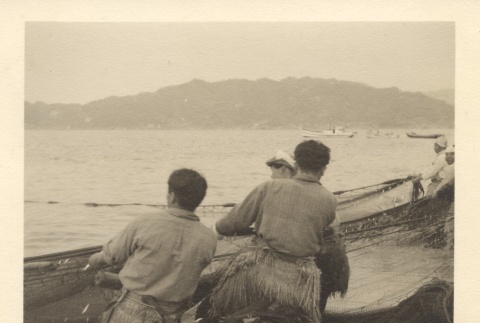
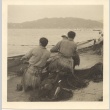
Fishing at Miyazu Village (ddr-one-2-77)
Black and white photographic print of three unidentified men in the foreground wearing straw skirts, and two unidentified men wearing straw skirts in the background, pulling in fishing nets at Miyazu, near Maizuru, Japan. Inscribed on back: "29 MAY 49/MIYAZU (NEAR MAIZURU)."
img
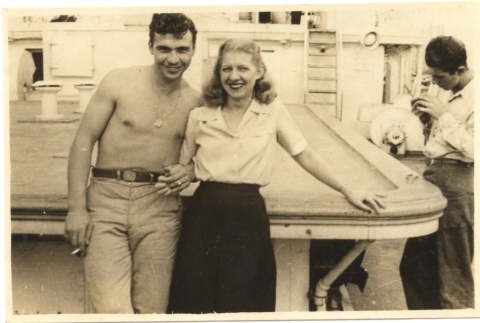
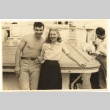
Aboard Acadia (ddr-one-2-292)
Black and white photographic print of passengers aboard the Acadia en route to Japan. A couple is holding hands on deck, the man without a shirt is unidentified, and the woman in a white blouse and black skirt is identified as Ella Thomas.
img
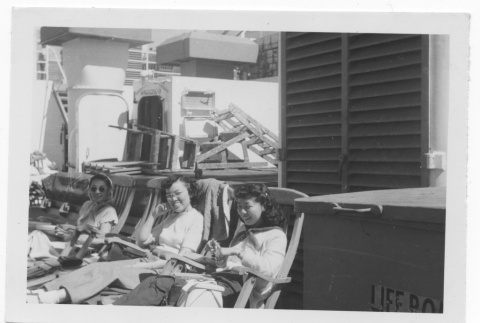
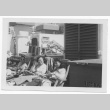
Aboard USNS General Daniel I. Sultan (ddr-one-2-680)
Black and white photographic print of (from left) Bessie Matsuoka, Kiku Shimazaki, and Shiuko Sakai seated on deck lounge chairs aboard “Gen. Daniel I. Sultan” en route to San Francisco from Japan. Inscribed on the back: "July '49/USAT SULTAN/ME KIKU BESSIE."
doc
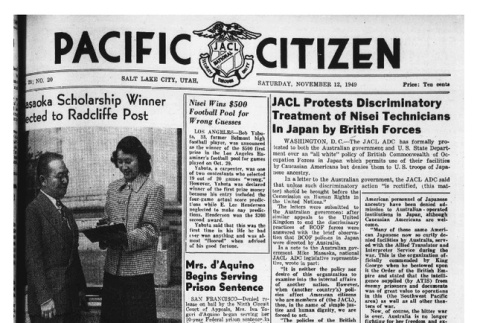
The Pacific Citizen, Vol. 29 No. 20 (November 12, 1949) (ddr-pc-21-45)
Selected article titles: "JACL Protests Discriminatory Treatment of Nisei Technicians in Japan by British Forces" (p. 1), "Six Court Cases Seeking U.S. Rights Filed for Strandees" (p. 1), "San Francisco's Supervisors Approve Policy of Non-Bias, Non-Segregation in Housing" (p. 2).
doc
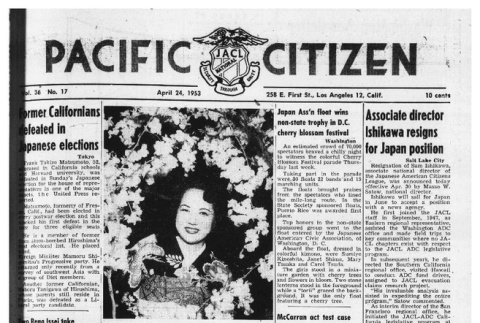
The Pacific Citizen, Vol. 36 No. 17 (April 24, 1953) (ddr-pc-25-17)
Selected article titles: "Japan Ass'n float wins non-state trophy in D.C. cherry blossom festival" (p. 1), "Introduce legislation to restore crosses on graves of war Dead in Punchbowl" (p. 1), "Oregon state legislature passes civil rights bill, fear referendum" (p. 3).
doc
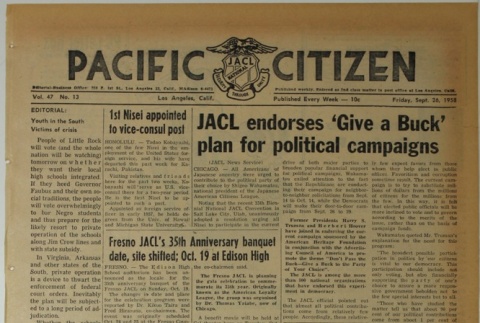
Pacific Citizen, Vol. 47, No. 13 (September 26, 1958) (ddr-pc-30-39)
Select article titles: "Man who helped 1,200 former aliens gain U.S. citizenship to be recognized" (p.1); "JACL endorses 'Give a Buck' plan for political campaigns" (p.1); "Buddhist leader appeals to Nisei, Sansei to fuse best of U.S.-Japan cultures" (p.7)