
1098 items








1098 items

img
Group of Nisei 8th graders with a teacher outside a barrack (ddr-csujad-44-28)
A large group photograph of boys and girls who are 8th graders incarcerated at Tule Lake, California, with their teacher. The group of children is posing in three rows outside a barrack. The girls and boys in the back two rows are standing. The girls in the front row are seated in chairs. Their teacher is …

img
Group of Nisei 8th graders with a teacher outside a barrack (ddr-csujad-44-29)
A large group photograph of boys and girls who are 8th graders incarcerated at Tule Lake, California, with their teacher. The group of children is posing in three rows outside a barrack. The girls and boys in the back two rows are standing. The girls in the front row are seated in chairs. Their Caucasian teacher …

img
Group of Nisei 7th graders with a teacher outside a barrack (ddr-csujad-44-31)
A large group photograph of boys and girls who are Nisei 7th graders incarcerated at Tule Lake, California, with a teacher. The group of children is posing in three rows outside a barrack. The children in the back two rows are standing. The girls in the front row are seated in chairs. Their Caucasian teacher is …

img
Art Club (ddr-csujad-44-34)
A photograph of Nisei students incarcerated at Tule Lake, California posing in front of a barrack with their teacher. They are presumably the members of Art Club. Two young men are standing behind a row of four women seated in chairs. Their Caucasian teacher is seated in a chair on the end of the front row. …
vh
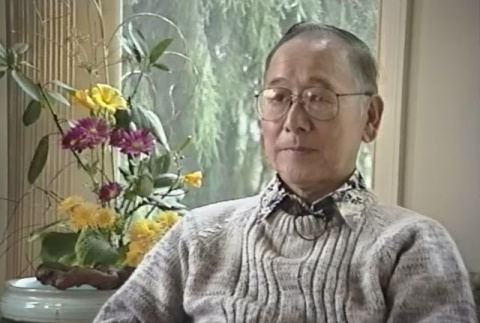
William Marutani Interview (ddr-phljacl-1-14)
Nisei male. Born March 31, 1923, in Kent, Washington. During World War II, was incarcerated at the Pinedale Assembly Center, California, and Tule Lake concentration camp, California. After leaving camp to attend college in South Dakota, was drafted into the U.S. Army and served with the Military Intelligence Service during the postwar occupation of Japan. After …
vh
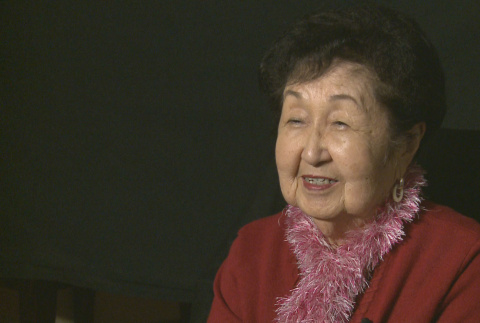
Mary Haruka Nakamura Interview (ddr-one-7-65)
Nisei female. Born March 21, 1924, in O'Brien, Washington. Grew up in the Auburn/Kent area of Washington, where parents ran a farm and then a grocery store. During World War II, removed to the Pinedale Assembly Center, California, and the Tule Lake concentration camp, California. After leaving camp, settled in Ontario, Oregon.
(This material is based …

doc
Kibei's view of Life in relocation camps during World War II (ddr-csujad-38-582)
A term paper prepared by Eileen Naohara Yoshimura, a daughter of George and Mitzi Naohara, for Professor Donald Teruo Hata's "Basic History 100" course at CSU Dominguez Hills Department of History. It focuses on the experiences of George Nobuo Naohara. She interviewed him about his time spent at the Tule Lake camp. See this object in …

img
Tule Lake scrapbook pastel drawing (ddr-csujad-26-66)
Scrapbook page featuring a pastel drawing of an agricultural field in a mountain landscape depicting figures working the field on foot and using farm equipment. The drawing is lined on the bottom by a series of radishes. "Yvanne" is signed in the lower right corner. Tule Lake scrapbook (ucsb_mei_0053), page 35. See this object in the …

img
Tule Lake scrapbook illustrated page (ddr-csujad-26-64)
Scrapbook page features a pastel drawing of women showering and in various states of undress in camp barracks. Illustration is accompanied by a poem "Barrack room ballads" about the lack of both privacy and comfort of women using camp barracks showers and toilets. Tule Lake scrapbook (ucsb_mei_0053), page 31. See this object in the California State …
doc
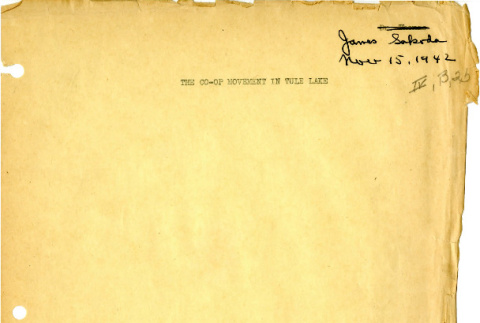
Co-op movement in Tule Lake (ddr-csujad-26-6)
Chronological report of the organization and initial leadership of the co-op movement at Tule Lake as decided by the War Relocation Authority (WRA). Includes details of the process, advisory council meetings, incarceree participation, and establishment proceedings. Report compiled as a portion of the Japanese American Evacuation and Resettlement Study (JERS). See this object in the California …

doc
[Report of the informal interview of the divisional responsible men and the detained stockade internees] (ddr-csujad-2-53)
Report from the incarceree-led government at Tule Lake Incarceration Camp. A transcript from an interview of the "Divisional Responsible Men" and their attempts to challenge the status-quo in the camp. Discusses hunger strike due to the army stealing incarceree items and attempts to release prisoners from the army stockades at the camp. See this object in …

doc
Memo from Harry L. Black, Advisory Committee, to Mr. [Raymond R.] Best, February 8, 1944 (ddr-csujad-2-91)
Memorandum regarding meeting with Co-ordinating Committee. Concerns meeting to discuss Committee's recommendation to release "18 additional detainees from the stockade." The memo on "Executive Office of the President, Office for Emergency Management" letterhead, also discusses employment of incarcerees from Manzanar and Tule Lake and moving incarcerees out of and into various housing blocks. See this object …

doc
Letter from R. R. Best, Project Director, and Lionel Perkins, Business Enterprises Adviser United States Department of the Interior War Relocation Authority to Mr. Ivan Williams Department of Justice, December 5, 1945 (ddr-csujad-12-24)
This official correspondence confirms that Tsugitada Kanamori had worked at the Tule Lake incarceration camp for 6.5 months and had earned a total of $131.86 as of November 30, 1945. Issued by R.R. Best, Project Director and Lionel Perkins, Business Enterprises Adviser United States Department of the Interior War Relocation Authority. See this object in the …

doc
Colorado Times Vol. 31, No. 4289 (March 27, 1945) (ddr-densho-150-2)
Selected article titles: "Nisei Loyalty Told as Hawaii Newspaper Calls for Statehood"; "Tule Lake Trio Sentenced"; "AFL Union Suspends Member for Anti-Nisei Talk"; "Nisei Indicted for Desertion From CPS Camp"; "Graves Bearing Enemy Names Desecrated"; "'Real Friendship' from California Man"; "Lost Battalion Thanks Nisei"; "Sacramento Evacuee Killed in Chicago"; "WRA Denies Plan to Unite Enemy Families"; …

img
Tule Lake musicians (ddr-csujad-55-2211)
Black and white photograph of musicians at Tule Lake incarceration camp. Pictured from left to right (standing): C. Nagao, K. Yamamoto (singer), unidentified (singer), J. Ota, S. Arima, J. Hatanaka (singer), F. Kunisawa (singer), unidentified (singer), [Frank Yoshimi]. Sitting - K. Arima, T. Matsuoka, B. Yokotaki, H. Nakata, J. Mitsukiro, and N. Yamaguchi. See this object …

doc
Letter to Mamie, November 2, 1943 (ddr-csujad-55-130)
Correspondence to Mamie describing events that occurred at Tule Lake incarceration camp on November 1, 1943. Correspondent describes the labor strike, a visit from Dillon S. Myer, director of the War Relocation Authority, a crowd of Japanese gathering at the camp administration building, the army's response, and the beating of Dr. Pedicord. See this object in …

doc
To the descendants of George and Masako Okabe (ddr-csujad-55-2311)
Transcription of an oral history interview with George and Masako Okabe regarding their experiences during World War II. Interview covers Pearl Harbor, mass removal, daily life at Tule Lake and Grenada incarceration camps, repatriation to Japan, and return to U.S. Includes Yamazaki's report on the interview for her Sophomore World History class. See this object in …
vh
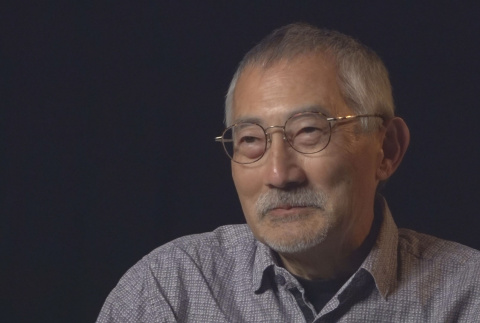
Stanley N. Shikuma Interview I (ddr-densho-1000-517)
Sansei male. Born December 2, 1953, in Brogan, Oregon. Grew up primarily in the Watsonville, California, area, where parents ran a farm. Exposed at an early age to activism and organized labor. Attended Stanford University and then moved to Seattle, Washington, and earned a nursing credential. Has joined and led several prominent Seattle-area taiko (Japanese drum) …
vh
Stanley N. Shikuma Interview II (ddr-densho-1000-520)
Sansei male. Born December 2, 1953, in Brogan, Oregon. Grew up primarily in the Watsonville, California, area, where parents ran a farm. Exposed at an early age to activism and organized labor. Attended Stanford University and then moved to Seattle, Washington, and earned a nursing credential. Has joined and led several prominent Seattle-area taiko (Japanese drum) …

Narrator Peggy Tanemura
Ni-ten-gosei (half Nisei, half Sansei) female. Born June 3, 1932, in Seattle, Washington. Incarcerated at the Puyallup Assembly Center, Washington; Minidoka concentration camp, Idaho; and Tule Lake segregation center, California. Returned to Seattle after the war and stayed temporarily at the Seattle Japanese Language School.

Narrator Keith One
Sansei male. Born 1953 in Chicago, Illinois. Parents' families lived in Sacramento, California, prior to World War II. During the war, they were sent to the Tule Lake concentration camp, California, and the Amache concentration camp, Colorado. Both parents resettled in Chicago after the war, where they met and Keith was born.

Narrator Mary Haruka Nakamura
Nisei female. Born March 21, 1924, in O'Brien, Washington. Grew up in the Auburn/Kent area of Washington, where parents ran a farm and then a grocery store. During World War II, removed to the Pinedale Assembly Center, California, and the Tule Lake concentration camp, California. After leaving camp, settled in Ontario, Oregon.

Narrator Tokio Hirotaka
Nisei male. February 17, 1910, in Bellevue, Washington. During World War II, incarcerated at the Pinedale Assembly Center, California, and Tule Lake concentration camp, California. Prior to the war, family was part of a Japanese American "Eastside" community that cleared and farmed a large portion of what is now the Bellevue-Kirkland-Redmond area.

Narrator Toshio Ito
Nisei male. Born October 23, 1922, in Bellevue, Washington. During World War II, incarcerated at the Pinedale Assembly Center, California, and Tule Lake concentration camp, California. Prior to the war, family was part of a Japanese American "Eastside" community that cleared and farmed a large portion of what is now the Bellevue-Kirkland-Redmond area.

Narrator Joe Matsuzawa
Nisei male. Born February 7, 1913, in Bellevue, Washington. During World War II, incarcerated at the Pinedale Assembly Center, California, and Tule Lake concentration camp, California. Prior to the war, family was part of a Japanese American "Eastside" community that cleared and farmed a large portion of what is now the Bellevue-Kirkland-Redmond area.