
1098 items







1098 items
vh
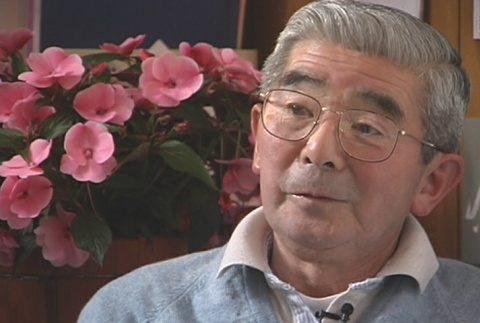
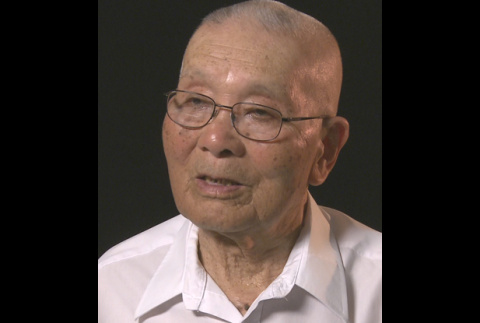
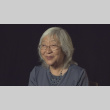
Kunio Otani Interview (ddr-densho-1000-75)
Nisei male. Born July 31, 1921, in Seattle, Washington. Raised in Raymond, Washington. Incarcerated at Tule Lake concentration camp, California, and Heart Mountain concentration camp, Wyoming; he worked on the staff of both camp newspapers, the Tulean Dispatch and the Heart Mountain Sentinel, respectively. Resettled in Seattle after the war and entered the greenhouse business. He …
vh
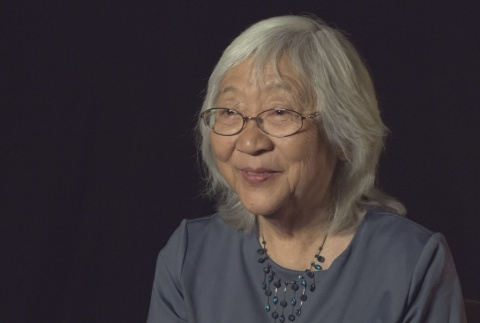
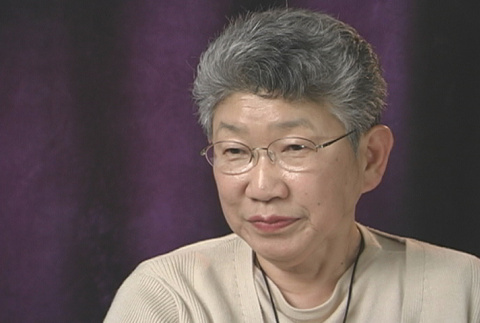
Misa (Oiye) Mihara Interview (ddr-densho-1000-547)
Sansei female. Born November 20, 1941, in Tacoma, Washington, where parents ran a restaurant. Spent early years at the Tule Lake concentration camp, California, where family was held. After leaving camp, moved to Seattle, Washington. Became an accomplished violinist, performing at an early age. Studied music at the University of Washington, then went on to become …
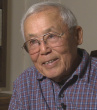
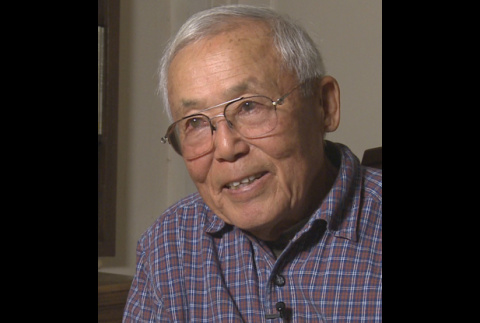
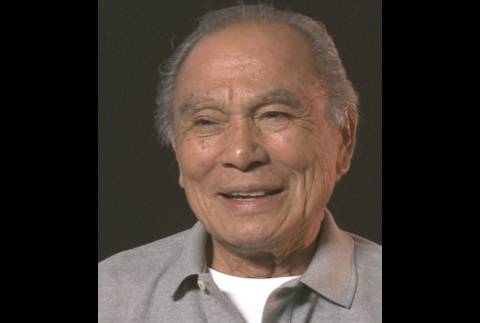
Narrator Jim M. Tanimoto
Nisei male. Born June 3, 1923, in Marysville, California. Grew up in Marysville, California, eventually moving to Gridley, California. After the bombing of Pearl Harbor on December 7, 1941, removed with family to the Tule Lake concentration camp, California. Refused to sign the so-called "loyalty questionnaire," and was removed with most other young men in Tule …

doc
War-time experiences (ddr-csujad-55-2385)
Narrative essay describing Hatsuye Nakamura's experience as an individual of Japanese ancestry living in California during the events of World War II. Nakamura describes the evacuation orders and their impact on the community, her experience at Tule Lake and Granada incarceration camps, relocation to Chicago, and eventual return to Marysville, California. See also the narrative essay …
vh
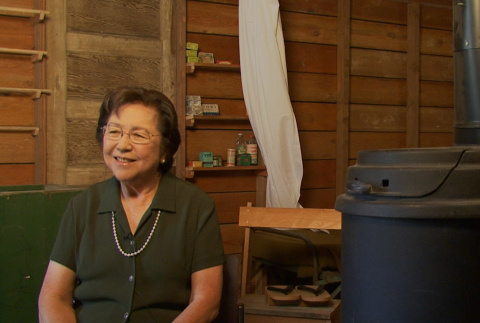
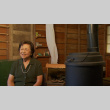
Sumi Uyeda Interview (ddr-densho-1011-8)
Nisei female. Born 1932 in Sacramento, California. Grew up in the small town of Penryn, California, where mother was a barber. During World War II, removed to the Marysville Assembly Center and Tule Lake concentration camp, California. After leaving camp, returned to Penryn.
(This material is based upon work assisted by a grant from the Department …
vh
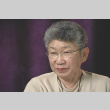
Betty Morita Shibayama Interview (ddr-densho-1000-152)
Nisei female. Born May 30, 1933, in Hood River, Oregon. Raised in the Hood River valley on family farm. After December 7, 1941, removed to the Pinedale Assembly Center, California, and then to the Tule Lake concentration camp, California. In 1943, moved with family to the Minidoka concentration camp, Idaho, before leaving camp for Chicago, Illinois, …
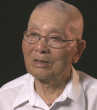
Narrator Hikaru Morohoshi
Kibei Nisei male. Born October 4, 1915, in Stockton, California. As a young child, sent to Japan to live with grandparents and attend school. Returned to California at age eighteen, and drafted into the U.S. military. Discharged from the army after Japan bombed Pearl Harbor. Removed to the Tanforan Assembly Center, Washington, and the Topaz concentration …

img
George Nobuo Naohara's handwritten note: postcard business at the Tule Lake camp (ddr-csujad-38-107)
George Nobuo Naohara's handwritten note describing his business at the Tule Lake camp in California. English translation: Geroge Naohara made postcards, adding his illustrations on blank cards, and sold them at the Post Exchange at the Tule Lake camp where his old friend worked. George's friend helped him to sell his postcards at the store. The …

doc
Card from George Naohara to Mitzi Naohara, February 14, 1945 (ddr-csujad-38-416)
A Valentine's Day card from George Nobuo Naohara to "Mitsuko" who is Mitzi Masukawa Naohara. He probably wrote from the Tule Lake camp in California where he was incarcerated to her while she was incarcerated at the Poston camp in Arizona. An item from: Mitzi Naohara scrapbook (csudh_nao_0400), page 37. See this object in the California …

img
Nisei men grouped around the back of truck (ddr-csujad-44-48)
A photograph of seven Nisei men, incarcerated at Tule Lake, California, grouped around the back of a large truck. The truck is loaded with furniture and boxes. Three men are in the truck bed. Four men are on the ground bending over a crate. A barrack is visible behind them. See this object in the California …

img
Football players (ddr-csujad-44-38)
A photograph of twelve young Nisei men incarcerated at Tule Lake, California. They are presumably football players. They are posing in two rows in front of a barrack. Six young men are standing in the back row behind six young men kneeling on the ground. Photo inscription on back: "B Football." See this object in the …

img
Girls' basketball team (ddr-csujad-44-37)
A photograph of eight young Nisei women incarcerated at Tule Lake, California. They are presumably girls' basketball team members. They are standing in two rows in front of a barrack. Four women are in each row, with one row standing in front of the other. Photo inscription on back: "Girls' Basket ball." See this object in …

doc
Daily Press Review, Vol. V, No. 6 (ddr-densho-156-246)
Article titles: "Jap Wife Killer Ordered to Gas Cell This Winter"; "Cleric Favors Jap Centers"; "Aliens are Warned on Curfew Law Violations"; "Fair Buildings to House Japs"; "Jap Woman Charged with Bribe Attempt"; "Items from Tule Lake"; "State Needs 3,429 More Beet Workers"; "Letters to Editors"; "'Loyal Alien' Status Likely for Many Italians in California"; "Mexico …

doc
Training of George K. Kambara, MD (ddr-csujad-55-1985)
Article on George K. Kambara covering his early life in California, education, incarceration, his ophthalmology practice at the Tule Lake incarceration camp, his experience as a doctor in Memphis and Wisconsin, relocation to Los Angeles, and discrimination as a Japanese-American. Published in "Archives of ophthalmology," Vol. 117, September 1999. See this object in the California State …

vh
Susumu Mukushima Interview (ddr-chi-1-4)
Nisei male. Born October 8, 1942, in Los Angeles, California. During World War II, mother and father received special dispensation to delay going to the Santa Anita Assembly Center to give birth. After Susumu was born, the family was sent to Santa Anita and then the Heart Mountain concentration camp, Wyoming, and later transferred to Tule …
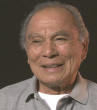
Narrator Richard E. Yamashiro
Nisei male. Born February 13, 1929, in Seattle, Washington. Grew up in Hollywood, California, and was living there when Japan bombed Pearl Harbor in 1941. Removed to the Manzanar concentration camp, California. Parents signed "no-no" on the so-called "loyalty questionnaire" and the family was transferred to the Tule Lake concentration camp, California, then designated as a …
doc
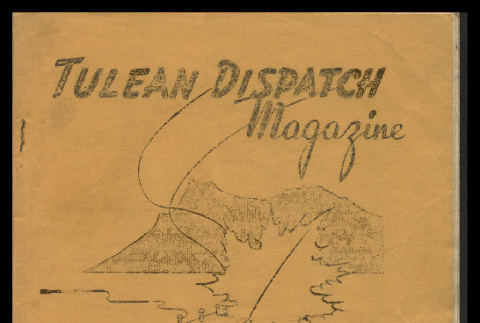
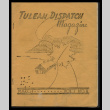
Tulean dispatch magazine section, vol. 1, no. 8 (March 1943) (ddr-csujad-55-1636)
Monthly publication at Tule Lake incarceration camp including stories, poems, commentary and creative writing. Current issue includes "Nisei America" by Riley O'Suga, "What Makes Peter Run?" by Frances Okomoto, "Haiku and Painting" by Ken Yasuda, "Tule in Rhyme" by Iku Wada, "Ramblings" by Eugene Okada, "It's the Little Things of Life" by Sachiko Higashi, "Looking Back" …

doc
The Pacific Citizen, Vol. 21 No. 18 (November 3, 1945) (ddr-pc-17-44)
Selected article titles: "Reveal Nisei GIs Served With Allied Units" (p. 1), "National JACL Plans to Enter Oyama Case Testing Validity Of California Alien Land Law" (p. 1), "WRA Closes Central Utah Camp On Time as Last Group Leaves" (p. 1), "Last Evacuee Family at Hunt Refused to Leave Center" (p. 2), "U.S. Deportation Program May …
doc
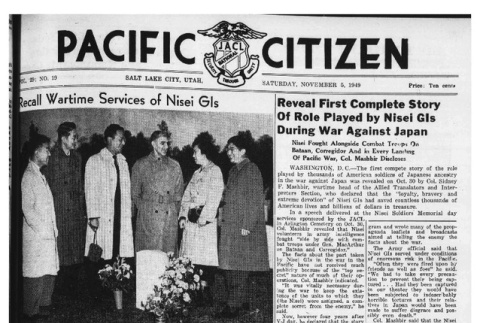
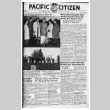
The Pacific Citizen, Vol. 29 No. 19 (November 5, 1949) (ddr-pc-21-44)
Selected article titles: "Reveal First Complete Story of Role Played by Nisei Gis During War Against Japan" (p. 1), "Missouri Law Bars Marriage of Nisei Vet, Springfield Girl" (p. 1), "South California ACLU Tells Effect of Government Action in Tule Lake Renunciants Case" (p. 2), "Masaoka Sees Little Chance For Extension of Deadline Under Evacuee Claims …

doc
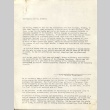
[Minutes of the special meeting of the divisional heads of the Tule Lake Center, January 12, 1944] (ddr-csujad-2-33)
Meeting minutes of incarceree led Tule Lake Camp government. Discusses plans for incarcerees to go back to work toward the end of the martial law period in the camp, a hunger strike, and the official formation of the Co-ordinating Committee. See this object in the California State Universities Japanese American Digitization project site: sjs_sch_0033
doc
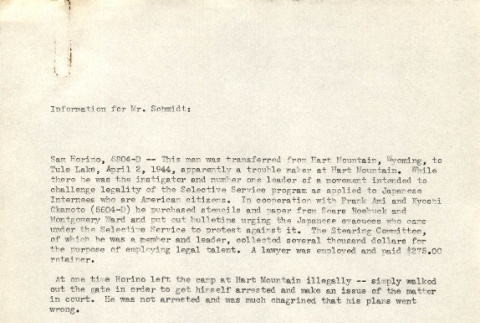
Report on Heart Mountain to Tule Lake transfer Sam Horino, leader of movement to challenge Selective Service for incarcerated Japanese Americans (ddr-csujad-2-45)
Informational report to Willard Schmidt about Sam Horino, an incarceree transferred from Heart Mountain Camp to Tule Lake Camp. Horino was accused of protesting the Selective Service program for incarcerated Japanese Americans and creating bulletins he posted throughout Heart Mountain Camp. See this object in the California State Universities Japanese American Digitization project site: sjs_sch_0045

img
View from Castle Rock facing east (ddr-csujad-26-129)
Landscape photo featuring the Tule Lake incarceration camp and the roads around it as seen in the snow from a nearby hill top. Verso reads, "view from Castle Rock facing east." From photo album of Robert Billigmeier. See this object in the California State Universities Japanese American Digitization project site: mei_05_099

img
Tule Lake scrapbook illustrated page (ddr-csujad-26-63)
Scrapbook page features a pencil drawn illustration of women studying and reading. The page is covered in notes of best wishes and good luck to the recipient and includes several signatures. Tule Lake scrapbook (ucsb_mei_0053), page 29. See this object in the California State Universities Japanese American Digitization project site: mei_03_20_011

img
Old Indian fort in Lava Beds National Monument, Calif., J. H. Eastman #B-1324 (ddr-csujad-26-104)
Postcard depicting Native American architecture at Lava Beds National Monument addressed to "Sgt. Tsukahara Student Det. Camp Savage, Minn" on verso. Lava Beds National Monument is nearby Tule Lake incarceration camp. From photo album of Robert Billigmeier. See this object in the California State Universities Japanese American Digitization project site: mei_05_043
doc
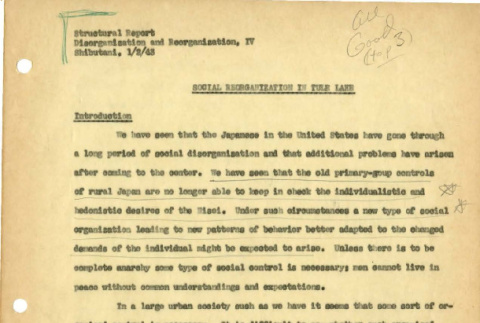
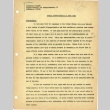
Structural report, disorganization and reorganization, IV: social reorganization in Tule Lake (ddr-csujad-26-21)
Manuscript evaluating potential behavior patterns and social organization among incarcerees at Tule Lake including leadership roles, planning boards, efforts to curb juvenile delinquency and "Nisei apathy." Report compiled as a portion of the Japanese American Evacuation and Resettlement Study (JERS). See this object in the California State Universities Japanese American Digitization project site: mei_02_28_001