Arranged marriage; system of inheritance in Japan (Japanese language)
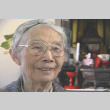
This interview was conducted in Japanese and was translated so as to convey Mrs. Terao's way of speaking as closely as possible. For example, there are instances in which she makes some grammatical errors. These mistakes are conveyed through similar grammatical errors in English in order to …
Receiving a formal note of appreciation from the Emperor of Japan for work following the atomic bombings
In this interview Mr. Schmoe refers to Aki Kurose, a former employee, fellow Quaker, peace activist, and long-time friend. At the time of this interview, Ms. Kurose had recently passed away after a long struggle with cancer. At the …
Anticipating war between the U.S. and Japan (Japanese language)
This interview was conducted in Japanese and was translated so as to convey Mrs. Terao's way of speaking as closely as possible. For example, there are instances in which she makes some grammatical errors. These mistakes are conveyed through similar grammatical errors in English in order to …
Corresponding infrequently with family in Japan (Japanese language)
This interview was conducted in Japanese and was translated so as to convey Mrs. Terao's way of speaking as closely as possible. For example, there are instances in which she makes some grammatical errors. These mistakes are conveyed through similar grammatical errors in English in order to recreate …
Being asked to go to Japan to conduct a research study after the atomic bombings of Hiroshima and Nagasaki
This material is based upon work assisted by a grant from the Department of the Interior, National Park Service. Any opinions, finding, and conclusions or recommendations expressed in this material are those of the author(s) and do …
Memories of mass removal: traveling to the Santa Anita Assembly Center, becoming head of the "vegetable department" at Santa Anita
Although Mr. Matsumoto does not identify himself as a Kibei (American-born person of Japanese ancestry sent to Japan for formal education and socialization when young and later returned to the U.S.), some of his life experiences …
The mental strain of being surrounded on Nhpum Ga hill; sent on a mission to secretly try to overhear enemy plans
Although Mr. Matsumoto does not identify himself as a Kibei (American-born person of Japanese ancestry sent to Japan for formal education and socialization when young and later returned to the U.S.), some of his life …
Description of relationship between Kibei and Nisei at Camp Savage, Minnesota; thoughts on the level of Japanese language education at the language school
Although Mr. Matsumoto does not identify himself as a Kibei (American-born person of Japanese ancestry sent to Japan for formal education and socialization when young and later returned to the U.S.), some of …
Frustration with the registration questions involving renouncing allegiance to Japan
This interview was conducted by sisters Emiko and Chizuko Omori for their 1999 documentary, Rabbit in the Moon, about the Japanese American resisters of conscience in the World War II incarceration camps. As a result, the interviews in this collection are typically not life histories, …
Family background: born in Japan; father's unorthodox arrival in the United States
This interview was conducted by sisters Emiko and Chizuko Omori for their 1999 documentary, Rabbit in the Moon, about the Japanese American resisters of conscience in the World War II incarceration camps. As a result, the interviews in this collection are typically not …
Description of siblings in Japan; working as a schoolboy in Pocatello, Idaho
This interview was conducted by sisters Emiko and Chizuko Omori for their 1999 documentary, Rabbit in the Moon, about the Japanese American resisters of conscience in the World War II incarceration camps. As a result, the interviews in this collection are typically not …
Family background: growing up in Hawaii, going to Japan as a child
This interview was conducted by sisters Emiko and Chizuko Omori for their 1999 documentary, Rabbit in the Moon, about the Japanese American resisters of conscience in the World War II incarceration camps. As a result, the interviews in this collection are typically not …
Nisei male. Born May 1, 1913, in Laguna, California. Lived in Japan from childhood through teenage years, before returning to the United States during high school. Incarcerated in the Santa Anita Assembly Center, California, and the Jerome concentration camp, Arkansas. Volunteered for the U.S. army in 1942, and was inducted in the Military Intelligence Service. Selected …
Kibei-Nisei male. Born January 20, 1916, in Alameda, California. At the age of five, family returned to live in Japan. Attended school in Japan before returning to the U.S. in 1937. Drafted into the U.S. Army, and was in training when Japan bombed Pearl Harbor on December 7, 1941. Resisted military orders while in basic training, …
The Gentaro Takahashi Collection consists of photos, documents and ephemera from the time of Gentaro Takahashi’s arrival in the United States in 1907 to the 1970’s. The collection includes family photos in the U.S. and Japan, photos of Takahashi's travels in the U.S. including Duluth, Minnesota and Yellowstone National Park, correspondence and academic work from Boston …
Collection consists of two albums containing photos of Ikebana, bonsai and demonstrations created and performed by Ikebana artist, Pauline Sakahara, and two diplomas from Ikebana flower arranging schools. In 1958, she was secretary, interpreter, and student of the Ikebana expert, Madame Josui Oshikawa, headmaster of the Sho-fu Ryu school. Mrs. Sakahara graduated from the Sho-fu Ryu …
Sansei female. Born August 2, 1922, in Suooshima, Yamaguchi, Japan, and lived there until she was about 1 1/2 years old. Grew up in Tacoma, Washington. During World War II, incarcerated at the Pinedale Assembly Center, California, and Tule Lake concentration camp, California. At Tule Lake she and her husband married, and her oldest son, Kenichi, …
Kibei male. Born November 9, 1919, in Thomas, Washington. Went to Japan at age twelve, attended school, and returned to the U.S. as a high school student. Enlisted in the army just prior to the bombing of Pearl Harbor, and was eventually recruited for the Military Intelligence Service. Selected as one of fourteen Japanese Americans to …
Nisei male. Born May 19, 1917, in Eastport, Idaho, and spent childhood in Spokane, Washington. In 1933 traveled to Japan with family where father became ill and died. Attended school in Japan for three years and then returned to Spokane in 1936 and worked on a farm. Following the bombing of Pearl Harbor, volunteered for military …
Nisei male. Born May 15, 1921, in Seattle, Washington. Spent much of childhood in Japan, returning to the U.S. at the age of fifteen. Began attending the University of Washington before being removed to Puyallup Assembly Center, Washington, and Minidoka concentration camp, Idaho. Created a series of art pieces depicting camp life. Moved to Spokane, Washington, …
Nisei female. Born April 11, 1923, in Seattle, Washington. Grew up in Seattle, where parents ran a hotel. Went to live in Japan for several years prior to World War II. During the war, removed to the Puyallup Assembly Center, Washington, and the Minidoka concentration camp, Idaho. While in Minidoka, recruited to teach elementary school, and …
Nisei male. Born February 7, 1925, in Sacramento, California. At a very young age, sent to Japan for several years. Returned at age six and lived with family in Loomis, California. During World War II, removed to the Arboga Assembly Center, California, and the Tule Lake concentration camp, California. Transferred briefly to the Amache concentration camp, …
Kibei Nisei male. Born October 4, 1915, in Stockton, California. As a young child, sent to Japan to live with grandparents and attend school. Returned to California at age eighteen, and drafted into the U.S. military. Discharged from the army after Japan bombed Pearl Harbor. Removed to the Tanforan Assembly Center, Washington, and the Topaz concentration …
Nisei female. Born December 5, 1930, in Gardena, California. Grew up in Gardena where parents ran a restaurant. After the bombing of Pearl Harbor, father was arrested and taken away by the FBI. During mass removal, family was sent to the Manzanar concentration camp, California, and reunited with father. Following the Leave Clearance questionnaire in 1943, …
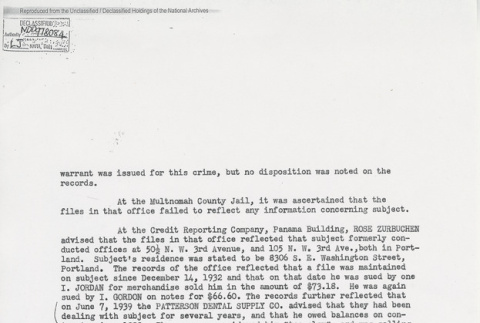
Photocopy of a declassified report on Keizaburo Koyama. A bench warrant was issued for Koyama for disregarding a signal, but no disposition was noted in his records. The files in the Multnomah County Jail did not show any information on Koyama's arrest or warrant on the matter. A report from the Credit Reporting Company from Rose …