Living conditions

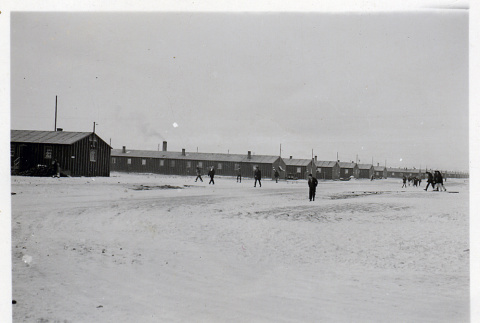
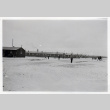
All of the camps were constructed according to the War Department's specifications, which included barbed-wire fences, guard towers, and armed guards around the perimeter. The camps were organized in "blocks" consisting of twelve to fourteen barracks, a mess hall, communal showers and toilets, laundry facilities, and a recreation hall. Each barracks was divided into four or six rooms with each room housing one family, no matter how large, and there was no running water. The furnishings that Japanese Americans found on their arrival were canvas cots, a potbellied stove, and a single bare light bulb. The thin walls offered little protection from the harsh weather, which ranged from 110 degrees in the summer to 25 degrees below zero on winter nights. The flimsy construction allowed no privacy and made normal family life difficult. Camp inmates improved their own living conditions by creating interior walls and partitions, constructing furniture from scrap lumber, and planting gardens.

World War II (277)
Concentration camps (1771)
Living conditions (1870)

Related articles from the Densho Encyclopedia :
Arts and crafts in camp, Community analysts, Manzanar Children's Village
Facilities
Format
Genre
Usage
Use <Ctrl> or (⌘) keys to select multiple terms

1870 items
Tule Lake nighttime panorama (ddr-csujad-3-6)
img Tule Lake nighttime panorama (ddr-csujad-3-6)
High vantage point panoramic nighttime photograph of Tule Lake camp with the lights from the buildings inside camp on. The photograph shows the expanse of the camp against the darkened landscape. See this object in the California State Universities Japanese American Digitization project site: tos_01_001_006
Tule Lake perimeter landscape (ddr-csujad-3-7)
img Tule Lake perimeter landscape (ddr-csujad-3-7)
Panoramic photograph of a part of the perimeter of Tule Lake with buildings, telephone poles, fencing and watch towers lining up in the distance. See this object in the California State Universities Japanese American Digitization project site: tos_01_001_007
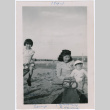
Mother and her children in front of their barracks (ddr-densho-34-111)
img Mother and her children in front of their barracks (ddr-densho-34-111)
Shigeko Kitamoto and her children (left to right): Frances, Jane, Frank, and Lilly Kitamoto.
Three children behind barracks (ddr-densho-34-118)
img Three children behind barracks (ddr-densho-34-118)
Left to right: Frank, Lilly, and Jane Kitamoto behind their barracks at the Minidoka concentration camp.
Family outside their barrack (ddr-densho-34-163)
img Family outside their barrack (ddr-densho-34-163)
The Takemoto family outside their barrack at the Manzanar concentration camp, California.
In Memory of Manzanar Plaque (ddr-densho-508-7)
img In Memory of Manzanar Plaque (ddr-densho-508-7)
Two sided plaque with Japanese characters on front. Inscription on back reads "IN MEMORY OF MANZANAR 1942"
Tule Lake Plaque (ddr-densho-508-5)
img Tule Lake Plaque (ddr-densho-508-5)
Two sided plaque with Japanese characters on front. Inscription on back reads "TULE LAKE 1943"
Short story:
doc Short story: "Uprooted" (ddr-densho-468-74)
Assignment for English 211 course. Story consists of dialogue between a mother and her daughter, a second-grade student. The mother and daughter are Japanese-Americans incarcerated during World War II. The mother is trying to explain the situation while answering the daughter's questions.
Letter from Joseph Ishikawa to Eva (ddr-densho-468-99)
doc Letter from Joseph Ishikawa to Eva (ddr-densho-468-99)
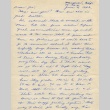
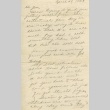
Letter written from Granada (Amache) describing life in the concentration camp compared to Santa Anita.
A Myopic Account of a Relocated Life during the Second World War (ddr-densho-468-97)
doc A Myopic Account of a Relocated Life during the Second World War (ddr-densho-468-97)
Personal recollections of life in an assembly center and relocation camp for Japanese descendants and various digressions
Book of 70th Anniversary of Japanese Congregational Church (ddr-densho-446-455)
doc Book of 70th Anniversary of Japanese Congregational Church (ddr-densho-446-455)
The Japanese Congregational Church's 70th Anniversary coincided with the 100th Anniversary of the Japanese Christian Mission in North America. This book traces the history of JCC within the larger setting of national and local events, and some of the photos and narratives may be of interest. Ai Chih Tsai was pastor at JCC from 1948 to …
Seattle Post-Intelligencer (ddr-densho-446-451)
doc Seattle Post-Intelligencer (ddr-densho-446-451)
Selected articles: Seattle woman's saga captured in photo (p.1-2); Club Asia (p. 2)
Hunt High School Reunion 1983 (ddr-densho-449-1)
doc Hunt High School Reunion 1983 (ddr-densho-449-1)
33 pages of memories from living and learning at Minidoka in 1943 and 1944. The book contains pictures of Minidoka, the classes, reunion program, Hunt High song, poems, directory, and a memoriam for classmates who were not able to make the reunion.
Incident in Topaz Internment Camp (ddr-densho-292-53)
doc Incident in Topaz Internment Camp (ddr-densho-292-53)
Seiji Kaibe recounts a time when he and several other young men tried to steal building materials from the Topaz Hospital construction site in order to better their own barracks. The men were caught by armed guards and Kaibe was almost shot. Bill T. Sakai also adds that they only received a reprimand the next day …
API