Living conditions

All of the camps were constructed according to the War Department's specifications, which included barbed-wire fences, guard towers, and armed guards around the perimeter. The camps were organized in "blocks" consisting of twelve to fourteen barracks, a mess hall, communal showers and toilets, laundry facilities, and a recreation hall. Each barracks was divided into four or six rooms with each room housing one family, no matter how large, and there was no running water. The furnishings that Japanese Americans found on their arrival were canvas cots, a potbellied stove, and a single bare light bulb. The thin walls offered little protection from the harsh weather, which ranged from 110 degrees in the summer to 25 degrees below zero on winter nights. The flimsy construction allowed no privacy and made normal family life difficult. Camp inmates improved their own living conditions by creating interior walls and partitions, constructing furniture from scrap lumber, and planting gardens.

World War II (283)
Concentration camps (2384)
Living conditions (1897)

Related articles from the Densho Encyclopedia :
Arts and crafts in camp, Community analysts, Manzanar Children's Village
Facilities
Format
Genre
Usage
Use <Ctrl> or (⌘) keys to select multiple terms

1897 items
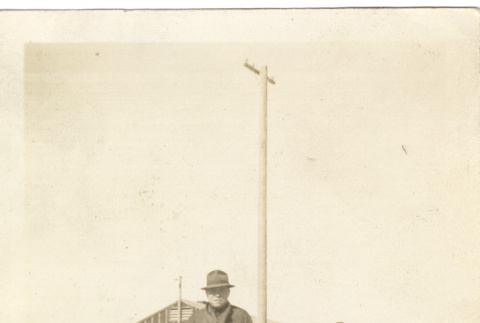
Man in front of camp barracks (ddr-csujad-37-9)
img Man in front of camp barracks (ddr-csujad-37-9)
Photograph of a man wearing an overcoat and hat standing in front of camp barracks and a utility pole at the Heart Mountain incarceration camp. See this object in the California State Universities Japanese American Digitization project site: mhf_009
Men posing out window (ddr-csujad-37-4)
img Men posing out window (ddr-csujad-37-4)
Photograph of two men posing out the window of a camp barrack at the Heart Mountain incarceration camp. See this object in the California State Universities Japanese American Digitization project site: mhf_004_01
Young child in front of Christmas tree (ddr-csujad-37-15)
img Young child in front of Christmas tree (ddr-csujad-37-15)
Photograph of a young child in front of a Christmas tree inside of the barracks building at the Heart Mountain camp, Wyoming. See this object in the California State Universities Japanese American Digitization project site: mhf_015_01
Camp barracks at Heart Mountain (ddr-csujad-37-12)
img Camp barracks at Heart Mountain (ddr-csujad-37-12)
Landscape photograph of camp barracks at the Heart Mountain incarceration camp in Wyoming. See this object in the California State Universities Japanese American Digitization project site: mhf_012
Woman standing in front of camp barrack (ddr-csujad-37-3)
img Woman standing in front of camp barrack (ddr-csujad-37-3)
Photograph of a women standing in front camp barracks at the Heart Mountain incarceration camp. A barracks building with a clothes line is seen in the behind. See this object in the California State Universities Japanese American Digitization project site: mhf_003
Tule Lake scrapbook (ddr-csujad-26-53)
img Tule Lake scrapbook (ddr-csujad-26-53)
Scrapbook created in Tule Lake camp by Japanese American students. Contents include drawings, art, holiday greeting cards prints, poetry and signatures of student groups. See this object in the California State Universities Japanese American Digitization project site: mei_03_20_001
Camp buildings with dust cloud (ddr-csujad-26-69)
img Camp buildings with dust cloud (ddr-csujad-26-69)
Camp barracks buildings line a road with dust cloud. People can be seen in front of the buildings in distance. From photo album of Robert Billigmeier. See this object in the California State Universities Japanese American Digitization project site: mei_05_006
Personality cards (ddr-csujad-26-44)
doc Personality cards (ddr-csujad-26-44)
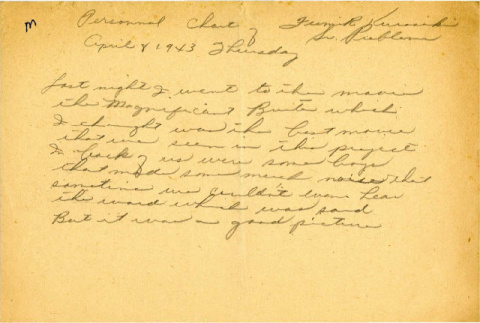
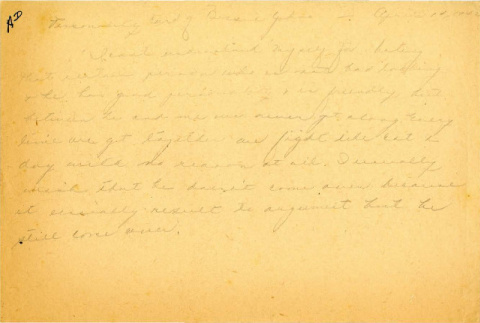
Journal entries written by high school students discussing their observations and perspectives on a variety of topics including social and cultural differences, personality conflicts, friendships, social interactions, school, dogs, memories, reflections on camp life, weather, a friend in the military visiting his parents in camp, hobbies, and opinions about other people and daily life. Each entry …
Fire department of Tule Lake (ddr-csujad-26-14)
doc Fire department of Tule Lake (ddr-csujad-26-14)
Description of the establishment, structure and operations of the fire department at Tule Lake. The report includes accounts of fires, what firemen do while waiting for fires, schedules, issues with wardens and administration, and ethnographic observations of "social status" in the camps. Report compiled as a portion of the Japanese American Evacuation and Resettlement Study (JERS). …
Group photo by car (ddr-csujad-26-111)
img Group photo by car (ddr-csujad-26-111)
A group of five women and one man poses in front of a car with barracks in the background. Additional photos in sequence include: ucsb_mei_0109, ucsb_mei_0113, ucsb_mei_0114, ucsb_mei_0115. From photo album of Robert Billigmeier. See this object in the California State Universities Japanese American Digitization project site: mei_05_075
Young women (ddr-csujad-26-123)
img Young women (ddr-csujad-26-123)
A group of young Japanese American women poses with a Caucasian woman in front of a barracks building. From photo album of Robert Billigmeier. See this object in the California State Universities Japanese American Digitization project site: mei_05_092
Chapter 8, 9, 10 personality cards (ddr-csujad-26-35)
doc Chapter 8, 9, 10 personality cards (ddr-csujad-26-35)
Journal entries written by high school students discussing their observations and perspectives on a variety of topics including movies, dances, dissatisfaction with recreation, family dynamics, desire to leave camp, cultural and generational differences, and weather. Each entry includes the full date and student name. The entries were part of a class assignment and collected for the …
Four women and two men (ddr-csujad-26-117)
img Four women and two men (ddr-csujad-26-117)
Four women and two men pose together in front of barracks buildings. All but one person is Japanese American. From photo album of Robert Billigmeier. See this object in the California State Universities Japanese American Digitization project site: mei_05_086
Outline of University of California study of evacuation and resettlement (ddr-csujad-26-2)
doc Outline of University of California study of evacuation and resettlement (ddr-csujad-26-2)
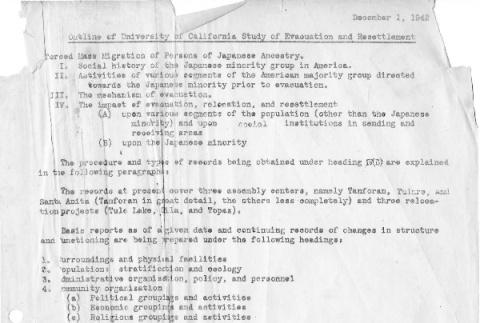
Outline for an academic social science study, the Japanese American Evacuation and Resettlement Study (JERS), led by the University of California of the incarceration of Japanese Americans during World War II. Outline highlights area of administrative, social, political and personal areas to be studied by a team of researchers encamped with incarcerees. See this object in …
Personality cards (ddr-csujad-26-43)
doc Personality cards (ddr-csujad-26-43)
Journal entries written by high school students discussing their observations and perspectives on a variety of topics including family interactions, memories, homesickness, friendships, social interactions, school, self-reflection, juvenile delinquency, peer behaviors, death, religion, opinions, and worldviews. Each entry includes the full date and student name. The entries were part of a class assignment and collected for …
Group photo in front of barracks (ddr-csujad-26-136)
img Group photo in front of barracks (ddr-csujad-26-136)
Three Japanese American women and one man pose together in front of a barracks building. An automobile and additional barracks can be seen in the background. From photo album of Robert Billigmeier. See this object in the California State Universities Japanese American Digitization project site: mei_05_106
Barracks row (ddr-csujad-26-86)
img Barracks row (ddr-csujad-26-86)
A man walks toward a row of barracks lining a dusty road. From photo album of Robert Billigmeier. See this object in the California State Universities Japanese American Digitization project site: mei_05_023
Group photo in front of barracks building (ddr-csujad-26-81)
img Group photo in front of barracks building (ddr-csujad-26-81)
Posed group photo in front of a barracks building of eighteen Japanese Americans and Caucasian adults, one baby, and one dog. From photo album of Robert Billigmeier. See this object in the California State Universities Japanese American Digitization project site: mei_05_018
Young man on tractor (ddr-csujad-26-131)
img Young man on tractor (ddr-csujad-26-131)
Photo of a young Japanese American man on a tractor. Barracks building are seen in the background. From photo album of Robert Billigmeier. See this object in the California State Universities Japanese American Digitization project site: mei_05_101
Large group photo (ddr-csujad-26-125)
img Large group photo (ddr-csujad-26-125)
Photo of a large group of Japanese Americans and Caucasian men and women pose in front of a barracks building with a baby and a dog. From photo album of Robert Billigmeier. See this object in the California State Universities Japanese American Digitization project site: mei_05_094
View from Castle Rock facing east (ddr-csujad-26-129)
img View from Castle Rock facing east (ddr-csujad-26-129)
Landscape photo featuring the Tule Lake incarceration camp and the roads around it as seen in the snow from a nearby hill top. Verso reads, "view from Castle Rock facing east." From photo album of Robert Billigmeier. See this object in the California State Universities Japanese American Digitization project site: mei_05_099
Young Japanese couple (ddr-csujad-26-119)
img Young Japanese couple (ddr-csujad-26-119)
Photo of a young Japanese American couple seated on a bench in front of barracks buildings. From photo album of Robert Billigmeier. See this object in the California State Universities Japanese American Digitization project site: mei_05_088
Tule Lake scrapbook illustrated page (ddr-csujad-26-64)
img Tule Lake scrapbook illustrated page (ddr-csujad-26-64)
Scrapbook page features a pastel drawing of women showering and in various states of undress in camp barracks. Illustration is accompanied by a poem "Barrack room ballads" about the lack of both privacy and comfort of women using camp barracks showers and toilets. Tule Lake scrapbook (ucsb_mei_0053), page 31. See this object in the California State …
University of California evacuation and resettlement study: The Gila River WRA relocation center, Rivers, Pinal County, Arizona (ddr-csujad-26-27)
doc University of California evacuation and resettlement study: The Gila River WRA relocation center, Rivers, Pinal County, Arizona (ddr-csujad-26-27)
Description of the Gila River incarceration camp during the first month of occupation, including camp location, climate, landscape, barracks, issues with camp construction, poor conditions and lack of furnishings, incarcerees who were subjected to upon arrival. Camp administration, food and housing issues, camp employment, security, recreation, and social groups are described and analyzed. Report compiled as …
Women pose in front of building (ddr-csujad-26-84)
img Women pose in front of building (ddr-csujad-26-84)
A group of young women pose in front of what may be the side of a barracks building. From photo album of Robert Billigmeier. See this object in the California State Universities Japanese American Digitization project site: mei_05_021
API