
Issei
The earliest wave of Japanese immigrants, the Issei (first generation), had a strong sense of their ethnic identity and retained the values and traditions of their country of birth. Most came to the United States as sojourners and planned to return to Japan after earning their fortunes. In addition, discriminatory laws forbade them from becoming American citizens and from exercising other basic rights, such as owning or leasing land. Since they were thus prevented from fully taking part in American life, it is not surprising that many still identified strongly with the culture of their homeland.
Identity and values
(362)
Issei
(1037)
Related articles from the
Densho Encyclopedia :
Issei
1037 items
![[Significant factors in requests for repatriation and expatriation] (ddr-csujad-2-57)](https://ddr.densho.org/media/cache/3c/6b/3c6b42c9418fb06a4afccaed41dbbe7a.jpg)
![Letter from Rose Tani to Rev. [Wendell L.] Miller, circa 1942 (ddr-csujad-20-8)](https://ddr.densho.org/media/cache/a4/50/a4505d1c174bd0184f2200cf2d3a8ff4.jpg)
1037 items
![[Significant factors in requests for repatriation and expatriation] (ddr-csujad-2-57)](https://ddr.densho.org/media/cache/88/1b/881b555fab5521a30cf91dd8cb6ffbdf.jpg)
doc
[Significant factors in requests for repatriation and expatriation] (ddr-csujad-2-57)
Report on the influx of repatriation to Japan requests from Manzanar Incarceration Camp. Report describes camp life in Tule Lake compared to Manzanar, special concerns with Kibei and Issei individuals, the draft, and family dilemma related to repatriation. See this object in the California State Universities Japanese American Digitization project site: sjs_sch_0057
![Letter from Rose Tani to Rev. [Wendell L.] Miller, circa 1942 (ddr-csujad-20-8)](https://ddr.densho.org/media/cache/f0/dd/f0dd7df7e3506b36217bb3900adf652d.jpg)
doc
Letter from Rose Tani to Rev. [Wendell L.] Miller, circa 1942 (ddr-csujad-20-8)
Personal letter written from the Santa Anita Assembly Center expressing gratitude for Miller's having allowed them to store goods at his church; also thanks Miller and Reverend Clay for the lunch prepared by church members, and describes church services for Issei and for Nisei. See this object in the California State Universities Japanese American Digitization project …
img
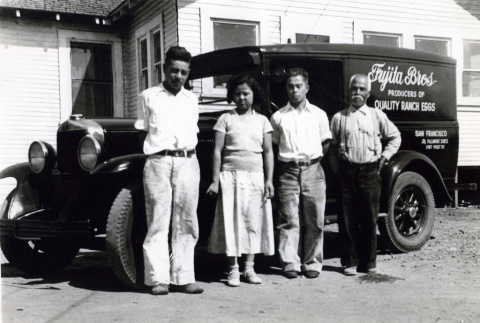
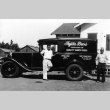
Fujita family in front of Fujita Brothers Egg Ranch truck (ddr-csujad-23-2)
Shows a circa 1930 Graham Paige panel delivery truck parked in front of the Fujita Brothers Egg Ranch (Ely Road and Fujita Lane, Petaluma, California). Shown from left to right are siblings Katsumi (Henry) Fujita, Michi (Grace) Fujita, Eigi (George) Fujita and their father Tsuneji Fujita. This photo appears to have been taken on the same …
img
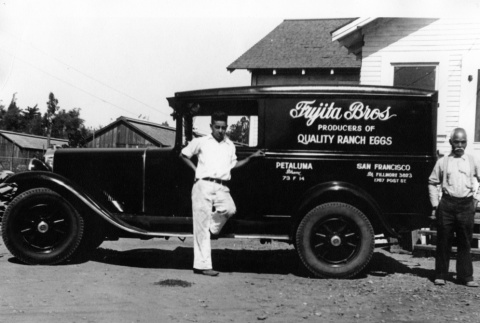
Tsuneji Fujita and Katsumi Henry Fujita in front of Fujita Brothers Egg Ranch truck (ddr-csujad-23-3)
This photo appears to have been taken on the same day as Item number ssu_lp_0001. Shown from left to right are Katsumi (Henry) Fujita and his father Tsuneji Fujita. See this object in the California State Universities Japanese American Digitization project site: lp028-08-002
img
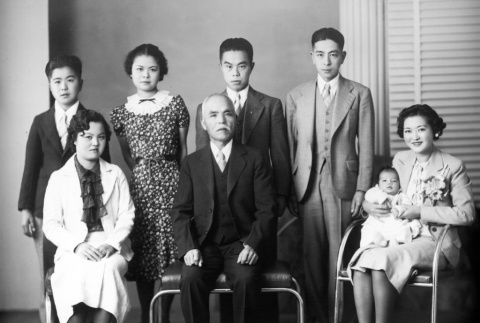
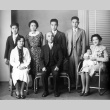
Three generations of the Fujita family (ddr-csujad-23-11)
Shows 3 generations of the Fujita family in 1938 at the christening of Gary Yoshio Fujita at the First Presbyterian Church in Petaluma, California. In the front row from left to right are Grace Michi Fujita, Tsuneji Fujita (grandfather), Gary Yoshio Fujita (baby) and Ann Sumiko (Kashiwase) Fujita (mother). In the second row from left to …
doc
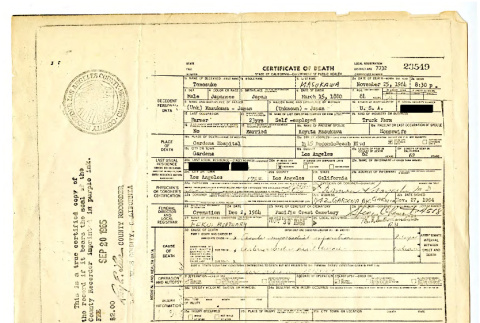
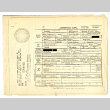
Certificate of death (ddr-csujad-38-548)
A certified copy of the death certificate of Tomosuke Masukawa. See this object in the California State Universities Japanese American Digitization project site: nao_05_12_001
doc
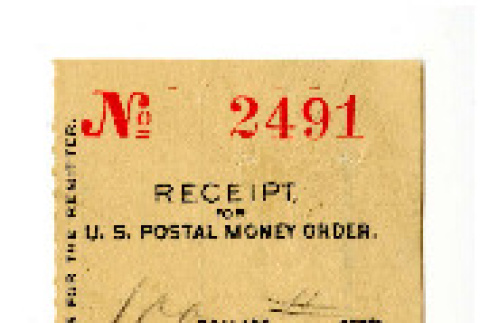
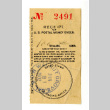
Receipt for U.S. postal money order (ddr-csujad-38-530)
A receipt for U.S. postal money order for 100 dollars. Issued by M.O.B. [Money Order Branch] of Walnut Grove, California. It was probably purchased by Tomosuke Masukawa. It is enclosed in an envelope which is found in item: csudh_nao_0504. See this object in the California State Universities Japanese American Digitization project site: nao_05_01_003
doc
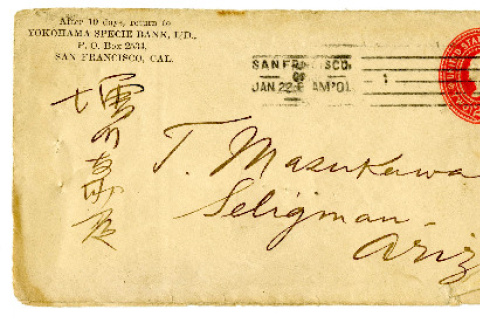
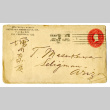
Envelope from Yokohama Specie Bank, LID., to Tomosuke Masukawa, January 22, 1901 (ddr-csujad-38-532)
An envelope from Yokohama Shōkin Ginkō, San Francisco, California to Tomosuke Masukawa in Seligman, Arizona. It contains the U.S. postal money order receipts, which are found in items: csudh_nao_0500, csudh_nao_0501, csudh_nao_0502, and csudh_nao_0503. See this object in the California State Universities Japanese American Digitization project site: nao_05_01_005
doc
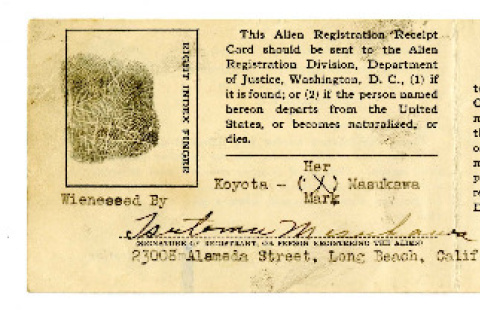
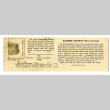
Alien registration receipt card, Form AR-3, Koyuta Masukawa (ddr-csujad-38-540)
An alien registration receipt card for Koyuta Masukawa. It is singed by her Nisei son, Tsutomu Masukawa. Form AR-3. See this object in the California State Universities Japanese American Digitization project site: nao_05_07_001
img
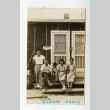
Yokota family (ddr-csujad-38-281)
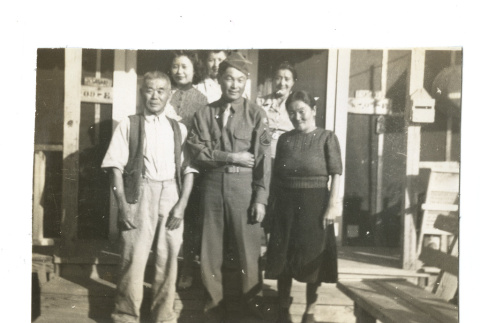
Photographed is the Yokota family, sitting in front of their barrack in the Jerome camp in Arkansas. Includes Yukie Masukawa. It was presumably taken when Yukie Masukawa, an incarceree at the Poston camp in Arizona, visited her family at the Jerome camp. The photo was sent from Sally Sakaye Sasaki at the Jerome camp to Mitzi …
img
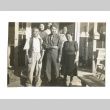
Sasaki family at the Jerome camp (ddr-csujad-38-275)
Photographed is the Sasaki family incarcerated at the Jerome camp in Arkansas, including Ichiji and Shika Sasaki, and their Nisei son in the U.S. Army uniform. The photo was sent from Sally Sakaye Sasaki at the Jerome camp to Mitzi Masukawa Naohara at the Poston camp in Arizona. A photo from: Mitzi Naohara photo album (csudh_nao_0200), …
doc
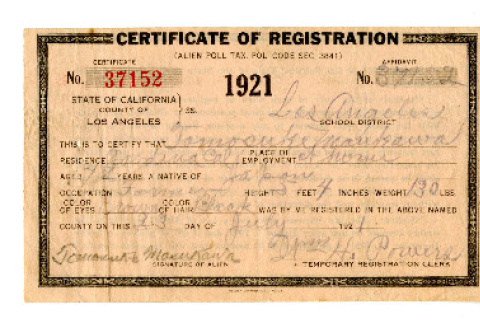
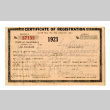
Certificate of registration (alien poll tax. pol. code sec. 3841) (ddr-csujad-38-534)
A certificate of registration for Alien Poll Tax Policy registered by Tomosuke Masukawa on July 23, 1921. See this object in the California State Universities Japanese American Digitization project site: nao_05_02_002
doc
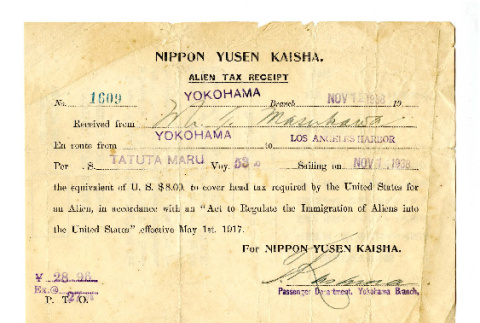
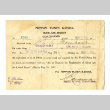
Alien tax receipt (ddr-csujad-38-539)
An alien tax receipt issued by Nihon Yuisen Kabushiki Kaisha. It certifies that Tomosuke Masukawa, who boarded on Tatuta [Tatsuta] Maru from Yokohama, Japan, on November 1, 1938, and arrived at Los Angeles Harbor, paid 8 dollars of alien tax required by the United States. See this object in the California State Universities Japanese American Digitization …
doc
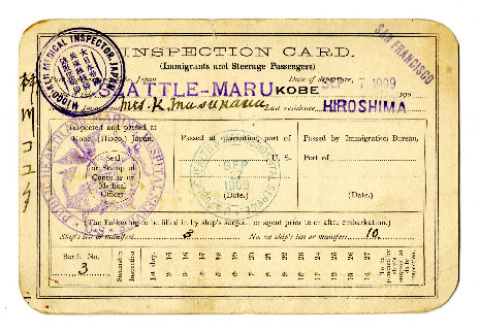
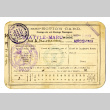
Inspection card (immigrants and steerage passengers) (ddr-csujad-38-533)
An inspection card for Koyuta Masukawa. She boarded on the ship, Seattle Maru, in Kobe, Japan, on September 7, 1909, and arrived in San Francisco, California. and was inspected on September 27, 1909 by U.S. Public Health and Marine Hospital Service presumably in Presidio, California, prior to Angel Island Immigration Station's operation. It also includes a …
img
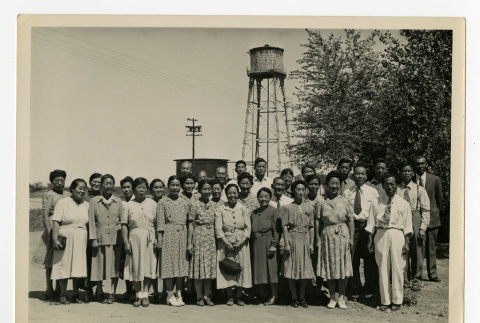
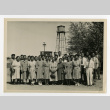
Poston bird carving class (ddr-csujad-35-11)
A group photograph of participants in a bird carving class in the Poston camp in Arizona. They are most likely Issei. A water tank is seen in the background. The handwritten note on the back side reads: April 1945, Poston bird carving class taken in front of barracks, Poston, Arizona. See this object in the California …
img
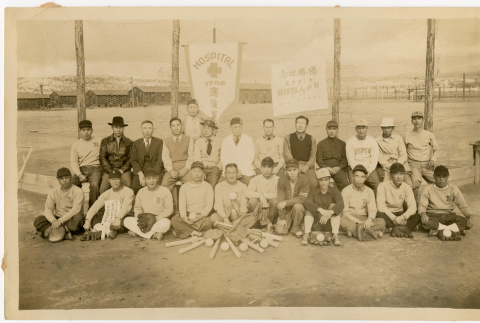
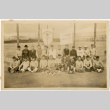
Santa Fe Japanese baseball club (ddr-csujad-36-10)
Group photograph of a baseball team, [ Santa Fe Japanese Baseball Club]. A photo from: Manzanar Photo Album. See this object in the California State Universities Japanese American Digitization project site: man_01_011
img
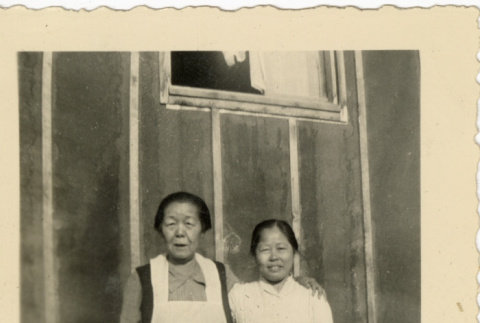
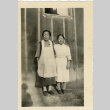
Women in apron (ddr-csujad-37-6)
Photograph of two women in apron standing in front of a barrack at the Heart Mountain incarceration camp. See this object in the California State Universities Japanese American Digitization project site: mhf_006
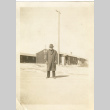
img
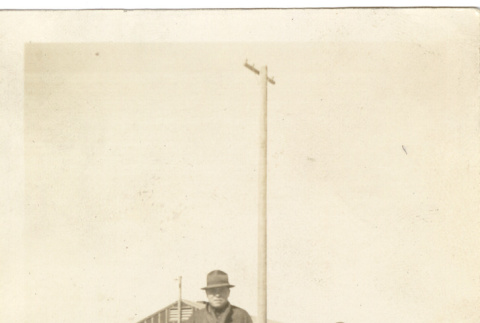
Man in front of camp barracks (ddr-csujad-37-9)
Photograph of a man wearing an overcoat and hat standing in front of camp barracks and a utility pole at the Heart Mountain incarceration camp. See this object in the California State Universities Japanese American Digitization project site: mhf_009
img
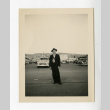
Tomosuke Masukawa (ddr-csujad-38-231)
Photographed is Tomosuke Masukawa, an incarceree of the Poston camp, Arizona. The caption reads: Pop, 1944. A photo from: Mitzi Naohara photo album (csudh_nao_0200), page 10. See this object in the California State Universities Japanese American Digitization project site: nao_02_10_004
img
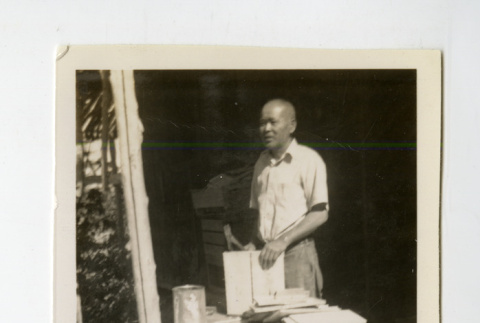
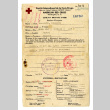
Mr. Tanaka (ddr-csujad-38-153)
Photographed is an Issei man, Mr. Tanaka. A photo from "George Naohara photo album" (csudh_nao_0001), page 32. See this object in the California State Universities Japanese American Digitization project site: nao_01_32_001
doc
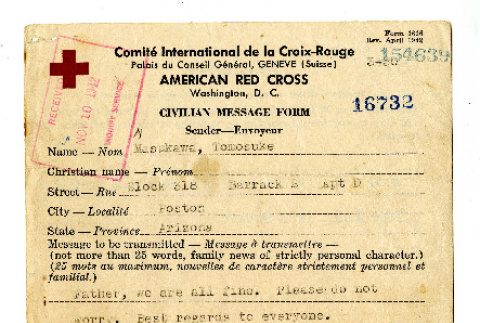
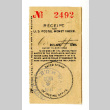
Messages between Tomosuke Masukawa in the Poston in Arizona and Hidetaro Myoren in Hiroshima, Japan, October 29, 1942-September 2, 1943 (ddr-csujad-38-545)
Messages exchanged between Tomosuke Masukawa at the Poston camp in Arizona and his father-in-law, Hidetaro Myoren, in Hiroshima, Japan. The original message informed Hidetaro of the safety of Tomosuke's family in the camp. The reply message informed of deaths of Hidetaro and Kazuko Myoren. The two messages were exchanged with the assistance of the Red Cross, …
doc
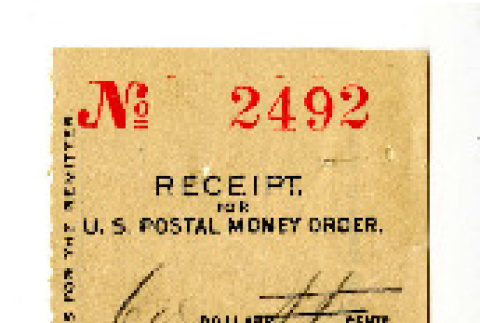
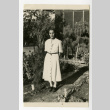
Receipt for U.S. postal money order (ddr-csujad-38-531)
A receipt for U.S. postal money order for 60 dollars. Issued by M.O.B. [Money Order Branch] of Walnut Grove, California. It was probably purchased by Tomosuke Masukawa. It is enclosed in an envelope which is found in item: csudh_nao_0504. See this object in the California State Universities Japanese American Digitization project site: nao_05_01_004
img
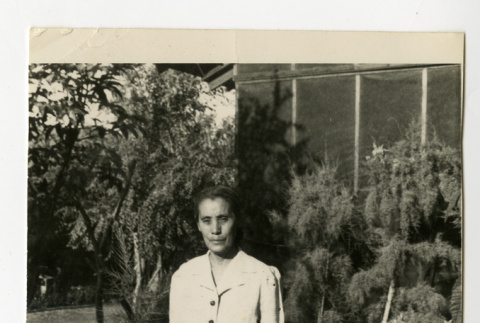
Koyuta Masukawa (ddr-csujad-38-229)
Photographed is Koyuta Masukawa, an incarceree of the Poston camp in Arizona. A photo from: Mitzi Naohara photo album (csudh_nao_0200), page 10. See this object in the California State Universities Japanese American Digitization project site: nao_02_10_002
doc
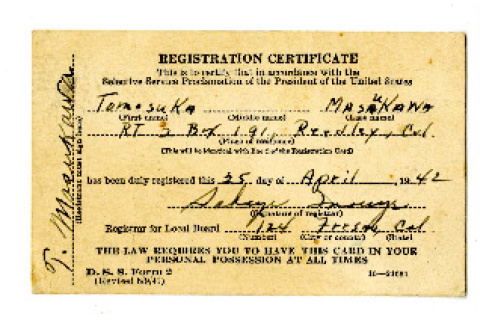
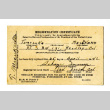
Registration certificate, D.S.S. Form 2, Tomosuke Masukawa (ddr-csujad-38-543)
Registration card, D.S.S. Form 2, for Tomosuke Masukawa including personal descriptive information on the verso. See this object in the California State Universities Japanese American Digitization project site: nao_05_08_002
img
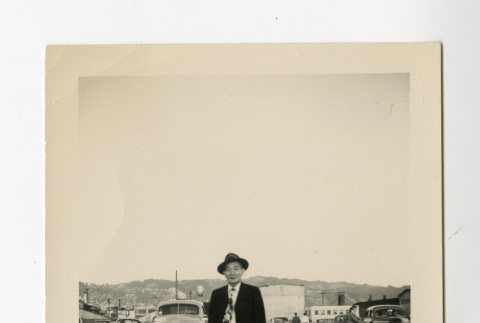
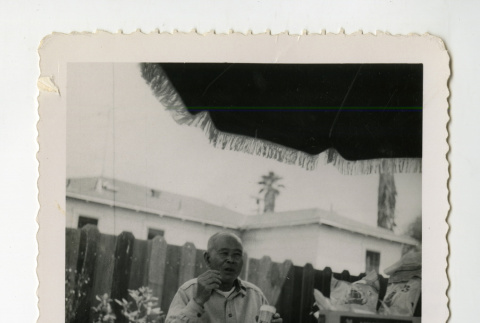
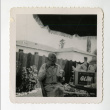
Tomosuke Masukawa (ddr-csujad-38-300)
Photographed is Tomosuke Masukawa. It is taken after he returned from the Poston incarceration camp in Arizona to Los Angeles, California. A photo from: Mitzi Naohara photo album (csudh_nao_0200), page 19. See this object in the California State Universities Japanese American Digitization project site: nao_02_19_001