
5022 items

5022 items
doc
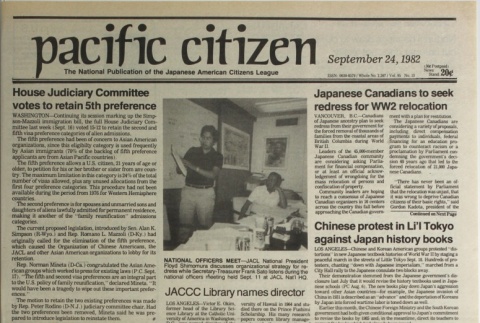
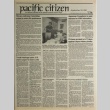
Pacific Citizen, Vol. 95, No. 13 (September 24, 1982) (ddr-pc-54-38)
Selected article titles: "House Judiciary Committee Votes to Retain 5th Preference" (p. 1), "Japanese Canadians to Seek Redress for WW2 Relocation" (pp. 1-2), "Former Nisei Queen Responds to Rift Over 'Mixed Ancestry'" (p. 3), and "Alaskan and Japan Cities Make 'Sister Port' Pact Official" (p. 8).
doc
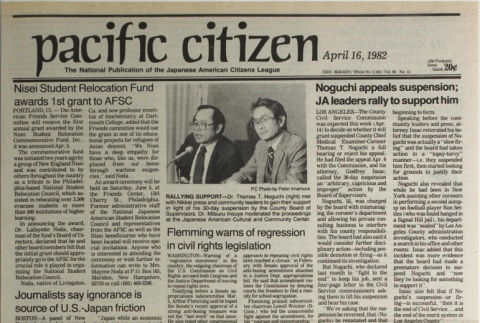
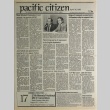
Pacific Citizen, Vol. 94, No. 15 (April 16, 1982) (ddr-pc-54-15)
Selected article titles: "Noguchi Appeals Suspension; JA Leaders Rally to Support Him" (pp. 1, 12), "Journalists Say Ignorance Is Source of U.S.-Japan Friction" (p. 1), "'Coram Nobis' to the the [sic] Supreme Court" (pp. 2, 5), and "Aging and Retirement: The Nisei Experience" (p. 7).
doc
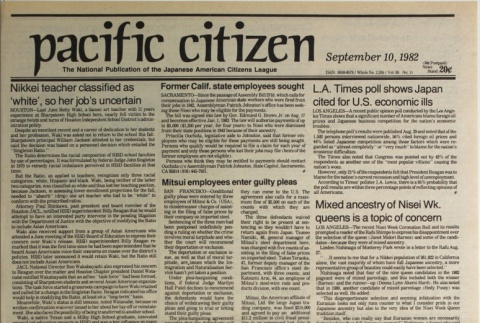
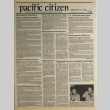
Pacific Citizen, Vol. 95, No. 11 (September 10, 1982) (ddr-pc-54-36)
Selected article titles: "Mixed Ancestry of Nisei Wk. Queens Is a Topic of Concern" (pp. 1, 3, 8), "Seattle JAs Riled by Column Espousing Anti-Japan Ideas" (pp. 1, 6), "Nagasaki Survivor Seeking Last Hope" (p. 1), and "East Wind: Pacific Citizen: A Free Press" (p. 5).
doc
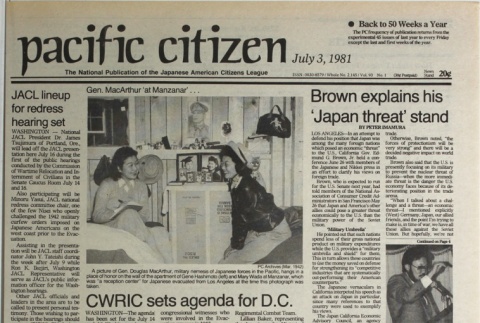
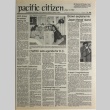
Pacific Citizen, Whole No. 2145, Vol. 93, No. 1 (July 3, 1981) (ddr-pc-53-26)
Selected article titles: "JACL lineup for redress hearing set" (p. 1), "Brown explains his 'Japan threat' stand" (p. 1), "Asian-Pacific Californians organize advocacy group" (p. 1), "At least 10 neighborhoods in L.A. County are 'Asians'" (p. 1), "Public outcry toughens anti-rape law" (p. 8).
doc
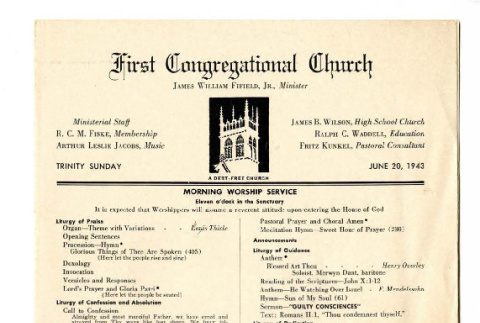
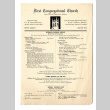
Bulletin of the First Congregational Church, 1943 June 20 (ddr-csujad-20-26)
Bulletin of the First Congregational Church announcing a forthcoming address entitled "When Japan Attacks". See this object in the California State Universities Japanese American Digitization project site: WLM_01-47_01
img
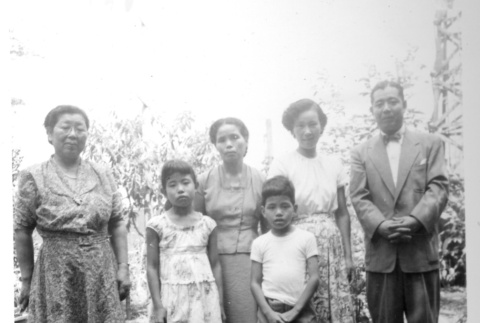
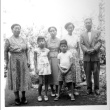
Kamie Taenaka, family reunion (ddr-csujad-25-195)
A group photograph of Kamie Taenaka and her relatives in Japan taken after the war. See this object in the California State Universities Japanese American Digitization project site: jia_08_03_067
img
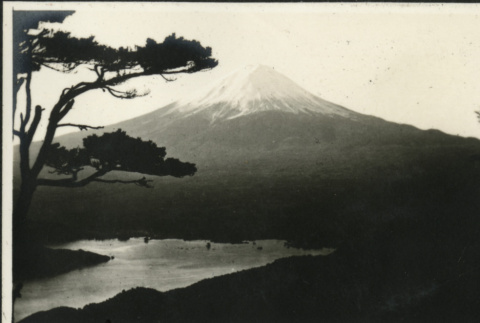
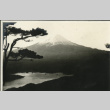
Mt. Fuji (ddr-csujad-11-164)
A photograph of Mt. Fuji in Japan. From page 59 of: Tazu Kawamoto photo album (csudh_taz_0001). See this object in the California State Universities Japanese American Digitization project site: taz_01_59_002
img
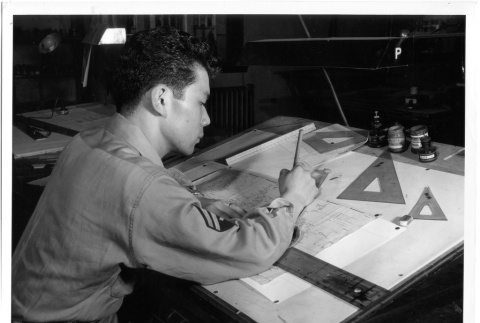
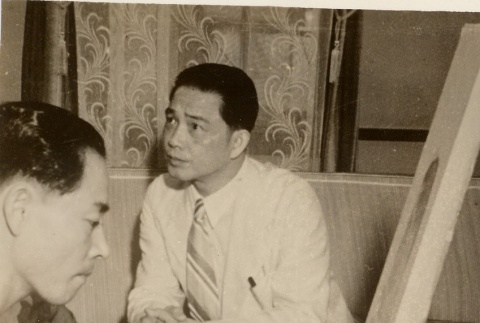
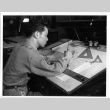
Nisei draftsman preparing maps (ddr-densho-114-157)
Original caption: Tec 5 George Fuyasho of Portland, Oregon, a Nisei Japanese draftsman for the Allied translator and interpreter section, General Headquarters, Allied Forces in the Pacific, prepares sketches and maps necessary for the production of documents, Floor plans and blueprints. Tokyo, Japan. 9-3-46.
doc
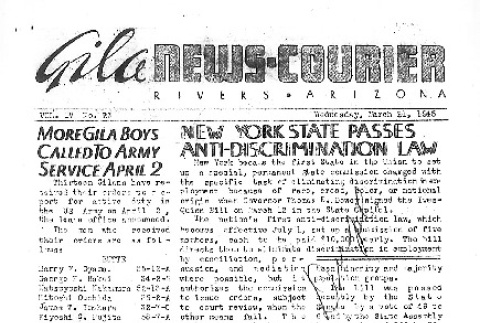
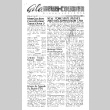
Gila News-Courier Vol. IV No. 23 (March 21, 1945) (ddr-densho-141-381)
Selected article titles: "Spring Frolic Friday Night" (p. 1), "New York State Passes Anti-Discrimination Law" (p. 1), "Red Cross: Poston Holds Japan Messages" (p. 2), "Decision Postponed on Validity of Exclusion" (p. 3), "442nd Medics Highly Esteemed" (p. 5), "WRA Compiles Nisei Casualties" (p. 5).
av
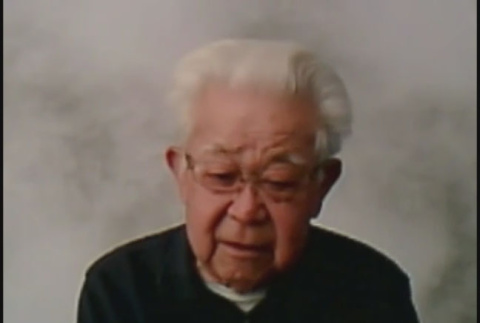
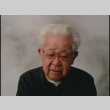
George Fukayama (ddr-ajah-8-1)
George Fukayama was born in Los Angeles, California, on February 21, 1926. During World War II, he served with the Military Intelligence Service and was assigned to ATIS (Allied Translator Interpreter Section) during the occupation of Japan after the war. Moved to Alameda, California, after military service.
img
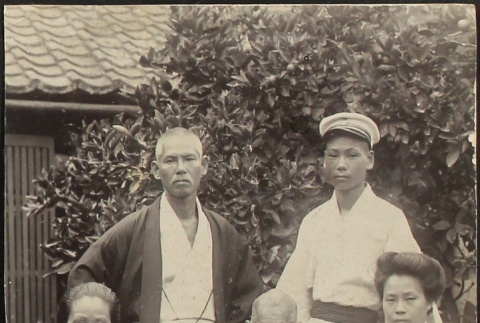
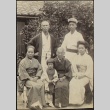
Family portrait in Japanese garden (ddr-densho-259-134)
Caption by Homer Yasui: "Part of the Miyake family in Japan, before [Shidzuyo] left to start teaching school. Pictured are Grandma Hisa Fujii Miyake, Grandpa Ichiro Miyake, Great Grandma Tsuno Sato Miyake, Uncle Saburo and Mom [Shidzuyo]. There's a little girl in this picture, but she's unidentified."
img
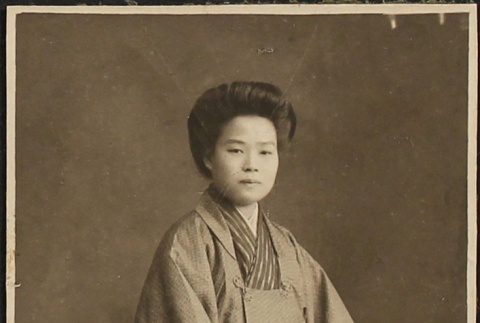
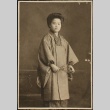
Japanese woman in kapogi (ddr-densho-259-167)
Caption by Homer Yasui: "Solo portrait of [Shidzuyo Yasui] in kimono, holding a budding twig in her right hand, and wearing what looks like a fancy kapogi (sort of a Japanese apron, but much nicer). This surely was taken in Japan before she emigrated to America."
img
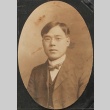
Portrait of an Issei man in Western clothing (ddr-densho-259-57)
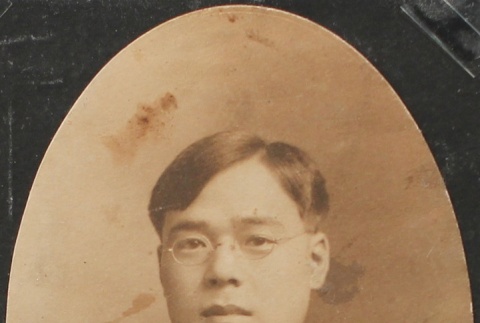
Portrait of Masuo Yasui as a young man wearing Western clothing. Caption by Homer Yasui: "Masuo Yasui came to the United States alone, departing from Yokohama, Japan on the Ryojun Maru, at the age of 16-1/2 years. He arrived in Seattle on June 4, 1903."
img
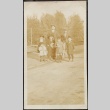
Issei man and children at train station (ddr-densho-259-195)
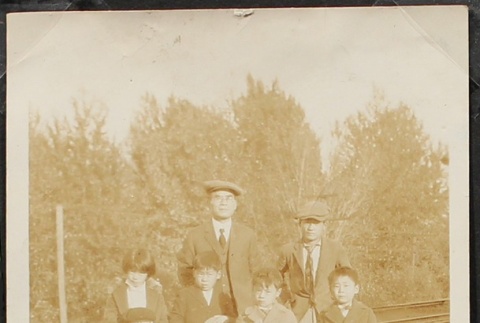
Caption by Homer Yasui: "Min[oru], Michi, Roku, Shu, Homer & Yuka standing with Chan [Renichi Fujimoto] at the Hood River train depot. This was probably taken in the winter of 1929, when Chan went back to Japan to bring Obasan [Matsuyo Fujimoto] home to Hood River."
doc
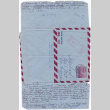
Letter from Tomoye to Henri Takahashi (ddr-densho-424-906)
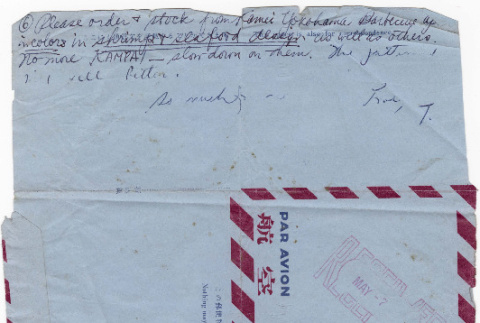
She believes Takahashi is getting a bad reputation in Japan for not communicating with vendors and makers. Insists that Henri follow through with vendors, and if he doesn't start treating them better, she will be too ashamed to face them and won't come on more buying trips.

vh
Yoneko Watanabe Okamoto Interview (ddr-phljacl-1-7)
Nisei female. Born 1918 in Tokyo, Japan. Immigrated to the U.S. with parents at age five, and grew up in Hollywood, California. During World War II, incarcerated at the Pomona assembly center, California, and the Heart Mountain concentration camp, Wyoming. Left camp to resettle in Philadelphia, California.
doc
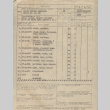
Issue slip (ddr-csujad-55-2254)
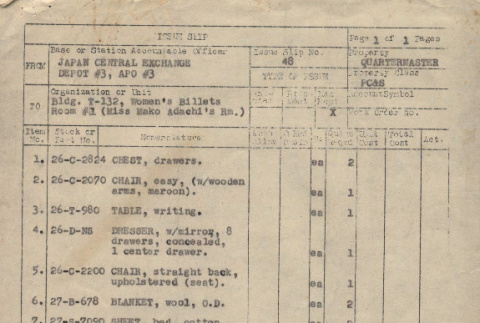
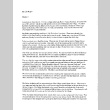
List of items belonging to Masako Adachi being transported from Japan to the United States. See this object in the California State Universities Japanese American Digitization project site: sac_jaac_2357
img
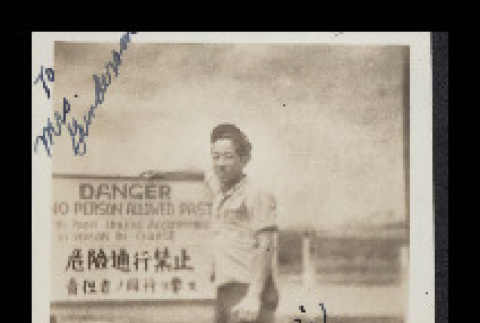
Juji Hada (ddr-csujad-55-250)
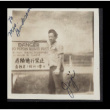
Black and white photograph of Juji Hada standing next sign at Kitagata Racetrack in Japan. See this object in the California State Universities Japanese American Digitization project site: sac_jaac_0252
vh
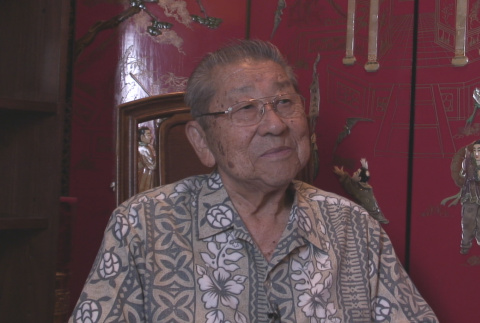
Arthur Nishimoto Interview (ddr-manz-1-129)
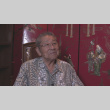
Nisei male. Born August 28, 1923, in Honolulu, Hawaii. After the bombing of Pearl Harbor, volunteered for the army and served in Europe with the 442nd Regimental Combat Team. After discharge, was called back to active duty and served with the U.S. Counterintelligence Corps in Japan.
vh
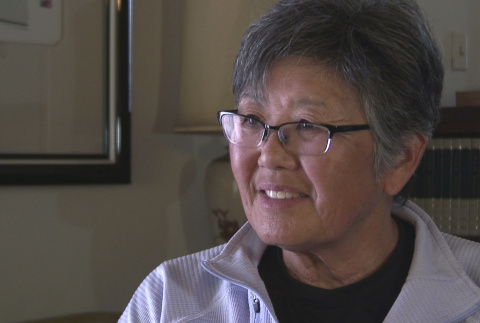
Patricia Mariko Morikawa Sakamoto Interview (ddr-manz-1-167)
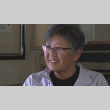
Sansei female. Born April 20, 1944, in Manzanar, California. Parents married in camp, but separated soon after when father returned with his family to Japan. Left Manzanar for the Burbank trailer camp, then moved with mother and stepfather to Los Angeles, California. Active with the Manzanar Committee.
doc
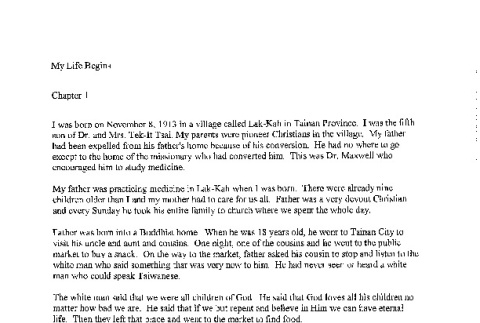
"My Life Begins" (ddr-densho-446-350)
My Life Begins (autobiography): Ai Chih's parents, conversion to Christianity, education in Japan, arrival in US on student visa, U of Chicago, Robert Cashman, Keimer Shou, Japanese Christian Church (Chicago), War, Ordination, Meeting Ryo, Marriage, Navy-Columbia U, War Dept.-D.C., MD, US Strategic Bombing Survey, UNRRA

img
Wang Jingwei having his portrait painted (ddr-njpa-1-1067)
Caption on reverse [translation]: "Wang Drawn. Young Western artist Kanuemon Asai travelled to Nanjing to have Wang Jingwei sit for a portrait to be entered into this fall's Ueno exhibition. Asai then returned to Japan on 15th. Photograph: Wang modelling for Asai. [Stamped] August 16, 1940."
img
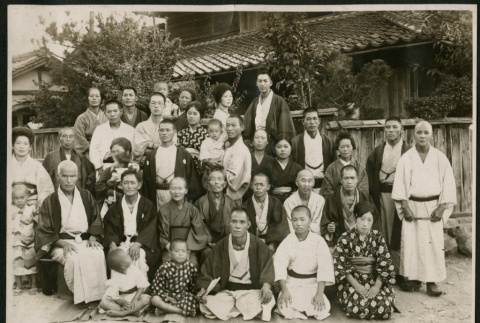
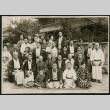
Group photograph (ddr-densho-359-791)
Men, women and children pose in traditional Japanese clothes. Kaichi Kawamoto is seated in 2nd row, second from left, next to his parents, Uta and Buhachi Kawamoto, third and fourth from left. Kaichi went to Japan one last time in 1929 to visit his aging parents.
vh
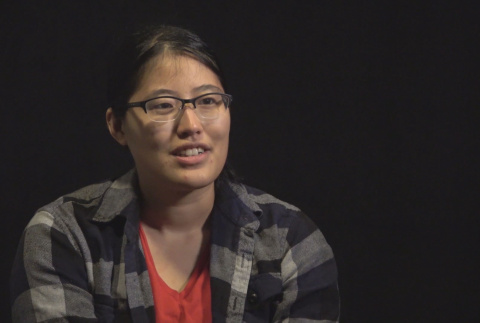
Anne Yuki Watanabe Interview (ddr-chi-1-2)
Yonsei female. Born in 1990 in Champaign, Illinois. Father's family is from Canada and her mother is from Japan. Paternal grandparents were incarcerated in Tashme and Lillooet in Canada. After attending college on the East Coast, moved to Chicago and became active in the Japanese American community.
vh
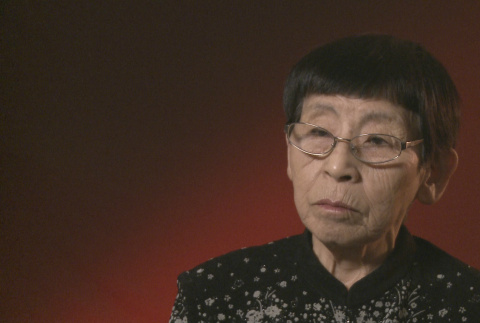
Yoshiko Asakura Interview (ddr-densho-1000-304)
Japanese female. Born November 29, 1930, in Shizuoka, Japan. Attended school during World War II. After the war, entered the nursing profession and became involved in a number of social and political causes. In the 1960s, married a Kibei Nisei and moved to the United States.