
3285 items

3285 items
doc
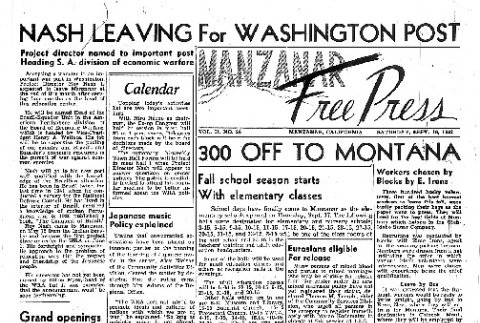
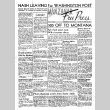
Manzanar Free Press Vol. II No. 26 (September 19, 1942) (ddr-densho-125-66)
Selected article titles: "Nash Leaving for Washington Post. Project Director Named to Important Post Heading S.A. Division of Economic Warfare" (p. 1), "Grand Openings Held by Kitchens" (p. 1), "Manzanar Farm Nets Thousands" (p. 1), "Idaho Furlough" (p. 1), "Japanese Music Policy Explained" (p. 1), "Plant Physicists Arrive from Santa Anita" (p. 1), "300 Off to …
doc
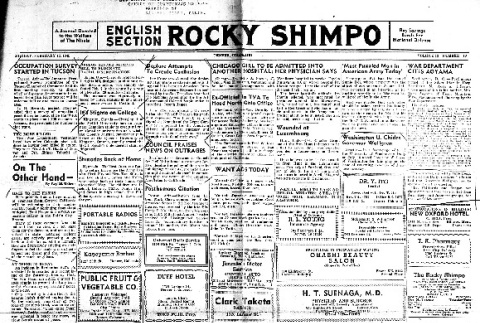
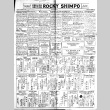
Rocky Shimpo Vol. 12, No. 19 (February 12, 1945) (ddr-densho-148-108)
Selected article titles: "Occupation Survey Started in Tucson"; "Two More Killed"; "On the Other Hand"; "Oregon Senate Defeats Bill to Eliminate Racial Discrimination"; "It's Stigma on College"; "Shinodas Back at Home"; "Deplore Attempts to Create Confusion"; "Council Praises News on Outrages"; "Posthumous Citation"; "Chicago Girl to be Admitted Into Another Hospital; Her Physician Says"; "Ex-Official in …
doc
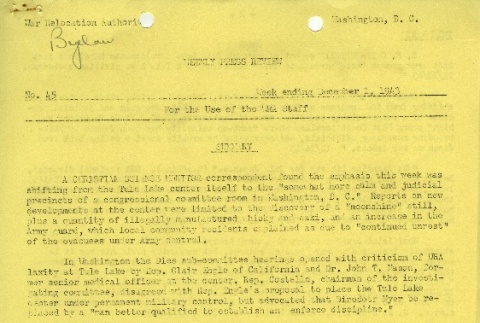
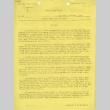
Weekly Press Review No. 45 (ddr-densho-156-358)
Original summary excerpts: A CHRISTIAN SCIENCE MONITOR correspondent found the emphasis this week was shifting from the Tule Lake center itself to the "somewhat more calm and judicial precincts of a congressional committee room in Washington, D.C." Reports on new developments at the center were limited to the discovery of a "moonshine" still, plus a quantity …
doc
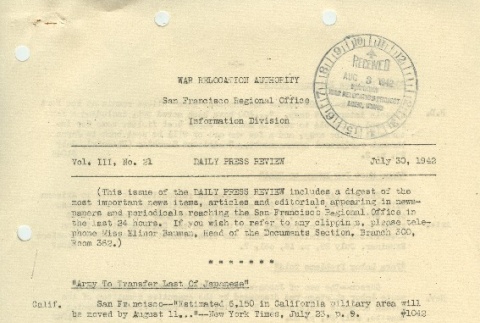
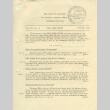
Daily Press Review, Vol. III, No. 21 (ddr-densho-156-222)
Article titles: "Army to Transfer Last of Japanese"; "Yolo County Beet Growers Face Labor Shortage"; "Coast Evacuee Group Arrives"; "Japanese School Plan Discussed"; "Camp Reduces Internee Total"; "Japs Must Pay Extra to Hunt"; "Farm Labor Problems Told"; "Washington Merry-Go-Round"; "Harvest Labor Shortage Seen"; "Jap Labor May be Obtained to East Labor Shortage"; "Church Services Held at …
doc
Petition for Rehearing (ddr-densho-385-1)
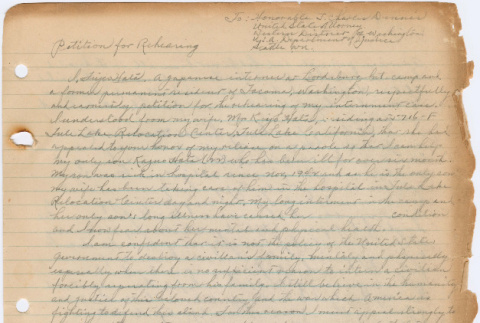
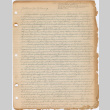
Fujio Hata requests a rehearing from Judge J. Charles Dennis in Seattle, Washington to reconsider his request of parole from Lordsburg U.S. Army Internment Camp so that he could be reunified with his family incarcerated at Tule Lake Concentration Camp. His son was sick and being treated at Tule Lake Hospital. Fujio Morikawa kept a journal …

vh
Sharon Yuen Interview (ddr-densho-1012-18)
Sansei female. Born July 1945 in Seattle, Washington. Daughter of Gordon Hirabayashi.
(This interview is audio-only. It contains raw footage used by Steven Okazaki in his 1985 film Unfinished Business.
This material is based upon work assisted by a grant from the Department of the Interior, National Park Service. Any opinions, finding, and conclusions or …
img
Photograph proofs (ddr-densho-359-485)
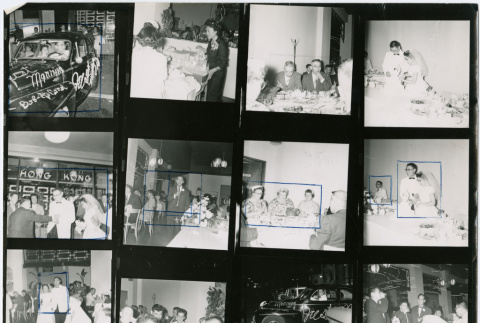
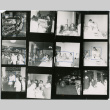
A sheet of photograph proofs from wedding reception for Bob and Carol Okano. 1st photo top left: Bob & Carol Okano; 2nd photo top : Ayako Masuko, standing; 3rd photo top : John Nakata and Joe Kawamoto: 4th photo right: Bob & Carol Okano. Middle row: 1st photo left and 4th photo right: Bob & Carol …
vh
Makoto Otsu Interview (ddr-densho-1000-497)
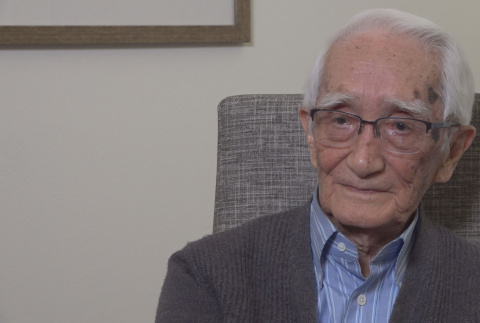
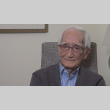
Nisei male. Born March 26, 1926, in Steveston, British Columbia, Canada. Grew up in Steveston, where father fished for a cannery. During World War II, the family was forced to leave Steveston and moved to the abandoned Minto Mine site in the Bridge River Valley of British Columbia. After staying for a few years, Makoto moved …
vh
Emery Brooks Andrews Interview (ddr-densho-1000-155)
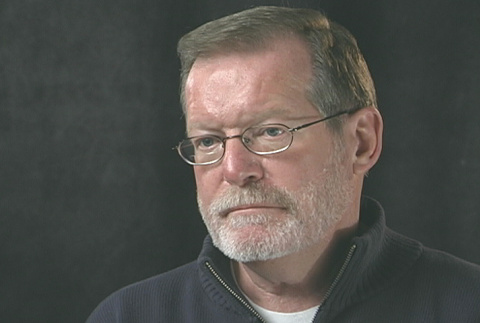
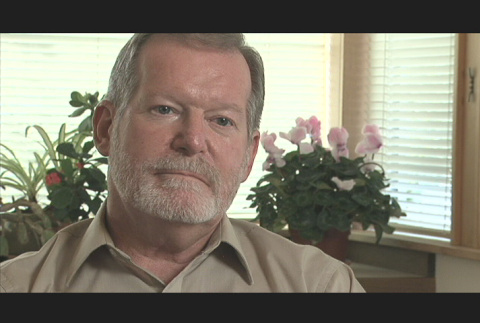
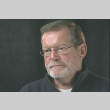
White male. Born November 14, 1937, in Seattle, Washington. Son of Reverend Emery Andrews, the Japanese Baptist Church minister in Seattle for many years. After the Japanese Americans in Seattle were removed to Minidoka concentration camp, Idaho, Emery Brooks moved with family to Twin Falls, Idaho, to minister to Nikkei in camp. Visited Japanese American friends …
vh
Yukiko Katayama Omoto Interview (ddr-densho-1001-38)
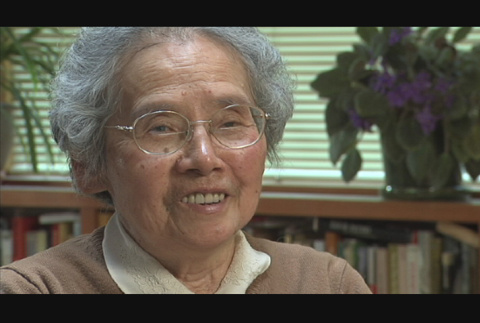
Nisei female. Grew up on Bainbridge Island, Washington. During World War II, removed to the Manzanar concentration camp, California, eventually transferring to the Minidoka concentration camp, Idaho. After leaving camp, returned to Bainbridge Island.
(This material is based upon work assisted by a grant from the Department of the Interior, National Park Service. Any opinions, finding, …
vh
Brooks Andrews Interview (ddr-densho-1001-7)
White male. Born November 14, 1937, in Seattle, Washington. Son of Reverend Emery Andrews, the Japanese Baptist Church minister in Seattle for many years. After the Japanese Americans in Seattle were removed to Minidoka concentration camp, Idaho, Emery Brooks moved with family to Twin Falls, Idaho, to minister to Nikkei in camp. Visited Japanese American friends …
doc
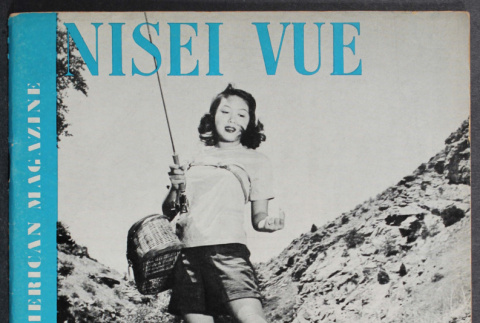
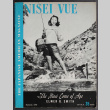
Nisei Vue Vol. 1 No. 2 (Summer, 1948) (ddr-densho-266-2)
Selected article titles: "Fukui Earthquake" (p. 5), "Canada Story" (p. 9), "Kawakita Case" (p. 13), United Veterans of Fresno (p. 16), Vanport Flood (p. 19), Good News from Washington (p. 21), The Unified Nisei Vote (p. 22), The Jacl Queen Contest (p. 23), Lilli Ann Oka (p. 28), Nisei Heroes Buried at Oka (p. 30), Care …
Narrator Frank Yamasaki
Nisei male. Born January 26, 1923, in Seattle, Washington. Spent prewar childhood in South Park and Belltown areas of Seattle. Incarcerated at the Puyallup Assembly Center, Washington and Minidoka concentration camp, Idaho. Refused to participate in draft, imprisoned at McNeil Island Penitentiary, Washington, for resisting the draft. Resettled in Seattle.
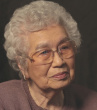
Narrator Dorothy H. Sato
Nisei female. Born May 24, 1923, in Carlisle, Washington. Grew up in Seattle, Washington, where parents ran a hotel. During World War II, removed to the Puyallup Assembly Center, Washington, and the Minidoka concentration camp, Idaho. After leaving camp, lived for a time in Chicago, Illinois, before returning to Oregon.
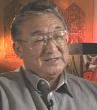
Narrator Frank S. Fujii
Nisei male. Born January 14, 1930, in Seattle, Washington. Grew up in the Jackson Street neighborhood of Seattle, Washington. Incarcerated at Puyallup Assembly Center, Washington, and Tule Lake concentration camp, California. Resettled in Seattle. Former teacher and varsity basketball coach at Seattle's Franklin High School and administrator at Seattle Central Community College.
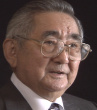
Narrator Jim Akutsu
Nisei male. Born January 25, 1920, in Seattle, Washington. Incarcerated at the Puyallup Assembly Center, Washington, and Minidoka concentration camp, Idaho. Resisted the draft, with the rationale that the U.S. government had classified him 4-C, an enemy alien, and he was therefore under no obligation to serve. Imprisoned at McNeil Island Penitentiary, Washington. Vocal critic of …
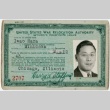
Collection
Mae Hara Collection (ddr-densho-308)
The Mae Hara Collection is comprised of photographs and documents from the personal family collection of Mae Hara, a Japanese American who was interview by Densho in 2004. The photos depict Mae's prewar life in Seattle, Washington. The documents concern her family's Oyster business pre-war, relocation to Minidoka, and post war life.
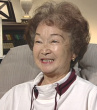
Narrator Edith Watanabe
Nisei female. Born August 29, 1921, in Seattle, Washington. Spent prewar years in Burlington, Washington. Was just starting college when incarcerated at Tule Lake concentration camp, California. Left camp early because of illness and married a Nisei GI, Harvey Watanabe. Lived in Midwest for duration of war and resettled in Seattle, Washington following the war.
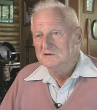
Narrator Earl Hanson
White male. Born June 29, 1923, in Seattle, Washington. Grew up on Bainbridge Island, Washington, with many Japanese American friends. Observed the mass removal of Japanese Americans from Bainbridge Island during World War II. Served with the 1901st Aviation Engineers during the war, and was stationed in Okinawa. Returned to the Bainbridge Island, Washington, area after …
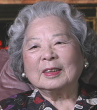
Narrator Peggie Nishimura Bain
Nisei female. Born March 31, 1909, in Vashon Island, Washington. Raised in Vashon Island and Des Moines, Washington, before being removed with her two children to the Pinedale Assembly Center, California. Later transferred to Tule Lake concentration camp, California, and Minidoka, Idaho, before resettling in Chicago, Illinois. Lived and worked in Chicago before eventually returning to …
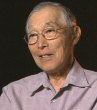
Narrator Tosh Tokunaga
Nisei male. Born January 2, 1925, in Selleck, Washington. Grew up in the Selleck logging camp before moving with family to Seattle, Washington, for high school. During World War II, removed to the Puyallup Assembly Center, Washington, and Minidoka concentration camp, Idaho. Volunteered for the military as a paratrooper, and served in Europe. Eventually returned to …
Narrator Giro Nakagawa
Nisei male. Born March 13, 1921, in Seattle, Washington. Grew up in Kent, Washington, where parents ran a farm. In the 1930s, moved to South Bend, Washington, to work for the New Washington Oyster Company. During World War II, removed to the Pinedale Assembly Center, California, and soon left to work on farms in Utah for …
doc
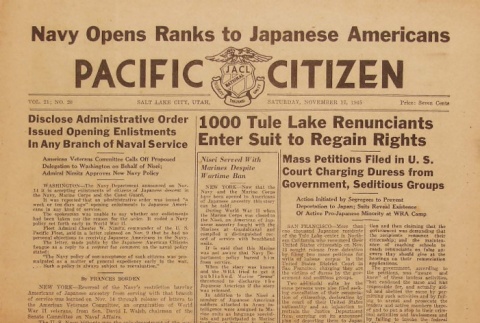
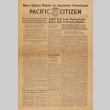
Pacific Citizen Vol. 21 No. 20 (ddr-densho-121-2)
Selected article titles: "Navy Opens Ranks to Japanese Americans" (p. 1), "Sgt. Ben Kuroki to Speak on "Town Meeting of the Air"" (p. 1), "1000 Tule Lake Renunciants Enter Suit to Regain Rights" (p. 1), "Evacuee Group Leaves Seattle for Hawaii" (p. 1), "Native Sons Want Relocation Camps to be Kept Open" (p. 1), "Southern Pacific …
vh
Nobu Suzuki Interview I (ddr-densho-1000-84)
Nisei female. Born November 25, 1909, in Seattle, Washington. Father established one of the largest oyster companies in the United States prior to World War II. Graduated from Garfield High School, the University of Washington, and then the Pacific School of Religion where she earned a master's degree in religious education. At the outbreak of WWII, …
vh
Hideo Hoshide Interview I (ddr-densho-1000-184)
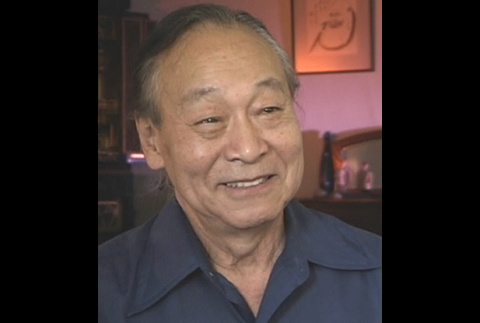
Nisei male. Born September 25, 1917, in Tacoma, Washington. Grew up in Tacoma except for living in Japan for several years at age four. Attended the University of Washington in Seattle, majoring in Political Science, Far Eastern Studies, with a minor in journalism. Prior to World War II, worked as sports editor for community newspaper, The …