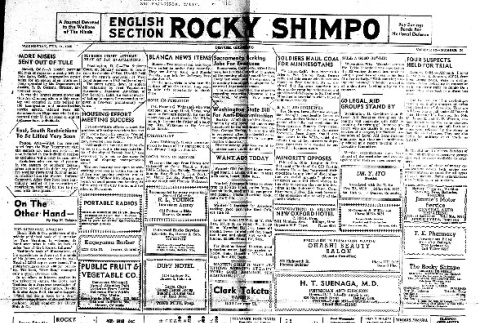
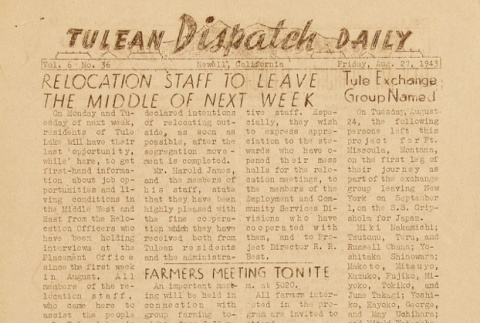
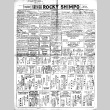
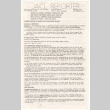
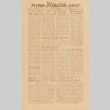
Selected article titles: "More Niseis Sent Out of Tule"; "East, South Restrictions to be Lifted Very Soon"; "On the Other Hand"; "Supreme Court Affirms Okay of Jap Evacuations"; "Housing Effort Meeting Success"; "Blanca News Items"; "Sacramento Seeking Jobs for Evacuees"; "Washington State Bill for Anti-Discrimination"; "Want Ads Today"; "Soldiers Haul Coal for Minnesotans"; "R.F.C. Aid Suggested"; …
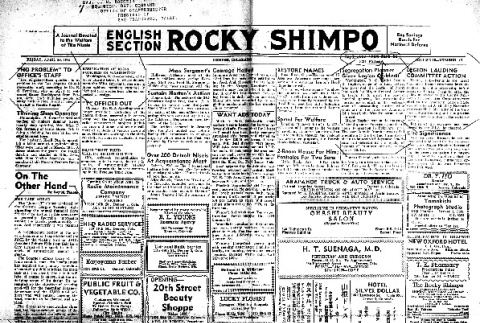
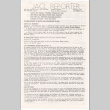
Selected article titles: "'No Problem' to Office's Staff"; "Thriving Shop Operator"; "On the Other Hand"; "Resignation of Ickes Rumored in Washington"; "'Y' Officer Out"; "$16,800 Trust Fund Will be Re-Distributed"; "Mess Sergeant's Courage Hailed"; "Sustain Horton's Action"; "Over 200 Detroit Niseis at Acquaintance Meet"; "Want Ads Today"; "Restore Names"; "Spend for Welfare"; "2-Room House for Him; …
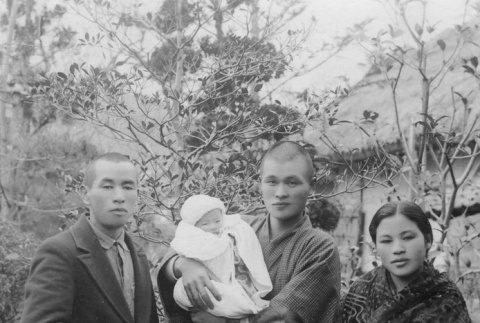
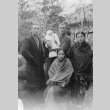
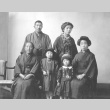
Photo donor's aunt, Masako Nakagawa, pictured with husband Masato, holding their infant daughter Seiko. Also in the photograph are Masako's uncle and aunt, the Yamasakis. Masako was born in Seattle, Washington, but was sent back to Japan at a young age and never returned to the U.S. She died of disease in Hiroshima during World War …
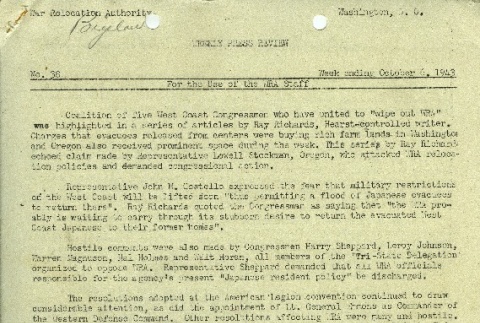
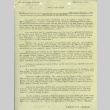
Original summary excerpt: Coalition of five West Coast Congressmen who have united to "wipe out WRA" was highlighted in a series of articles by Ray Richards, Hearst-controlled writer. Charges that evacuees released from centers were buying rich farm lands in Washington and Oregon also recevied prominent space during the week. This series by Ray Richards echoed …
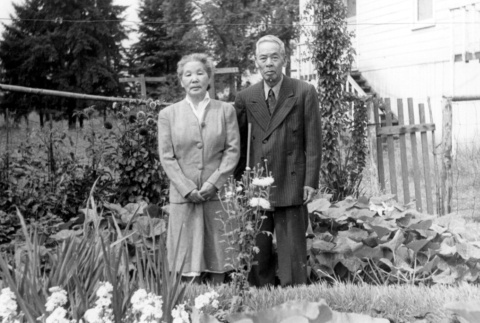
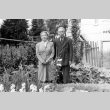
Kadju Nishimura (left) and her husband, Kumataro, in front of their housing project home in Seattle, Washington. Kadju Nishimura (1883-1967) and her husband, Kumataro (1876-1958), lived in a house that was part of the White Center Housing Project in West Seattle. According to their daughter, the project was home for a number of Issei who resettled …
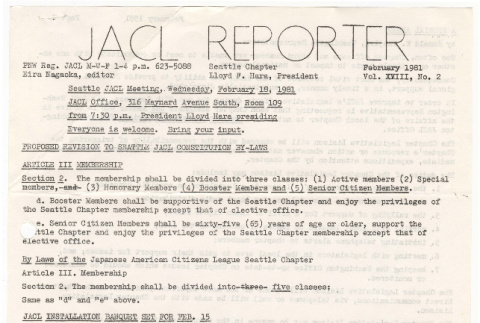
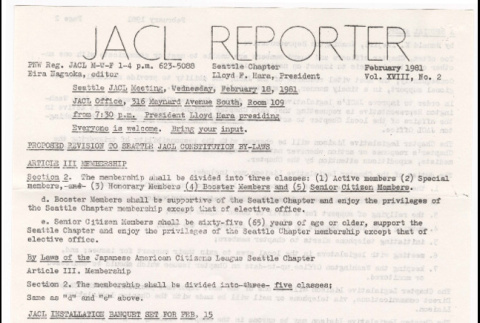
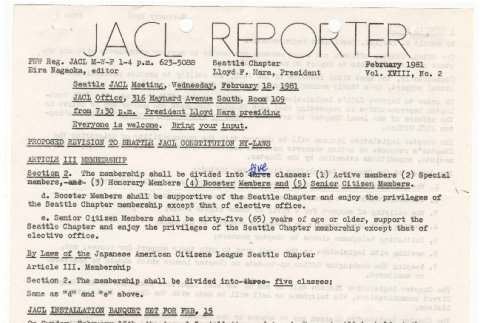
Newsletter covering the following topics: Installation Banquet, February 15, Butcher Restaurant, NW Design Center, $15.00, Keynote- Cong Mike Lowry, Lori Matsukawa MC; fundraiser for Min Masuda Memorial Fund (Died June 1980); summary of article in Seattle Sun on Gordon Hirabayashi; Review of first full length feature film JAs produced by JAs, Hito Hata; Lake Washington JACL …
Newsletter covering the following topics: Installation Banquet, February 15, Butcher Restaurant, NW Design Center, $15.00, Keynote- Cong Mike Lowry, Lori Matsukawa MC; fundraiser for Min Masuda Memorial Fund (Died June 1980); summary of article in Seattle Sun on Gordon Hirabayashi; Review of first full length feature film JAs produced by JAs, Hito Hata; Lake Washington JACL …
Newsletter covering the following topics: Installation Banquet, February 15, Butcher Restaurant, NW Design Center, $15.00, Keynote- Cong Mike Lowry, Lori Matsukawa MC; fundraiser for Min Masuda Memorial Fund (Died June 1980); summary of article in Seattle Sun on Gordon Hirabayashi; Review of first full length feature film JAs produced by JAs, Hito Hata; Lake Washington JACL …
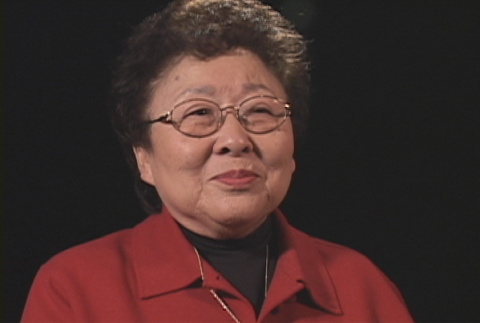
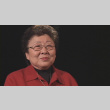
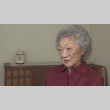
Nisei female. Born in Asher, Washington. Grew up in Vale, Oregon, where parents ran a farm. Remained in Oregon during World War II.
(This material is based upon work assisted by a grant from the Department of the Interior, National Park Service. Any opinions, finding, and conclusions or recommendations expressed in this material are those of …
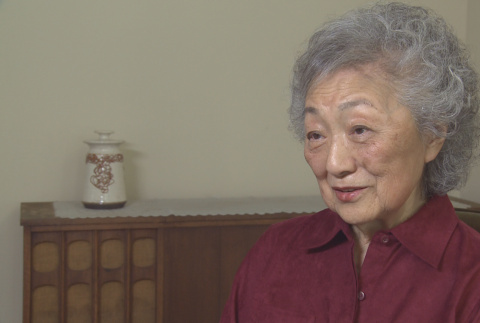
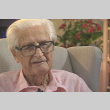
Nisei female. Born March 8, 1925, in Portland, Oregon. Lost mother at an early age and helped to take care of the family. During World War II, removed to the Portland Assembly Center, Oregon, and the Minidoka concentration camp, Idaho. After leaving camp, worked for a War Relocation Authority office helping to return confiscated property to …
This interview was conducted with siblings David R. Boyd and Marietta Boyd Gruner, children of Gene Boyd, who worked for the Seattle Parks Department. Gene Boyd was the athletic director for the Collins Field House, and had a close relationship with members of the Japanese American community in Seattle. Notably, during World War II, Gene Boyd …
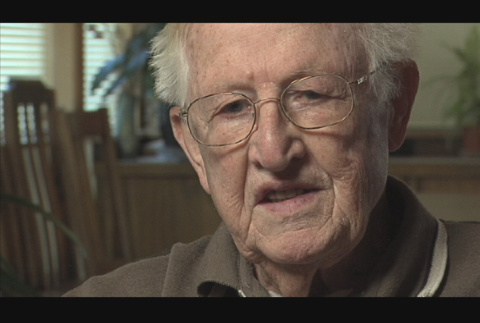
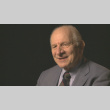
Caucasian male. Born in 1923. Grew up on Bainbridge Island, Washington. Joined the navy during World War II and eventually returned to Bainbridge.
(This material is based upon work assisted by a grant from the Department of the Interior, National Park Service. Any opinions, finding, and conclusions or recommendations expressed in this material are those of …
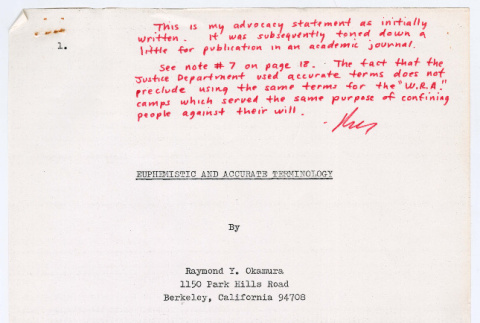
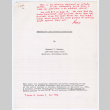
Raymond Y. Okamura's testimony to the Commission on Wartime Relocation and Internment of Civilians in Seattle Washington on September 11, 1981 describing policies and terminology used by the U.S. government to enforce wartime incarceration of Japanese Americans. He compares the American government's misleading terminology to that of Nazi propaganda. It was later published by the Journal …
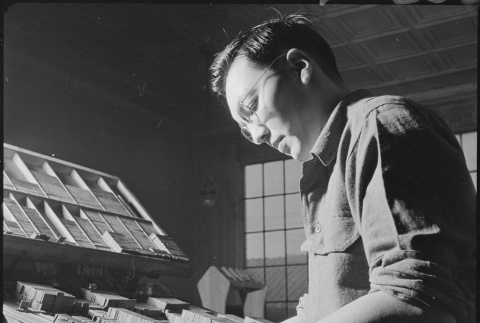
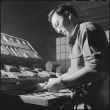
Original WRA caption: Heart Mountain Relocation Center, Heart Mountain Wyoming. In the press room of the Cody Enterprise, Bill Hosokawa, Editor of the Sentinel, Heart Mountain Relocation Center newspaper, sets type for the final makeup of the weekly edition. Bill, a former foreign correspondent and Washington U. graduate, sets type, pulls proofs, operates the linotype, locks …
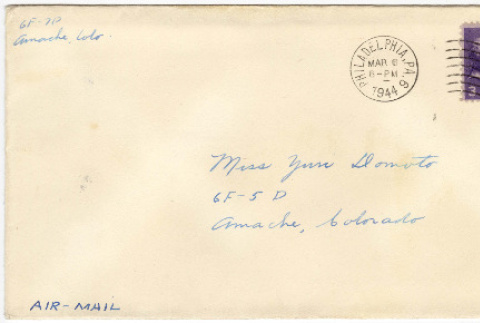
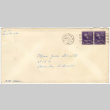
Letter to Yuriko Domoto Tsukada from her future husband Richard "Dick" Tsukada. Dick writes about his journey to Philidelpha, including a stop to see Kaneji Domoto (Yuri's brother) who was staying around Baltimore, together Dick and Kaneji visited Washington D.C. to see sights and have dinner. Dick also details the next steps in his journey to …
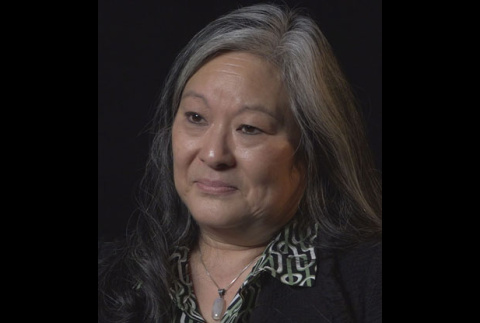
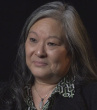
Sansei female. Born 1962 in Spokane, Washington. Father was born in British Columbia, Canada, and mother was born in Thomas, Washington. Grew up in the Tacoma, Washington, area, before eventually moving to Portland, Oregon, and then Seattle, Washington. Graduated from the University of Washington. Became regional director for the Japanese American Citizens League, and then Executive …
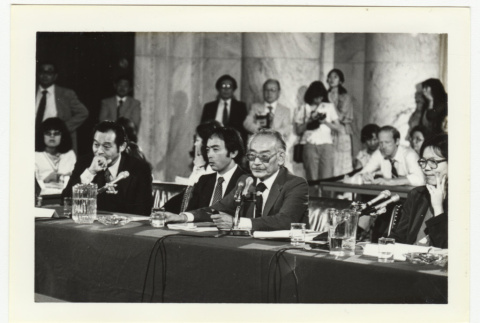
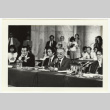
The Paul Bannai Collection consists of a photograph album of documenting the Commission on Wartime Relocation and Internment of Civilians hearings. Images include meetings of the Seattle committee and scenes from the Seattle, Washington D.C., and Los Angeles hearings.
The Kondo collection consists of photographs and documents from the personal family collection of Kara Kondo, who was interviewed by Densho in 2002. Many of the materials depict Kara's life growing up in Wapato, Washington, prior to World War II.
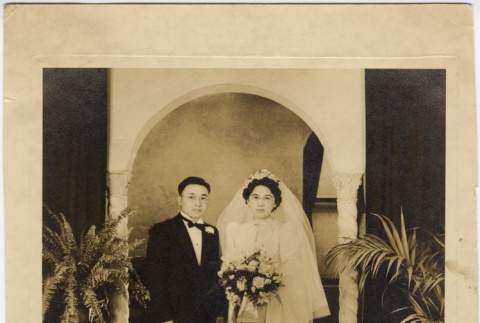
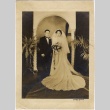
The Ami Kinoshita Collection is comprised of nine photographs from the family's personal collection. These photos, mostly taken in pre-war era, depict Ami Kinoshita's wedding day, honeymoon, and her family in Oregon and Washington. One photo was taken at Minidoka.
Giving aid to Japanese Americans returning to Washington state after the war
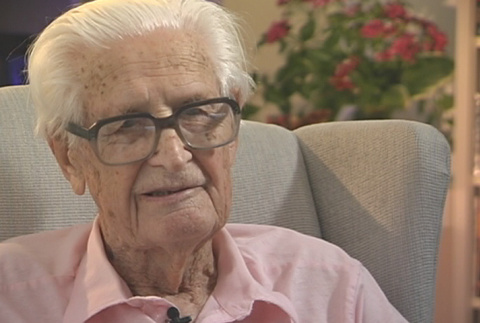
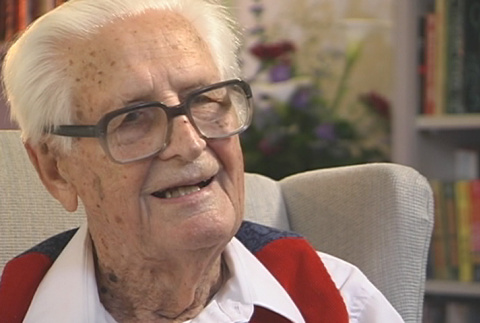
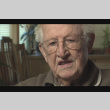
In this interview Mr. Schmoe refers to Aki Kurose, a former employee, fellow Quaker, peace activist, and long-time friend. At the time of this interview, Ms. Kurose had recently passed away after a long struggle with cancer. At the time of this interview, Mr. …
Meeting people of Japanese ancestry at the University of Washington
In this interview Mr. Schmoe refers to Aki Kurose, a former employee, fellow Quaker, peace activist, and long-time friend. At the time of this interview, Ms. Kurose had recently passed away after a long struggle with cancer. At the time of this interview, Mr. Schmoe is …
Nisei male. Born July 24, 1925, in Ketchikan, Alaska. Grew up in Ketchikan, where parents ran a store. During World War II, was removed to the Puyallup Assembly Center, Washington, and the Minidoka incarceration camp, Idaho. After leaving camp, went with family to work for a time in Idaho …
Nisei male. Born July 24, 1925, in Ketchikan, Alaska. Grew up in Ketchikan, where parents ran a store. During World War II, was removed to the Puyallup Assembly Center, Washington, and the Minidoka incarceration camp, Idaho. After leaving camp, went with family to work for a time in Idaho before …
Nisei male. Born July 24, 1925, in Ketchikan, Alaska. Grew up in Ketchikan, where parents ran a store. During World War II, was removed to the Puyallup Assembly Center, Washington, and the Minidoka incarceration camp, Idaho. After leaving camp, went with family to work for a time in Idaho before eventually …