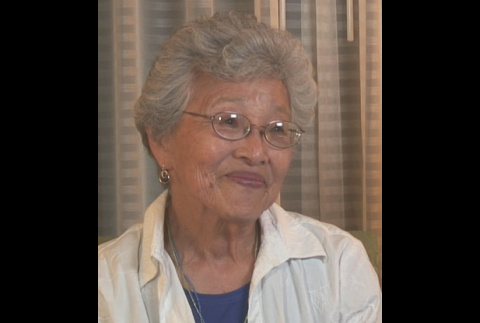
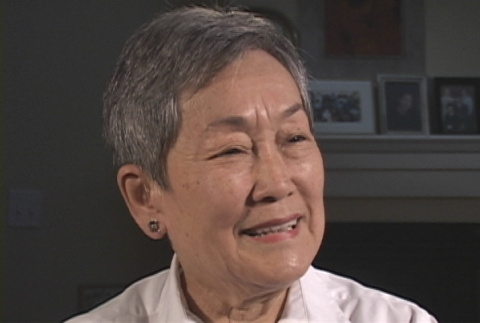
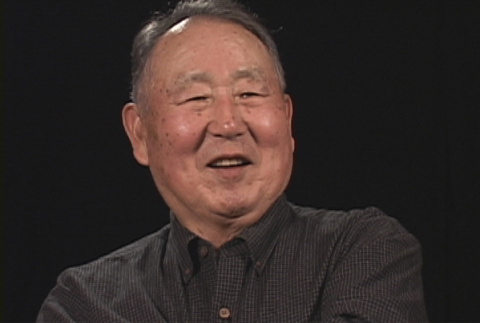
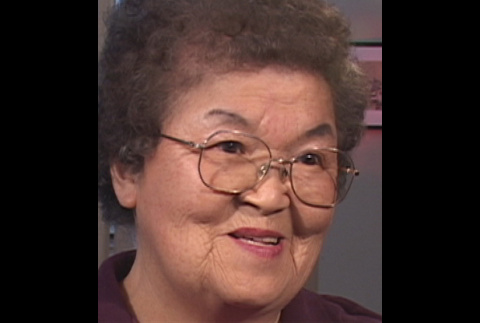
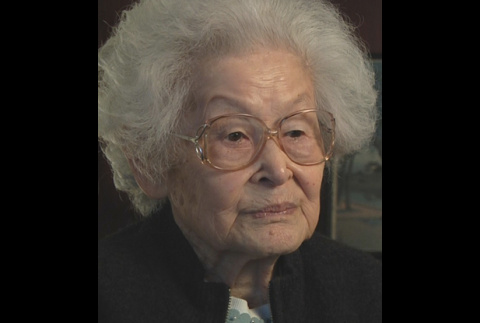
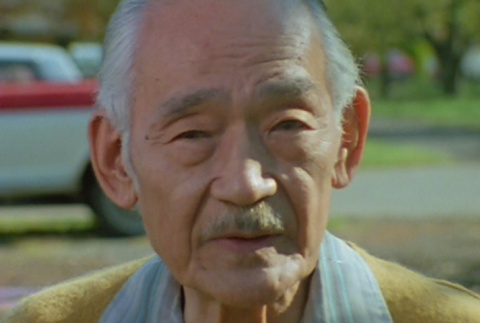
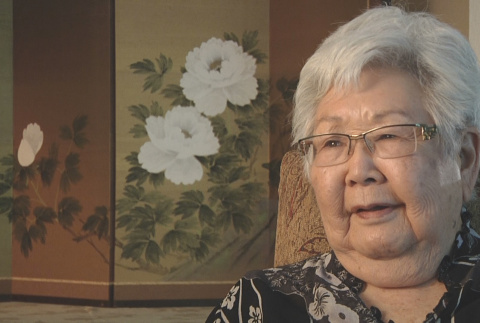
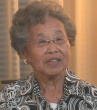
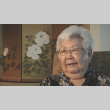
Nisei female. Born March 31, 1927, in Nyssa, Oregon, where parents ran a farm. During World War II, removed to the Portland Assembly Center, Oregon. Instead of going on to a concentration camp, moved with family to a nearby farm labor camp. After the war, eventually returned to Oregon.
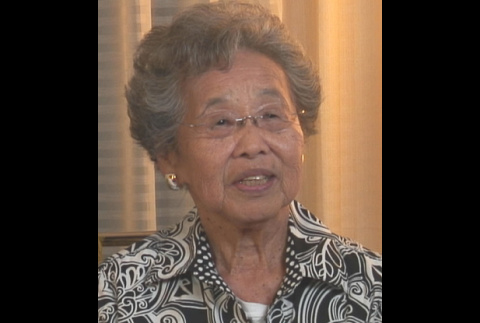
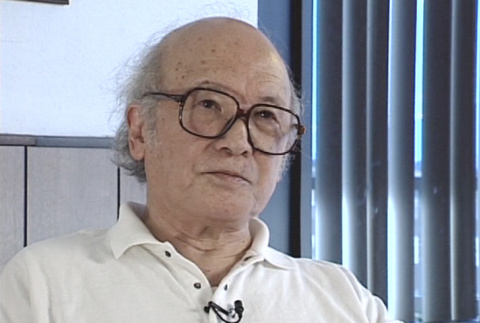
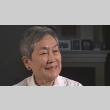
Nisei female. Born May 30, 1924, in Hillsboro, Oregon, where parents ran a farm. During World War II, removed to the Portland Assembly Center, Oregon. Instead of going on to an incarceration camp, moved with family to a nearby farm labor camp. After the war, eventually returned to Oregon.
This material is based upon work assisted by a grant from the Department of the Interior, National Park Service. Any opinions, finding, and conclusions or recommendations expressed in this material are those of the author(s) and do not necessarily reflect the views of the Department of the Interior.
This material is based upon work assisted by a grant from the Department of the Interior, National Park Service. Any opinions, finding, and conclusions or recommendations expressed in this material are those of the author(s) and do not necessarily reflect the views of the Department of the Interior.
This material is based upon work assisted by a grant from the Department of the Interior, National Park Service. Any opinions, finding, and conclusions or recommendations expressed in this material are those of the author(s) and do not necessarily reflect the views of the Department of the Interior.
This interview was conducted at the 1998 Tule Lake Pilgrimage held at Klamath Falls, Oregon and at the site of Tule Lake incarceration camp in California. Given the limited time available during this event, the length and breadth of this interview are shorter than other Densho interviews.
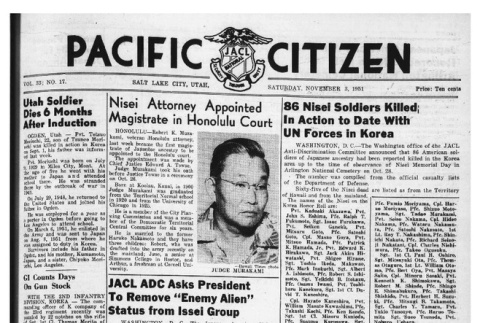
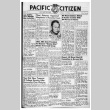
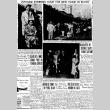
Selected article titles: "86 Nisei Soldiers Killed in Action to Date With UN Forces in Korea" (p. 1), "JACL ADC Asks President to Remove 'Enemy Alien' Status from Issei Group" (p. 1), "Evacuee GIs Will be Eligible For Oregon Bonus Payments" (p. 6).
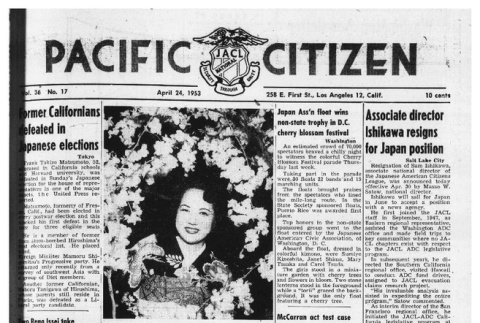
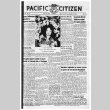
Selected article titles: "Japan Ass'n float wins non-state trophy in D.C. cherry blossom festival" (p. 1), "Introduce legislation to restore crosses on graves of war Dead in Punchbowl" (p. 1), "Oregon state legislature passes civil rights bill, fear referendum" (p. 3).
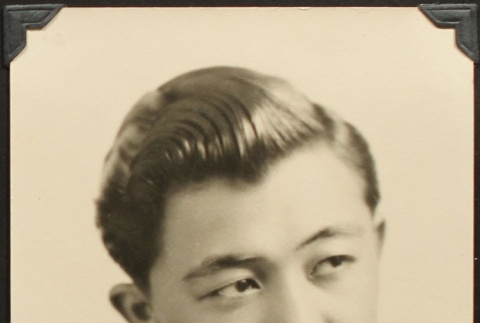
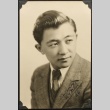
Caption by Homer Yasui: "Portrait of William Ito, the eldest son of Keisuke and Kei Ito, of Portland. William became the first Oregon Nisei to earn an M.D. degree. He established his practice in Honolulu, Hawaii." Signature on photograph: "Sincerely, William Ito."
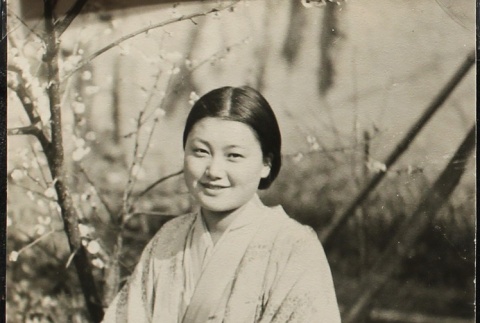
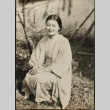
Caption by Homer Yasui: "Midori Miyake taken in Japan in kimono. She is our first cousin, who was born in Hood River, Oregon (actually, Pine Grove, on our family farm), where her father Saburo Miyake, worked the orchard and the berry field."
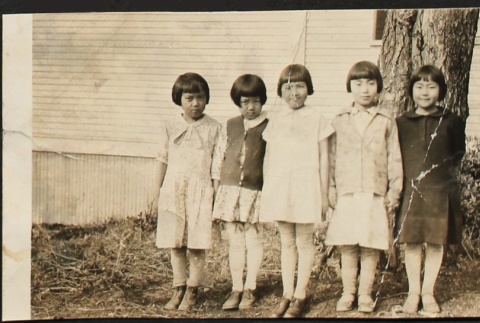
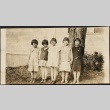
Caption by Homer Yasui: "Five Nisei girls who lived in Dee [Oregon]. This picture was taken on the south side of the old Dee Japanese Community Hall. I can identify Mikie Kageyama and Hannah Kinoshita but I don't recognize the other three."
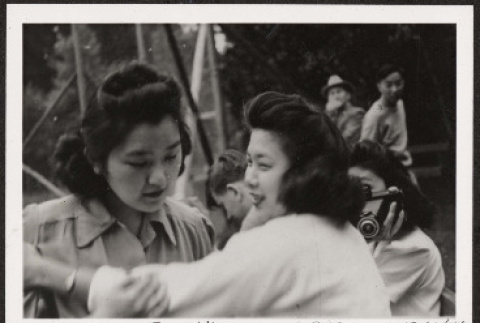
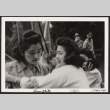
Photograph of two women with a camera in the background. Wirtten along the bottome of the image is "Jean Akita O.S.C 1940-'41" in black ink. Written on the back is "Jean Akita Hayashi Oregon State campus 1940-'41 (?)" in black ink.
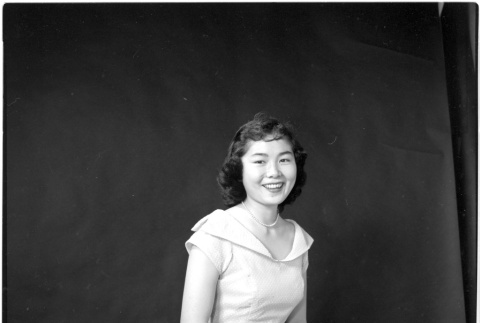
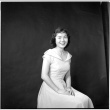
Black and white photographic negative of Misty (Kiyomura) Takeoka sitting in front of a black backdrop inside the Oregon Camera Club's studio. She is wearing a formal dress with her body turned to the right as she smiling brightly at the camera.
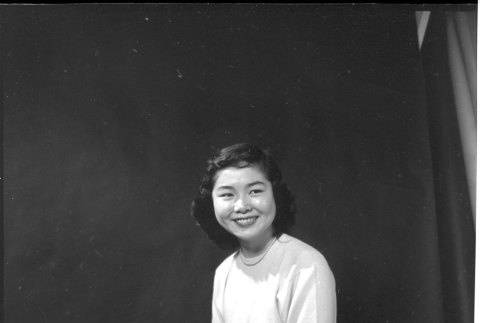
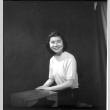
Black and white photographic negative of Misty (Kiyomura) Takeoka sitting in front of a black backdrop inside the Oregon Camera Club's studio. She is dressed in an elbow length sweater, smiling brightly with her hands on the table in front of her.
Nisei female. Born August 3, 1920, in Portland, Oregon. Lost father at an early age, and mother and siblings set up a family farm and greenhouse business. During World War II, removed to the Portland Assembly Center, Oregon, and the Minidoka concentration camp, Idaho. After leaving camp, returned to Oregon.
Nisei female. Born January 4, 1919, in Portland, Oregon. Grew up in Fairview, Oregon, where family ran a farm. Married and had a child before World War II. During the war, removed to the Portland Assembly Center, Oregon, and the Minidoka concentration camp, Idaho. After leaving camp, returned to Fairview.
Nisei female. Born September 19, 1929, in Portland, Oregon. Grew up in Milwaukie, Oregon, where parents ran a farm. During World War II, removed to the Portland Assembly Center, Oregon, and the Minidoka concentration camp, Idaho. After leaving camp, returned to Oregon and parents ran a hotel business in Portland. Went to business school and worked …
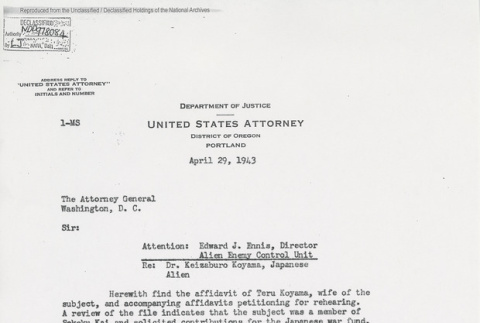
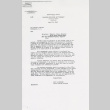
Photocopy of a declassified typed letter from Carl C. Donaugh, United States Attorney for Portland, Oregon, to Edward J. Ennis, Director, Alien Enemy Control Unit about Dr. Keizaburo Koyama, Japanese alien. Donaugh writes that he is attaching an affidavit from Teru Koyama, Dr. Koyama's wife, petitioning for a rehearing. He also mentions several letters and phone …
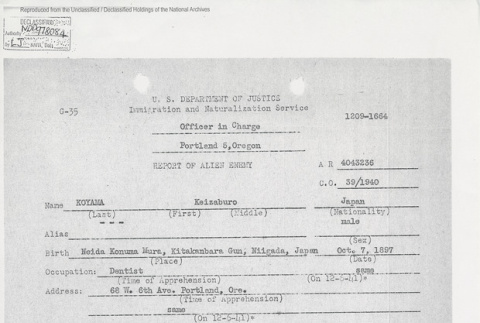
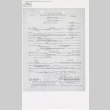
Photocopy of a declassified report on the status of Keizaburo Koyama. Koyama's status has changed from "Parolee" to "Alien enemy proceedings terminated" and he is currently residing at 219 W. Burnside, Portland 9, Oregon. The form lists his occupation as "Dentist" and that he is not deportable.
Letter sent to President Roosevelt and reprinted in the Oregon Journal, arguing that Japanese incarcerees should be forced to work on the sugar beet harvest or be deported to Japan. The detailed rebuttal from Hasegawa, Higawa and Sekiguchi gives exact numbers of available labor, problems with work conditions on the farms, hypocrisy of demanding the removal …
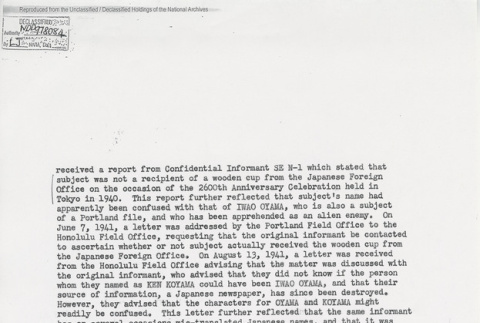
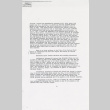
Photocopy of a declassified report on Keizaburo Koyama. This page further elaborates that Confidential Informant SE N-1 has, on several occasions, mis-translated Japanese names. In this case, he mistook the name "Iwao Oyama" for Keizaburo Koyama. The informant said that his original source for the names, a Japanese newspaper, has since been destroyed. The informant went …
Nisei male. Born October 19, 1916, in Hood River, Oregon. Earned a law degree from the University of Oregon law school and was practicing law prior to World War II. In 1942, deliberately defied the curfew imposed upon Japanese Americans in Portland, Oregon, and was arrested. His case was tried, and he was sentenced to one …
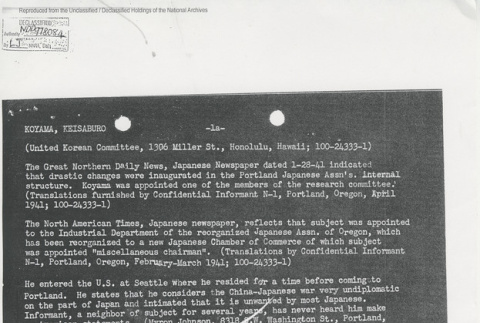
Photocopy of a declassified data card with biographical information on Keisaburo Koyama. The card is labeled "1a" and has a white check mark along the bottom center. Information on the card was acquired from two Japanese newspapers: The Great Northern Daily News and The North American Times. Translations of both articles was provided by Confidential Informant …
Nisei female. Born March 8, 1930, in Brooks, Oregon. Grew up in Brooks, where parents ran a farm. During World War II, removed to the Tule Lake concentration camp, California, and transferred to the Minidoka concentration camp, Idaho. After the war, returned to Oregon and remained in Portland.