
2130 items

![Letter from Naoji Okine to Seiichi Okine, December 13, 1949 [in Japanese] (ddr-csujad-5-266)](https://ddr.densho.org/media/cache/1f/ce/1fce7de10ecc9214cc15e3c4ff4aec58.jpg)
![Letter from Y. Fujii to Mr. and Mrs. S. Okine, May 24, 1947 [in Japanese] (ddr-csujad-5-204)](https://ddr.densho.org/media/cache/3c/1d/3c1d2b19a733cddd81a8bde6cbf46f1b.jpg)

2130 items
img
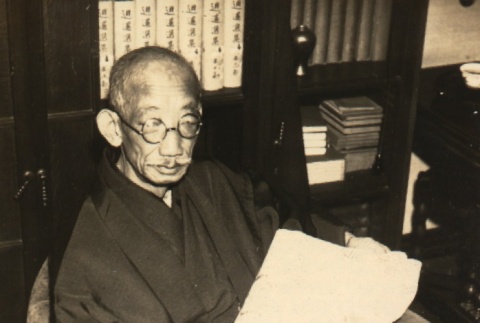
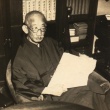
Tatsukichi Minobe announcing his resignation from the Diet (ddr-njpa-4-974)
Caption on reverse [translation]: "Sogo Photo, News No. 1. After today, 'one scholar.' Dr. Minobe's longing feelings. (Tokyo) September 18, 1935. Dr. Minobe, who faced the big contradiction that he was appointed to the honorable position of Diet member for his achievements in the academic world and must now give up the post because of that …
doc
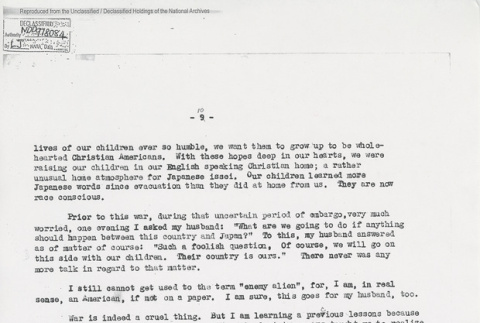
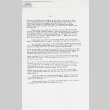
Typed and notarized letter from Teru Koyama to Edward J. Ennis, Director, Enemy Alien Control Unit. Page 10 of 13. (ddr-one-5-237)
Photocopy of a typed letter from Teru Koyama to Edward J. Ennis concerning the rehearing of Keizaburo Koyama's case. Mrs. Koyama notes that it is very unusual for Issei parents to raise their kids in an American-style environment, but she doesn't regret the decision to do so. While she was worried about war between the United …
doc
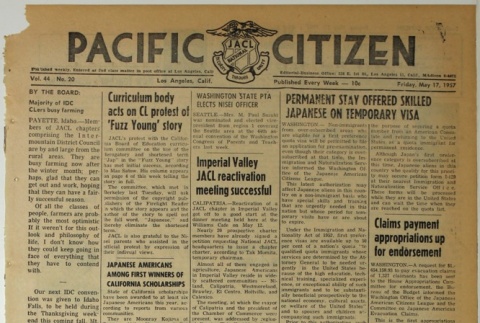
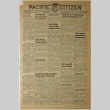
Pacific Citizen, Vol. 44, No. 20 (May 17, 1957) (ddr-pc-29-20)
Select article titles: "Permanment Stay Offered Skilled Japanese on Temporary Visa" (p. 1); "Curriculum body acts on CL protest of 'Fuzz Young' story" (p. 1); "Claims payment appropriations up for endorsment" (p. 1); "Los Angeles-born Nisei successful in transition to life in Detroit circles" (p. 1); "Calif. pension bill passes Assembly" (p. 1); "Japanese Americans Among …
doc
My plans for my future (ddr-csujad-48-19)
Term Paper by Haruye Imahori for period VII Social Problems course, taught by Harry Bentley Wells at Manzanar High School. Haruye would like to be a bookkeeper eventually. She recounts the satisfaction in seeing results during her classes. However, war and subsequent forced evacuation create uncertainty for her. She tells that her parents believe the best …
doc
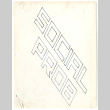
Term paper (ddr-csujad-48-3)
Term paper by Susie Matsuno for period V Social Problems class taught by Mr. Harry Bentley Wells, a teacher at Manzanar High School. Susie's greatest ambition is to be a social welfare worker. She had personal experience with one when her mother was sick and greatly admired the patience and kindness of someone who would put …
doc
Social prob: the future (ddr-csujad-48-18)
Term paper by Toshiro Hara for period 5 Social Problems class taught by Mr. Harry Bentley Wells, a teacher at Manzanar High School. Toshiro discusses his ambition to be a stenographer. With the enforced draft of the armed forces, he believes his best hope is entering and helping to win the war. If Japan wins, he …
![Letter from Naoji Okine to Seiichi Okine, December 13, 1949 [in Japanese] (ddr-csujad-5-266)](https://ddr.densho.org/media/cache/ed/4a/ed4a87c5910ae2256e2916be5e29d93b.jpg)
doc
Letter from Naoji Okine to Seiichi Okine, December 13, 1949 [in Japanese] (ddr-csujad-5-266)
A letter from Naoji Okine in Hiroshima, Japan to his brother, Seiichi Okine. He informs that Seiichi's gifts have been brought by Kenji Okine, including milk, sugar, and soap bars, and appreciates his support. He asks about prices in the U.S. as short supply drives prices high in Japan. He thinks back of his life in …
![Letter from Y. Fujii to Mr. and Mrs. S. Okine, May 24, 1947 [in Japanese] (ddr-csujad-5-204)](https://ddr.densho.org/media/cache/cd/c4/cdc4f84010fb146c7249b19e12783194.jpg)
doc
Letter from Y. Fujii to Mr. and Mrs. S. Okine, May 24, 1947 [in Japanese] (ddr-csujad-5-204)
A letter from Yosokichi Fujii, a former incarceree in the Heart Mountain incarceration camp, Wyoming, to Seiichi and Tomeyo Okine. He gives an update of his life after leaving the camp in September 1945 and resettling in Nyssa, Oregon until May 1946. He currently works in Penryn, California in fruit production following his friends' suggestion. He …
doc
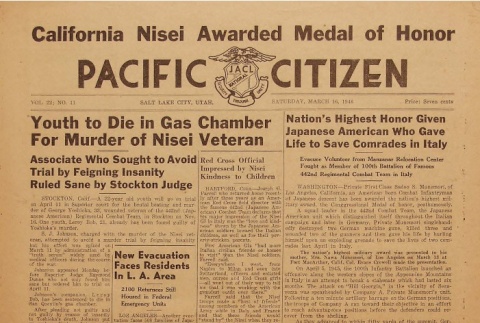
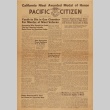
Pacific Citizen Vol. 22 No. 11 (ddr-densho-121-16)
Selected article titles: "California Nisei Awarded Medal of Honor. Nation's Highest Honor Given Japanese American Who Gave Life to Save Comrades in Italy" (p. 1), "Youth to Die in Gas Chamber for Murder of Nisei Veteran" (p. 1), "New Evacuation Faces Residents in L.A. Area" (p. 1), "California Seeks Confiscation of Farm Property" (p. 1), "Tule …
doc
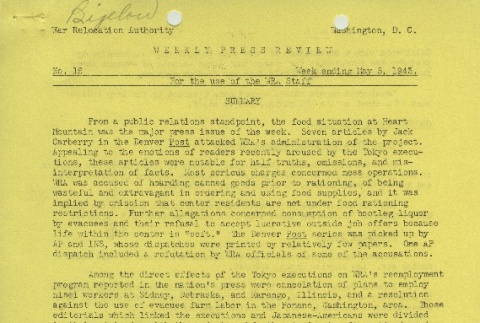
Weekly Press Review No. 16 (ddr-densho-156-328)
Original summary excerpt: From a public relations standpoint, the food situation at Heart Mountain was a major press issue of the week. Seven articles by Jack Carberry in the Denver Post attacked WRA's administration of the project. Appealing to the emotions of readers recently aroused by the Tokyo executions, these articles were notable for half truths, …
vh
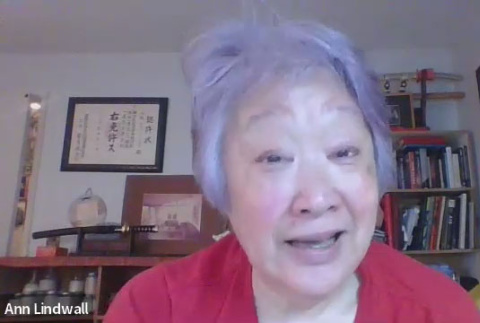
In Memory of Elaine Akagi Interview (ddr-sjacl-2-36)
In this session, Elaine Kim led a panel of Elaine Reiko Akagi's friends (Ann Fujii Lindwall, Arlene Oki, Karen Yoshitomi, and Bill Tashima) in a remembrance conversation on Akagi. Elaine Reiko Akagi devoted her life to JACL, teaching children with special education needs, and a love of animals She was active in the Detroit Jr. JACL …
doc
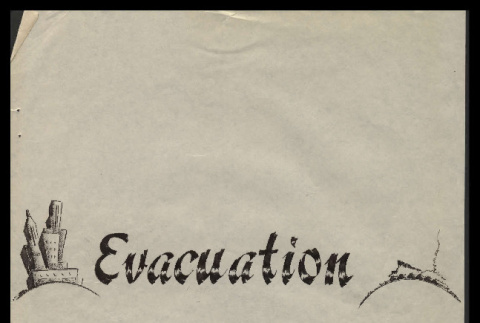
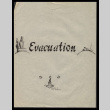
Evacuation (ddr-csujad-55-2528)
Booklet containing an illustrated commentary on forced evacuation and incarceration, newspaper clippings, and an essay, "My viewpoint on evacuation." Clippings include "Capt. Crowley tells of heroism of Nisei soldiers," "Shop workers refuse Nisei on the job," "Pfc. Yamamoto awarded medal for gallantry," "Nisei serving armed forces in Japan," "Private Naito's letter to the VFW," "Two Heart …
vh
Ben Uyeno Interview (ddr-densho-1000-100)
Nisei male. Born November 30, 1918, in Yakima, Washington. Spent two years of childhood in Japan. Returned to Seattle and became an active participant in Japanese American community life. Was attending the University of Washington when World War II started. Avoided incarceration with the help of the Friends (a Quaker organization), which hid him and helped …
vh
Frank Emi Interview (ddr-densho-1002-9)
Nisei male. Born September 23, 1916, in Los Angeles, California. Attended Los Angeles City College for one year before leaving to run the family produce business. Married and had a daughter before being removed to Pomona Assembly Center, California, and Heart Mountain concentration camp, Wyoming. The leader of Heart Mountain's Fair Play Committee, was convicted of …
vh
Frank Miyamoto Interview (ddr-densho-1002-1)
Nisei male. Born July 29, 1912, in Seattle, Washington. Wrote 'Social Solidarity Among the Japanese in Seattle' as a Master's thesis, published in 1939 as one of the first academic works on the Japanese immigrant community. Incarcerated in Tule Lake concentration camp, California. Member of the Evacuation and Resettlement Study which studied the incarceration and resettlement …
vh
Hisaye Yamamoto Interview (ddr-densho-1002-10)
Nisei female. Born August 23, 1921, in Redondo Beach, California. Raised in California before mass removal to Parker Dam Assembly Center, Arizona, which was later converted into Poston concentration camp. An aspiring writer, worked for the camp newspaper, the Poston Chronicle, while incarcerated. After leaving camp, returned to California and worked for the Los Angeles Tribune. …
vh
Mits Koshiyama Interview (ddr-densho-1002-6)
Nisei male. Born August 7, 1924, in Mountain View, California. Grew up in the Santa Clara Valley, California, working on his family's leased strawberry farm. In June of 1942, he was involuntarily "evacuated" to Santa Anita Assembly Center, California, then to Heart Mountain concentration camp, Wyoming. Graduated from high school in camp and at the age …
vh
Aiko Herzig Interview (ddr-densho-1002-8)
Nisei female. Born August 5, 1924, in Sacramento, California. Grew up in Sacramento and Los Angeles. During World War II, removed to the Manzanar concentration camp, California, and transferred to the Jerome concentration camp, Arkansas. Washington representative and researcher for National Council for Japanese American Redress (NCJAR) and primary archival researcher for Commission on Wartime Relocation …
vh
Jim Hirabayashi Interview (ddr-densho-1002-5)
Nisei male. Born October 30, 1926, in small town of Thomas, Washington, on family farm. Attended school in Auburn, Washington, before being removed to the Pinedale Assembly Center and Tule Lake concentration camp, California. Left camp to work in Idaho, and was subsequently joined by family. Postwar, became a social anthropologist, and later became only the …
doc
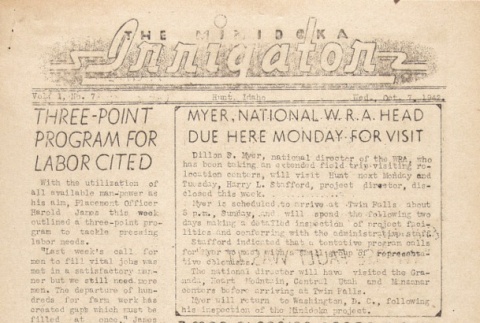
Minidoka Irrigator Vol. I No. 7 (October 7, 1942) (ddr-densho-119-6)
Selected article titles: "Three-Point Program For Labor Cited" (p. 1), "Myer, National W.R.A. Head Due Here Monday for Visit" (p. 1), "7 Man Planning Board Picked Okajima Polls Highest Vote" (p. 1), "Two Voted in Labor Board" (p. 1), "Ten Leave for Domestic Jobs" (p. 1), "Editorial: 'Whose Fault Was It?'" (p. 2), "Family Transfer Forms …
av
Interview with Gary and Grace Itano, part 2 of 6 (ddr-densho-1007-1806)
Grace discusses working with her husband-to-be before the war, her husband asking for a divorce (knowing that he would be imprisoned for refusing to serve), her husband Henry's reasons for refusing to serve, her husband's family preventing him from going to college, trying and failing to live outside of camp in Arizona, evacuation and closing her …
vh
Mits Koshiyama Interview (ddr-densho-122-10)
Nisei male. Born August 7, 1924, in Mountain View, California. Grew up in the Santa Clara Valley, California, working on his family's leased strawberry farm. In June of 1942, he was involuntarily "evacuated" to Santa Anita Assembly Center, California, then to Heart Mountain concentration camp, Wyoming. Graduated from high school in camp and at the age …
vh
Frank Emi Interview II (ddr-densho-122-20)
Nisei male. Born September 23, 1916, in Los Angeles, California. Attended Los Angeles City College for one year before leaving to run the family produce business. Married and had a daughter before being removed to Pomona Assembly Center, California, and Heart Mountain concentration camp, Wyoming. The leader of Heart Mountain's Fair Play Committee, was convicted of …
vh
Frank Emi Interview I (ddr-densho-122-5)
Nisei male. Born September 23, 1916, in Los Angeles, California. Attended Los Angeles City College for one year before leaving to run the family produce business. Married and had a daughter before being removed to Pomona Assembly Center, California, and Heart Mountain concentration camp, Wyoming. The leader of Heart Mountain's Fair Play Committee, was convicted of …
Collection
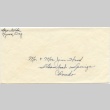
Kenjiro and Miyuki “Kay” Kida Family Collection (ddr-one-3)
This collection consists of personal correspondence, legal documents, photographic prints, news clippings, and other materials related to a Japanese American family from White Salmon, Washington. These historical records trace a journey that included hurdles of federal and state laws, war and incarceration, exile and resettlement. Significantly, the collection includes firsthand accounts of the Portland Assembly Center …