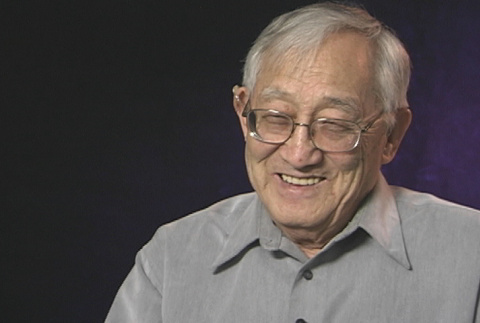
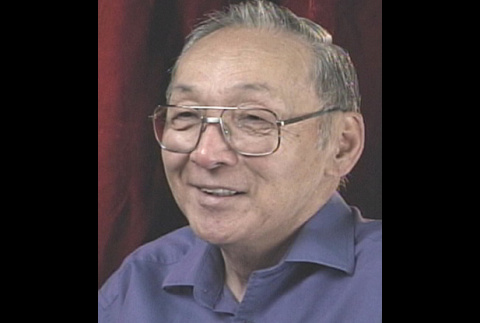
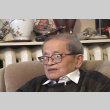
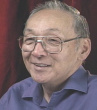
A Sansei and conscientious objector to the Vietnam war discusses alternate service as partner in Amerasia Bookstore, a nonprofit organization serving Los Angeles's Little Tokyo; activities in Young Buddhist Association; parent's reaction to his current life-style; and long term effect of World War II incarceration. This oral history was conducted for the Japanese Oral History Project …
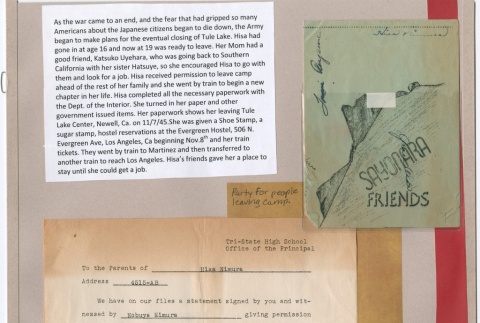
This page of the scrapbook shows documents from two distinct periods of Hisa's wartime life. At the top of the page is an invitation to a Goodbye party thrown at Tule Lake as people began to leave the camp. At the bottom is one of the forms Hisa had to turn into Tri-State High School in …
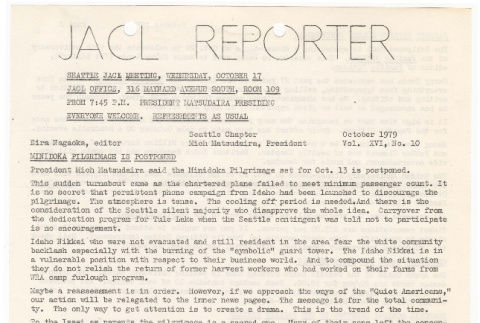
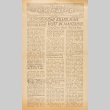
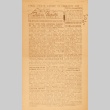
Newsletter covering the following topics: Minidoka Pilgrimage postponed. Not enough reservations to fill a charter plane. Idaho Nikkei who were not evacuated feared white backlash especially the planned building and burning of a watchtower. Good opining of ?quiet American? actions vs respect for Issei for whom a pilgrimage represents a visit to resting place for fallen …
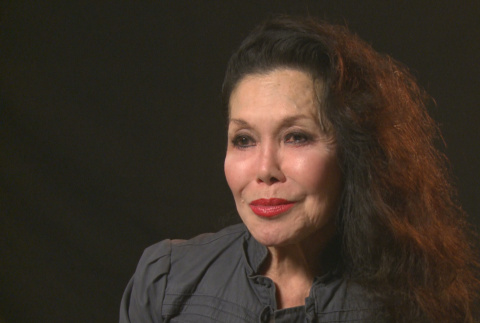
Sansei female. Born February 1941, in Stockton, California. As an infant, she was incarcerated with her family at the Rohwer, Arkansas, concentration camp during World War II. After leaving camp, she grew up in Chicago, Illinois, and Petaluma, California, where she endured an unstable home life and years of abuse. During the 1960s and '70s, she …
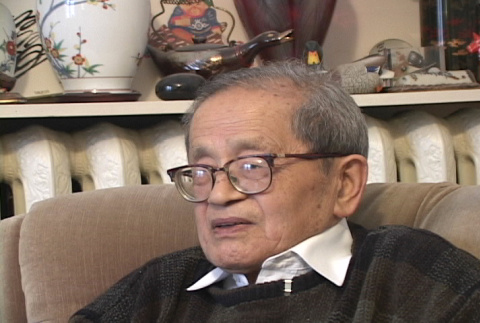
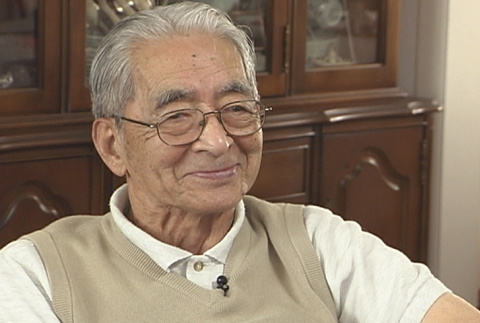
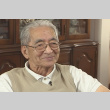
Nisei male. Born August 20, 1924, in Mission, British Columbia, Canada. Grew up in Mission, attending school and helping on family farm. Left home to work several jobs, including in a sawmill and on a sugar beet farm. After World War II, moved to Japan, worked as an interpreter for the British Army, and got married. …
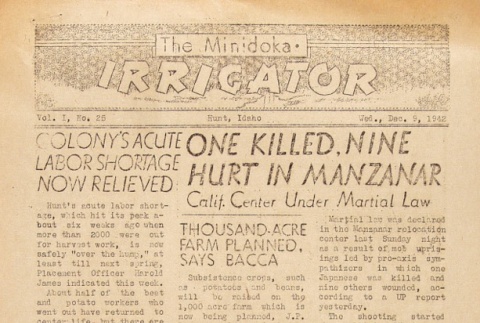
Selected article titles: "Colony's Acute Labor Shortage Now Relieved" (p. 1), "One Killed, Nine Hurt in Manzanar. Calif. Center Under Martial Law" (p. 1), "Long Leaves For 3 More Approved" (p. 1), "Dearer Than Life Itself Is U.S. Citizenship -- Yasui" (p. 2), "Japanese Library Opened. Shelves Contain Over 1000 Volumes" (p. 3), "Postage Now Required …
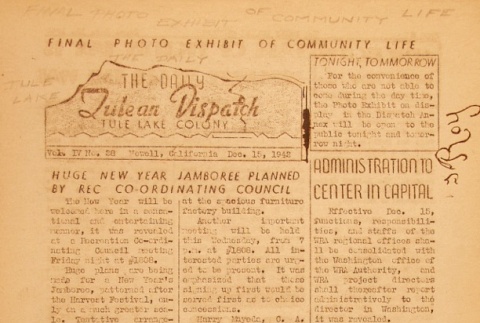
Selected article titles: "Final Photo Exhibit of Community Life" (p. 1), "Huge New Year Jamboree Planned by Rec. Co-ordinating Council" (p. 1), "Manzanar Report by WRA, War Department" (p. 1), "Orchestras to be Cleared at #2508" (p. 1), "Caution Against Bath Room Theft" (p. 1), "Administration to Center in Capital" (p. 1), "'__Develop Faith, Loyalty' Bennett" …
Readjusting to life in the U.S. after living in Japan
This interview was conducted as part of a project to capture stories of the Japanese American community of Spokane, Washington. Densho worked in collaboration with the Northwest Museum of Arts and Culture.
Effect of World War II on personal life; restrictions
This interview was conducted as part of a project to capture stories of the Japanese American community of Spokane, Washington. Densho worked in collaboration with the Northwest Museum of Arts and Culture.
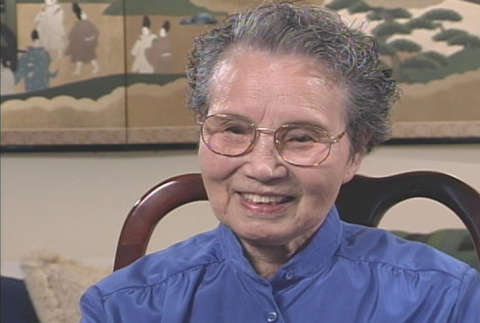
During this interview, Mrs. Kurosu alternately speaks in both English and Japanese. As a result, the English translation of the transcript contains [Jpn.] and [Eng.], which indicate whether the original dialogue was spoken in Japanese or English.
The Fujii and Mori Families Collection consists of 6 photograph albums documenting life in Tacoma and Vashon Island, Washington before World War II, incarceration at Heart Mountain and Jerome concentration camps and relocation to California after the war.
These photographs are from the collection of James G. Lindley, project director of the Granada (Amache) concentration camp. The scans were made from color slides depicting everyday life in Granada, with an emphasis on camp personnel and administrative staff.
The Kondo collection consists of photographs and documents from the personal family collection of Kara Kondo, who was interviewed by Densho in 2002. Many of the materials depict Kara's life growing up in Wapato, Washington, prior to World War II.
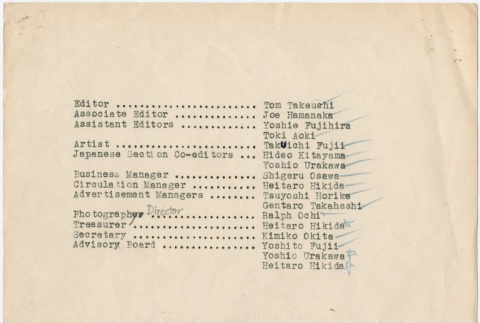
The Hamanaka Family Collection is comprised of documents, newspaper clippings, and ephemera from the life of Joe Hamanaka. Materials include clippings of Joe's writing in Broadway High School's student newspaper, wartime materials, as well as JACL's 17th Biennial National convention materials.
During this interview, Mrs. Kurosu alternately speaks in both English and Japanese. As a result, the English translation of the transcript contains [Jpn.] and [Eng.], which indicate whether the original dialogue was spoken in Japanese or English.
The May Sakuma Collection consists of one composition notebook. Some time after World War II May Okano Sakuma wrote this essay about her experiences in Minidoka concentration camp. Topics include: schools, working at the hospital, social life, the Irrigator, strikes, and camp conditions.
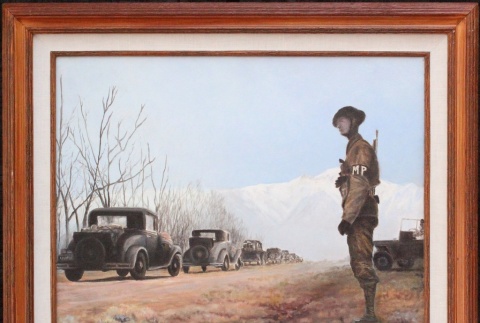
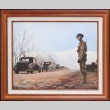
The Harry Hiroshi Imamura Collection consists of 7 paintings by Harry Hiroshi Imamura. These paintings capture the journey to and life in Manzanar concentration camp, California. Mr. Imamura began painting in the 1970s after he sold his truckstop restaurant, the East Valley Cafe.
John Bonomi worked for the Brunswig Drug Company and supplied pharmaceutical materials to Japanese Americans in concentration camps. This collection contains approximately 50 letters from Japanese Americans who requested medicine and household materials, discussed payment methods, shared camp life, and other messages.
Nisei male. Born August 15, 1924, in Portland, Oregon. Incarcerated at the North Portland Assembly Center and Minidoka concentration camp, Idaho. Kept a diary beginning December, 1941, and through incarceration. Beginning as a teenager, was exceptionally active as a volunteer leader, first within a Japanese American church in Portland, later in camp with Federated Christian Church, …
Original WRA caption: "Here is a corner view of the spacious living room in the home of the Kaneko and Isoda families who have resettled in Milwaukee. Mrs. Tei Kaneko is opening her knitting bag while on the floor (left to right) are Robin Isoda, 2-1/2, son of Mr. and Mrs. Georg[e] Isoda, and Wayne Kaneko, …
An oral history with Lillie Y. McCabe, an incarceree at the Santa Anita Temporary Assembly Center and the Granada (Amache) incarceration camp. This interview was conducted for the Japanese American Oral History Project by California State University, Fullerton. The interview covers her childhood in Hollister, California, her family background; moving to Los Angeles, California in 1920 …
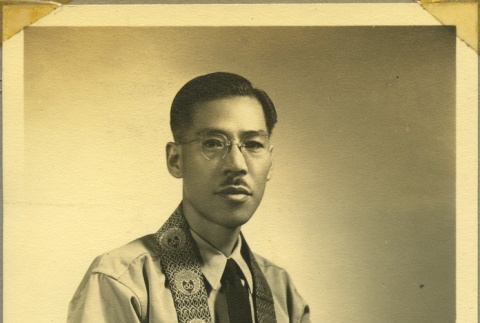
The Shinjo Nagatomi Collection consists of 3 photograph albums and various documents compiled by Reverend Shinjo Nagatomi about his time at Manzanar War Relocation Center. Rev. Nagatomi was the lead Buddhist minister at Manzanar. Topics cover life in camp, family, weddings and celebrations, and Buddhisim.
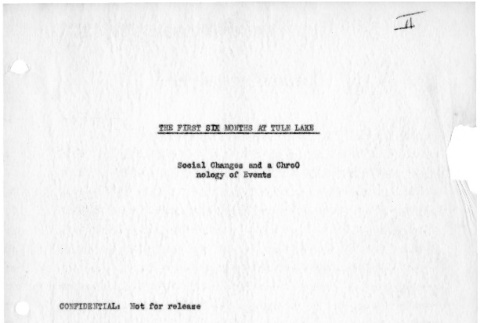
Report chronicling the first six months Tule Lake camp including the establishment of community activities, employment, schools, and barracks infrastructure. Describes challenges of adjusting to life in camp often using direct quotations from incarcerees to express struggles amid social and cultural groups as well as conflicts and strikes. Several events are also described including a description …