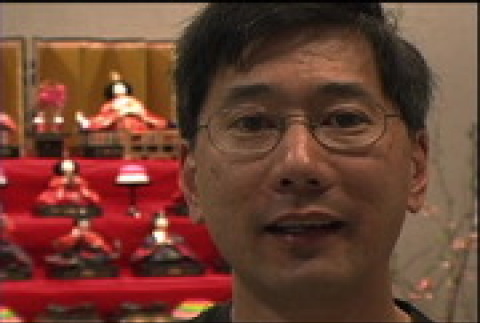
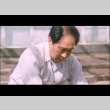
Documentary film by Cynthia Gates Fujikawa consisting of highlights from 2003 Day of Remembrance (DoR) commemorations in New York, San Francisco, Los Angeles, Seattle, and Honolulu, all of which highlight the parallels between what happened to Japanese Americans in 1942 and what was then happening to Arab and Muslim Americans in the aftermath of the 9/11 …
Aura Newlin, a Northwest College faculty member and board member of the Heart Mountain Wyoming Foundation, talks about her family history as a fourth generation Japanese American and a fourth generation Wyomingite, then takes the viewer on a tour of the Heart Mountain Interpretive Center , telling the story of the forced removal and incarceration and …
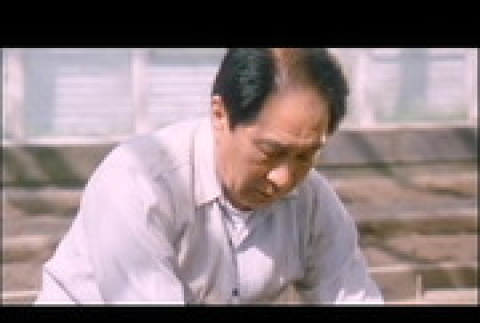
Short narrative film about Japanese Americans struggling to run a flower nursery set in Northern California in 1949. Based on a short story by Toshio Mori , filmmaker Ken Kokka made the film as a film student at UCLA.
As the story begins, Mas, a middle-aged Nisei man who had lost his nursery as a result …
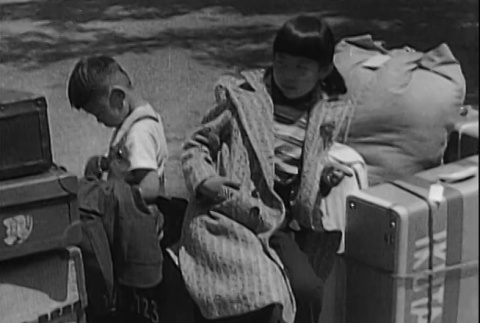
Documentary film that provides an overview of the Japanese American World War II incarceration experience with a focus on the two camps in Arkansas, Jerome and Rohwer. Time of Fear tells its story using archival still and moving images—including home movie footage of Jerome taken by Akira and Yoshio Hayashi—along with recreations and interviews with Japanese …
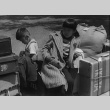
The Tsubota collection consists of photographs from the personal family collection of Minoru "Min" Tsubota, who was interviewed by Densho in 2003. The photographs document Minoru's life growing up in Kent, Washington, through his incarceration at Tule Lake concentration camp, and finally through his military service.
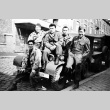
The Ito collection, 1940s, features photographs of WRA camp inmates working on farms in Utah and Montana under the seasonal leave program. Also included are photographs of a family that relocated to Spokane, Washington, after World War II. Densho interviewed collection donor Toshio Ito in 1998.
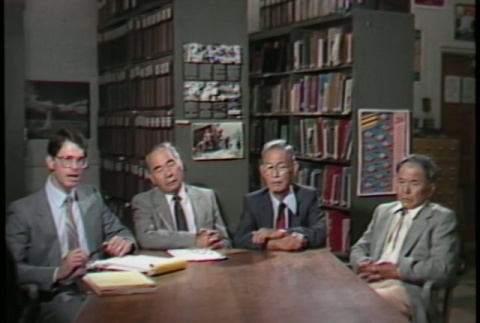
From start of tape until 3:00, footage of Frank Emi and Gary (last name unknown) sparring at the Hollywood Judo Dojo. Interview with (from left to right) Paul Minerich, Tim Nomiyama, Masao Kataoka and Kenjiro Hayakawa starts at 3:08. Nomiyama, Kataoka and Hayakawa were part of the "DB Boys", Nisei soldiers who were court-martialed for disobeying …
Oka is on the left, Yagi in the center, and Ito on the right. Oka discusses his recovery from tuberculosis, entering and winning a cartoon contest, going to art school after recovery, starting to work in advertising, returning to cartooning after retirement, and serving in JICPOA, and working with white officers. Yagi discusses working in the …
Grace discusses working with her husband-to-be before the war, her husband asking for a divorce (knowing that he would be imprisoned for refusing to serve), her husband Henry's reasons for refusing to serve, her husband's family preventing him from going to college, trying and failing to live outside of camp in Arizona, evacuation and closing her …
From left to right: Minerich, Nomiyama, Kataoka, Hayakawa. Kataoka discusses his hopes for the future, his feelings on Abraham Lincoln, and sneaking a letter from Hugh Nozawa to President Roosevelt out of camp. Minerich discusses the hearings that had taken place shortly before this interview at the Pentagon. Nomiyama discusses how he felt after the hearings …
Daniels discusses the early successes of the Japanese army, the political justifications for relocation, why German and Italian Americans were not vilified in the same way, and the lack of support for Japanese Americans politically, culturally, and legally. Includes audio from reaction shots of Daniels and Hori, as well as recordings of Hori asking standalone questions. …
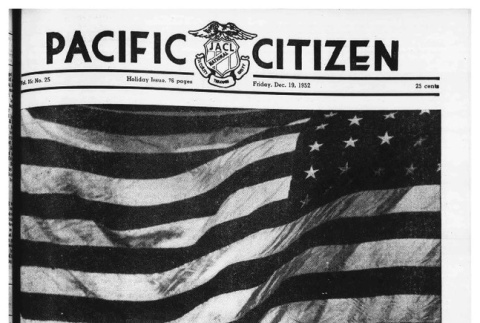
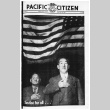
Selected article titles: "The JACL Decade" (p. 2), "The End of Racial Exclusions" (p. 4), "Is the JACL on the Right Track?" (p. 27).
The holiday issue included advertisements bought by JACL members and chapters that included personal addresses and phone numbers to better foster communications between Japanese American communities. These addresses and phone numbers have …
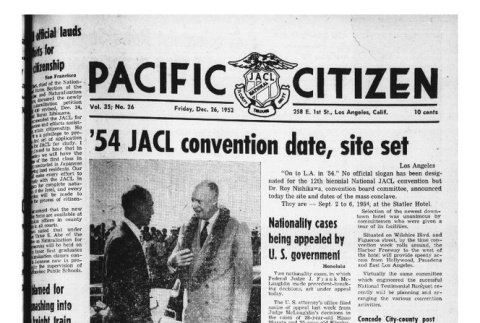
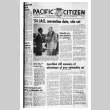
Selected article titles: "Issei-Nisei still unaware of advantages of new nationality act" (p. 1), "'54 JACL convention date, site set" (p. 1).
The this issue included advertisements bought by JACL members and chapters that included personal addresses and phone numbers to better foster communications between Japanese American communities. These addresses and phone numbers have been redacted …
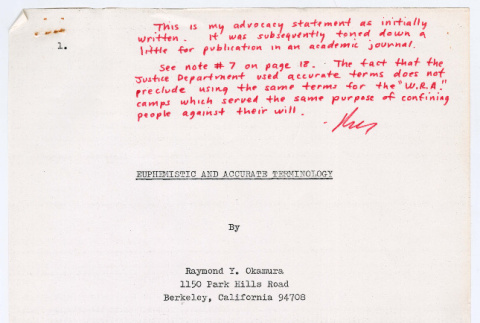
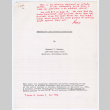
Raymond Y. Okamura's testimony to the Commission on Wartime Relocation and Internment of Civilians in Seattle Washington on September 11, 1981 describing policies and terminology used by the U.S. government to enforce wartime incarceration of Japanese Americans. He compares the American government's misleading terminology to that of Nazi propaganda. It was later published by the Journal …
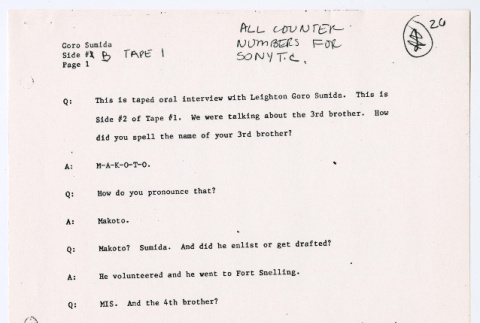
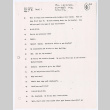
Eric Saul interview with Leighton "Goro" Sumida in Honolulu, Hawaii on November 18, 1980: Tape 1, Side B. In this interview Sumida describes his experiences in the 100th Infantry Battalion as well as his family's wartime experience including his aunt's incarceration at Rohwer incarceration camp. This transcript is a continuation of object ddr-densho-1007-1871 as indicated by …
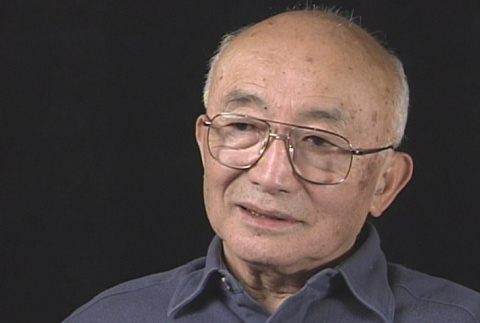
Sumida discusses his family, visiting his family at Rohwer, his impressions of camp, his time in basic training, war stories from Germany, the awards he received after the war, and whether he considers himself lucky. This interview was not conducted specifically for Loni Ding's work, rather for a book the Presidio was putting together. Partial transcript …
Staying in New York City after the war, meeting future wife, and passing civil service exam
William Toshio Yasutake was interviewed together with his sister Mitsuye (Yasutake) Yamada and surviving brother, Joseph Yasutake, in group sessions on October 8-9, 2002. He was interviewed individually on November 14, 2002.
Before being contacted by Densho, the Yasutake siblings …
Deciding to volunteer for the army in hopes that father would be released; feeling conflicted upon being placed in a segregated unit
William Toshio Yasutake was interviewed together with his sister Mitsuye (Yasutake) Yamada and surviving brother, Joseph Yasutake, in group sessions on October 8-9, 2002. He was interviewed individually on November 14, 2002.
Discovering that family home in Seattle had been donated to a museum in Japan, and physically relocated there
William Toshio Yasutake was interviewed together with his sister Mitsuye (Yasutake) Yamada and surviving brother, Joseph Yasutake, in group sessions on October 8-9, 2002. He was interviewed individually on November 14, 2002.
Landing in Europe; setting up headquarters station and aid stations as moved from place to place
William Toshio Yasutake was interviewed together with his sister Mitsuye (Yasutake) Yamada and surviving brother, Joseph Yasutake, in group sessions on October 8-9, 2002. He was interviewed individually on November 14, 2002.
Before being contacted by Densho, the Yasutake siblings …
In retrospect, feeling more positive about the fact that the 442nd Regimental Combat Team was a segregated unit
William Toshio Yasutake was interviewed together with his sister Mitsuye (Yasutake) Yamada and surviving brother, Joseph Yasutake, in group sessions on October 8-9, 2002. He was interviewed individually on November 14, 2002.
Volunteering to move early to Minidoka to help prepare the camp for the other Japanese Americans
William Toshio Yasutake was interviewed together with his sister Mitsuye (Yasutake) Yamada and surviving brother, Joseph Yasutake, in group sessions on October 8-9, 2002. He was interviewed individually on November 14, 2002.
Before being contacted by Densho, the Yasutake siblings …
Arranging a trip out of camp to visit father in Lordsburg, New Mexico before induction into the army
William Toshio Yasutake was interviewed together with his sister Mitsuye (Yasutake) Yamada and surviving brother, Joseph Yasutake, in group sessions on October 8-9, 2002. He was interviewed individually on November 14, 2002.
Reuniting with family in Chicago, Illinois after deciding to attend graduate school at the University of Chicago
Mitsuye Yamada was interviewed together with her two surviving brothers, William Toshio Yasutake and Joseph Yasutake, in group sessions on October 8-9, 2002. She was interviewed individually on October 9-10, 2002.
Before being contacted by Densho, the Yasutake siblings …
Renewed hope after discovering illness was misdiagnosed: "I just decided that I would do something with my life"
Mitsuye Yamada was interviewed together with her two surviving brothers, William Toshio Yasutake and Joseph Yasutake, in group sessions on October 8-9, 2002. She was interviewed individually on October 9-10, 2002.