Mass removal ("evacuation")

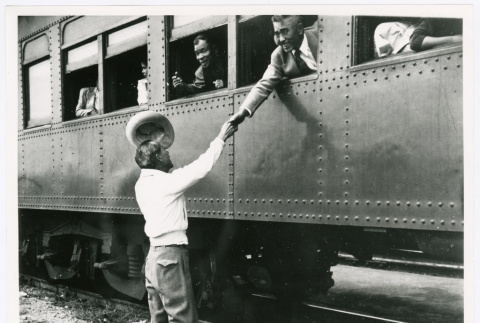
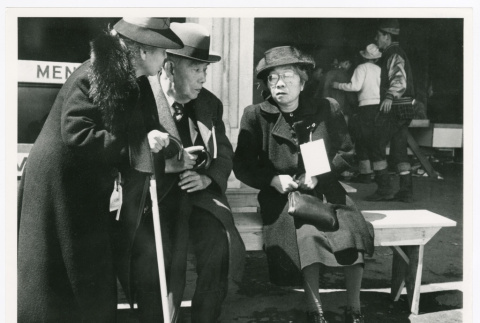
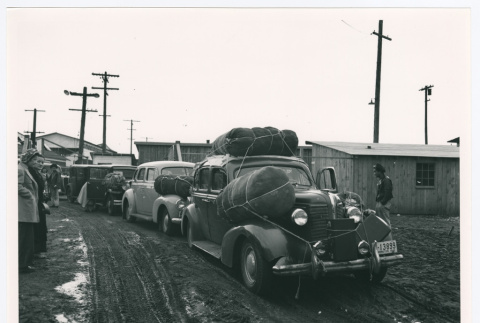
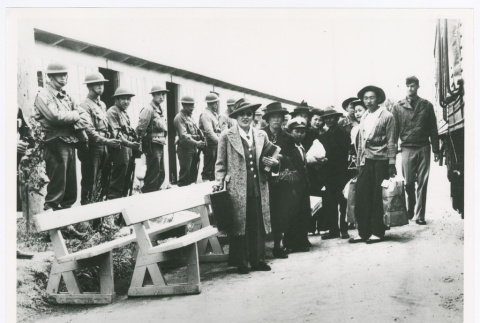
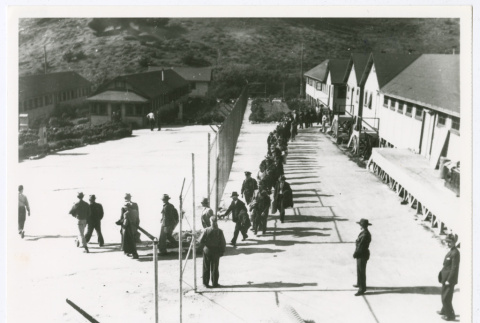
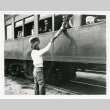
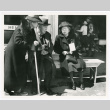
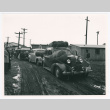
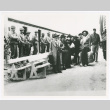
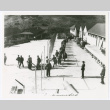
On March 2, 1942, Public Proclamation No. 1 began to appear on telephone poles and buildings. This was the first official notice Japanese Americans had of their immediate removal from the West Coast. The notices stated that they had six or seven days to prepare, and were to take only what they could carry. They were not told where they would be taken. People rushed to sell or store, in one week, property and belongings acquired over a lifetime. Some families tucked their valuables away in their attic or basement and locked the door, hoping to return soon. On the appointed "evacuation" day, thousands of Japanese Americans gathered at designated locations, with the numbered identification tags they had been issued tied to their coats. Watched by curious onlookers, they were met by armed soldiers and transported in buses, private cars, and trains to sixteen temporary "assembly centers" in California, Washington, Oregon and Arizona.

World War II (283)
Mass removal ("evacuation") (746)

Related articles from the Densho Encyclopedia :
Final Report, Japanese Evacuation from the West Coast, 1942 (book)
Facilities
Format
Genre
Usage

Use <Ctrl> or (⌘) keys to select multiple terms

746 items
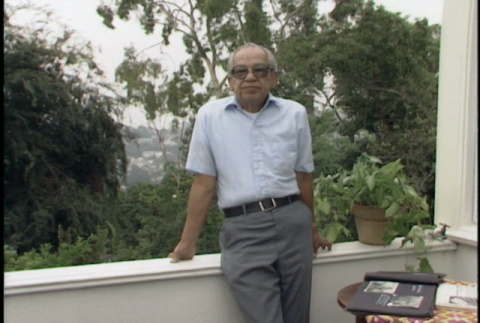
Interview with Harry Fukuhara, part 6 of 6 (ddr-densho-1007-1637)
av Interview with Harry Fukuhara, part 6 of 6 (ddr-densho-1007-1637)
Fukuhara discusses the reasons why some Nisei did not join the military, why he volunteered, his feelings on incarceration, and discrimination he faced in the US. Loni Ding can be heard asking questions behind the camera. Video ends at 20:00. Original title: 123, II SJ #29, 8-17-85, Harry's House SJ
Interview with Gary and Grace Itano, part 2 of 6 (ddr-densho-1007-1806)
av Interview with Gary and Grace Itano, part 2 of 6 (ddr-densho-1007-1806)
Grace discusses working with her husband-to-be before the war, her husband asking for a divorce (knowing that he would be imprisoned for refusing to serve), her husband Henry's reasons for refusing to serve, her husband's family preventing him from going to college, trying and failing to live outside of camp in Arizona, evacuation and closing her …
Interview with Sho Nomura, part 1 of 6 (ddr-densho-1007-1610)
av Interview with Sho Nomura, part 1 of 6 (ddr-densho-1007-1610)
Nomura discusses growing up in California, selling the family business and evacuation, and his thoughts on war with Japan. Video starts at 0:27. Loni Ding can be heard asking questions behind the camera. Original title: 93, II LA #40, 7-25-85, Sho Nomura Interview I. Interview continues at ddr.densho.org/ddr-densho-1007-1611/
70th Anniversary of the Japanese Congregational Church (ddr-densho-474-53)
doc 70th Anniversary of the Japanese Congregational Church (ddr-densho-474-53)
The Japanese Congregational Church's 70th Anniversary book traces the history of JCC within the context of national and local events.
50th Anniversary of the Japanese Congregational Church (ddr-densho-474-52)
doc 50th Anniversary of the Japanese Congregational Church (ddr-densho-474-52)
This book traces the first fifty years of the history of the JCC in Seattle. The first four pages covering the introduction from Rev. Archie H. Hook and the brief overview of the church's history are in English, as are the photo captions throughout the book.The bulk of the text is in Japanese. The JCC members' …
Interview with Yukio Kawamoto, part 7 of 8 (ddr-densho-1007-1551)
av Interview with Yukio Kawamoto, part 7 of 8 (ddr-densho-1007-1551)
Kawamoto discusses the evacuation order, his parents' time in camp, interrogating Japanese soldiers, and an encounter with an American soldier who mistook him for a Japanese national. Video starts at 0:54. Loni Ding can be heard asking questions behind the camera. Original title: 51, II NY #35, 6-85, Kawamoto. Interview continues at ddr.densho.org/ddr-densho-1007-1552/
Interview with John Kaneko, part 3 of 3 (ddr-densho-1007-1761)
av Interview with John Kaneko, part 3 of 3 (ddr-densho-1007-1761)
Kaneko discusses the reasons some Japanese Americans joined the military and his father's decision to bury or burn all their family's Japanese possessions. Audio only. Loni Ding can be heard asking questions. Seems to be the fourth part of the interview started in ddr-densho-1007-1759, but the third portion is missing. Original title: 407, John Kaneko IV, …
Interview with Jacob Herzog, part 6 of 6; b-roll of Herzog (ddr-densho-1007-1544)
av Interview with Jacob Herzog, part 6 of 6; b-roll of Herzog (ddr-densho-1007-1544)
Herzog discusses evacuation, which he did not learn about until after the war. Video starts at 0:54, interview ends at 3:16. Loni Ding can be heard asking questions behind the camera. Rest of tape is b-roll: pictures of Herzog, articles. Original title: 46, II NY #28, 6-85, Herzog
Interview with Kazuko Iijima, part 1 of 4 (ddr-densho-1007-1531)
av Interview with Kazuko Iijima, part 1 of 4 (ddr-densho-1007-1531)
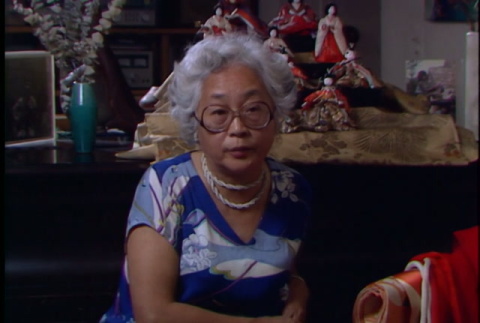
Iijima discusses Hinamatsuri dolls, her childhood in Oakland, the Buddhist church, evacuation, internment at Topaz, and her mother. Video starts at 0:56. Loni Ding can be heard asking questions behind the camera. Original title: 36, II NY #15, 6-85, Kazuko Iijima. Interview continues at ddr.densho.org/ddr-densho-1007-1532/
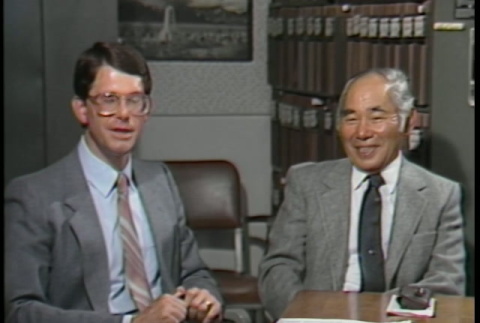
Interview with Paul Minerich, Tim Nomiyama, Masao Kataoka, and Kenjiro Hayakawa, part 8 of 8; interview with Gary and Grace Itano, part 1 of 6 (ddr-densho-1007-1805)
av Interview with Paul Minerich, Tim Nomiyama, Masao Kataoka, and Kenjiro Hayakawa, part 8 of 8; interview with Gary and Grace Itano, part 1 of 6 (ddr-densho-1007-1805)
From left to right: Minerich, Nomiyama, Kataoka, Hayakawa. Kataoka discusses his hopes for the future, his feelings on Abraham Lincoln, and sneaking a letter from Hugh Nozawa to President Roosevelt out of camp. Minerich discusses the hearings that had taken place shortly before this interview at the Pentagon. Nomiyama discusses how he felt after the hearings …
Interview with John Kaneko (ddr-densho-1007-1651)
av Interview with John Kaneko (ddr-densho-1007-1651)
John Kaneko tells the story of his family burying many of their Japanese possessions before evacuation. Loni Ding can be heard asking questions behind the camera. Original title: 136, II SAC #7, 9-7-85, John tells the story
Interview with Yukio Kawamoto, part 2 of 8 (ddr-densho-1007-1546)
av Interview with Yukio Kawamoto, part 2 of 8 (ddr-densho-1007-1546)
Kawamoto discusses working in the army's financial department, the internment of his parents, and joining the MIS. Video starts at 0:53. Loni Ding can be heard asking questions behind the camera. Original title: 48, II NY #30, 6-85, Kawamoto. Interview continues at ddr.densho.org/ddr-densho-1007-1547/
Interview with Manny Goldberg, part 1 of 6 (ddr-densho-1007-1562)
av Interview with Manny Goldberg, part 1 of 6 (ddr-densho-1007-1562)
Goldberg discusses his service on Iwo Jima and Saipan, his work with Nisei, his education at New York University and the University of Michigan, his time at the MISLS, his thoughts on evacuation/internment and the difference in treatment of white and Nisei students at the MISLS. Video starts at 0:36. Loni Ding can be heard asking …
Interview with a woman of the Watsonville Issei Singers, part 1 of 2 (ddr-densho-1007-1660)
av Interview with a woman of the Watsonville Issei Singers, part 1 of 2 (ddr-densho-1007-1660)
An Issei woman (not named) discusses incarceration, the future she imagined for her children, her feelings on her sons joining the military, and her feelings towards the US after the war. An interpreter translates her answers into English. Loni Ding can be heard asking questions in the background. Original title: II MON #12, 9-9-85, #12 Issei …
Interview with Jim Ariyasu, part 2 of 5 (ddr-densho-1007-1597)
av Interview with Jim Ariyasu, part 2 of 5 (ddr-densho-1007-1597)
Ariyasu discusses his deployment, having to sell a camera of his, the secrecy required of him while serving, the censorship of letters he sent back home, and military language school. Video starts at 0:23. Loni Ding can be heard asking questions behind the camera. Original title: II LA #24, 7-24-85, Jim Ariyasu Interview III. Interview continues …
Roger Daniels interviewed by Kent Hori, part 3 of 4 (ddr-densho-1007-1758)
av Roger Daniels interviewed by Kent Hori, part 3 of 4 (ddr-densho-1007-1758)
Daniels discusses what may have happened if the Japanese American community resisted evacuation en masse, how Japanese Americans were placed under 4C (enemy alien, undraftable) status and the military's eventual interest in Japanese Americans (particularly Kibei) for intelligence work, the importance of the 100th Battalion and the 442nd Regimental Combat Team, the loyalty questionnaire, the persecution …
API