
555 items


555 items
av
Interview with Hugh Nozawa, part 2 of 3 (ddr-densho-1007-1714)
Nozawa discusses the mistreatment of the Nisei during Roosevelt's visit to Fort Riley, a complaint he wrote to John J. McCloy afterwards, being punished for writing the letter without permission, the differences between Kibei and US-educated Nisei, growing up in Japan, being drafted while in Santa Monica, and being court martialed. Loni Ding can be heard …

av
Goro Sumida interviewed by Eric Saul, part 1 of 2 (ddr-densho-1007-1765)
Sumida discusses serving in the 100th Battalion, only having Christian priests during the war, his service in Brouay, his family, what a dead body smells like, the impact of wartime casualties, his relationship with his Caucasian officers, Hawaiian terms used during the war, how he wants the 100th to be remembered, Partial transcript available through 6:39 …
av
Interview with Harry Fukuhara, part 3 of 6 (ddr-densho-1007-1634)
Fukuhara discusses his relationship with the Mount family, his time in the Gila internment camp, volunteering for the military from camp, his time in military language school, and the possibility of being captured by the Japanese military. Video ends at 19:49. Original title: 119, II SJ #25, 8-17-85, Fukuhara, Harry's house. Interview continues at ddr.densho.org/ddr-densho-1007-1635/
av
Interview with Clarence Matsumura, part 5 of 5 (ddr-densho-1007-1773)
Matsumura discusses being discharged from the military, moving to Minneapolis, working for Lew Bonn Company, attending the University of Minnesota, being ordered to report for duty in 1949, his difficulty talking about Dachau, his thoughts on war and America's role in international politics, the importance of fighting for what is right, his efforts against discrimination at …
av
Interview with Ray Aka, part 1 of 2; b-roll interior and exterior Dai Ichi building, Japanese constitution (ddr-densho-1007-1726)
Aka discusses coming to the Dai Ichi building to do interpretation work. Interview ends at 4:01. Rest of tape is b-roll: interior of Dai Ichi building, draft of Japanese constitution, Aka outside Dai Ichi building. Video starts at 0:25. Loni Ding can be heard asking questions behind the camera. Original title: 233, II JA #65, Daiichi …
av
Interview with Yukio Kawamoto, part 7 of 8 (ddr-densho-1007-1551)
Kawamoto discusses the evacuation order, his parents' time in camp, interrogating Japanese soldiers, and an encounter with an American soldier who mistook him for a Japanese national. Video starts at 0:54. Loni Ding can be heard asking questions behind the camera. Original title: 51, II NY #35, 6-85, Kawamoto. Interview continues at ddr.densho.org/ddr-densho-1007-1552/
av
Interview with Shiro Tokuno, part 1 of 4 (ddr-densho-1007-1781)
Tokuno discusses his time in occupied Japan, giving out sandwiches on Christmas, a commanding officer of his during occupation who wanted all shops removed from Ginza and the difficulty some officers had understanding cultural and economic issues. Loni Ding can be heard asking questions behind the camera. Original title: II SAC #1, 9-6-85, Shiro T.. Interview …
av
Interview with Yukio Kawamoto, part 3 of 8 (ddr-densho-1007-1547)
Kawamoto discusses serving in the MIS while his parents were interned, draft resistance, and his attitude toward the US during the war. Video starts at 0:56. Loni Ding can be heard asking questions behind the camera. Original title: 99, II NY #31, Channel #1 Audio Kawamoto. Interview continues at ddr.densho.org/ddr-densho-1007-1548/
av
Interview with Kazuko Iijima, part 3 of 4 (ddr-densho-1007-1533)
Iijima discusses the 442nd, mentions volunteers from Topaz and Fred Korematsu. Also discusses her husband, who she married in camp and who later joined the 442nd. Video starts at 0:56. Loni Ding can be heard asking questions behind the camera. Original title: 38, II NY #17, 6-85, Kazuko Iijima. Interview continues at ddr.densho.org/ddr-densho-1007-1534/
av
Interview with Yoshio Miwa, part 4 of 4 (ddr-densho-1007-1670)
Miwa discusses Japanese impressions of Nisei soldiers and the relationships between Nisei families and Japanese families after the war. Interview conducted mostly in Japanese with the aid of an interpreter. Loni Ding can be heard asking questions behind the camera. Original title: 191, II JA #4, Yoshio Miwa, Fri. Jan. 31, 1986

av
Interview with John Kaneko, part 3 of 3 (ddr-densho-1007-1761)
Kaneko discusses the reasons some Japanese Americans joined the military and his father's decision to bury or burn all their family's Japanese possessions. Audio only. Loni Ding can be heard asking questions. Seems to be the fourth part of the interview started in ddr-densho-1007-1759, but the third portion is missing. Original title: 407, John Kaneko IV, …
av
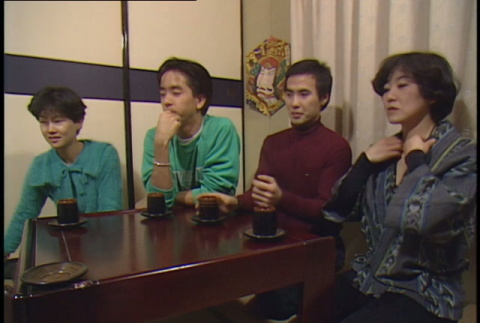
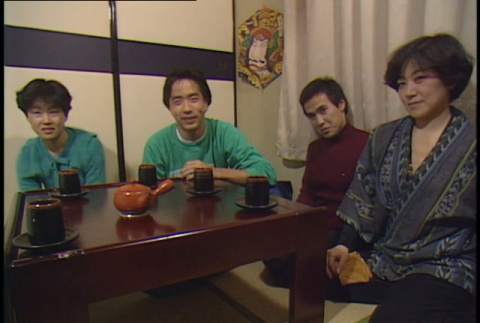
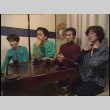
Interview with Akiko, Brian Yamakoshi, Kenny and Chizuko, part 1 of 4 (ddr-densho-1007-1717)
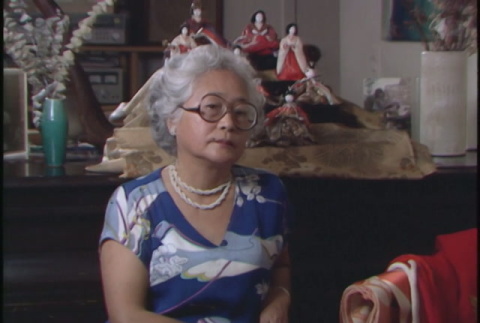
In order of left to right: Akiko, Brian Yamakoshi, Kenny, and Chizuko. Aside from Brian, last names unknown; Kenny and Chizuko are married. This tape focuses mainly on Chizuko, who discusses her relationship with her grandfather, her reasons for coming to Japan, and making Noh masks. Loni Ding can be heard asking questions behind the camera. …
av
Interview with Hugh Nozawa, part 3 of 3 (ddr-densho-1007-1715)
Nozawa discusses being court-martialed for refusing to serve in the military while the internment camps were operating, the long fight for honorable discharge after the fact, and his reasons for trying to hard to reverse the dishonorable discharge given to Nisei who refused to serve. Original title: 222, II JA #54, Hugh Nozawa, Sun. Feb. 2
av
Interview with Bill Dizer, part 3 of 3 (ddr-densho-1007-1678)
Dizer discusses the differences between Nisei and Japanese nationals, his thoughts on Japanese/Nisei "ethnocentrism", his experience with Japanese work and social life, his advice for his Japanese and American peers, and his views on racial discrimination. Loni Ding can be heard asking questions in the background. Original title: 195, II JA #12, Bill Dizer, Fri. Jan. …
av
Interview with Yukio Kawamoto, part 4 of 8 (ddr-densho-1007-1548)
Kawamoto reads through a letter he wrote from the south Pacific to a camp newspaper in Topaz, talks about his service, and tells a few war stories. Also mentions the atomic bombs. Video starts at 0:59. Loni Ding can be heard asking questions behind the camera. Original title: 49, II NY #32, 6-85, Kawamoto. Interview continues …
av
Interview with John Aiso, part 3 of 5 (ddr-densho-1007-1576)
Aiso discusses his relationships with students at the MISLS, the background of those enrolled, and the relationships between Nisei and white students. Video starts at 0:30. Loni Ding can be heard asking questions behind the camera. Original title: 73, II LA #3, 7-23-85, Judge Aiso III, Interview in Law Library Cont. Interview continues at ddr.densho.org/ddr-densho-1007-1577/
av
Interview with Jacob Herzog, part 6 of 6; b-roll of Herzog (ddr-densho-1007-1544)
Herzog discusses evacuation, which he did not learn about until after the war. Video starts at 0:54, interview ends at 3:16. Loni Ding can be heard asking questions behind the camera. Rest of tape is b-roll: pictures of Herzog, articles. Original title: 46, II NY #28, 6-85, Herzog
doc
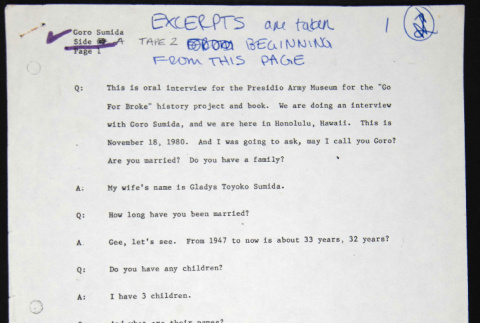
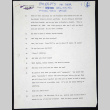
Goro Sumida oral interview transcript (ddr-densho-1007-1043)
Tape 2, side A. Conducted by Eric Saul for the Presidio Army Museum. Sumida served in the 100th Battalion in WWII.
av
Interview with Sho Nomura, part 6 of 6 (ddr-densho-1007-1615)
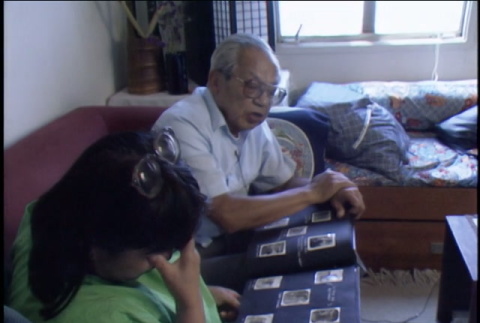
Nomura and Loni Ding look through a photo album of his, with several photos from his service in China. Nomura recounts several stories relating to the documents and photos in the album. Original title: II LA #45, 7-25-85, Sho Nomura Interview VI
av
Interview with Manny Goldberg, part 3 of 6 (ddr-densho-1007-1564)
Goldberg discusses his service in Saipan and Iwo Jima, particularly extracting Japanese soldiers from caves. Video starts at 0:52. Loni Ding can be heard asking questions behind the camera. Original title: II NY, #48, 6-85, Goldberg. Interview continues at ddr.densho.org/ddr-densho-1007-1565/
av
Interview with Nobuo Yamashita, part 3 of 5 (ddr-densho-1007-1778)
Yamashita discusses why his parents didn't want him to go to college, joining his family's produce business, meeting his wife in Manzanar, his service in the Philippines, interrogating prisoners of war, seeing American prisoners who came out of Santo Tomas, the selfishness of weathy Japanese people in Korea, and not getting any promotions or furlough in …
av
Interview with Manny Goldberg, part 4 of 6 (ddr-densho-1007-1565)
Goldberg discusses the United States' engagement on Iwo Jima, army distrust of Nisei personnel, trying to capture Tadamichi Kuribayashi, and working with prisoners of war on Iwo Jima. Video starts at 0:52. Loni Ding can be heard asking questions behind the camera. Original title: 62, II NY #49, 6-85, Goldberg. Interview continues at ddr.densho.org/ddr-densho-1007-1566/
av
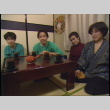
Interview with Akiko, Brian Yamakoshi, Kenny and Chizuko, part 4 of 4 (ddr-densho-1007-1720)
Akiko and Brian Yamakoshi discuss the differences between Japanese Americans and Japanese nationals. Chizuko discusses the unique opportunity afforded to Sansei to pursue Japanese arts and culture. Interview ends around 10:30; rest of tape is reaction shots. Original title: 227, II JA #59, Brian Yamakoshi, Fri. Feb. 7
av
Interview with Jacob Herzog, part 4 of 6 (ddr-densho-1007-1542)
Herzog discusses post-war occupation of Okinawa and interrogating Japanese prisoners. Video starts at 0:58. Loni Ding can be heard asking questions behind the camera. Original title: 44, II NY #26, 6-85, Herzog. Interview continues at ddr.densho.org/ddr-densho-1007-1543/
av
Interview with Harry Fukuhara, part 4 of 6 (ddr-densho-1007-1635)
Fukuhara discusses the danger of being mistaken for a Japanese soldier and his experiences interrogating Japanese prisoners of war. Video starts at 0:49. Loni Ding can be heard asking questions behind the camera. Original title: 120, II SJ #26, 8-17-85, Fukuhara, Harry's house, 8/17/18, reel #26. Interview continues at ddr.densho.org/ddr-densho-1007-1636/