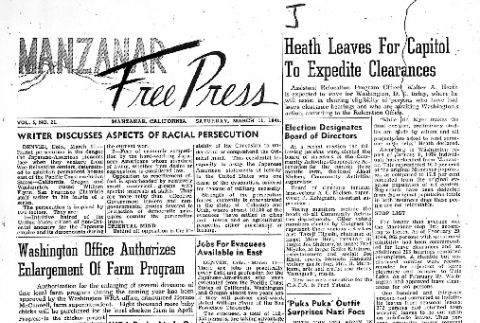
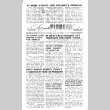
Selected article titles: "Writer Discusses Aspects of Racial Persecution" (p. 1), "Washington Office Authorizes Enlargement of Farm Program" (p. 1), "WRA Probe Made on Hiring of Nisei Help" (p. 1), "Jobs for Evacuees Available in East" (p. 1), "Madison Japanese-Americans Get Favorable Reception" (p. 2).
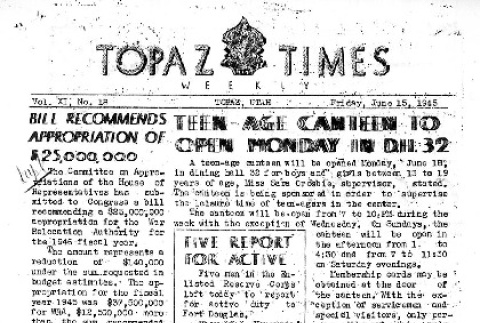
Selected article titles: "Bill Recommends Appropriation of $25,000,000" (p. 1), "Center Health Services to be Curtailed, Washington Reveals" (p. 1), "Japanese Americans in War Effort Told in JACL Booklet" (p. 2), "Trial Set for Five CIO Racists" (p. 6), "Nisei Council, JACL to Aid Resettlers" (p. 6).
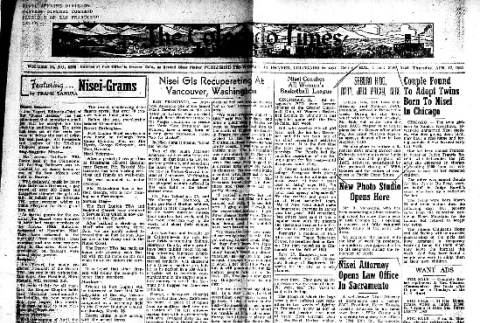
Selected article titles: "Featuring... Nisei-Grams"; "Nisei GIs Recuperating at Vancouver, Washington"; "Nisei Coaches All Women's Basketball League"; "Saburo Kido, Nat'l JACL Prexy, Here"; "New Photo Studio Opens Here"; "Nisei Attorney Opens Law Office in Sacramento"; "Couple Found to Adopt Twins Born to Nisei in Chicago."
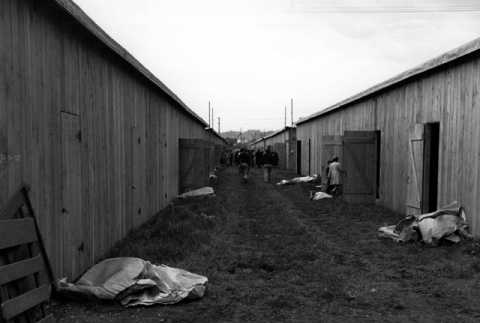
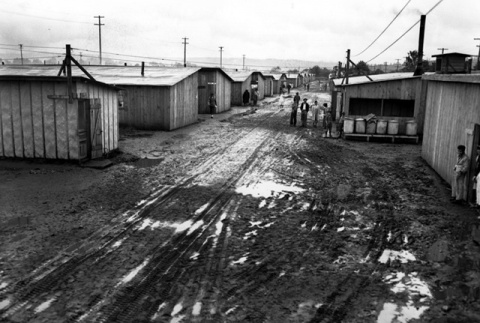
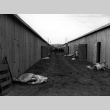
The Puyallup Assembly Center, also known as "Camp Harmony," was on the racetrack of the Puyallup fairgrounds. The center was open from April 28, 1942, through September 23, 1942. Most camp inmates were from Seattle, Washington. This is a view of the barracks that housed them.
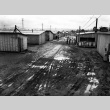
The Puyallup Assembly Center, also known as "Camp Harmony," was on the racetrack of the Puyallup fairgrounds. The center was open from April 28, 1942, through September 23, 1942. Most camp inmates came from Seattle, Washington. This is a view of the barracks that housed them.
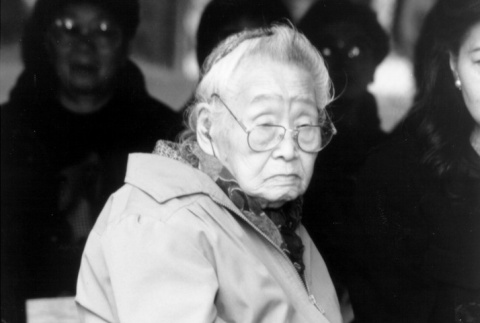
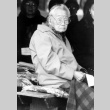
This four-star mother is at the annual Nisei Veteran Memorial Day service. The service takes place at the Lakeview Cemetery in Seattle, Washington. This woman received her United States citizenship on March 21, 1997 at the age of 100 years. She died on June 29, 1998.
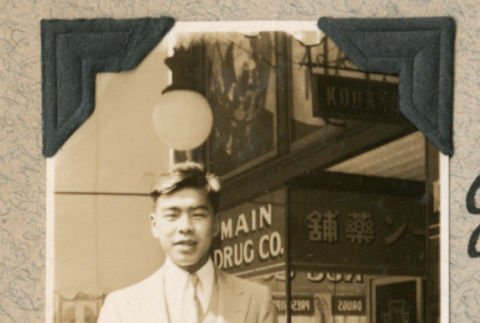
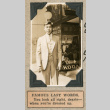
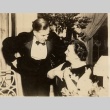
Written on album page next to photograph: "God's Gift to Women, Giggolo Nishimura." Printed and pasted on album page below photograph: "Famous last words. You look all right, dearie-when you're dressed up." Toshimi Nishimura was a University of Washington student and Japanese Students Club member.
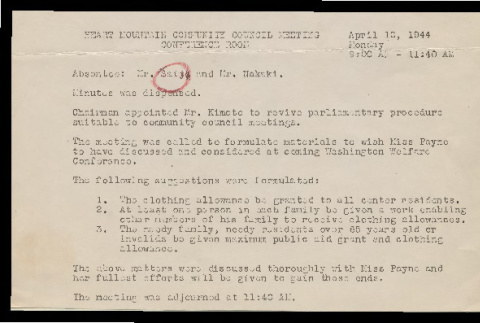
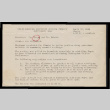
Minutes from the Heart Mountain Community Council meeting. Includes discussion on topics for Washington Welfare Conference. See this object in the California State Universities Japanese American Digitization project site: sac_jaac_0550
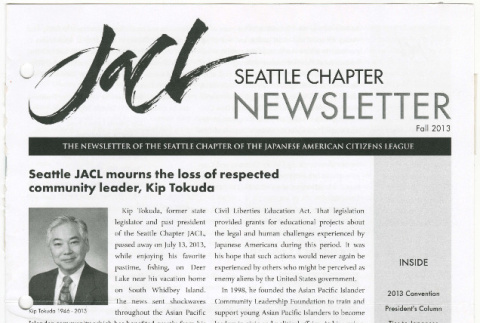
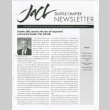
Selected article titles: "Seattle JACL Mourns the Loss of Respected Community Leader, Kip Tokuda" (p. 1-2), "Commemorating Redress at the 2013 Convention" (p. 4-5), "Youth Impressions from the 2013 Convention" (p. 5), "Why Sister Cities? Washington Boasts Numerous Ties to Japanese Cities" (p. 7).
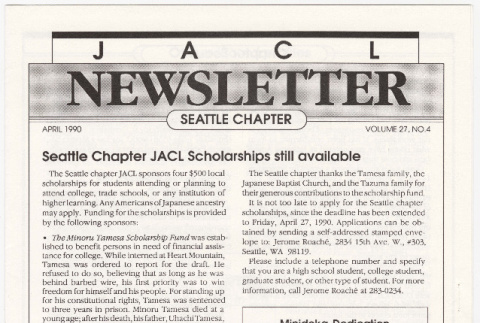
Newsletter covering the following topics: Scholarships include Tamesa, Andrews, and Bunshiro Tazuma; Doshi Kai report; Board Profiles: Wayne Kimura, Bruce Echigoshima, Massie Tomita, May Sasaki; April 21, 1990-Redress Workshop, Blaine, Bob Bratt speaker (WA Coalition for Redress-Seattle, Lake Washington, Puyallup Valley, and White River JACL.
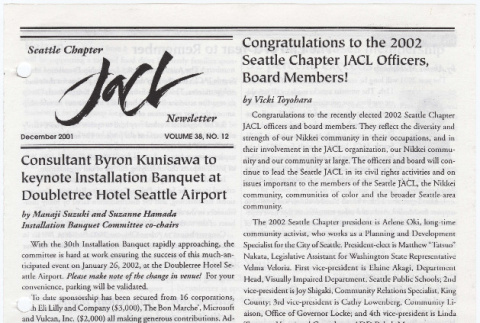
Newsletter covering the following topics: 2002 Installation Banquet, January 26, 2002, SeaTac Doubletree Keynote-Bryon Kunisawa; Chapter sees 32% growth in membership to 649 members; Akemi Matsumoto reviews 2001 accomplishments including the post-9/11 coalition of groups to form a hate free zone in Washington.
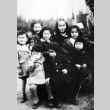
These Japanese Americans are waiting for army trucks to take them to the Eagledale ferry dock on Bainbridge Island, Washington. From there, a special ferry will take them to Seattle, where they will be transferred to a train bound for the Manzanar concentration camp in California.
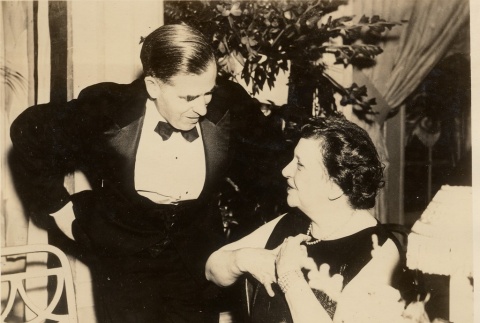
Caption on reverse [translation]: "The Flourishing Female Secretary Mrs. Wallace. (Washington) Domei. The flourishing Labor Secretary Frances Perkins (left) and the wife of Agriculture Secretary Henry Wallace (right) attending the 26th anniversary banquet held by the Department of Commerce on May 5. [Stamped] June 11, 1938."
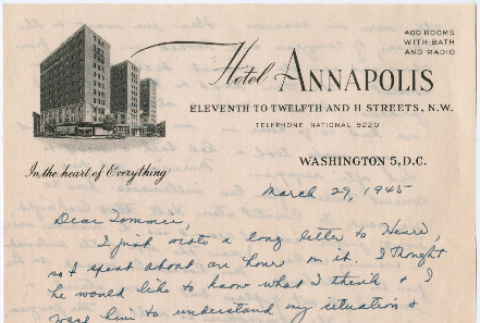
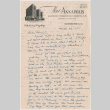
Describing sightseeing in Washington D.C. with their father, her plans to stay in Minneapolis, hoping Tomoye will let their father live with her and Henri even though they don't get along because she believes Mrs. Harada is a bad choice for him. Written on Hotel Annapolis stationary.
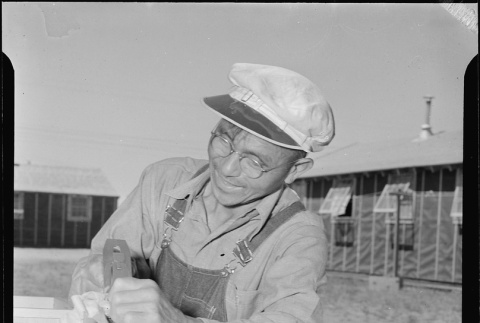
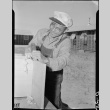
Original WRA caption: Tule Lake Relocation Center, Newell, California. Shinkichi Kiyono, 56, carpenter-evacuee from Longview, Washington, is shown using a carpenter's plane which he won as first prize in a furniture contest conducted among the evacuees of Japanese descent at this War Relocation Authority center.
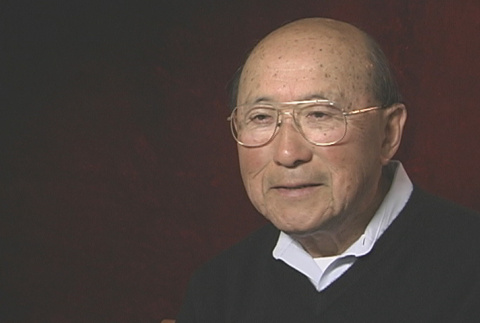
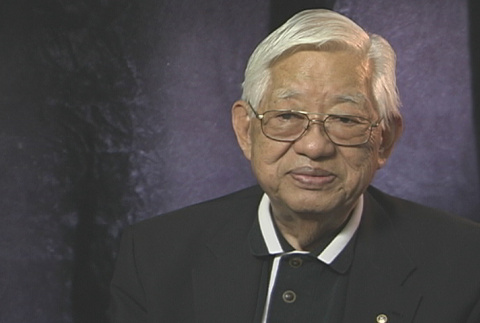
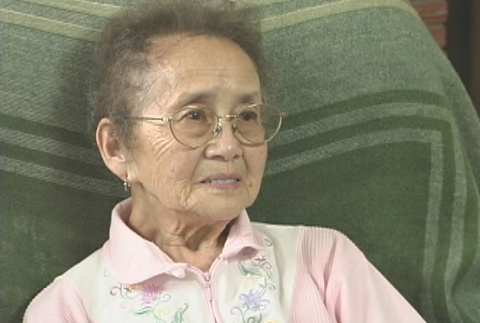
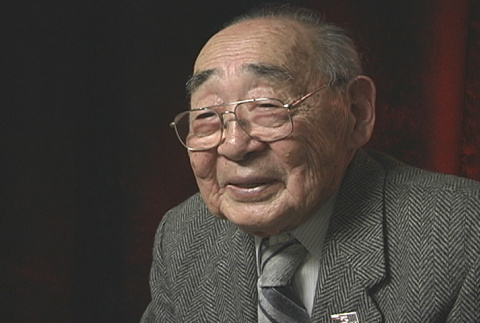
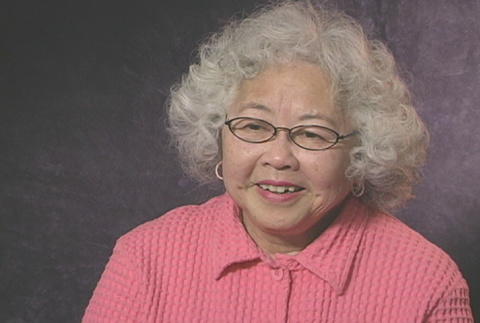
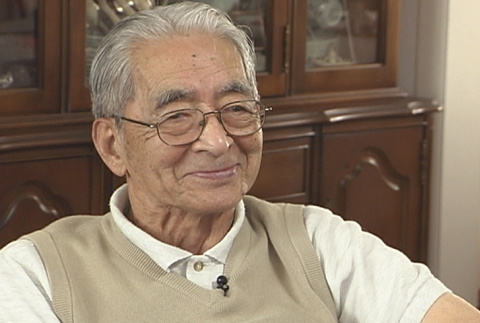
This interview was conducted as part of a project to capture stories of the Japanese American community of Spokane, Washington. Densho worked in collaboration with the Northwest Museum of Arts and Culture.
This interview was conducted as part of a project to capture stories of the Japanese American community of Spokane, Washington. Densho worked in collaboration with the Northwest Museum of Arts and Culture.
This interview was conducted as part of a project to capture stories of the Japanese American community of Spokane, Washington. Densho worked in collaboration with the Northwest Museum of Arts and Culture.
This interview was conducted as part of a project to capture stories of the Japanese American community of Spokane, Washington. Densho worked in collaboration with the Northwest Museum of Arts and Culture.
This interview was conducted as part of a project to capture stories of the Japanese American community of Spokane, Washington. Densho worked in collaboration with the Northwest Museum of Arts and Culture.
This interview was conducted as part of a project to capture stories of the Japanese American community of Spokane, Washington. Densho worked in collaboration with the Northwest Museum of Arts and Culture.
This interview was conducted as part of a project to capture stories of the Japanese American community of Spokane, Washington. Densho worked in collaboration with the Northwest Museum of Arts and Culture.
This interview was conducted as part of a project to capture stories of the Japanese American community of Spokane, Washington. Densho worked in collaboration with the Northwest Museum of Arts and Culture.
This interview was conducted as part of a project to capture stories of the Japanese American community of Spokane, Washington. Densho worked in collaboration with the Northwest Museum of Arts and Culture.