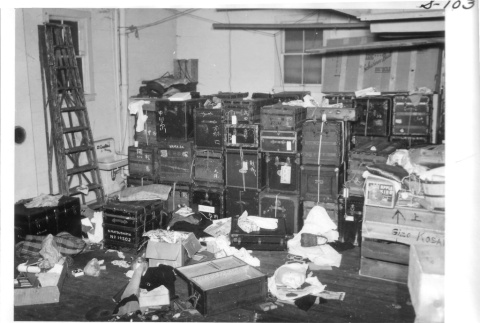
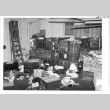
Original WRA caption: Tacoma Buddhist Church, Tacoma, Washington. View showing the results of pilferage of evacuee property originally stored in the Tacoma Buddhist Church. Gained admittance through this end of building. Trunks pilfered unidentified. These stored articles are owned by members of the church.
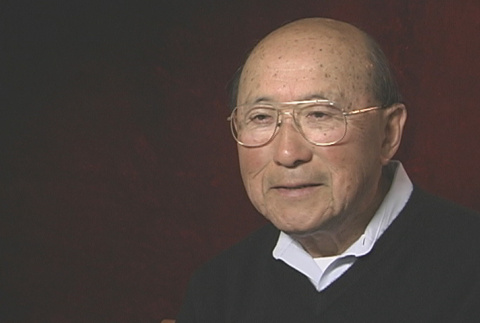
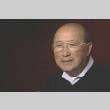
This interview was conducted as part of a project to capture stories of the Japanese American community of Spokane, Washington. Densho worked in collaboration with the Northwest Museum of Arts and Culture.
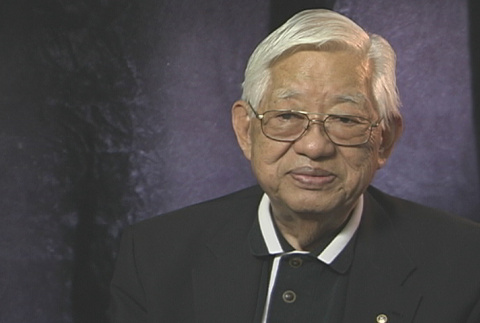
This interview was conducted as part of a project to capture stories of the Japanese American community of Spokane, Washington. Densho worked in collaboration with the Northwest Museum of Arts and Culture.
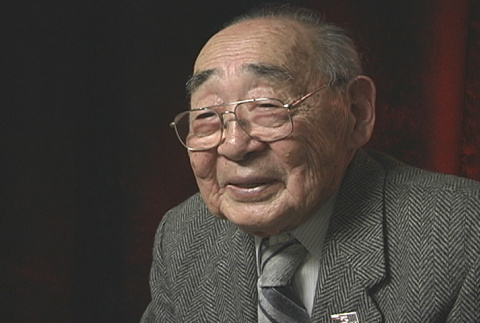
This interview was conducted as part of a project to capture stories of the Japanese American community of Spokane, Washington. Densho worked in collaboration with the Northwest Museum of Arts and Culture.
This interview was conducted as part of a project to capture stories of the Japanese American community of Spokane, Washington. Densho worked in collaboration with the Northwest Museum of Arts and Culture.
This interview was conducted as part of a project to capture stories of the Japanese American community of Spokane, Washington. Densho worked in collaboration with the Northwest Museum of Arts and Culture.
This interview was conducted as part of a project to capture stories of the Japanese American community of Spokane, Washington. Densho worked in collaboration with the Northwest Museum of Arts and Culture.
This interview was conducted as part of a project to capture stories of the Japanese American community of Spokane, Washington. Densho worked in collaboration with the Northwest Museum of Arts and Culture.
This interview was conducted as part of a project to capture stories of the Japanese American community of Spokane, Washington. Densho worked in collaboration with the Northwest Museum of Arts and Culture.
This interview was conducted as part of a project to capture stories of the Japanese American community of Spokane, Washington. Densho worked in collaboration with the Northwest Museum of Arts and Culture.
This interview was conducted as part of a project to capture stories of the Japanese American community of Spokane, Washington. Densho worked in collaboration with the Northwest Museum of Arts and Culture.
This interview was conducted as part of a project to capture stories of the Japanese American community of Spokane, Washington. Densho worked in collaboration with the Northwest Museum of Arts and Culture.
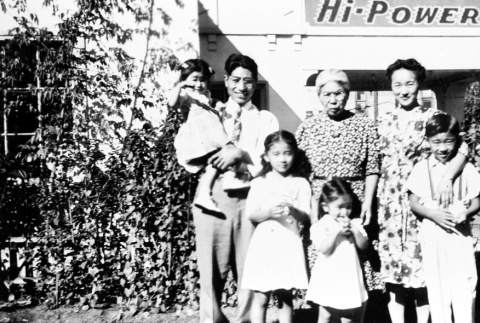
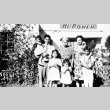
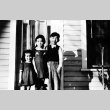
The Fukuda family was originally from Seattle and voluntarily relocated to Nampa, Idaho, during World War II. After the war, the family moved to Spokane, Washington. Front (left to right): Janet, Lillian, and Alan Fukuda. Back: Jim Fukuda holding his daughter Mitsue, Mrs. Fukuda, and Rina Fukuda.
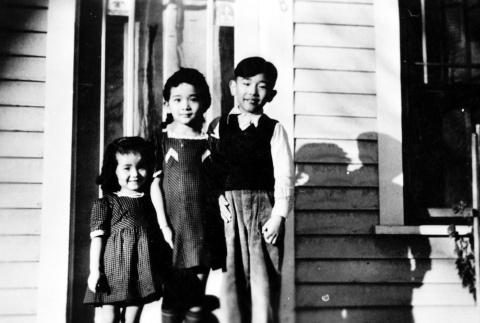
Left to right: Lillian, Janet, and Alan Fukuda on their porch. The Fukuda family was originally from Seattle and voluntarily relocated to Nampa, Idaho, during World War II. After the war, they moved to Spokane, Washington, where their father, Dr. Susumu Fukuda, opened a dental practice.
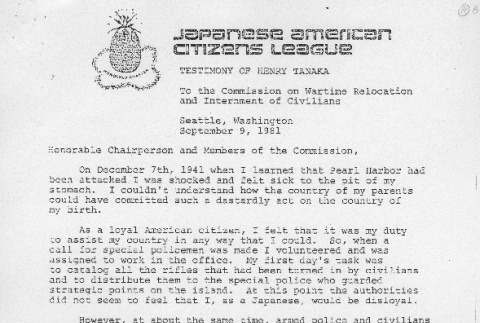
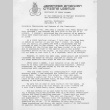
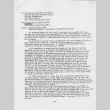
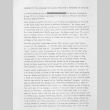
Written testimony of Henry Tanaka, from Hawaii. He was incarcerated at Sand Island and Honouliuli internment camps, Hawaii. This testimony was presented at the CWRIC hearing in Seattle, Washington, on Wednesday, September 9, 1981, in the section titled "The Hawaiian Experience." Personal information excised by Densho.
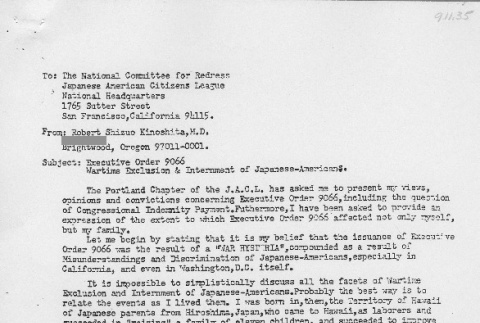
Written testimony of Robert Shizuo Kinoshita of Brightwood, Oregon. Incarcerated in the North Portland Assembly Center, Oregon, and the Heart Mountain concentration camp, Wyoming. This testimony was presented at the CWRIC hearing in Seattle, Washington, on Friday, September 11, 1981, in the section titled "Multiple Impact."
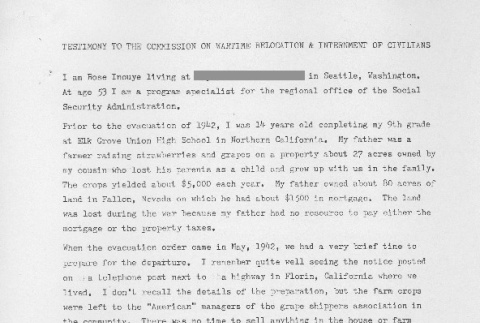
Written testimony of Rose Inouye, born in Florin, California. Incarcerated in the Fresno Assembly Center, California, the Jerome concentration camp, Arkansas, and the Granada concentration camp, Colorado. This testimony was submitted for the CWRIC hearings in Seattle, Washington, September 9-11, 1981. Personal information excised by Densho.
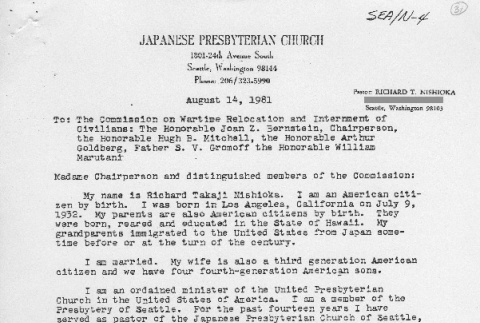
Written testimony of Richard Takaji Nishioka, born in Los Angeles, California. Incarcerated in Poston concentration camp, Arizona. This testimony was presented at the CWRIC hearing in Seattle, Washington, on Wednesday, September 9, 1981, in the section titled "Discrimination and Psychological Impact." Personal information excised by Densho.
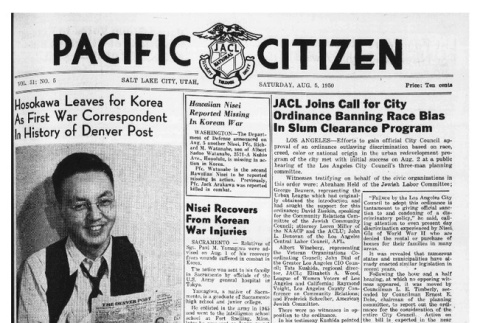
Selected article titles: "Hosokawa Leaves for Korea as First War Correspondent in History of Denver Post" (p. 1), "JACL Joins Call for City Ordinance Banning Race Bias in Slum Clearance Program" (p. 1), "Justice Department Plans to Open New Evacuee Claims Offices in Chicago, Washington" (p. 3).
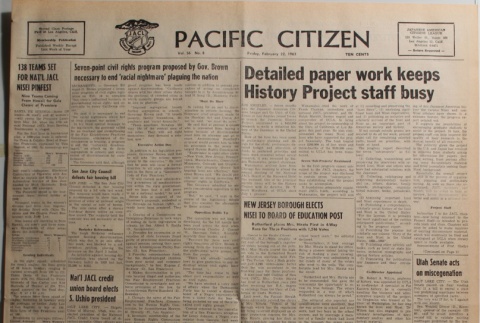
Selected article titles: "Detailed Paper Work Keeps History Project Staff Busy" (pp. 1-2), "Ineffective Oral Communication Viewed as 'Achilles Heel' For Japanese Americans" (p. 1), "Tokyo Topics: Japanese in Hawaii Celebration" (p. 2), and "By the Board: Civil Rights in the State of Washington" (p. 4).
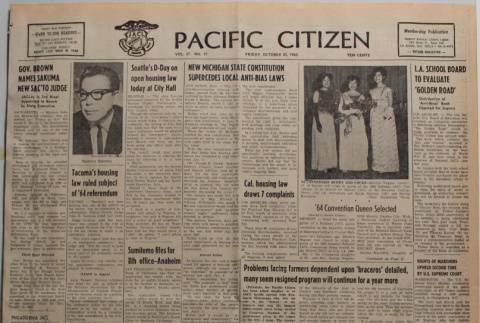
Selected article titles: "Problems Facing Farmers Dependent upon 'Braceros' Detailed, Many Seem Resigned Program Will Continue for a Year More" (pp. 1-2), "Washington Newsletter: Civil Rights Battle" (p. 2), and "U.S. Gov't Will Pay for Property Claims Rising Out of Bombing on Pearl Harbor" (p. 3).
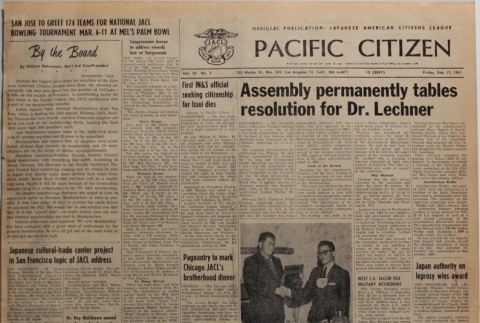
Selected article titles: "San Jose to Greet 174 Teams for National JACL Bowling Tournament Mar. 6-11 at Mel's Palm Bowl: Congressman Inouye to Address Awards Fete at Fairgrounds" (p. 1), "Washington Newsletter: Minorities in the Administration" (p. 1), and "Puyallup Valley's Issei Story Outlined" (p. 3).
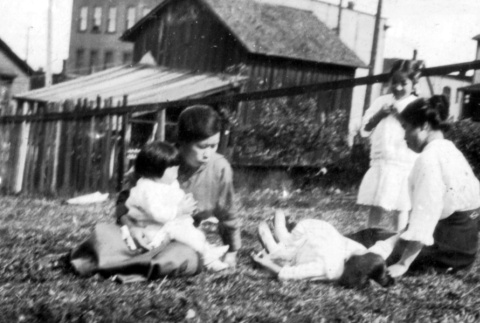
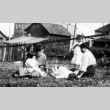
This is the backyard of the Kunitsugu family who resided at 515 Yesler Way in Seattle's Nihonmachi, or Japantown. The Kawai family of Tacoma, Washington is visiting the Kunitsugus. Left to right: Tomie Kunitsugu, Fusa Kunitsugu, Mae Kawai (child on the ground), Chiyeko Kawai, and Mrs. Kawai.
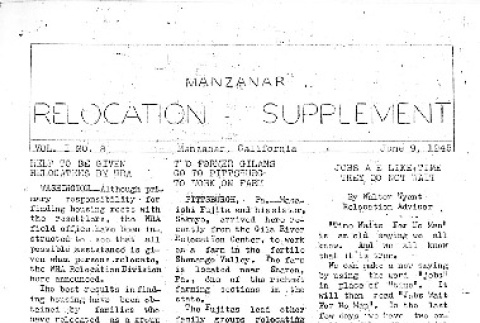
Selected article titles: "Evacuee Problems Discussed by 150" (p. 1), "Jobs Are Like Time They Do Not Wait" (p. 1), "Many Jobs Offered in Los Angeles Area" (p. 4), "Gets Pamphlets on 'Small Business' for Chicago Area" (p. 4), "First Evacuee Returns to Tacoma, Washington" (p. 4).
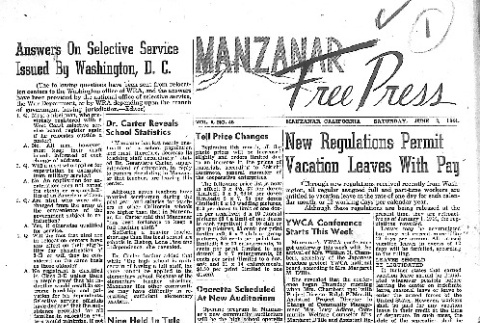
Selected article titles: "Answers on Selective Service Issued by Washington, D.C." (p. 1), "Nine Held in Tule on Coercion Charge" (p. 1), "New Regulations Permit Vacation Leaves With Pay" (p. 1), "Tule Lake Sentry Cleared of Charges" (p. 1), "Pictures by Adams Prove Popular Here" (p. 1).