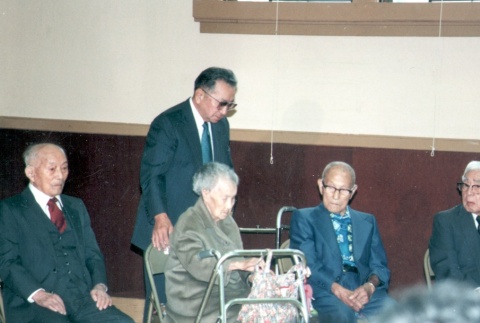
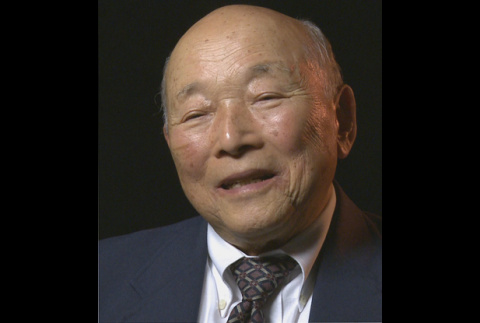
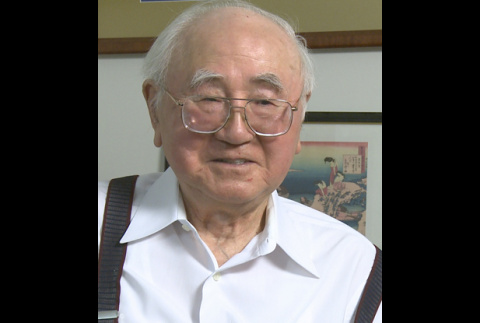
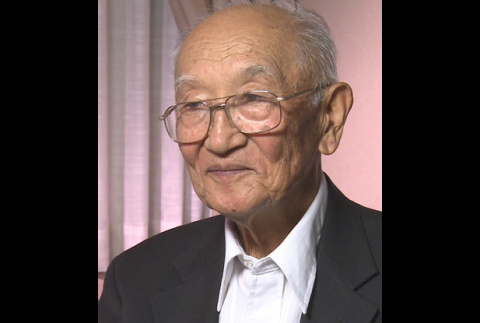
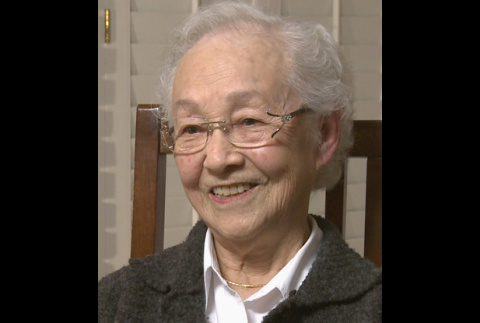
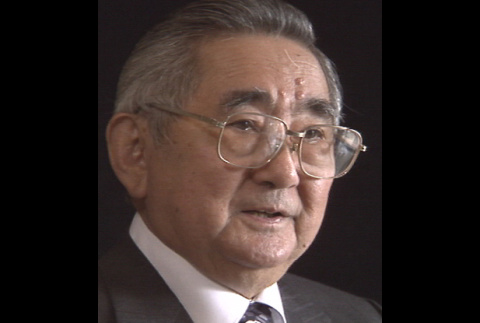
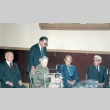
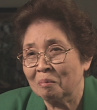
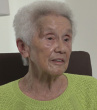
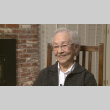
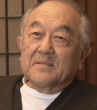
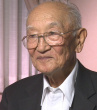
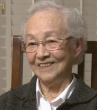
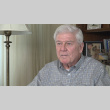
Four Issei, all at least 100 years of age, waiting to receive their redress checks at the Nisei Veterans Hall in Seattle, Washington. Left to right: Mr. Katsuo, Ms. Wakamatsu, Mr. Ishimitsu, and Mr. Nakagawa. The fifth Issei recipient, Mr. Frank Yatsu, is not pictured. The man standing behind Ms. Wakamatsu is unidentified. The Civil Liberties …
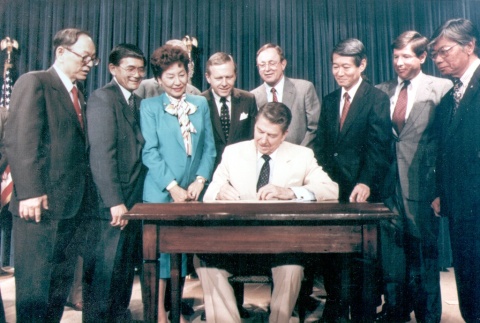
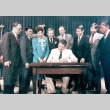
Onlookers watch as President Ronald Reagan signs the Civil Liberties Act of 1988. Left to right: Senator Spark Matsunaga (Hawaii), Representative Norman Mineta (California), Representative Patsy Saiki (Hawaii), Senator Pete Wilson (California), Representative. Don Young (Alaska), Representative Robert Matsui (California), Representative Bill Lowery (California), and Harry Kajihara, President, National JACL. The man in the back is …
Story of a relative who was "tricked" by the Japanese government into going to Japan and being drafted into the Japanese army
Although Mr. Matsumoto does not identify himself as a Kibei (American-born person of Japanese ancestry sent to Japan for formal education and socialization when young and later returned to the U.S.), some of his …
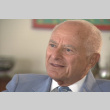
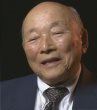
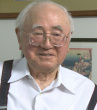
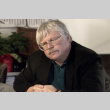
Thoughts on postwar life, feelings about the U.S. government: "I forgive them"
This interview was conducted by sisters Emiko and Chizuko Omori for their 1999 documentary, Rabbit in the Moon, about the Japanese American resisters of conscience in the World War II incarceration camps. As a result, the interviews in this collection are typically not …
The ACLU's attempts to challenge the U.S. government on its World War II actions
This interview was conducted by filmmaker Frank Abe for his 2000 documentary, Conscience and the Constitution, about the World War II resisters of conscience at the Heart Mountain incarceration camp. As a result, the interviews in this collection are typically not …
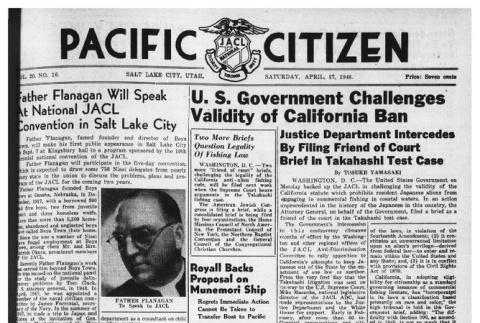
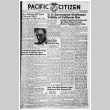
Selected article titles: "U.S. Government Challenges Validity of California Ban. Justice Department Intercedes By Filing Friend of Court Brief In Takahashi Test Case" (p. 1), "Los Angeles Supervisors Urge Congress to Remove Race Bans from Naturalization Law" (p. 1), "JACL Endorses Immediate Statehood for Hawaii Islands" (p. 2), "Japanese Canadians Continue Campaign to Win Franchise Right …
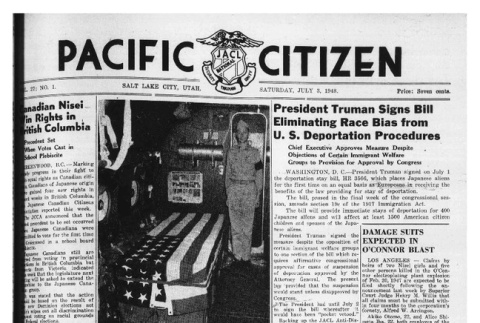
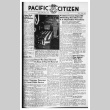
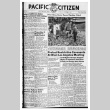
Selected article titles: "Canadian Nisei Win Rights in British Columbia" (p. 1), "President Truman Signs Bill Eliminating Race Bias from U.S. Deportation Procedures" (p. 1), "Japanese American Attorneys Enter Hawaii Public Service" (p. 1), "Government Witnesses Testify on Acts of Brutality Charged To Prison Camp Interpreter" (p. 2), "San Francisco JACL Declares Slum Clearance Project Does …
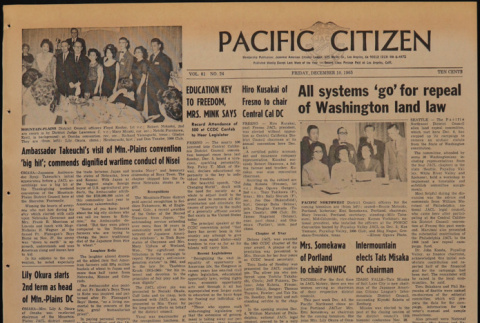
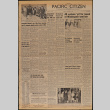
Selected article titles: "All Systems 'Go' for Repeal of Washington Land Law"(p.1-2), "Education Key to Freedom, Mrs. Mink says" (p.1), "1965 Immigration Laws" (p.2), "Tall Watch-Tower Overlooking Minidoka WRA Camp Still Standing, says Seattleite after Insepction Trip" (p.3), "'Nisei' Japanese Cherry Trees Planted at Washington Monument Area, Part of 3,800 from Japanese Government" (p.5), "10 Visas …
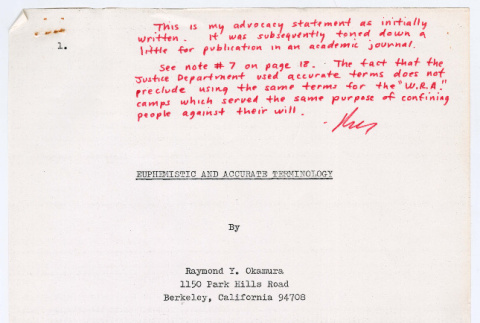
Raymond Y. Okamura's testimony to the Commission on Wartime Relocation and Internment of Civilians in Seattle Washington on September 11, 1981 describing policies and terminology used by the U.S. government to enforce wartime incarceration of Japanese Americans. He compares the American government's misleading terminology to that of Nazi propaganda. It was later published by the Journal …
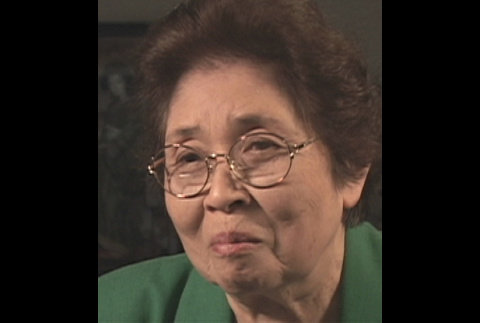
Nisei female. Born March 27, 1927, in Ola'a, Hawaii. Grew up in Ola'a until family moved to Hawaii just before World War II. Attended high school and college during in Japan and then had to work a factory to support the war effort. Witnessed the atomic bombing of Nagasaki. Worked for the military government in Japan, …
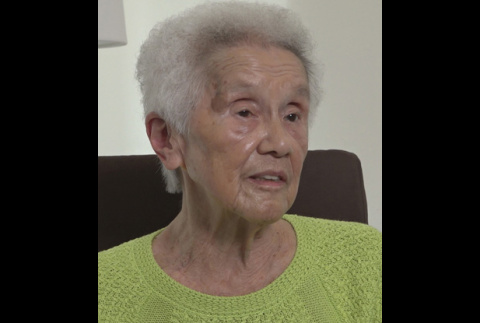
Nisei female. Born June 14, 1931, in Seattle, Washington. Grew up in Seattle, where parents ran a boarding house. During World War II, removed to the Puyallup Assembly Center, Washington, and Minidoka concentration camp, Idaho. Left camp in 1943 and moved to Salt Lake City, Utah. Returned with family to Seattle after the war, attended the …
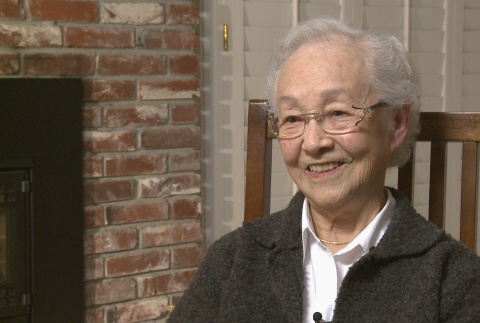
Nisei female. Born May 12, 1925, in Spreckels, California. Moved frequently with family as a child, eventually settling in Gilroy, California. After the bombing of Pearl Harbor, removed to the Salinas Assembly Center, California, and the Poston concentration camp, Arizona. Following father's desire to repatriate to Japan, transferred to Tule Lake concentration camp, California, when it …
Nisei male. Born February 14, 1920, in Kent, Washington. Grew up in the nearby town of Auburn, where parents ran a farm. Family was involved Auburn Buddhist Church. Graduated from the University of Washington in 1942 and removed to the Pinedale Assembly Center and Tule Lake concentration camp, California. Recruited out of Tule Lake to teach …
Nisei male. Born July 16, 1917, in San Francisco, California. Grew up in Sacramento, and graduated from UC Berkeley in 1939. During World War II, was removed to the Tule Lake concentration camp, California. Voluntarily stayed in Tule Lake after it was designated a Segregation Center, and worked in the legal aid office. Assisted attorney Wayne …
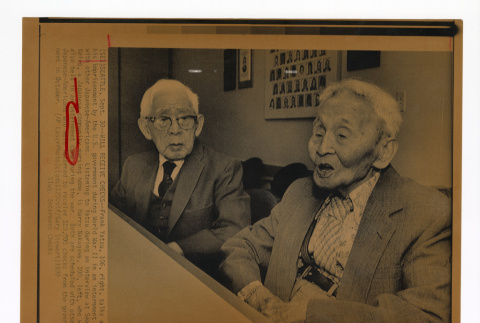
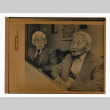
Two Japanese-American men wearing suits. The caption next to the image reads, "SEATTLE, Sept. 30--WILL RECEIVE CHECKS--Frank Yatsu, 106, right, talks about his imprisonment by the U.S. government during World War II in an internment camp with other Japanese-Americans. Listening to Yatsu during an interview at Seattle Keiro, a Japanese community nursing home, is Harry Nakagawa, …
Volume 4 divides into three sections. Description about this volume reads directly from the book as follows: Section 1 contains archival documents from April 1942 about the growing opposition of western officials outside of the West Coast to having Japanese Americans moved to their localities. Section 2 contains the Federal government Surveys of Public Opinion dated …
Belief that Ben Kuroki's visits to concentration camps "didn't have the desired effect" for the U.S. government
This interview was conducted by filmmaker Frank Abe for his 2000 documentary, Conscience and the Constitution, about the World War II resisters of conscience at the Heart Mountain incarceration camp. As a result, the interviews in this collection …
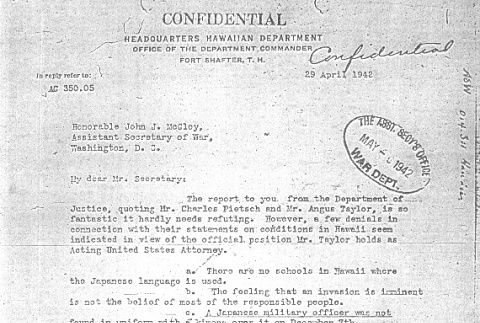
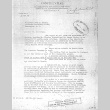
Memorandum from Delos Emmons, Lieutenant General, U.S. Army, to John J. McCloy, Assistant Secretary of War, regarding a previous report on the Japanese in Hawaii. In this memo, Emmons refutes much of the information in the report. He dispels many of the rumors about the Hawaiian Japanese and admonishes the author of the report for being …
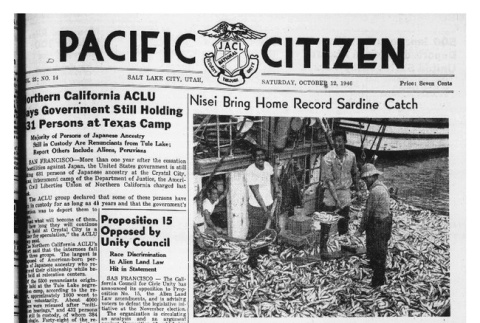
Selected article titles: "Northern California ACLU Says Government Still Holding 631 Persons at Texas Camp" (p. 1), "Protest Restrictive Covenants At West Los Angeles Meeting. Civil Rights Groups Support Right of Japanese American Family to Occupy New Home" (p. 1), "500 Japanese Canadians Deported to Japan Aboard United States Army Vessel" (p. 2), "Federal Judge Raps …
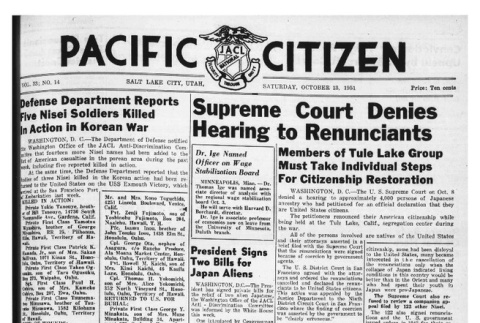
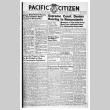
Selected article titles: "Supreme Court Denies Hearing to Renunciants. Members of Tule Lake Group Must Take Individual Steps For Citizenship Restoration" (p. 1), "Defense Department Reports Five Nisei Soldiers Killed in Action in Korean War" (p. 1), "Government Ponders Next Step in Renunciants Test Case" (p. 1), "Conviction of 'Tokyo Rose' Upheld by U.S. Circuit Court" …
Nisei male. Born June 26, 1922, in Montebello, California. Grew up in California, spending a short time in Japan prior to World War II. After the bombing of Pearl Harbor, moved to Denver, Colorado, during the "voluntary evacuation" period designated by the U.S. government. Arrested after refusing to report for military service after being drafted. Tried …
Nisei male. Born October 1, 1919, in Heber, California, in the Imperial Valley. Grew up in Boyle Heights. Received draft notice one day after the bombing of Pearl Harbor, and joined the Military Intelligence Service. After being denied furlough to visit his mother in Manzanar concentration camp, refused to serve overseas with his unit. Was placed …
Nisei female. Born May 12, 1925, in Spreckels, California. Moved frequently with family as a child, eventually settling in Gilroy, California. After the bombing of Pearl Harbor, removed to the Salinas Assembly Center, California, and the Poston concentration camp, Arizona. Following father's desire to repatriate to Japan, transferred to Tule Lake concentration camp, California, when it …
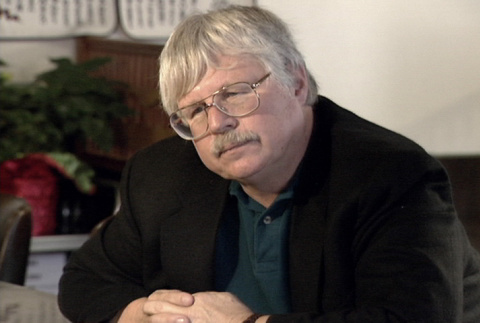
Caucasian male. Born May 13, 1943, in New London, Connecticut. Moved frequently as an adolescent since father was in the U.S. Navy. Attended high school in Honolulu, Hawaii, then college at the University of Washington. Served in the U.S. Air Force, then attended the University of the Pacific McGeorge Law School and Georgetown University School of …
Nisei male. Born January 25, 1920, in Seattle, Washington. Incarcerated at the Puyallup Assembly Center, Washington, and Minidoka concentration camp, Idaho. Resisted the draft, with the rationale that the U.S. government had classified him 4-C, an enemy alien, and he was therefore under no obligation to serve. Imprisoned at McNeil Island Penitentiary, Washington. Vocal critic of …