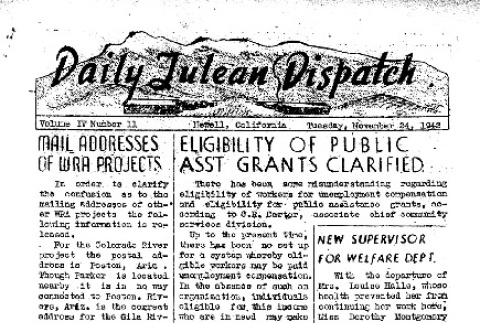
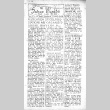
Selected article titles: "Mail Addresses of WRA Projects" (p. 1), "Eligibility of Public Ass't Grants Clarified" (p. 1), "Chico Students Offer Goodwill to Tule Nisei" (p. 3), "Block 26 Has 1st Japanese Bathtubs" (p. 3), "Local Firemen Get Lazy, Not Enough Excitement!" (p. 3).
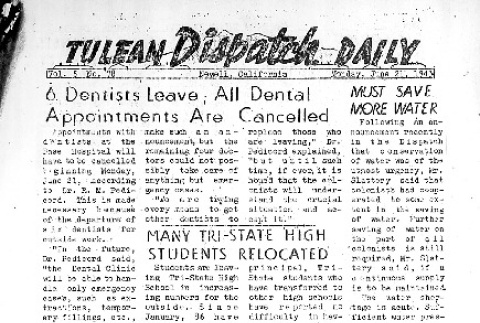
Selected article titles: "6 Dentists Leave; All Dental Appointments are Cancelled" (p. 1), "Must Save More Water" (p. 1), "'Blueprint for a Slum' Tells Relocation Camp Life" (p. 2), "Believes Nisei Should Relocate" (p. 2).
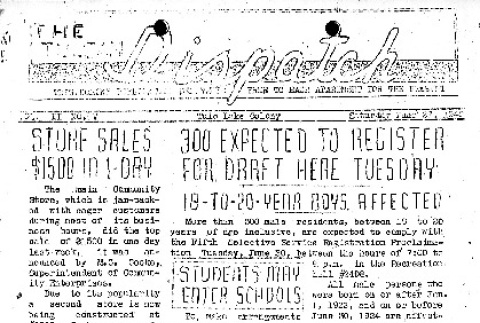
Selected article titles: "Store Sales $1500 in 1 Day" (p. 1), "300 Expected to Register for Draft Here Tuesday. 18-to-20 Year Boys Affected" (p. 1), "Students May Enter Schools" (p. 1), "Lumber Affair Serious, Council Warns" (p. 1), "Let There be More Smiles" (p. 2), "Police Force on 24-Hour Duty" (p. 3), "Warden's Dilemma" (p. 3), …
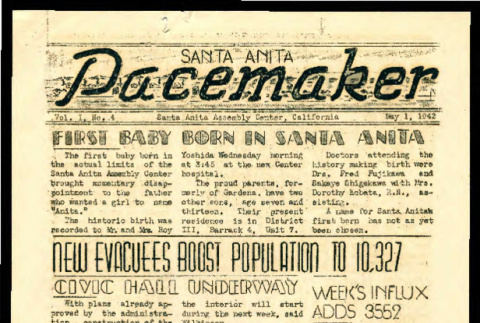
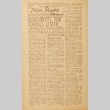
Biweekly newspaper published at the Santa Anita Assembly Center from April through October 1942. Current issue includes information on recreational activities, religious services, sports, a birth at the center, sanitation, postal services, personal property, fire prevention, classes, and other center services. See this object in the California State Universities Japanese American Digitization project site: sac_jaac_1238
Biweekly newspaper published at the Santa Anita Assembly Center from April through October 1942. Current issue includes information on recreational activities, religious services, sports, boy scouts, memorial day services, medical calls, food, and center statistics, and the feature "Win, Place, and Show." See this object in the California State Universities Japanese American Digitization project site: sac_jaac_1246
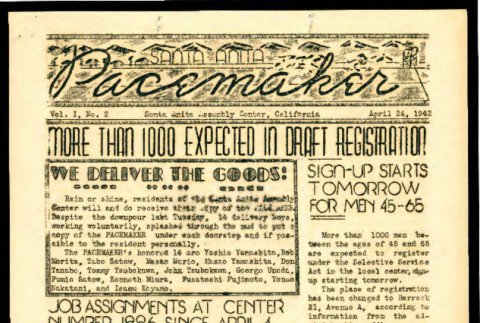
Biweekly newspaper published at the Santa Anita Assembly Center from April through October 1942. Current issue includes information on recreational activities, religious services, sports, draft registration, job assignments, sports, typhoid inoculation, change of address, classes, and clubs. See this object in the California State Universities Japanese American Digitization project site: sac_jaac_1236
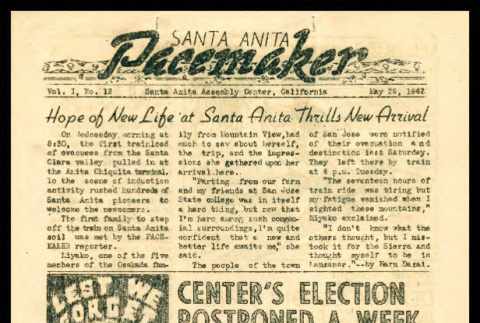
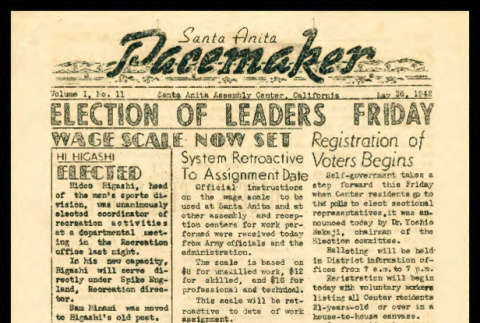
Biweekly newspaper published at the Santa Anita Assembly Center from April through October 1942. Current issue includes information on recreational activities, religious services, sports, elections, voter registration, coupons, blackout, library, obituary, camp facilities, and the feature "Win, Place, and Show." See this object in the California State Universities Japanese American Digitization project site: sac_jaac_1245
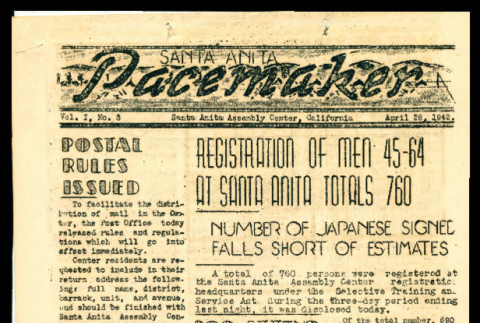
Biweekly newspaper published at the Santa Anita Assembly Center from April through October 1942. Current issue includes information on recreational activities, religious services, sports, postal services, registration, and camp facilities. See this object in the California State Universities Japanese American Digitization project site: sac_jaac_1237
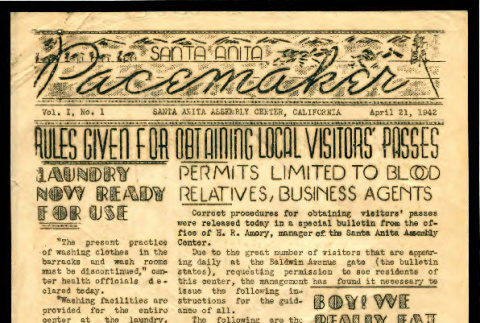
Biweekly newspaper published at the Santa Anita Assembly Center from April through October 1942. Current issue includes information on recreational activities, religious services, sports, laundry, visitor passes, Assembly Center food, facilities, Sunday School, registration, and the draft. See this object in the California State Universities Japanese American Digitization project site: sac_jaac_1235
Hank writes to Keizie (Kimiko) Fujii about the people they know who have died during the war, people leaving the concentration camp, and his educational aspirations. He also asks if she's seen Hattie Kawahara's essay, " I am an American," in Mademoiselle's college issue.
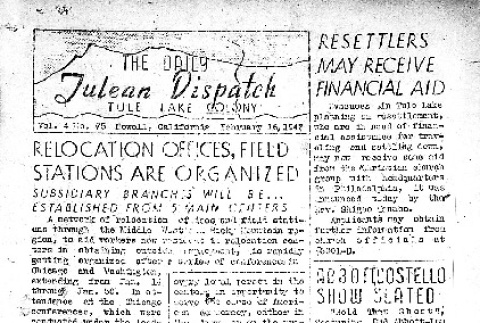
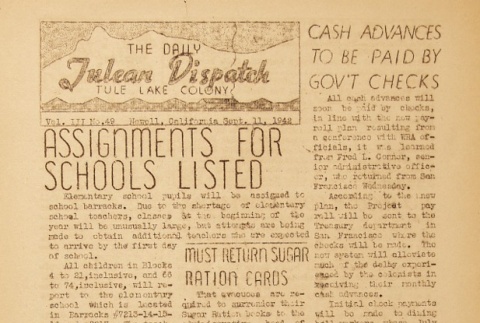
Selected article titles: "Relocation Offices, Field Stations are Organized. Subsidiary Branches Will Be... Established from 5 Main Centers" (p. 1), "Resettlers May Receive Financial Aid" (p. 1), "Food Crisis in China is Grave" (p. 2).
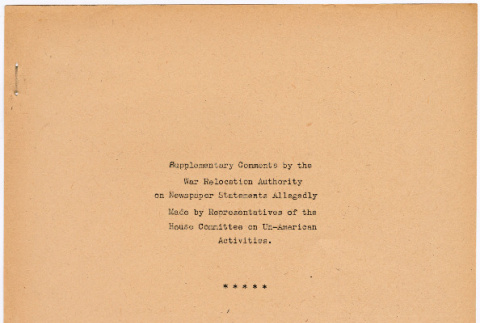
Additional comments from the War Relocation Authority in response to statements made by to the House Committee on Un-American Activities to the press about living conditions in the camps, rumors of violence and protest, and criticisms of how the camps are being managed.
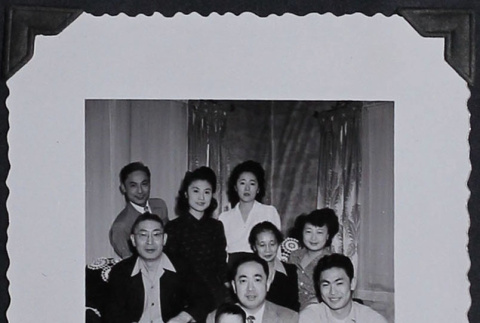
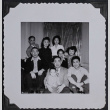
Okano family: back row: Min Okano, Ayako Masuko, Alice Okano; middle row: Toshiyuki and Haruno Okano, Niki Okano; bottom row: Phil Okano with Rick Masuko, Bob Okano
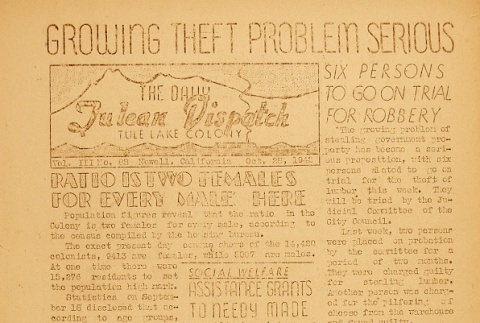
Selected article titles: "Growing Theft Problem Serious: Six Persons to Go on Trial for Robbery" (p. 1), "Ratio is Two Females for Every Male Here" (p. 1), "New Classes in Knitting Will Open" (p. 1), "Social Welfare: Assistance Grants to Needy Made" (p. 1), "First Aid Talk" (p. 1), "Prospective Wife Ad Gets 'Not Interested' Reply" …
Serving sentence for draft resistance at a road camp
This interview is incomplete. It ends after the first hour of taping, when Mr. Yoshida is describing serving time at the road camp for resisting the draft. This material is based upon work assisted by a grant from the Department of the Interior, National Park Service. Any …
Hearing about the bombing of Pearl Harbor, evading curfew
This interview is incomplete. It ends after the first hour of taping, when Mr. Yoshida is describing serving time at the road camp for resisting the draft. This material is based upon work assisted by a grant from the Department of the Interior, National Park Service. Any …
This interview is incomplete. It ends after the first hour of taping, when Mr. Yoshida is describing serving time at the road camp for resisting the draft. This material is based upon work assisted by a grant from the Department of the Interior, National Park Service. Any opinions, finding, …
This interview is incomplete. It ends after the first hour of taping, when Mr. Yoshida is describing serving time at the road camp for resisting the draft. This material is based upon work assisted by a grant from the Department of the Interior, National Park Service. Any opinions, finding, …
Pleading no contest to charges of draft resistance
This interview is incomplete. It ends after the first hour of taping, when Mr. Yoshida is describing serving time at the road camp for resisting the draft. This material is based upon work assisted by a grant from the Department of the Interior, National Park Service. Any opinions, …
This interview is incomplete. It ends after the first hour of taping, when Mr. Yoshida is describing serving time at the road camp for resisting the draft. This material is based upon work assisted by a grant from the Department of the Interior, National Park Service. Any opinions, finding, and conclusions or …
Picked up and taking to a county jail for refusing draft order
This interview is incomplete. It ends after the first hour of taping, when Mr. Yoshida is describing serving time at the road camp for resisting the draft. This material is based upon work assisted by a grant from the Department of the Interior, National …