
Topics
Facilities
Format
Genre
Usage

Use <Ctrl> or (⌘) keys to select multiple terms

119 items
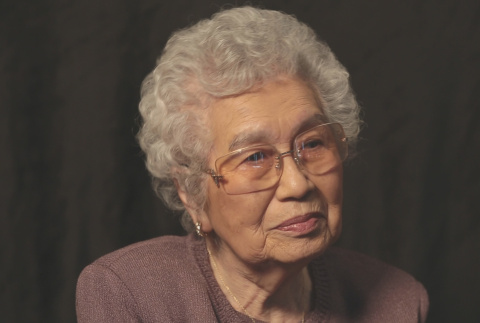
Dorothy H. Sato Interview (ddr-one-7-50)
vh Dorothy H. Sato Interview (ddr-one-7-50)
Nisei female. Born May 24, 1923, in Carlisle, Washington. Grew up in Seattle, Washington, where parents ran a hotel. During World War II, removed to the Puyallup Assembly Center, Washington, and the Minidoka concentration camp, Idaho. After leaving camp, lived for a time in Chicago, Illinois, before returning to Oregon.

(This material is based upon work …
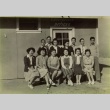
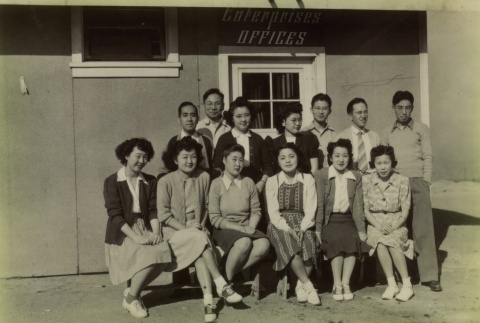
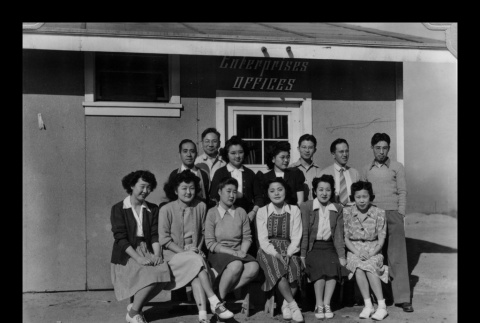
Office staff, Amache Consumer Enterprises (ddr-densho-163-17)
img Office staff, Amache Consumer Enterprises (ddr-densho-163-17)
Back (L to R): G. Akahoshi, B. Sato, R. Tanisaki, S. Hamatani, T. Shirokawa, E. Yoshimoto, N. Endo. Front (L to R): T. Miyano, T. Furuye, S. Nishihara, H. Hayashigawa, F. Yoshimura, T. Heya.
Four women posing with book, two in kimono (ddr-densho-534-89)
img Four women posing with book, two in kimono (ddr-densho-534-89)
Madame Josui Oshikawa and possibly author Hazel H. Gorham are shown with their book "Manuel of Japanese Flower Arrangement" alongside Pauline Sakahara and Sato Tamiki. The book has two covers: one in Japanese and one in English.
Dorothy H. Sato Interview Segment 1 (ddr-one-7-50-1)
vh Dorothy H. Sato Interview Segment 1 (ddr-one-7-50-1)
Family background

This material is based upon work assisted by a grant from the Department of the Interior, National Park Service. Any opinions, finding, and conclusions or recommendations expressed in this material are those of the author(s) and do not necessarily reflect the views of the Department of the Interior.

Dorothy H. Sato Interview Segment 9 (ddr-one-7-50-9)
vh Dorothy H. Sato Interview Segment 9 (ddr-one-7-50-9)
Mother's emotional difficulties adjusting to camp

This material is based upon work assisted by a grant from the Department of the Interior, National Park Service. Any opinions, finding, and conclusions or recommendations expressed in this material are those of the author(s) and do not necessarily reflect the views of the Department of the Interior.

Dorothy H. Sato Interview Segment 3 (ddr-one-7-50-3)
vh Dorothy H. Sato Interview Segment 3 (ddr-one-7-50-3)
Growing up in Seattle where parents ran a hotel

This material is based upon work assisted by a grant from the Department of the Interior, National Park Service. Any opinions, finding, and conclusions or recommendations expressed in this material are those of the author(s) and do not necessarily reflect the views of the Department of the …

Dorothy H. Sato Interview Segment 14 (ddr-one-7-50-14)
vh Dorothy H. Sato Interview Segment 14 (ddr-one-7-50-14)
Living on a farm

This material is based upon work assisted by a grant from the Department of the Interior, National Park Service. Any opinions, finding, and conclusions or recommendations expressed in this material are those of the author(s) and do not necessarily reflect the views of the Department of the Interior.

Dorothy H. Sato Interview Segment 7 (ddr-one-7-50-7)
vh Dorothy H. Sato Interview Segment 7 (ddr-one-7-50-7)
Hearing about the bombing of Pearl Harbor and preparing to leave home

This material is based upon work assisted by a grant from the Department of the Interior, National Park Service. Any opinions, finding, and conclusions or recommendations expressed in this material are those of the author(s) and do not necessarily reflect the views of the …

Dorothy H. Sato Interview Segment 12 (ddr-one-7-50-12)
vh Dorothy H. Sato Interview Segment 12 (ddr-one-7-50-12)
Enjoying living in Chicago

This material is based upon work assisted by a grant from the Department of the Interior, National Park Service. Any opinions, finding, and conclusions or recommendations expressed in this material are those of the author(s) and do not necessarily reflect the views of the Department of the Interior.

Dorothy H. Sato Interview Segment 2 (ddr-one-7-50-2)
vh Dorothy H. Sato Interview Segment 2 (ddr-one-7-50-2)
Description of parents

This material is based upon work assisted by a grant from the Department of the Interior, National Park Service. Any opinions, finding, and conclusions or recommendations expressed in this material are those of the author(s) and do not necessarily reflect the views of the Department of the Interior.

Dorothy H. Sato Interview Segment 5 (ddr-one-7-50-5)
vh Dorothy H. Sato Interview Segment 5 (ddr-one-7-50-5)
Attending diverse schools

This material is based upon work assisted by a grant from the Department of the Interior, National Park Service. Any opinions, finding, and conclusions or recommendations expressed in this material are those of the author(s) and do not necessarily reflect the views of the Department of the Interior.

Dorothy H. Sato Interview Segment 8 (ddr-one-7-50-8)
vh Dorothy H. Sato Interview Segment 8 (ddr-one-7-50-8)
First impressions of the Puyallup Assembly Center

This material is based upon work assisted by a grant from the Department of the Interior, National Park Service. Any opinions, finding, and conclusions or recommendations expressed in this material are those of the author(s) and do not necessarily reflect the views of the Department of the Interior.

Dorothy H. Sato Interview Segment 4 (ddr-one-7-50-4)
vh Dorothy H. Sato Interview Segment 4 (ddr-one-7-50-4)
Attending elementary school and starring in the school play

This material is based upon work assisted by a grant from the Department of the Interior, National Park Service. Any opinions, finding, and conclusions or recommendations expressed in this material are those of the author(s) and do not necessarily reflect the views of the Department of the …

Dorothy H. Sato Interview Segment 13 (ddr-one-7-50-13)
vh Dorothy H. Sato Interview Segment 13 (ddr-one-7-50-13)
Returning to Oregon and getting married; coping with in-laws

This material is based upon work assisted by a grant from the Department of the Interior, National Park Service. Any opinions, finding, and conclusions or recommendations expressed in this material are those of the author(s) and do not necessarily reflect the views of the Department of the …

Dorothy H. Sato Interview Segment 6 (ddr-one-7-50-6)
vh Dorothy H. Sato Interview Segment 6 (ddr-one-7-50-6)
Childhood memories

This material is based upon work assisted by a grant from the Department of the Interior, National Park Service. Any opinions, finding, and conclusions or recommendations expressed in this material are those of the author(s) and do not necessarily reflect the views of the Department of the Interior.

Dorothy H. Sato Interview Segment 15 (ddr-one-7-50-15)
vh Dorothy H. Sato Interview Segment 15 (ddr-one-7-50-15)
Husband's experiences in Hood River after the war

This material is based upon work assisted by a grant from the Department of the Interior, National Park Service. Any opinions, finding, and conclusions or recommendations expressed in this material are those of the author(s) and do not necessarily reflect the views of the Department of the Interior.

Dorothy H. Sato Interview Segment 10 (ddr-one-7-50-10)
vh Dorothy H. Sato Interview Segment 10 (ddr-one-7-50-10)
Leaving camp and moving to Chicago

This material is based upon work assisted by a grant from the Department of the Interior, National Park Service. Any opinions, finding, and conclusions or recommendations expressed in this material are those of the author(s) and do not necessarily reflect the views of the Department of the Interior.

Dorothy H. Sato Interview Segment 16 (ddr-one-7-50-16)
vh Dorothy H. Sato Interview Segment 16 (ddr-one-7-50-16)
Raising children

This material is based upon work assisted by a grant from the Department of the Interior, National Park Service. Any opinions, finding, and conclusions or recommendations expressed in this material are those of the author(s) and do not necessarily reflect the views of the Department of the Interior.

Dorothy H. Sato Interview Segment 11 (ddr-one-7-50-11)
vh Dorothy H. Sato Interview Segment 11 (ddr-one-7-50-11)
Brother's military service

This material is based upon work assisted by a grant from the Department of the Interior, National Park Service. Any opinions, finding, and conclusions or recommendations expressed in this material are those of the author(s) and do not necessarily reflect the views of the Department of the Interior.

Dorothy H. Sato Interview Segment 17 (ddr-one-7-50-17)
vh Dorothy H. Sato Interview Segment 17 (ddr-one-7-50-17)
Reflections

This material is based upon work assisted by a grant from the Department of the Interior, National Park Service. Any opinions, finding, and conclusions or recommendations expressed in this material are those of the author(s) and do not necessarily reflect the views of the Department of the Interior.

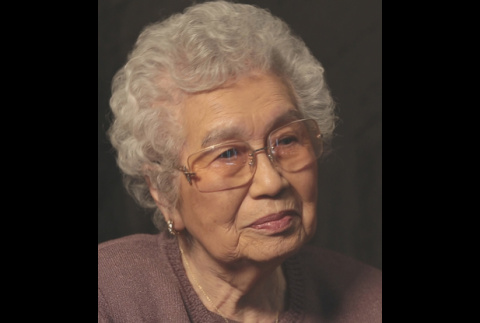
Narrator Dorothy H. Sato
Nisei female. Born May 24, 1923, in Carlisle, Washington. Grew up in Seattle, Washington, where parents ran a hotel. During World War II, removed to the Puyallup Assembly Center, Washington, and the Minidoka concentration camp, Idaho. After leaving camp, lived for a time in Chicago, Illinois, before returning to Oregon.
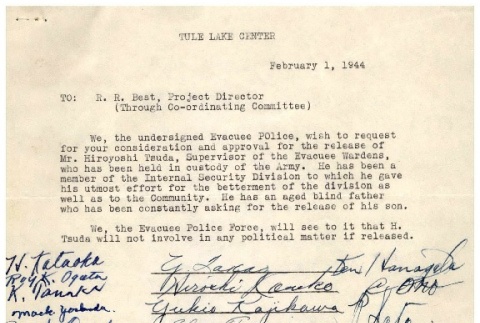
Letter from Evacuee Police to Raymond Best, Director of Tule Lake Camp, February 1, 1944 (ddr-csujad-2-13)
doc Letter from Evacuee Police to Raymond Best, Director of Tule Lake Camp, February 1, 1944 (ddr-csujad-2-13)
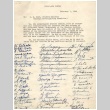
Letter from Evacuee Police Force to Raymond Best, Director of Tule Lake Camp, requesting the release of Hiroyoshi Tsuda from the army stockades at Tule Lake Camp. Signed names: Kataoka, H.; Okusako, Thomas; Ogata, Roy K.; Miyamoto, H.; Tanaka, K.; Haruyama, N.; Yoshida, Maeko; Hanagata, Ken; Ayabe, Toshi S.; Ono, I; Kanno, Thomas K.; Sato, R.; …
Office staff, Amache Co-op (ddr-csujad-55-1544)
img Office staff, Amache Co-op (ddr-csujad-55-1544)
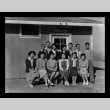
Black and white photograph of staff members at Amache Consumer Enterprises at Amache incarceration camp. Pictured from left to right (front row) T. Miyano, T. Furuye, S. Nishihara, H. Hayashigawa, F. Yoshimura, T. Heya (second row) G. Akahoshi, B. Sato, K. Tanisake, S. Hamatani, I. Shirokawa, Z. Yoshimoto, and N. Endo. From Amache Co-op Souvenir Album, …
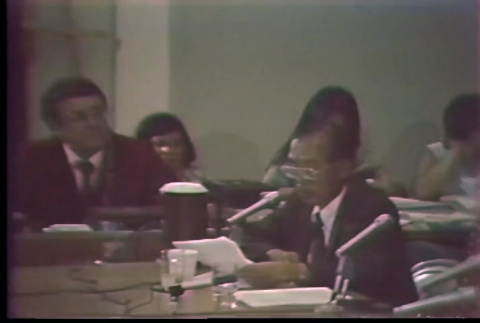
Speak Out for Justice: August 6, 1981 - Part 4 (ddr-densho-1024-112)
av Speak Out for Justice: August 6, 1981 - Part 4 (ddr-densho-1024-112)
Members from various associations and organizations provide legal viewpoints on the constitutional issues and impact of camp experiences on Japanese American psyche. All of them demand for monetary reparations and constitutional remedy. Introduction by Steve Nagano of NCRR and Nikkei Progressives. Part 4 Testifiers: Fred Okrand, Junji Kumamoto, Alan Terakawa, Carole Sei Morita, Rose Matsui Ochi, …
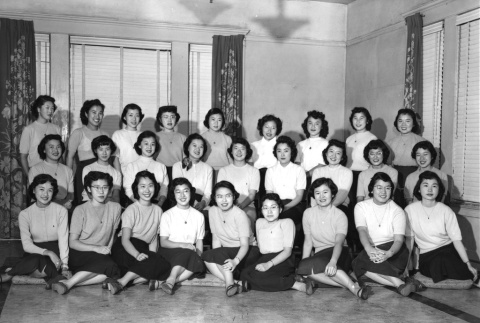
Sorelles Group Photo (ddr-one-1-4)
img Sorelles Group Photo (ddr-one-1-4)
Original black and white photographic print of the Sorelles, a high school social group. Back Row (left to right): Elsie Okazaki, Agnes (Inouye) Kitayama, Atsuko “Alice” Kida, Atsuko “Alice” (Matsumoto) Ando, Nami (Miura) Koida, Kimi Wakabayashi, Grace Mieko (Muramatsu) Ouchida, Masae “Elsie” (Morita) Onishi, and Betty Nakashimada. Middle Row (left to right): Rose Haruye (Muramatsu) Ouchida, …
API