Topics
Facilities
Format
Genre
Usage

Use <Ctrl> or (⌘) keys to select multiple terms

347 items
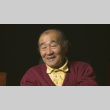
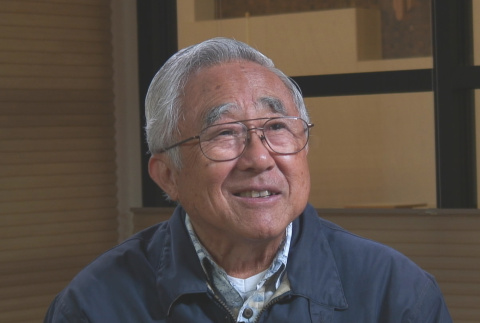
Frank S. Kawana Interview Segment 7 (ddr-densho-1000-367-7)
vh Frank S. Kawana Interview Segment 7 (ddr-densho-1000-367-7)
A child's memories of the Santa Anita assembly center

This material is based upon work assisted by a grant from the Department of the Interior, National Park Service. Any opinions, finding, and conclusions or recommendations expressed in this material are those of the author(s) and do not necessarily reflect the views of the Department of the …

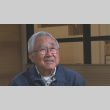
Bill Shishima Interview Segment 3 (ddr-densho-1011-1-3)
vh Bill Shishima Interview Segment 3 (ddr-densho-1011-1-3)
First impressions of the Santa Anita Assembly Center

This material is based upon work assisted by a grant from the Department of the Interior, National Park Service. Any opinions, finding, and conclusions or recommendations expressed in this material are those of the author(s) and do not necessarily reflect the views of the Department of the Interior.
Donald Yamamoto Interview Segment 2 (ddr-densho-1011-2-2)
vh Donald Yamamoto Interview Segment 2 (ddr-densho-1011-2-2)
First impressions of Santa Anita assembly center

This material is based upon work assisted by a grant from the Department of the Interior, National Park Service. Any opinions, finding, and conclusions or recommendations expressed in this material are those of the author(s) and do not necessarily reflect the views of the Department of the Interior.
Bill Hiroshi Shishima Interview Segment 9 (ddr-densho-1000-393-9)
vh Bill Hiroshi Shishima Interview Segment 9 (ddr-densho-1000-393-9)
First impressions of Santa Anita Assembly Center

This material is based upon work assisted by a grant from the Department of the Interior, National Park Service. Any opinions, finding, and conclusions or recommendations expressed in this material are those of the author(s) and do not necessarily reflect the views of the Department of the Interior.
Hy Shishino Interview Segment 11 (ddr-densho-1000-386-11)
vh Hy Shishino Interview Segment 11 (ddr-densho-1000-386-11)
First impressions of the Santa Anita Assembly Center

This material is based upon work assisted by a grant from the Department of the Interior, National Park Service. Any opinions, finding, and conclusions or recommendations expressed in this material are those of the author(s) and do not necessarily reflect the views of the Department of the Interior.

Japanese Americans waiting with baggage (ddr-densho-151-120)
img Japanese Americans waiting with baggage (ddr-densho-151-120)
Original caption: San Francisco, California. Evacuees of Japanese descent among a contingent of 664, first to be removed from San Francisco, awaiting buses at 2020 Van Ness Avenue to transport them to Santa Anita Park assembly center at Arcadia, California. Evacuees are transported later to War Relocation Authority centers for the duration.
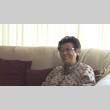
Michiko Hara Kawaguchi Interview (ddr-manz-1-115)
vh Michiko Hara Kawaguchi Interview (ddr-manz-1-115)
Nisei female. Born September 30, 1925, in San Francisco, California. Grew up in San Francisco where father ran a dry cleaning business. During World War II, removed to the Santa Anita Assembly Center, California, and the Topaz concentration camp, Utah. After leaving camp, lived in Indiana and attended college. Eventually returned to California.
June T. Watanabe Interview (ddr-manz-1-160)
vh June T. Watanabe Interview (ddr-manz-1-160)
Nisei female. Born 1924 in Venice, California. Grew up in Lawndale, California, where parents farmed. During World War II, removed to the Santa Anita Assembly Center, California, and the Rohwer concentration camp, Arkansas. After leaving camp, married and moved to Bloomington, Minnesota, while husband served in the military. Eventually returned to California.
Letter from Grace Sumida Nagai to Chimata Sumida (ddr-densho-379-29)
doc Letter from Grace Sumida Nagai to Chimata Sumida (ddr-densho-379-29)
Grace Sumida's letter to her father, Chimata Sumida regarding life at Santa Anita Assembly Center. She mentions that 5 adults occupy a 12' x 20' room in their barracks. She mentions that all Japanese reading material with the exception of Bibles, hymnals and dictionaries were contraband, and Japanese records were off limits as well.
Charles Oihe Hamasaki Interview Segment 24 (ddr-densho-1000-274-24)
vh Charles Oihe Hamasaki Interview Segment 24 (ddr-densho-1000-274-24)
Released from Bismarck and transferred to the Santa Anita assembly center, California

This material is based upon work assisted by a grant from the Department of the Interior, National Park Service. Any opinions, finding, and conclusions or recommendations expressed in this material are those of the author(s) and do not necessarily reflect the views of the …

Marshall M. Sumida Interview (ddr-densho-1000-332)
vh Marshall M. Sumida Interview (ddr-densho-1000-332)
Nisei male. Born August 26, 1921, in Los Angeles, California. Grew up in the Los Angeles area prior to World War II. After the bombing of Pearl Harbor, removed to the Santa Anita Assembly Center, California, and the Rohwer concentration camp, Arkansas. Drafted into the military and served in the Military Intelligence Service. Eventually returned to …
Administrative Notice No. 27 Transfer to Amache (ddr-densho-356-802)
doc Administrative Notice No. 27 Transfer to Amache (ddr-densho-356-802)
Administrative Notice No. 27 from Santa Anita Assembly Center contains information regarding personal belongings in storage outside of the camp remaining their until settled at Amache at which point individuals my request their items be shipped to camp at the WRA's expense. It also provides instructions regarding train travel to Amache including water conservation, cleanliness, and …
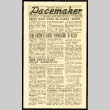
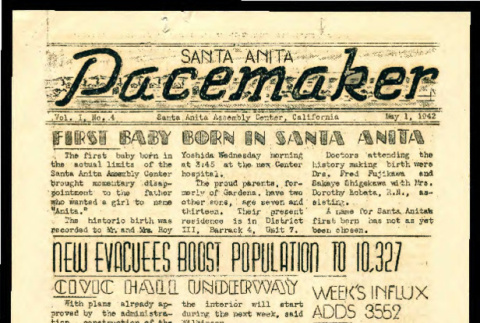
Santa Anita pacemaker, vol. 1, no. 4 (May 1, 1942) (ddr-csujad-55-1236)
doc Santa Anita pacemaker, vol. 1, no. 4 (May 1, 1942) (ddr-csujad-55-1236)
Biweekly newspaper published at the Santa Anita Assembly Center from April through October 1942. Current issue includes information on recreational activities, religious services, sports, a birth at the center, sanitation, postal services, personal property, fire prevention, classes, and other center services. See this object in the California State Universities Japanese American Digitization project site: sac_jaac_1238
Santa Anita pacemaker, vol. 1, no. 13 (June 2, 1942) (ddr-csujad-55-1245)
doc Santa Anita pacemaker, vol. 1, no. 13 (June 2, 1942) (ddr-csujad-55-1245)
Biweekly newspaper published at the Santa Anita Assembly Center from April through October 1942. Current issue includes information on recreational activities, religious services, sports, center population, jobs, a wedding, farmers, camp statistics, and the feature "Win, Place, and Show." See this object in the California State Universities Japanese American Digitization project site: sac_jaac_1247
Santa Anita pacemaker, vol. 1, no. 16 (June 9, 1942) (ddr-csujad-55-1248)
doc Santa Anita pacemaker, vol. 1, no. 16 (June 9, 1942) (ddr-csujad-55-1248)
Biweekly newspaper published at the Santa Anita Assembly Center from April through October 1942. Current issue includes information on recreational activities, religious services, sports, camouflage nets, handicrafts, and the feature ""Win, Place, and Show."" See this object in the California State Universities Japanese American Digitization project site: sac_jaac_1250
Santa Anita pacemaker, vol. 1, no. 15 (June 6, 1942) (ddr-csujad-55-1247)
doc Santa Anita pacemaker, vol. 1, no. 15 (June 6, 1942) (ddr-csujad-55-1247)
Biweekly newspaper published at the Santa Anita Assembly Center from April through October 1942. Current issue includes information on recreational activities, religious services, sports, elections, immunizations, handicrafts, election runners-up, camp news, and the feature "Win, Place, and Show." See this object in the California State Universities Japanese American Digitization project site: sac_jaac_1249
Santa Anita pacemaker, vol. 1, no. 14 (June 3, 1942) (ddr-csujad-55-1246)
doc Santa Anita pacemaker, vol. 1, no. 14 (June 3, 1942) (ddr-csujad-55-1246)
Biweekly newspaper published at the Santa Anita Assembly Center from April through October 1942. Current issue includes information on recreational activities, religious services, sports, elections, nominees, an editorial on democracy, and the feature ""Win, Place, and Show."" See this object in the California State Universities Japanese American Digitization project site: sac_jaac_1248
Santa Anita pacemaker, vol. 1, no. 6 (May 8, 1942) (ddr-csujad-55-1238)
doc Santa Anita pacemaker, vol. 1, no. 6 (May 8, 1942) (ddr-csujad-55-1238)
Biweekly newspaper published at the Santa Anita Assembly Center from April through October 1942. Current issue includes information on recreational activities, religious services, sports, mother's day, population at the center, milk station, and bedding equipment, and the feature "Win, Place, and Show." See this object in the California State Universities Japanese American Digitization project site: sac_jaac_1240
Santa Anita pacemaker, vol. 1, no. 10 (May 22, 1942) (ddr-csujad-55-1242)
doc Santa Anita pacemaker, vol. 1, no. 10 (May 22, 1942) (ddr-csujad-55-1242)
Biweekly newspaper published at the Santa Anita Assembly Center from April through October 1942. Current issue includes information on recreational activities, religious services, sports, food, center residents, clubs, classes, bedding, and the feature "Win, Place, and Show." See this object in the California State Universities Japanese American Digitization project site: sac_jaac_1244
Bob Berry Interview (ddr-densho-1011-3)
vh Bob Berry Interview (ddr-densho-1011-3)
White male. Grew up in Pasadena, California, where parents had a flower growing business. Provided flowers for the Santa Anita racetrack for over fifty years. During World War II, visited Japanese American friends at the Santa Anita Assembly Center, California, and the Gila River concentration camp, Arizona.

(This material is based upon work assisted by a …
Art Ishida Interview Segment 13 (ddr-densho-1000-363-13)
vh Art Ishida Interview Segment 13 (ddr-densho-1000-363-13)
Going to assembly center in a caravan of private cars; memories of Santa Anita

This material is based upon work assisted by a grant from the Department of the Interior, National Park Service. Any opinions, finding, and conclusions or recommendations expressed in this material are those of the author(s) and do not necessarily reflect the views …

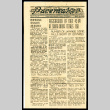
Administrative notice, no. 23 (August 11, 1942) (ddr-csujad-42-157)
doc Administrative notice, no. 23 (August 11, 1942) (ddr-csujad-42-157)
An issue of "Administrative notice" circulated in the Santa Anita Assembly Center. It instructs the incarcerees to register, who own rentable properties used for dwelling accommodations in the defense-rental areas. See this object in the California State Universities Japanese American Digitization project site: tak_01_79_001
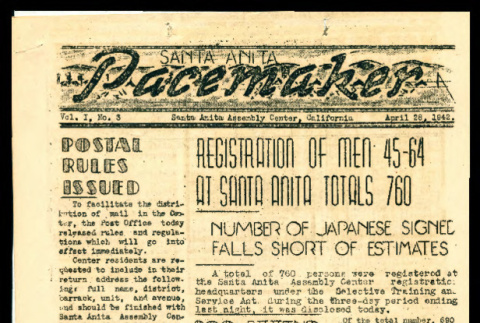
Santa Anita pacemaker, vol. 1, no. 3 (April 28, 1942) (ddr-csujad-55-1235)
doc Santa Anita pacemaker, vol. 1, no. 3 (April 28, 1942) (ddr-csujad-55-1235)
Biweekly newspaper published at the Santa Anita Assembly Center from April through October 1942. Current issue includes information on recreational activities, religious services, sports, postal services, registration, and camp facilities. See this object in the California State Universities Japanese American Digitization project site: sac_jaac_1237
Yooichi Wakamiya Interview (ddr-manz-1-87)
vh Yooichi Wakamiya Interview (ddr-manz-1-87)
Nisei male. Born July 10, 1933, in Hawthorne, California. Grew up in Hawthorne where parents ran a flower growing business. During World War II, removed with family to the Santa Anita Assembly Center, California, and the Rohwer concentration camp, Arkansas. After leaving camp, lived with family for a time in a trailer camp in Los Angeles, …
Crusaders Collection (ddr-janm-19)
Collection Crusaders Collection (ddr-janm-19)
Mary Yuri Nakahara (later known as Yuri Kochiyama) founded a young women's social organization while at Santa Anita Assembly Center called the Crusaders. The members later spread out to multiple incarceration sites, and many members wrote letters to Japanese American servicemen. The Crusaders assembled scrapbooks of letters received, including this one compiled by Rinko Shimasaki. Also …
API