
933 items



933 items

doc
Letter from Carlos Bee to Kimi Fujii (ddr-densho-433-62)
Carlos Bee writes to Kimi Fujii with an updated date for a meeting.

doc
Letter from Edmund G. Brown to Kimiko Fujii (ddr-densho-433-444)
Edmund G. Brown, Governor of California, writes to Kimiko Fujii about her election as a Congressional District Co-Chairman of the State Committee.

doc
Letter from Stacy Burton to Kimiko Fujii (ddr-densho-433-54)
Stacy Burton writes to Kimiko Fujii about a check with a missing endorsement.

img
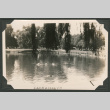
BYU reunion group photograph (ddr-densho-433-303)
A Brigham Young University reunion group photograph. Kimiko Fujii Kitayama is standing in the center with a navy cardigan and checked dress.
av
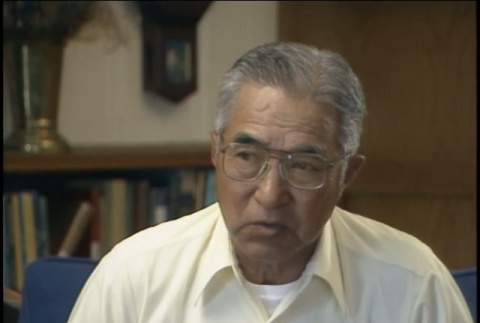
Interview with Shiro Tokuno, part 1 of 4 (ddr-densho-1007-1781)
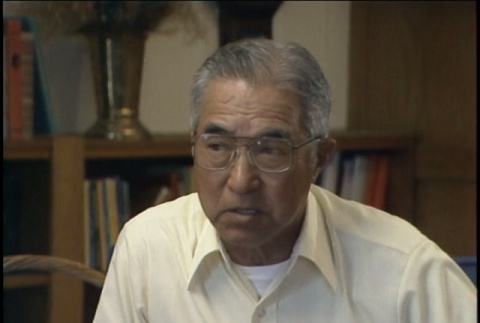
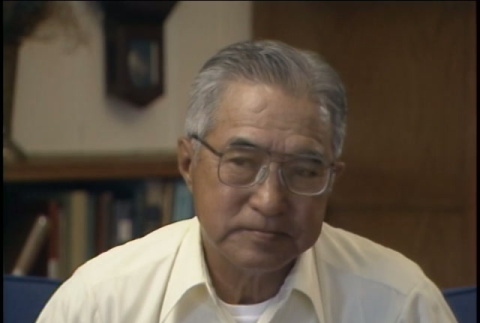
Tokuno discusses his time in occupied Japan, giving out sandwiches on Christmas, a commanding officer of his during occupation who wanted all shops removed from Ginza and the difficulty some officers had understanding cultural and economic issues. Loni Ding can be heard asking questions behind the camera. Original title: II SAC #1, 9-6-85, Shiro T.. Interview …
av
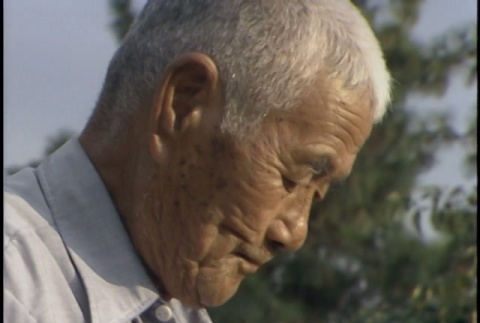
John Kaneko and father digging; interview with father (ddr-densho-1007-1650)
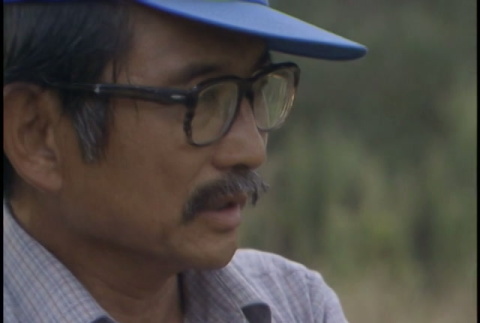
John Kaneko and his father dig in a field; Loni asks the father about his time in Japan and the US. Original title: 135, II SAC #6, 9-7-85, John & father dig and talk
av
B-roll of John Kaneko digging (ddr-densho-1007-1652)
Footage of John Kaneko digging on his family's land. Loni Ding and her crew can be heard in the background. Some black and white stills from 15:18, a bit more digging just before the tape ends. Original title: 137, II SAC #8, 9-7-85, B/W shots of digging/[illegible]
av
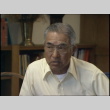
Interview with Shiro Tokuno, part 2 of 4 (ddr-densho-1007-1782)
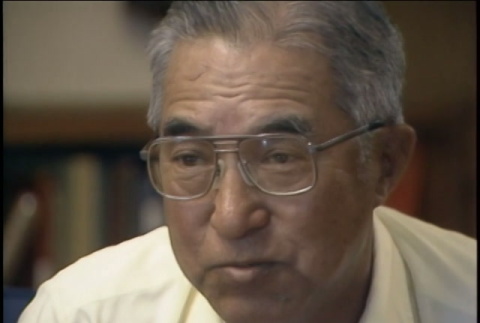
Tokuno discusses food distribution and hunger issues in post-war Japan, working on rice collection in Saga Prefecture, the story of a Japanese veteran who was nearly sent back home on his way to a hospital, and how the Nisei were viewed by Japanese nationals. Loni Ding can be heard asking quetsions behind the camera. Original title: …
doc
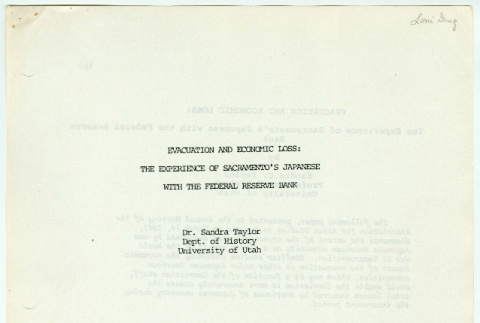
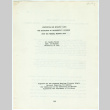
Evacuation and Economic Loss: The Experience of Sacramento's Japanese with the Federal Reserve Bank (ddr-densho-1007-1500)
Loni Ding's name written in top left corner.
av
Interview with John Kaneko (ddr-densho-1007-1651)
John Kaneko tells the story of his family burying many of their Japanese possessions before evacuation. Loni Ding can be heard asking questions behind the camera. Original title: 136, II SAC #7, 9-7-85, John tells the story
av
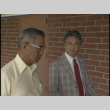
Shiro Tokuno & Mr. Matsumoto walking and talking (ddr-densho-1007-1649)
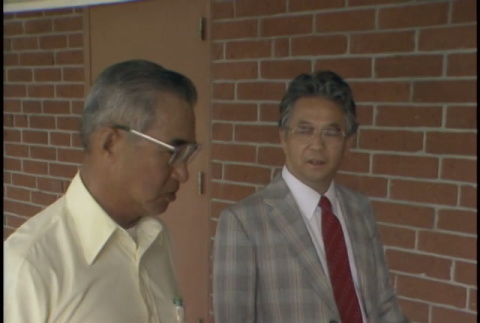
Footage of two men walking and talking in Japanese. Tokuno is on the left, in yellow; Mr. Matsumoto is not named. Loni Ding and her crew can be heard behind the camera. Original title: 134, II SAC #5, 9-7-85, Shiro & Mr. Matsumoto on walk
av
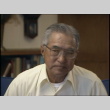
Interview with Shiro Tokuno, part 4 of 4 (ddr-densho-1007-1784)
Tokuno discusses his work in the land reform program in occupied Japan, his lifelong interest in Japanese agriculture, his relationship with Mr. Matsumoto (a high-ranking Japanese official working in agriculture), California's water distribution system, and what the US could learn from Japanese agriculture. Loni Ding can be heard asking questions behind the camera. Original title: II …
doc
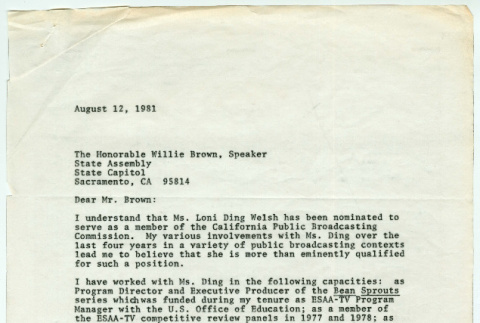
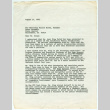
Letter from Dave Berkman to Willie Brown (ddr-densho-1007-1505)
Endorses Loni Ding for membership on the California Public Broadcasting Commission.
av
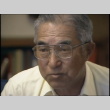
Interview with Shiro Tokuno, part 3 of 4 (ddr-densho-1007-1783)
Tokuno discusses the role of Nisei in the occupation, the attitudes Japanese nationals and American officers had toward Nisei, his service managing agricultural/forestry/fisheries/mining in occupied Japan, the policies he helped implement, moving to Sacramento and farming after the war, deciding to go into military intelligence, his mother's thoughts on him joining the military, and working with …
img
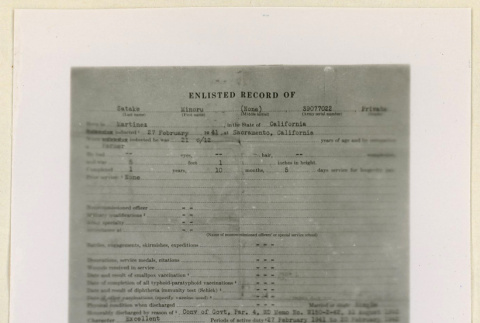
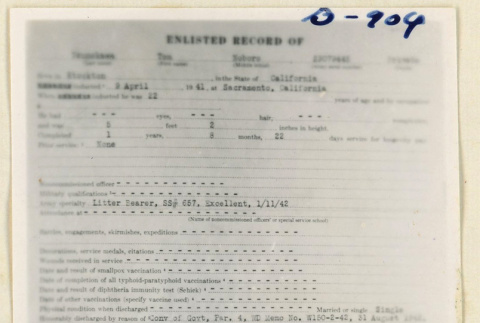
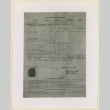
Enlisted record of Satake Minoru (ddr-densho-37-1141)
Included annotation: A-503-504, Minoru Satake.
img
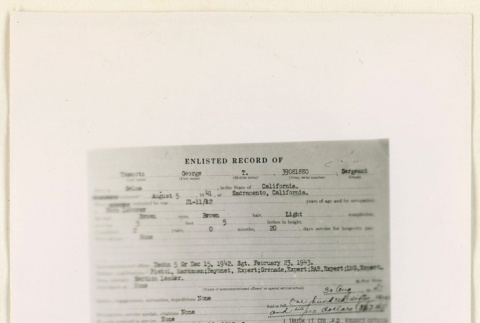
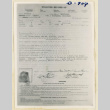
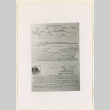
George T. Umamoto enlisted record (ddr-densho-37-1011)
Included annotation: B-406, George T. Umamoto, 23-10-B.
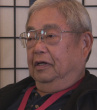
Narrator Richard M. Murakami
Sansei male. Born January 29, 1932, in Florin, California. Grew up in Sacramento, California, where father ran a farm. After the bombing of Pearl Harbor, returned with family to Florin. Removed to the Marysville Assembly Center, California, and the Tule Lake concentration camp, California. After the so-called "loyalty questionnaire" in 1943, transferred to the Jerome concentration …
doc
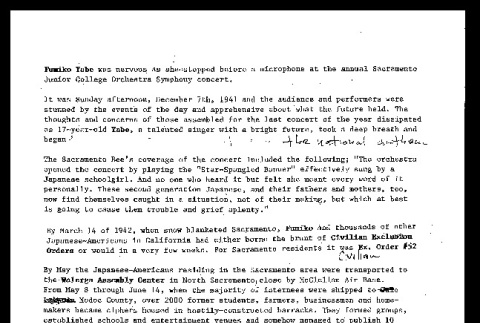
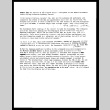
Fumiko Yabe (ddr-csujad-55-2517)
Essay about Japanese American singer Fumiko Yabe. Covers Yabe's performances on December 7, 1941 and in June 1942 at the Walerga Assembly Center, that is, the Sacramento Assembly Center. See also sac_jaac_2622. See this object in the California State Universities Japanese American Digitization project site: sac_jaac_2623
Narrator Kazie Good
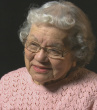
Nisei female. Born May 6, 1925, in Sacramento, California. During World War II, sent with family to the Sacramento Assembly Center, California, and the Tule Lake concentration camp, California. Due to father's refusal to answer the so-called "loyalty questions" in 1943, the family remained in Tule Lake when it was turned into a segregation center. Subject …
vh
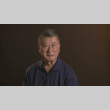
Jack Dairiki Interview (ddr-densho-1000-325)
Kibei male. Born December 25, 1930 in Sacramento, California. Grew up in Sacramento where parents ran a hotel. In 1941, traveled to Japan with father to Japan, then could not return to the United States because of impending war. Was living in Hiroshima when the United States dropped the atomic bomb in 1945. Returned to the …
vh
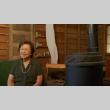
Sumi Uyeda Interview (ddr-densho-1011-8)
Nisei female. Born 1932 in Sacramento, California. Grew up in the small town of Penryn, California, where mother was a barber. During World War II, removed to the Marysville Assembly Center and Tule Lake concentration camp, California. After leaving camp, returned to Penryn.
(This material is based upon work assisted by a grant from the Department …
vh
Chizuko Judy Sugita de Quieiroz Interview (ddr-densho-1000-252)
Nisei female. Born September 15, 1932, in Lodi, California. Grew up in Jersey Island, a small island in the Sacramento Delta. Following the bombing of Pearl Harbor on December 7, 1941, removed to the Poston concentration camp, Arizona. After leaving camp, returned with family to Los Angeles, California. Graduated from Long Beach State and earned a …
Narrator Harry Umeda
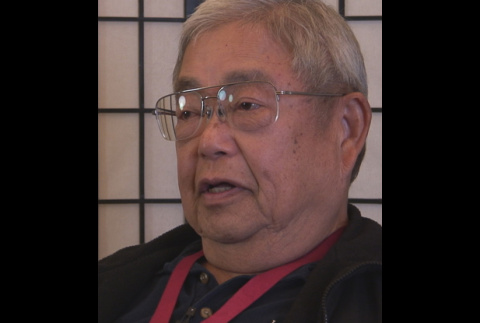
Nisei male. Born May 12, 1915, in Sacramento, California. Grew up in Sacramento, where parents ran a successful farm. Drafted into the military in 1941, prior to the bombing of Pearl Harbor. Served in the Military Intelligence Service, interrogating Japanese prisoners of war in New Guinea and the Philippines. After returning to the U.S., settled in …