
1379 items


1379 items

av
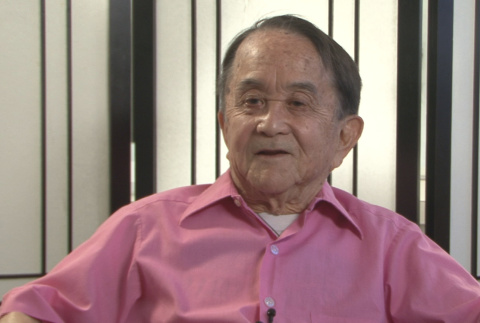
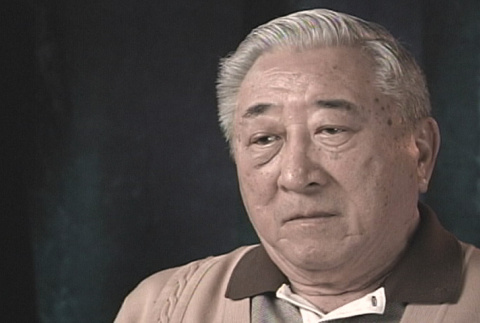
Oral history with Richard Matsunaga (ddr-csujad-29-73)
An oral interview with Richard Matsunaga, resident living in Hawaii during the attack on Pearl Harbor. The interview was conducted for the Japanese American Oral History Project by California State University, Fullerton. Transcript is found in item: csufccop_jaoh_0182. See this object in the California State Universities Japanese American Digitization project site: 1428.1_T01

av
Oral history with Richard Matsunaga (ddr-csujad-29-74)
An oral interview with Richard Matsunaga, resident living in Hawaii during the attack on Pearl Harbor. The interview was conducted for the Japanese American Oral History Project by California State University, Fullerton. Transcript is found in item: csufccop_jaoh_0184. See this object in the California State Universities Japanese American Digitization project site: 1428.2_T01
vh
James Nishimura Interview (ddr-manz-1-33)
Nisei male. Born February 6, 1930, in Seattle, Washington. Following the bombing of Pearl Harbor, was removed to the Puyallup Assembly Center, Washington, and Minidoka concentration camp, Idaho. While in camp, was allowed to leave to attend high school for one year in the nearby town of Eden, Idaho. After leaving camp, Mr. Nishimura moved to …
vh
Osamu Mori Interview (ddr-manz-1-93)
Nisei male. Born July 13, 1928, in Wilmington, California. Grew up in San Pedro, California, where parents operated a farm. After the bombing of Pearl Harbor on December 7, 1941, removed with family to the Santa Anita Assembly Center, California, and the Jerome concentration camp, Arkansas. Family answered "no-no" on the so-called "loyalty questionnaire," and was …
vh
Shoichi Kobara Interview (ddr-densho-1015-8)
Nisei male. Born April 23, 1922, in Watsonville, California. Grew up in Watsonville until age six, then family moved to Salinas. Following the bombing of Pearl Harbor, removed to Salinas Assembly Center, California, and the Poston concentration camp, Arizona. After leaving camp, lived and worked in Utah for a time before serving in Japan in the …
vh
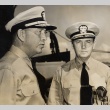
Eugene Tatsuru Kimura Interview (ddr-densho-1000-231)
Nisei male. Born September 19, 1922, in Sheridan, Wyoming. At a young age, moved to Seattle, Washington, and spent most of childhood there. Was enrolled at the University of Washington when Japan bombed Pearl Harbor on December 7, 1941. Removed to the Puyallup Assembly Center, Washington, before returning with family to Sheridan. Attended the University of …
img
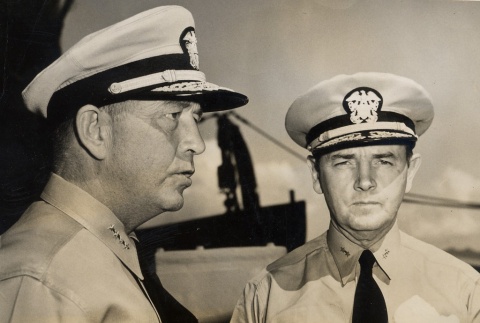
Admiral Arthur W. Radford and Rear Admiral Charles C. Hartman (ddr-njpa-1-1456)
Caption on reverse: Adm. Radford welcomes Adm. Hartman: Adm. Arthur W. Radford (left), commander-in-chief of the Pacific Fleet, is shown greeting Rear Adm. Charles C. Hartman, commander of Cruiser Division Three, aboard the U.S. heavy cruiser Helena which arrived at Pearl Harbor from the Korean war zone yesterday afternoon. Arriving with the Helena were the heavy …
vh
Sharon Tanagi Aburano Interview II (ddr-densho-1000-209)
Nisei female. Born October 31, 1925, in Seattle, Washington. Family owned and operated a successful grocery store prior to World War II. After the bombing of Pearl Harbor, removed to the Puyallup Assembly Center, Washington, and the Minidoka concentration camp, Idaho. Left camp in 1944 to attend St. Mary's School of Nursing in Rochester, Minnesota. Worked …
vh
Kazumi Yoneyama Interview (ddr-densho-1000-412)
Nisei male. Born March 10, 1932, in Hollywood, California. After the bombing of Pearl Harbor, family moved to Sanger, California, to avoid mass removal, but were sent to camp anyway when the removal area was expanded. Removed to the Gila River concentration camp, Arizona. After leaving camp, returned to Los Angeles, finished school, and became a …
vh
Sharon Tanagi Aburano Interview I (ddr-densho-1000-208)
Nisei female. Born October 31, 1925, in Seattle, Washington. Family owned and operated a successful grocery store prior to World War II. After the bombing of Pearl Harbor, removed to the Puyallup Assembly Center, Washington, and the Minidoka concentration camp, Idaho. Left camp in 1944 to attend St. Mary's School of Nursing in Rochester, Minnesota. Worked …
vh
Grace Watanabe Kimura Interview (ddr-densho-1000-249)
Nisei female. Born 1925 in Los Angeles, California. Grew up in Boyle Heights, where father was a prominent Baptist minister, establishing his own church. Following the bombing of Pearl Harbor on December 7, 1941, removed with family to the Poston concentration camp, Arizona. Obtained student leave to finish high school in Abilene, Texas. Post-World War II, …
vh
Sarah Sato Interview (ddr-densho-1000-81)
Sansei female. (Mother and father born in Hawaii.) Born February 1925 in Peru. Spent prewar childhood in Peru and Hawaii. Father picked up by the FBI and detained after bombing of Pearl Harbor. Was incarcerated at Jerome concentration camp, Arkansas, and Tule Lake concentration camp, California. Renounced citizenship in order to stay with parents, and was …
vh
Zen Shibayama Interview (ddr-densho-1001-15)
Nisei male. Born July 5, 1924, in Seattle, Washington, but raised in Bainbridge Island, Washington. Lived in Japan for several years, returning to the U.S. just prior to the bombing of Pearl Harbor in 1941. Moved with family to Moses Lake, Washington, as part of "voluntary evacuation." Drafted into the army and served with the Military …
av
Interview with Sen Nishiyama, part 2 of 5 (ddr-densho-1007-1672)
Nishiyama discusses working with the occupation govnerment, rebuilding telecommunications infrastructure after the war, advocating against the romanization of written Japanese, the laws imposed by the occupation government, and his reaction to Pearl Harbor. Loni Ding can be heard asking questions behind the camera. Original title: II JA #6, Sen Nishiyama, Fri. Jan. 31, 1986. Interview continues …
vh
Toru Sakahara - Kiyo Sakahara Interview I Segment 27 (ddr-densho-1000-76-27)
Atmosphere and events following Pearl Harbor: denied service at a barbershop, being under surveillance by the FBI
This interview was conducted over two days at the Sakaharas' home.
vh
Takashi Matsui Interview Segment 9 (ddr-densho-1008-4-9)
Attitude towards attack on Pearl Harbor: a cowardly move
Members of the National Japanese American Historical Society (NJAHS) arranged for and conducted this interview in conjunction with Densho.
vh
Akiko Kurose Interview II Segment 5 (ddr-densho-1000-42-5)
Attending school the day after the bombing of Pearl Harbor
Mrs. Kurose was undergoing treatment for cancer and required frequent breaks and medication to help her with pain management.
vh
Rudy Tokiwa Interview II Segment 14 (ddr-densho-1000-92-14)
Remembering the Pearl Harbor bombing and a visit from the FBI
This interview was conducted at the 1998 Americans of Japanese Ancestry Veterans National Convention, held in Honolulu, Hawaii.
vh
Robert Mizukami Interview Segment 8 (ddr-densho-1000-114-8)
Surprise upon hearing of Pearl Harbor bombing
This is the first in a series of interviews conducted by the Puyallup Valley Japanese American Citizen League in collaboration with Densho.
doc
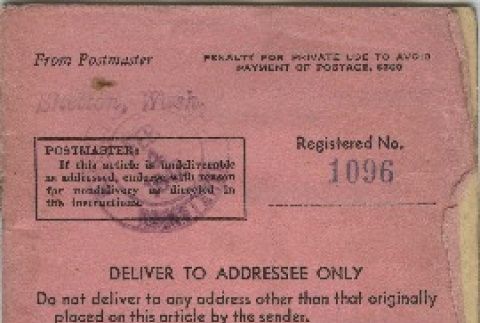
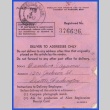
Alien certificate of identification (ddr-densho-23-8)
After the bombing of Pearl Harbor on December 7, 1941, Issei were required to carry identification documents because of their alien status. (Issei were barred from becoming naturalized citizens until 1952.) This document belonged to Bunshiro Tazuma, a permanent resident of Seattle since 1917. The identification certificate was the same size as an American passport and …
doc
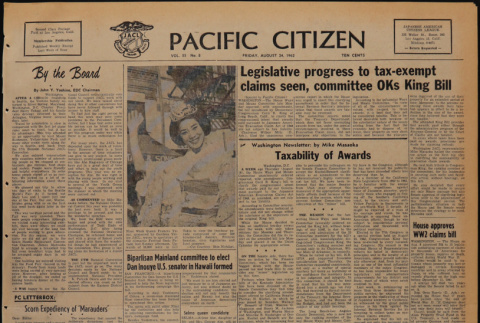
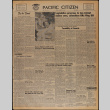
Pacific Citizen, Vol. 55, No. 8 (August 24, 1962) (ddr-pc-34-34)
Selected article titles: "Legislative Progress to Tax-Exempt Claims Seen, Committee Oks King Bill" (p.1), "House Approves WW2 Claims Bill" (p.1), "Nihonmachi Project Diagrams Presented" (p.1), "'Are You Really an America!' Badgers Nisei Students with UCLA's Project India" (p.1), "Internal Revenue Service Slashes Open a Wound" (p.2), "Pearl Harbor Spy Story Interest Revived by German Window's Suit …
doc
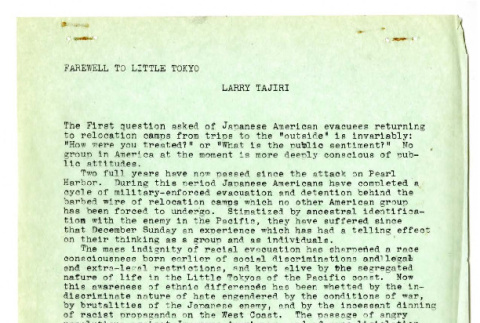
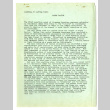
Farewell to Little Tokyo (ddr-csujad-19-76)
This document describes the sentiment of the American people towards the Japanese Americans after the attack on Pearl Harbor. It also describes the "military-forced effect of the evacuation and detention behind the barbed wire of relocation camps" on the Japanese American people. See this object in the California State Universities Japanese American Digitization project site: WRA_02-25_01
doc
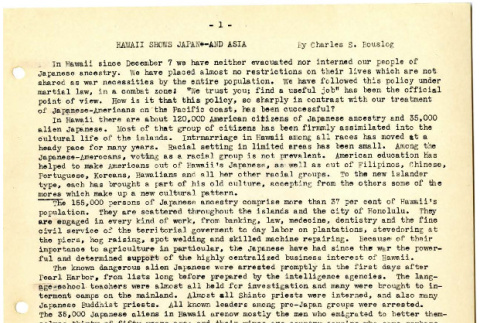
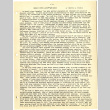
Hawaii shows Japan and Asia (ddr-csujad-19-40)
This is an article by Charles S. Bouslog from the magazine "Asia and the Americas," vol. 43, no. 2 (February 1943) which describes the life of the people of Japanese ancestry in Hawaii after the attack on Pearl Harbor on December 7, 1941. See this object in the California State Universities Japanese American Digitization project site: …
img
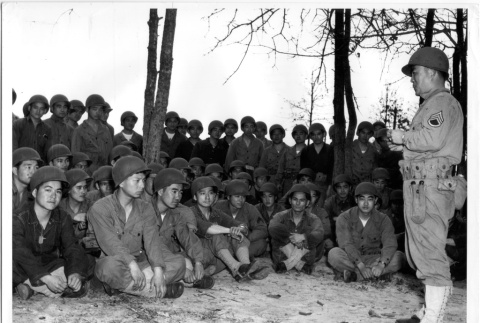
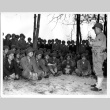
100th Infantry Battalion training (ddr-densho-114-114)
Original caption: Japanese-Americans in Army Train to Avenge Pearl Harbor: 100th Infantry Battalion Officers and some of the enlisted men are of Japanese ancestry. American citizens, born in the Hawaiian Islands of unquestioned loyalty and patriotism. Formerly part of the Hawaiian National Guard: S/Sgt. Harry Mijamoto, who was a professional boxer in his days as a …
doc
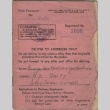
Alien certificate of identification (ddr-densho-126-6)
After the bombing of Pearl Harbor on December 7, 1941, Issei were required to carry identification documents because of their alien status. (Issei were barred from becoming naturalized citizens until 1952.) This document belonged to George Mitsutaro Yoshihara, a permanent U.S. resident since 1902. The identification certificate was the same size as an American passport and …