This material is based upon work assisted by a grant from the Department of the Interior, National Park Service. Any opinions, finding, and conclusions or recommendations expressed in this material are those of the author(s) and do not necessarily reflect the views of the Department of the Interior.
Leaving camp and raising family in Ontario, Oregon
This material is based upon work assisted by a grant from the Department of the Interior, National Park Service. Any opinions, finding, and conclusions or recommendations expressed in this material are those of the author(s) and do not necessarily reflect the views of the Department of the Interior.
This material is based upon work assisted by a grant from the Department of the Interior, National Park Service. Any opinions, finding, and conclusions or recommendations expressed in this material are those of the author(s) and do not necessarily reflect the views of the Department of the Interior.
This material is based upon work assisted by a grant from the Department of the Interior, National Park Service. Any opinions, finding, and conclusions or recommendations expressed in this material are those of the author(s) and do not necessarily reflect the views of the Department of the Interior.
This material is based upon work assisted by a grant from the Department of the Interior, National Park Service. Any opinions, finding, and conclusions or recommendations expressed in this material are those of the author(s) and do not necessarily reflect the views of the Department of the Interior.
This material is based upon work assisted by a grant from the Department of the Interior, National Park Service. Any opinions, finding, and conclusions or recommendations expressed in this material are those of the author(s) and do not necessarily reflect the views of the Department of the Interior.
This material is based upon work assisted by a grant from the Department of the Interior, National Park Service. Any opinions, finding, and conclusions or recommendations expressed in this material are those of the author(s) and do not necessarily reflect the views of the Department of the Interior.
This material is based upon work assisted by a grant from the Department of the Interior, National Park Service. Any opinions, finding, and conclusions or recommendations expressed in this material are those of the author(s) and do not necessarily reflect the views of the Department of the Interior.
Family background and mother's decision to send son to Japan
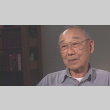
This interview was conducted at the 1998 Tule Lake Pilgrimage held at Klamath Falls, Oregon and at the site of Tule Lake incarceration camp in California. Given the limited time available during this event, the length and breadth of this interview are shorter than other Densho …
Resisting the Japanese way of teaching,"...regimentation, constant examination"
This interview was conducted at the 1998 Tule Lake Pilgrimage held at Klamath Falls, Oregon and at the site of Tule Lake incarceration camp in California. Given the limited time available during this event, the length and breadth of this interview are shorter than other Densho interviews.
This interview was conducted at the 1998 Tule Lake Pilgrimage held at Klamath Falls, Oregon and at the site of Tule Lake incarceration camp in California. Given the limited time available during this event, the length and breadth of this interview are shorter than other Densho interviews.
Being raised with Japanese values and customs in America
This interview was conducted at the 1998 Tule Lake Pilgrimage held at Klamath Falls, Oregon and at the site of Tule Lake incarceration camp in California. Given the limited time available during this event, the length and breadth of this interview are shorter than other Densho interviews.
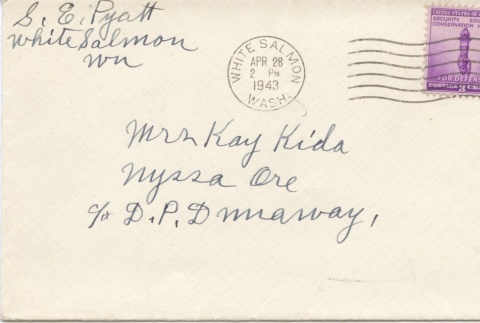
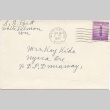
Envelope addressed to Miyuki "Kay" Kida in Nyssa, Oregon. Letter from "Grandma" (Sarah "Sade" Pyatt) to her "children" (the Kida family) dated January 4, 1943. Says she misses the Kida family and hopes the war will end soon so they can come home. Discusses her health problems.
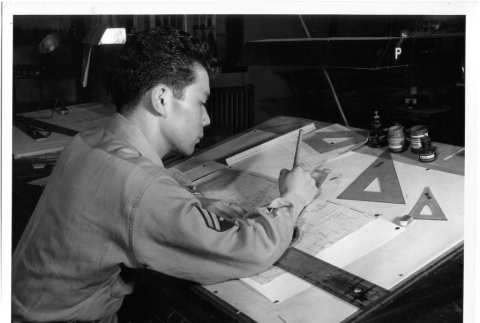
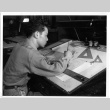
Original caption: Tec 5 George Fuyasho of Portland, Oregon, a Nisei Japanese draftsman for the Allied translator and interpreter section, General Headquarters, Allied Forces in the Pacific, prepares sketches and maps necessary for the production of documents, Floor plans and blueprints. Tokyo, Japan. 9-3-46.
Postcard from Mitsuko to Ruth Monroe in the Poston incarceration camp depicting Klamath Falls, Oregon. See this object in the California State Universities Japanese American Digitization project site: sac_jaac_2130
Newsletter covering the following topics: PNWDC votes no on Oregon anti-gay referendum; Seattle receives on of first of the Legacy Fund Grants; Installation Banquet to be January 15, 1993 at Southcenter Doubletree, $35, honoring George Tsutakawa and Paul Horiuchi; Congress passes bill for JA Memorial.
Nisei male. Born July 31, 1926, in Kelton, Utah. Grew up in Kelton, where father worked for the railroad. After the bombing of Pearl Harbor, father was fired from the railroad. Mr. Yagi was drafted into the military during World War II. Eventually moved to Portland, Oregon.
Black and white photographic negative of Misty (Kiyomura) Takeoka sitting in front of a white backdrop in the Oregon Camera Club's studio. She wears a formal dress with her body facing left as she leans slightly against the table in front of her with a forced smile.
Black and white photographic negative of Tom Fujii (left) and Shig Tada (right) sitting on Yoji Kiso at the Oregon Coast at a beach outing planned by the Sorrelles (a high school social group). Aki (Shiraishi) Dong is laying in the sand next to Yoji Kiso.
Black and white photographic negative of Misty (Kiyomura) Takeoka sitting in front of a white backdrop inside the Oregon Camera Club's studio. She is wearing a formal dress with her arm resting on a table in front of her looking up at the camera with her eyes.
Black and white photographic negative of Misty (Kiyomura) Takeoka sitting in front of a white backdrop inside the Oregon Camera Club's studio. She is wearing a formal dress with her arm resting on a table in front of her looking up at the camera with her face.
Nisei female. Born January 22, 1923, in Wilsonville, Oregon. Taken to Japan to live with family for a few years before the outbreak of World War II. Returned alone to Oregon to join sister at age sixteen with the help of a white benefactor. Removed to the Portland Assembly Center, Oregon, but then left immediately to …
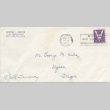
Envelope addressed to George Kida in Nyssa, Oregon. Letter from Dan and Sarah Mosier to George Kida and his parents, Kenjiro and Kay, dated June 20, 1943. Says it has been about 18 months since they have heard from the Kida family. Asks if they were allowed to return to their ranch but notes that their …
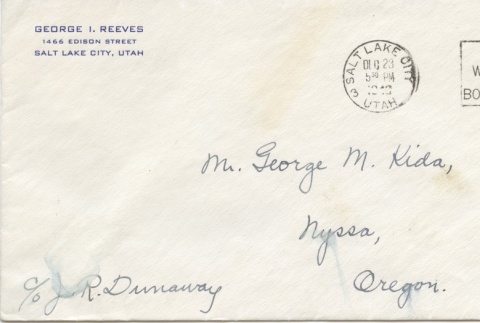
Two letters dated December 22, 1943, one from Miriam Reeves to Miyuki "Kay" Kida, the other from George Reeves to the Kida family. The letter from Miriam Reeves describes her new hobby of knitting. Mentions that she had just finished knitting a suit for a Japanese American girl who was an evacuee from Los Angeles but …
Nisei male. Born December 28, 1924, in Hood River, Oregon. Grew up in Hood River, where father and uncles ran a store. During World War II, removed to the Pinedale Assembly Center, California, and the Tule Lake concentration camp, California. After leaving camp, attended college in Denver and Philadelphia. Eventually became a physician and returned to …