
131 items
131 items
doc
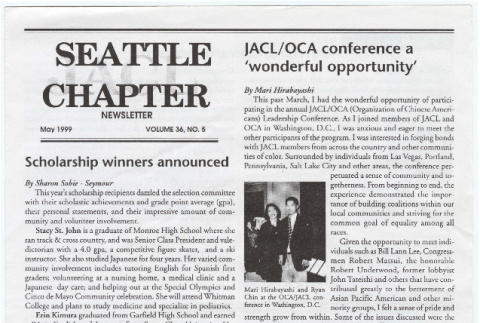
Seattle Chapter, JACL Reporter, Vol. 36, No. 5, May 1999 (ddr-sjacl-1-462)
Newsletter covering the following topics: Scholarship winners Stacy St. John, Erin Kimura, Junko Nishimura, and Christine Beppu; Mari Hirabayashi attends JACL/OCA Leadership Conference in Washington DC; Seattle JACL receives the Samuel McKinney Racial Justice and Reconciliation Award from the Church Council of Greater Seattle for the leadership in the I-200 campaign. Elaine Akagi, Jeffrey Hattori, Janice …
vh
Peggie Nishimura Bain Interview Segment 11 (ddr-densho-1000-170-11)
Older sister contracts tuberculosis, wants to go to Idaho
vh
Peggie Nishimura Bain Interview Segment 16 (ddr-densho-1000-170-16)
Staying in Seattle's Fujin Home, a home for women run by the Japanese Baptist Church
vh
Peggie Nishimura Bain Interview Segment 31 (ddr-densho-1000-170-31)
Harsh conditions in assembly center: heat, lines, poor facilities
vh
Peggie Nishimura Bain Interview Segment 27 (ddr-densho-1000-170-27)
Thoughts of war prior to 1941: "I don't think I took war that seriously"
vh
Peggie Nishimura Bain Interview Segment 48 (ddr-densho-1000-170-48)
Facing discrimination and unpleasant conditions while trying to find housing
vh
Peggie Nishimura Bain Interview Segment 7 (ddr-densho-1000-170-7)
Childhood memories: school activities, using cultivator on family farm
vh
Peggie Nishimura Bain Interview Segment 34 (ddr-densho-1000-170-34)
Receiving treatment in an concentration camp hospital
vh
Peggie Nishimura Bain Interview Segment 10 (ddr-densho-1000-170-10)
Working in a restaurant in Seattle's Nihonmachi, or Japantown
vh
Peggie Nishimura Bain Interview Segment 47 (ddr-densho-1000-170-47)
Leaving camp and moving to Chicago: "I thought, 'This is terrible'"
vh
Peggie Nishimura Bain Interview Segment 30 (ddr-densho-1000-170-30)
The train ride to Pinedale Assembly Center: "we were being treated as enemies"
vh
Peggie Nishimura Bain Interview Segment 49 (ddr-densho-1000-170-49)
Finding housing in Chicago; receiving help from a Jewish man
vh
Peggie Nishimura Bain Interview Segment 46 (ddr-densho-1000-170-46)
Circumstances surrounding losing family property during the war
vh
Peggie Nishimura Bain Interview Segment 22 (ddr-densho-1000-170-22)
Memories of working on family farm as a child
vh
Peggie Nishimura Bain Interview Segment 44 (ddr-densho-1000-170-44)
Discussion of process of coloring photographs
vh
Peggie Nishimura Bain Interview Segment 6 (ddr-densho-1000-170-6)
Interaction with non-Japanese Americans: schoolmates, church members, neighbors
vh
Peggie Nishimura Bain Interview Segment 45 (ddr-densho-1000-170-45)
Preparing to leave camp, deciding where to go
vh
Peggie Nishimura Bain Interview Segment 38 (ddr-densho-1000-170-38)
Dealing with the questions of military service and leaving camp
vh
Peggie Nishimura Bain Interview Segment 51 (ddr-densho-1000-170-51)
Description of working in a corrugated box factory with people of different ethnicities
vh
Peggie Nishimura Bain Interview Segment 37 (ddr-densho-1000-170-37)
Shell collecting and crafting in Tule Lake
vh
Peggie Nishimura Bain Interview Segment 2 (ddr-densho-1000-170-2)
Birth of siblings, early memories of living on Vashon Island, Washington
vh
Peggie Nishimura Bain Interview Segment 1 (ddr-densho-1000-170-1)
Family background: parents immigrated from Japan, settled near Seattle, Washington
vh
Peggie Nishimura Bain Interview Segment 39 (ddr-densho-1000-170-39)
Daughter moves out to attend school; Peggie and son are transferred to Minidoka
vh
Peggie Nishimura Bain Interview Segment 58 (ddr-densho-1000-170-58)
Fond memories of diverse co-workers in photo studio
vh
Peggie Nishimura Bain Interview Segment 70 (ddr-densho-1000-170-70)
Description of five-generation family; getting married again