
2652 items
![Letter from Ayame Okine to Mr. and Mrs. Okine, March 6, 1946 [in Japanese] (ddr-csujad-5-137)](https://ddr.densho.org/media/cache/2d/00/2d00920b513ddd8e6fd2bdace1f7335a.jpg)
![Letter from Masao Okine to Mr. and Mrs. Okine, July 24, 1946 [in Japanese] (ddr-csujad-5-151)](https://ddr.densho.org/media/cache/09/51/09515f789934c4ecd56395896cfd5553.jpg)
![Letter from Sojiro Nishimura to Mr. and Mrs. Okine, December 24, [1945] [in Japanese] (ddr-csujad-5-114)](https://ddr.densho.org/media/cache/2b/d5/2bd54660bc48e59fd764d94fe8c63e61.jpg)
![Letter from M. Kurima to Mr. and Mrs. Okine, January 22, 1946 [in Japanese] (ddr-csujad-5-126)](https://ddr.densho.org/media/cache/a3/cc/a3cc898815673990492f6dc189fd9b0f.jpg)
![Letter from Morio Tanimoto to Mr. and Mrs. Okine, January [1], [1948?] [in Japanese] (ddr-csujad-5-284)](https://ddr.densho.org/media/cache/ff/1d/ff1d8c8dbb5611dcb8fc42e07e8e400f.jpg)
![Psotcard from Nishi Hongwanji Betsuin to Mr. S. Okine, May 14, 1946 [in Japanese] (ddr-csujad-5-183)](https://ddr.densho.org/media/cache/8f/a2/8fa2200bbb43c9b547e6e2eaa2c8d8df.jpg)
![Letter from Masao Okine to Mr. and Mrs. Okine, January 10, 1946 [in Japanese] (ddr-csujad-5-121)](https://ddr.densho.org/media/cache/98/5a/985a9e384e81da3476dcd4c2284e90e7.jpg)
![Letter from Nobuyuki Tanimoto to Mr. Mas [Masao] Okine, November 27, 1946 [in Japanese] (ddr-csujad-5-178)](https://ddr.densho.org/media/cache/6c/7f/6c7f9280db33f5b4415b7f659b442b80.jpg)
![Letter from Miyuki Matsuura to Mr. and Mrs. Okine, March 31, 1946 [in Japanese] (ddr-csujad-5-139)](https://ddr.densho.org/media/cache/a7/58/a758665e67b1e574cb9fd58bafdbaac6.jpg)
![Postcard from Rafu Zenshuji Betsuin to Mr. M. Hamada, February 1, 1950 [in Japanese] (ddr-csujad-5-299)](https://ddr.densho.org/media/cache/5f/1e/5f1ef9d805a5c6a49685f8b8dccd5c86.jpg)
![Letter from Teruko Fuji to Mr. and Mrs. Okine, April 9, 1947 [in Japanese] (ddr-csujad-5-202)](https://ddr.densho.org/media/cache/4c/24/4c24f9c59e1d78ceec76dbf9d0056977.jpg)
![Letter from Masao Okine to Mr. and Mrs. Okine, July 21, 1945 [in Japanese] (ddr-csujad-5-80)](https://ddr.densho.org/media/cache/ff/89/ff89635e5cc141b358013aef336948f5.jpg)
![Letter from Masao Okine to Mr. and Mrs. Okine, January 19, 1946 [in Japanese] (ddr-csujad-5-124)](https://ddr.densho.org/media/cache/6e/47/6e47c717bde11813193ed77970c2b9f8.jpg)
![Letter from Ayame Okine to Mr. and Mrs. Okine, January 15, 1946 [in Japanese] (ddr-csujad-5-120)](https://ddr.densho.org/media/cache/97/3d/973d2b7008a1bb85b41f32a2f2af2e36.jpg)
![Letter from Ayame Okine to Mr. and Mrs. Okine, January 7, 1946 [in Japanese] (ddr-csujad-5-118)](https://ddr.densho.org/media/cache/d4/25/d42549bb467d32f99eea1fdbe6a94522.jpg)
![Letter from Masao Okine to Mr. and Mrs. Okine, September 7, 1945 [in Japanese] (ddr-csujad-5-88)](https://ddr.densho.org/media/cache/13/53/135301b1ceb5b0ca677971dbdbb422e3.jpg)
![Letter from Ayame [Okine] to Mr. and Mrs. Okine, January 6, 1946 [in Japanese] (ddr-csujad-5-117)](https://ddr.densho.org/media/cache/db/a9/dba972cc0cf576dbda09a94799241d4e.jpg)
![Letter from Masao Okine to Mr. and Mrs. Okine, June 10, 1946 [in Japanese] (ddr-csujad-5-148)](https://ddr.densho.org/media/cache/6b/22/6b220080e19c11e1ebd7b82ccdfda933.jpg)
![Letter from Ayame Okine to Mr. and Mrs. Okine, December 13, 1945 [in Japanese] (ddr-csujad-5-112)](https://ddr.densho.org/media/cache/e0/e3/e0e391687beed0bebabd360be2880011.jpg)
![Letters from Makoto Okine to Mr. and Mrs. Okine, March 21, 1946 [in Japanese] (ddr-csujad-5-138)](https://ddr.densho.org/media/cache/79/73/79737edc7b7e81b38605349932a42594.jpg)
![Letter from Edwin Matsuura to Mr. and Mrs. Okine, April 25, 1947 [in Japanese] (ddr-csujad-5-203)](https://ddr.densho.org/media/cache/4e/68/4e689037d8caeda89842a3b545cc3a1d.jpg)
![Letter from Masao Okine to Mr. and Mrs. Okine, October 22, 1945 [in Japanese] (ddr-csujad-5-96)](https://ddr.densho.org/media/cache/e8/3c/e83cfe68d6769d6f449c68befe0f402c.jpg)
![Letters from Ayame Okine to Mr. and Mrs. Okine, June 8, 1946 [in Japanese] (ddr-csujad-5-147)](https://ddr.densho.org/media/cache/69/20/6920e0e9b2c8474406601ad363cc3442.jpg)
![Letter from Tsukiyo Okasako to Mr. S, Seichi Okine, February 16, 1948 [in Japanese] (ddr-csujad-5-241)](https://ddr.densho.org/media/cache/a4/72/a47225469a70fc3550cb70e901e165d5.jpg)
2652 items
![Letter from Ayame Okine to Mr. and Mrs. Okine, March 6, 1946 [in Japanese] (ddr-csujad-5-137)](https://ddr.densho.org/media/cache/bb/08/bb087a5435d84ce2d4f00508b5f0f2cc.jpg)
doc
Letter from Ayame Okine to Mr. and Mrs. Okine, March 6, 1946 [in Japanese] (ddr-csujad-5-137)
A letter from Ayame Okine in Chicago, Illinois to her parents-in-law, Seiichi and Tomeyo Okine in Hawthorne, California. In the letter, she describes her new job, making women's leather purses. She packs merchandise into boxes for shipping, earning 65 cents per hour. At work, there are only 12 Japanese workers and other workers are all African …
doc
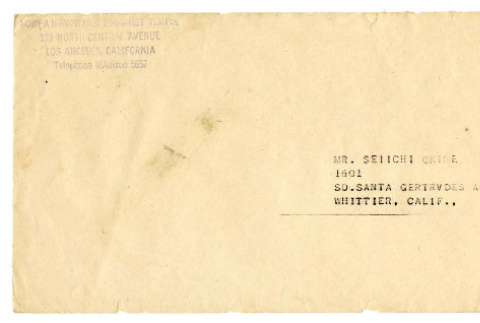
Envelope from Honmpa Hongwanji Los Angeles Betsuin to Mr. Seiichi Okine, February 11, 1947 (ddr-csujad-5-223)
An envelope mailed by Hompa Hongwanji Los Angeles Betsuin to Seiichi Okine. It probably encloses two issues of the newsletter, "Betsuin jiho" [=Betsuin newsletter], which are found in items: csudh_oki_0219 and csudh_oki_0220. See this object in the California State Universities Japanese American Digitization project site: oki_02_62_001
![Letter from Masao Okine to Mr. and Mrs. Okine, July 24, 1946 [in Japanese] (ddr-csujad-5-151)](https://ddr.densho.org/media/cache/dc/d7/dcd7894efe7bd31b3a3098c0ebf4eabc.jpg)
doc
Letter from Masao Okine to Mr. and Mrs. Okine, July 24, 1946 [in Japanese] (ddr-csujad-5-151)
A letter from Masao Okine to his parents, Seiichi and Tomeyo Okine. He writes from Japan where he is stationed as a Nisei soldier. In the letter, he writes about his duties as a jeep driver, working a night shift from 10PM to 6AM. He drives for Japanese coworkers who speak English and serve as interpreters …
![Letter from Sojiro Nishimura to Mr. and Mrs. Okine, December 24, [1945] [in Japanese] (ddr-csujad-5-114)](https://ddr.densho.org/media/cache/b7/fb/b7fb89152b13da1442e67e3d953decc7.jpg)
doc
Letter from Sojiro Nishimura to Mr. and Mrs. Okine, December 24, [1945] [in Japanese] (ddr-csujad-5-114)
A greeting letter from Munejiro Nishimura in Gardena, California to Seiichi and Tomeyo Okine in Hawthorne, California. In the letter, he thanks them for a Christmas gift and informs that he and his family has been staying in a house provided by a Caucasian friend who is supportive to the Japanese. The arrival date and place …
![Letter from M. Kurima to Mr. and Mrs. Okine, January 22, 1946 [in Japanese] (ddr-csujad-5-126)](https://ddr.densho.org/media/cache/8d/81/8d81ecb9c88eb4d04a5224f48521e098.jpg)
doc
Letter from M. Kurima to Mr. and Mrs. Okine, January 22, 1946 [in Japanese] (ddr-csujad-5-126)
A letter from Tadashi Mac and Fusaye Alice Kurima in Chicago, Illinois, to their relatives, Seiichi and Tomeyo Okine in Hawthorne, California. Kurima thanks them for the Christmas gift and congratulates on their daughter, Hatsuno's marriage. He also writes about Masao Okine who sent a 5-yen bill to Kurima from Japan. See this object in the …
![Letter from Morio Tanimoto to Mr. and Mrs. Okine, January [1], [1948?] [in Japanese] (ddr-csujad-5-284)](https://ddr.densho.org/media/cache/50/b6/50b619201d7d9b3a6297d3231de48849.jpg)
doc
Letter from Morio Tanimoto to Mr. and Mrs. Okine, January [1], [1948?] [in Japanese] (ddr-csujad-5-284)
A New Year's letter from Morio Tanimoto to Seiichi and Tomeyo Okine. Morio Tanimoto is a father of their daughter-in-law, Ayame Okine. He expresses his appreciation for the Christmas gift from the Okines, and is glad to see a photograph of Ayame's daughter, Jeanne Okine. See this object in the California State Universities Japanese American Digitization …
![Psotcard from Nishi Hongwanji Betsuin to Mr. S. Okine, May 14, 1946 [in Japanese] (ddr-csujad-5-183)](https://ddr.densho.org/media/cache/87/b2/87b2dd63f49233d59f4d5dad17ff39e8.jpg)
doc
Psotcard from Nishi Hongwanji Betsuin to Mr. S. Okine, May 14, 1946 [in Japanese] (ddr-csujad-5-183)
A card from Hompa Hongwanji Los Angeles Betsuin to Seiichi Okine. It informs of their Buddhist service to commemorate the anniversary of the birth of Reverend Shinran. See this object in the California State Universities Japanese American Digitization project site: oki_02_28_001
![Letter from Masao Okine to Mr. and Mrs. Okine, January 10, 1946 [in Japanese] (ddr-csujad-5-121)](https://ddr.densho.org/media/cache/b0/08/b008621cc4cbd7352bdd5ce9a5199fc8.jpg)
doc
Letter from Masao Okine to Mr. and Mrs. Okine, January 10, 1946 [in Japanese] (ddr-csujad-5-121)
A letter from Masao Okine to his parents, Seiichi and Tomeyo Okine in Hawthorne. This letter is written in Japan where Masao is currently stationed as a Nisei soldier and mailed via San Francisco by the U.S. Army Postal Service. In the letter, Masao describes his work as a US Army solider in Japan: He has …
![Letter from Nobuyuki Tanimoto to Mr. Mas [Masao] Okine, November 27, 1946 [in Japanese] (ddr-csujad-5-178)](https://ddr.densho.org/media/cache/d6/56/d6563bff3ffd3b726107de31602c2bd9.jpg)
doc
Letter from Nobuyuki Tanimoto to Mr. Mas [Masao] Okine, November 27, 1946 [in Japanese] (ddr-csujad-5-178)
A letter from Nobuyuki Tanimoto to his brother-in-law, Masao Okine. Nobuyuki writes from Japan where he is stationed as a US Army soldier of Supreme Commander for the Allied Powers or General Headquarters (GHQ). He describes his work place, Prince Shimazu House, in Tokyo, Japan, and also improvement from inadequate supplies in Japan after the war. …
![Letter from Miyuki Matsuura to Mr. and Mrs. Okine, March 31, 1946 [in Japanese] (ddr-csujad-5-139)](https://ddr.densho.org/media/cache/e9/1b/e91b8a246e077c1b6a50d134069094c2.jpg)
doc
Letter from Miyuki Matsuura to Mr. and Mrs. Okine, March 31, 1946 [in Japanese] (ddr-csujad-5-139)
A letter from Miyuki Matsuura to her uncle and aunt, Seiichi and Tomeyo Okine. In the letter, she writes about her family in Japan. She has received a letter from her family in Japan and learned about their situations. She writes about her father who suffers from flash burns because of the atomic bombing in August. …
![Postcard from Rafu Zenshuji Betsuin to Mr. M. Hamada, February 1, 1950 [in Japanese] (ddr-csujad-5-299)](https://ddr.densho.org/media/cache/43/b7/43b79e81afba16a1485727fb40a5b4f7.jpg)
doc
Postcard from Rafu Zenshuji Betsuin to Mr. M. Hamada, February 1, 1950 [in Japanese] (ddr-csujad-5-299)
An announcement from Rafu Zenshuji Betsuin, Los Angeles, California, to M. Hamada regarding an annual meeting. See this object in the California State Universities Japanese American Digitization project site: oki_06_15_001
![Letter from Teruko Fuji to Mr. and Mrs. Okine, April 9, 1947 [in Japanese] (ddr-csujad-5-202)](https://ddr.densho.org/media/cache/6f/36/6f3696b6e6b7595c26da3146eec41dd2.jpg)
doc
Letter from Teruko Fuji to Mr. and Mrs. Okine, April 9, 1947 [in Japanese] (ddr-csujad-5-202)
A letter from Teruko Fujii, a member of "S.P. Church" in Los Angeles, California, to Seiichi and Tomeyo Okine. Teruko informs them that the properties of the S.P. Church have been sold. She also invites the Okines to her church's prayers on the second Sunday. The arrival date of the letter, April 10, 1947, is recorded …
![Letter from Masao Okine to Mr. and Mrs. Okine, July 21, 1945 [in Japanese] (ddr-csujad-5-80)](https://ddr.densho.org/media/cache/66/70/66702e408c5fbd33b24de6b2ab07c9f2.jpg)
doc
Letter from Masao Okine to Mr. and Mrs. Okine, July 21, 1945 [in Japanese] (ddr-csujad-5-80)
A letter from Masao Okine to his parents, Seiichi and Tomeyo Okine in the Rohwer incarceration camp, Arkansas. He probably writes from Military Intelligence Language School in Fort Snelling, Minnesota. The letter informs that he has been serving as a truck driver until his Japanese language school starts in August, 1945; and his brother-in-law, Nobuyuki Tanimono, …
![Letter from Masao Okine to Mr. and Mrs. Okine, January 19, 1946 [in Japanese] (ddr-csujad-5-124)](https://ddr.densho.org/media/cache/9c/ba/9cba07a33ea3ab48964bdf48f9ae2f5d.jpg)
doc
Letter from Masao Okine to Mr. and Mrs. Okine, January 19, 1946 [in Japanese] (ddr-csujad-5-124)
A letter from Masao Okine to his parents, Seiichi and Tomeyo Okine in Hawthorne, California. This letter is written in Japan where Masao is stationed as a U.S. military soldier and mailed via San Francisco by the U.S. Army Postal Service. Masao describes his stay in Japan, being transferred from Sagamihara, Kanagawa, to Tokyo, possibly being …
![Letter from Ayame Okine to Mr. and Mrs. Okine, January 15, 1946 [in Japanese] (ddr-csujad-5-120)](https://ddr.densho.org/media/cache/9a/54/9a5461719da20139ae766a138da9fb5a.jpg)
doc
Letter from Ayame Okine to Mr. and Mrs. Okine, January 15, 1946 [in Japanese] (ddr-csujad-5-120)
A letter from Ayame Okine in Chicago, Illinois, to her parents-in-law, Seiichi and Tomeyo Okine in Hawthorne, California. In the letter, Ayame describes her job in Chicago. She assists in making cameras and helps to light tobaccos. Her work starts at 8:00 AM and ends at 4:30 PM, including a 20-minute break two times. She earns …
![Letter from Ayame Okine to Mr. and Mrs. Okine, January 7, 1946 [in Japanese] (ddr-csujad-5-118)](https://ddr.densho.org/media/cache/f7/f2/f7f2a56f06d135ea9505954be6186432.jpg)
doc
Letter from Ayame Okine to Mr. and Mrs. Okine, January 7, 1946 [in Japanese] (ddr-csujad-5-118)
A letter from Ayame Okine in Chicago, Illinois, to her parents-in-law, Seiichi and Tomeyo Okine, in Hawthorne, California. Ayame Okine encloses a check for the marriage of her sister-in-law, Hatsuno Hotty Okine. Ayame also writes about her moving plan, informing that her sister has bought a house and Ayame is going to move into the house …
![Letter from Masao Okine to Mr. and Mrs. Okine, September 7, 1945 [in Japanese] (ddr-csujad-5-88)](https://ddr.densho.org/media/cache/79/c9/79c9b5ee851cebda5b179e92220eeed0.jpg)
doc
Letter from Masao Okine to Mr. and Mrs. Okine, September 7, 1945 [in Japanese] (ddr-csujad-5-88)
A letter from Masao Okine in Fort Snelling, Minnesota to his parents, Seiichi and Tomeyo Okine, in the Rohwer incarceration camps. Masao writes about Military Intelligence Service Language School in Fort Snelling and informs that he is finishing the language training in February 2, 1946. He also talks about his trip to Chicago, visiting their relatives …
![Letter from Ayame [Okine] to Mr. and Mrs. Okine, January 6, 1946 [in Japanese] (ddr-csujad-5-117)](https://ddr.densho.org/media/cache/f2/0a/f20a980a2faaf4dc72720b75857bf3f5.jpg)
doc
Letter from Ayame [Okine] to Mr. and Mrs. Okine, January 6, 1946 [in Japanese] (ddr-csujad-5-117)
A new year's greeting letter from Ayame Okine in Bartlett, Illinois, to her parents-in-law, Seiichi and Tomeyo Okines in Hawthorne, California. This letter is mailed from Fred S. Tange's place where Ayame stays. In the letter, she appreciates the monetary gift from her parents-in-law while she feels ashamed to have them to still worry about her …
![Letter from Masao Okine to Mr. and Mrs. Okine, June 10, 1946 [in Japanese] (ddr-csujad-5-148)](https://ddr.densho.org/media/cache/15/db/15db368ca1d063785f2e40e779af4938.jpg)
doc
Letter from Masao Okine to Mr. and Mrs. Okine, June 10, 1946 [in Japanese] (ddr-csujad-5-148)
A letter from Masao Okine to his parents, Seiichi and Tomeyo Okine. Masao Okine writes from Japan where he is stationed as a US Army soldier. This letter is mailed via San Francisco by the U.S. Army Postal Service. The letter includes updates, informing of the arrival of his parents' four letters written on May 20, …
![Letter from Ayame Okine to Mr. and Mrs. Okine, December 13, 1945 [in Japanese] (ddr-csujad-5-112)](https://ddr.densho.org/media/cache/8d/5a/8d5a0b99f0f8f758463a18d17c837900.jpg)
doc
Letter from Ayame Okine to Mr. and Mrs. Okine, December 13, 1945 [in Japanese] (ddr-csujad-5-112)
Ayame Okine writes from Bartlett, Illinois, to her parents-in-law, Seiichi and Tomeyo Okine in Hawthorne, California. She states that she is glad to hear that they have returned to California safely and would be able to spend winter holidays at home. She also describes the Japanese community in Chicago, making mochi for new year's day. The …
![Letters from Makoto Okine to Mr. and Mrs. Okine, March 21, 1946 [in Japanese] (ddr-csujad-5-138)](https://ddr.densho.org/media/cache/f2/d6/f2d676c6faf70429087ca489030c9f0c.jpg)
doc
Letters from Makoto Okine to Mr. and Mrs. Okine, March 21, 1946 [in Japanese] (ddr-csujad-5-138)
Contains two letters and one envelope mailed by Makoto Okine from Italy where he is stationed as an U.S. Army soldier. He writes to his parents, Seiichi and Tomeyo Okine in Hawthorne, California, separately and encloses two letters in one envelope. See this object in the California State Universities Japanese American Digitization project site: oki_01_60_001-003
![Letter from Edwin Matsuura to Mr. and Mrs. Okine, April 25, 1947 [in Japanese] (ddr-csujad-5-203)](https://ddr.densho.org/media/cache/66/56/6656a54420325048ff2e54062c31d9eb.jpg)
doc
Letter from Edwin Matsuura to Mr. and Mrs. Okine, April 25, 1947 [in Japanese] (ddr-csujad-5-203)
A letter from Edwin Takashi Matsuura to Seiichi and Tomeyo Okine. The letter includes general correspondence, enquiring about the health and well-being of the Okine family. He also encloses a letter from Jokichi Yamanaka in Hiroshima, Japan, addressing the Okines. The arrival date of the letter, April 25, 1947, is recorded on the backside of the …
![Letter from Masao Okine to Mr. and Mrs. Okine, October 22, 1945 [in Japanese] (ddr-csujad-5-96)](https://ddr.densho.org/media/cache/e8/a1/e8a1d40a2602df71bf9874cb5a43f109.jpg)
doc
Letter from Masao Okine to Mr. and Mrs. Okine, October 22, 1945 [in Japanese] (ddr-csujad-5-96)
Masao Okine writes from the Military Intelligence Service Language School in Fort Snelling, Minnesota, to his parents, Seiichi and Tomeyo Okine in the Rohwer incarceration camp. The letter describes the school situation in which the US Army demands that the students need to complete the study and training in a shorter period of time. He also …
![Letters from Ayame Okine to Mr. and Mrs. Okine, June 8, 1946 [in Japanese] (ddr-csujad-5-147)](https://ddr.densho.org/media/cache/1a/c5/1ac5f53d64b0631486e7ebf31808ddc8.jpg)
doc
Letters from Ayame Okine to Mr. and Mrs. Okine, June 8, 1946 [in Japanese] (ddr-csujad-5-147)
Contains two letters from Ayame Okine in Chicago, Illinois to her parents-in-law, Seiichi and Tomeyo Okine. She writes two separate letters to the Okines and encloses into one envelope. See this object in the California State Universities Japanese American Digitization project site: oki_01_68_001-003
![Letter from Tsukiyo Okasako to Mr. S, Seichi Okine, February 16, 1948 [in Japanese] (ddr-csujad-5-241)](https://ddr.densho.org/media/cache/67/fe/67fe6eb44db8235c590704479f8f9c07.jpg)
doc
Letter from Tsukiyo Okasako to Mr. S, Seichi Okine, February 16, 1948 [in Japanese] (ddr-csujad-5-241)
A letter from Tsukiyo Okasako in Hiroshima, Japan to Seiichi Okine. She is presumably one of the neighbors in Seiichi Okine's hometown. She thanks him for the gifts including 4 lbs of sugar, safety pins, needles, thread, clothes, and towels which are scarce in Japan. She informs that Jokichi Yamanaka brought the gifts to her. She …