2652 items
![Letter from Jokichi Yamanaka to Mr. S. Okine, May 17, 1948 [in Japanese] (ddr-csujad-5-256)](https://ddr.densho.org/media/cache/e3/65/e36512fb049055391e589a2c3c0a87cc.jpg)
![Letter from Megumi Sasaki to Mr. S. Okine, January 22, 1948 [in Japanese] (ddr-csujad-5-244)](https://ddr.densho.org/media/cache/b2/18/b218515d9fb17ec64e05f946d132ed87.jpg)
![Letter from Makoto Okine to Mr. S. Okine, March 26, 1946 [in Japanese] (ddr-csujad-5-191)](https://ddr.densho.org/media/cache/b0/8e/b08e787fd8b2675fdbd9d7e963210988.jpg)
![Letter from Aochi to Mr. and Mrs. Okine, September 1, 1945 [in Japanese] (ddr-csujad-5-89)](https://ddr.densho.org/media/cache/03/9c/039c3396c0bc8475d412f8fddb95304f.jpg)
![Letter from Makoto Okine to Mr. S. Okine, September 24, 1945 [in Japanese] (ddr-csujad-5-109)](https://ddr.densho.org/media/cache/ef/69/ef69ebd0d80826414a4cb1c72e26334d.jpg)
![Letter from Ayame Okine to Mr. S. Okine, December 28, 1945 [in Japanese] (ddr-csujad-5-179)](https://ddr.densho.org/media/cache/2e/71/2e71618c5c93b7b610d9fdb6ae3106f4.jpg)
![Letter from Fusako Sasaki to Mr. S. Okine, June 15, 1948 [in Japanese] (ddr-csujad-5-293)](https://ddr.densho.org/media/cache/7e/ea/7eead1b002623d814ef3326b09a594db.jpg)
![Letter from Jokichi Yamanaka to Mr. S. Okine, September 12, 1947 [in Japanese] (ddr-csujad-5-218)](https://ddr.densho.org/media/cache/73/cf/73cf470f4c25f4e0f5a0bc59f885b803.jpg)
![Letter from Joikichi Yamanaka to Mr. S. Okine, April 13, 1948 [in Japanese] (ddr-csujad-5-242)](https://ddr.densho.org/media/cache/30/62/30620885d5cc7bee854070a5c04bd5a0.jpg)
![Letter from Kamekichi Nakano to Mr. S. Okine, August 27, 1947 [in Japanese] (ddr-csujad-5-219)](https://ddr.densho.org/media/cache/55/64/5564824d02d8fe2e0dad24020f284a64.jpg)
![Letter from Ayame Okine to Mr. S. Okine, September 2, 1946 [in Japanese] (ddr-csujad-5-158)](https://ddr.densho.org/media/cache/1b/6a/1b6acc5f27336c8e848982d52dd92e7a.jpg)
![Letter from Makoto Okine to Mr. S. Okine, January 15, 1946 [in Japanese] (ddr-csujad-5-123)](https://ddr.densho.org/media/cache/0c/72/0c72f4f003ae26b9a09baaae55304906.jpg)
![Letter from Makoto Okine to Mr. S. Okine, December 11, 1945 [in Japanese] (ddr-csujad-5-111)](https://ddr.densho.org/media/cache/21/f4/21f47fde0df364e224c35328cb2e6ae0.jpg)
![Letter from Makoto Okine to Mr. S. Okine, August 19, 1945 [in Japanese] (ddr-csujad-5-87)](https://ddr.densho.org/media/cache/24/49/244988711e193af78c5ff2aa840d2e66.jpg)
2652 items
![Letter from Jokichi Yamanaka to Mr. S. Okine, May 17, 1948 [in Japanese] (ddr-csujad-5-256)](https://ddr.densho.org/media/cache/3b/8f/3b8f41a12a75fda699ec7d83ce0e260c.jpg)
doc
Letter from Jokichi Yamanaka to Mr. S. Okine, May 17, 1948 [in Japanese] (ddr-csujad-5-256)
A letter from Jokichi Yamanaka in Hiroshima, Japan to his brother-in-law, Seiichi Okine. He thanks the Okines for the letter, the tobacco, and ajinomoto brought by the Nakano family. He also thanks Hatsuno Hotty Befu for the gifts. He informs that his daughter, Fumiko, has left for the U.S., but it is not clear when he …
![Letter from Megumi Sasaki to Mr. S. Okine, January 22, 1948 [in Japanese] (ddr-csujad-5-244)](https://ddr.densho.org/media/cache/ac/82/ac823b05d1d661bdfbf1ad9e755c8b6e.jpg)
doc
Letter from Megumi Sasaki to Mr. S. Okine, January 22, 1948 [in Japanese] (ddr-csujad-5-244)
A letter from Megumi Sasaki in Hiroshima, Japan to Seiichi and Tomeyo Okine. Megumi introduces himself as though he has never met them nor been in contact with them before. He is a son of Matsuyo Sasaki and a brother of Minoru Sasaki. He explains that he was drafted into the Japanese military in 1944 and …
![Letter from Makoto Okine to Mr. S. Okine, March 26, 1946 [in Japanese] (ddr-csujad-5-191)](https://ddr.densho.org/media/cache/d9/3d/d93db809af25028d4ac95b106fd189e0.jpg)
doc
Letter from Makoto Okine to Mr. S. Okine, March 26, 1946 [in Japanese] (ddr-csujad-5-191)
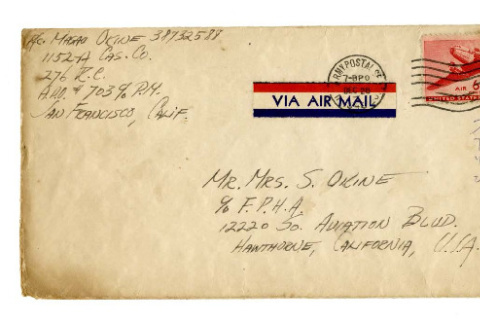
A letter from Makoto Okine to his father, Seiichi Okine. He writes from Italy where he is stationed as a Nisei solder. The letter is mailed via New York by the U.S. Army Postal Service. In the letter, he explains how Seiichi would receive 25.00 dollars of the military family allowance monthly. The government deducts 25.00 …
![Letter from Aochi to Mr. and Mrs. Okine, September 1, 1945 [in Japanese] (ddr-csujad-5-89)](https://ddr.densho.org/media/cache/11/f3/11f3d2ae9a43d12bc3b1e2af05012370.jpg)
doc
Letter from Aochi to Mr. and Mrs. Okine, September 1, 1945 [in Japanese] (ddr-csujad-5-89)
A letter from Aochi who resides in Denver, Colorado to Seiichi and Tomeyo Okine. He thanks the Okines for the potatoes that they sent to him. He also comments on the Okines' plan returning to California. See this object in the California State Universities Japanese American Digitization project site: oki_01_26_002
doc
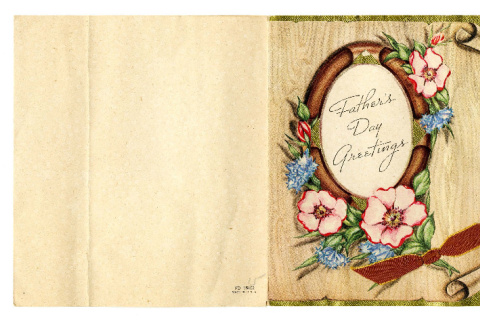
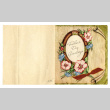
Father's Day card from Masao Okine to Mr. S. Okine, June 9, 1945 (ddr-csujad-5-81)
A Father's Day card from Masao Okine to his father, Seiichi Okine. Masao writes from Fort Meade, Minnesota, where he attends the U.S. military Japanese language School to Seiichi Okine who is incarcerated in the Rohwer camp, Arkansas. See this object in the California State Universities Japanese American Digitization project site: oki_01_20_001
![Letter from Makoto Okine to Mr. S. Okine, September 24, 1945 [in Japanese] (ddr-csujad-5-109)](https://ddr.densho.org/media/cache/59/b2/59b24f9093990e1bb2c4c280f571d9bf.jpg)
doc
Letter from Makoto Okine to Mr. S. Okine, September 24, 1945 [in Japanese] (ddr-csujad-5-109)
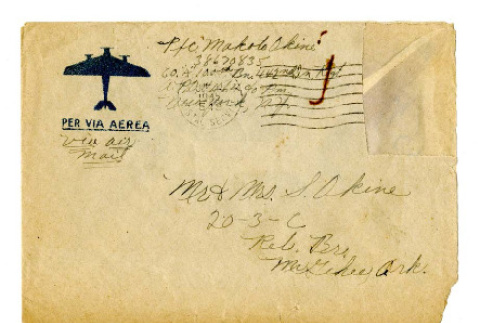
A letter from Makoto Okine who is probably stationed in Italy as a U.S. military soldier to his father, Seiichi Okine in the Rohwer incarceration camp, Arkansas. He describes his vacation, staying in a hotel and eating at a restaurant. He states that he has not had a chance to sleep in a bed with sheets …
![Letter from Ayame Okine to Mr. S. Okine, December 28, 1945 [in Japanese] (ddr-csujad-5-179)](https://ddr.densho.org/media/cache/5a/e5/5ae56683aafa7cb2331889a781408a46.jpg)
doc
Letter from Ayame Okine to Mr. S. Okine, December 28, 1945 [in Japanese] (ddr-csujad-5-179)
A letter from Ayame Okine to her parents-in-law, Seiichi and Tomeyo Okine. In the letter, Ayame writes about her sister-in-law, Hatsuno Hotty Okine who works at a Caucasian family's place and is getting married to Masuo Robert Befu soon. She also updates on her life in Illinois, working for 12 hours with fifteen to sixteen people …
doc
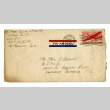
Letters from Masao Okine to Mr. and Mrs. S. Okine, December 23, 1945 (ddr-csujad-5-185)
Contains one envelope, two letters written by Masao Okine to his parents, Seiichi and Tomeyo Okine, one note, and one Japanese yen bill. All are enclosed in the same envelope and mailed by Masao Okine from Japan where he is stationed as a Nisei soldier. See this object in the California State Universities Japanese American Digitization …
![Letter from Fusako Sasaki to Mr. S. Okine, June 15, 1948 [in Japanese] (ddr-csujad-5-293)](https://ddr.densho.org/media/cache/96/85/96856fcf58900825d1fc2aab59acd8bb.jpg)
doc
Letter from Fusako Sasaki to Mr. S. Okine, June 15, 1948 [in Japanese] (ddr-csujad-5-293)
A letter from Fusako Sasaki in Hiroshima, Japan to Seiichi and Tomeyo Okine. She writes about the package of gifts from the Okines and appreciates their help. The package arrived on May 29, 1948 and included cloth, clothes, a sweater, sugar, soap bars, candies, tobacco, and medicines which are scarce in post-war Japan. She laments about …
![Letter from Jokichi Yamanaka to Mr. S. Okine, September 12, 1947 [in Japanese] (ddr-csujad-5-218)](https://ddr.densho.org/media/cache/67/54/67548a4cc59072f4743bf73e04333628.jpg)
doc
Letter from Jokichi Yamanaka to Mr. S. Okine, September 12, 1947 [in Japanese] (ddr-csujad-5-218)
A letter from Jokichi Yamanaka in Hiroshima, Japan, to his brother-in-law and sister-in-law, Seiichi and Tomeyo Okine. Jokichi congratulates on the Okines' grandchild and includes updates on issues of his family, the Sasaki family, and the Nakano family in Japan. He also describes high inflation in post-war Japan, listing high prices of food and other necessities. …
![Letter from Joikichi Yamanaka to Mr. S. Okine, April 13, 1948 [in Japanese] (ddr-csujad-5-242)](https://ddr.densho.org/media/cache/d6/0c/d60c5e2a64bc9fe33741531ddc0fa2b2.jpg)
doc
Letter from Joikichi Yamanaka to Mr. S. Okine, April 13, 1948 [in Japanese] (ddr-csujad-5-242)
A letter from Jokichi Yamanaka in Hiroshima, Japan to his brother-in-law, Seichi Okine. Jokichi Yamanaka updates on his family noting that his his daughter Tomomi graduated from school and works as an interpreter at the U.S. military camp, Camp Kure. Mr. Nakano's house construction starts on April 14 and 15 and he is going to help …
![Letter from Kamekichi Nakano to Mr. S. Okine, August 27, 1947 [in Japanese] (ddr-csujad-5-219)](https://ddr.densho.org/media/cache/a6/cd/a6cdb569aca1110550b269e7fad530b5.jpg)
doc
Letter from Kamekichi Nakano to Mr. S. Okine, August 27, 1947 [in Japanese] (ddr-csujad-5-219)
A letter from Kamekichi Nakano in Japan to his brother-in-law, Seiichi Okine. Kamekichi thanks Seiichi for the gifts brought by Jokichi Yamanaka, including sugar and ajinomoto [monosodium glutamate], as there is a scarcity of food in Japan. He describes Masao's visit when he was stationed in Japan and his wishes to meet the Okines', with hopes …
![Letter from Ayame Okine to Mr. S. Okine, September 2, 1946 [in Japanese] (ddr-csujad-5-158)](https://ddr.densho.org/media/cache/7e/76/7e7684973f215935776755f9a1ed5f4f.jpg)
doc
Letter from Ayame Okine to Mr. S. Okine, September 2, 1946 [in Japanese] (ddr-csujad-5-158)
A letter from Ayame Okine in Chicago, Illinois to her parents-in-law, Seiichi and Tomeyo Okine. She congratulates on Makoto Okine's returning home from Europe. She also writes about her next plan moving back to California with her husband, Masao, once he returns from Japan to Chicago. See this object in the California State Universities Japanese American …
![Letter from Makoto Okine to Mr. S. Okine, January 15, 1946 [in Japanese] (ddr-csujad-5-123)](https://ddr.densho.org/media/cache/11/1a/111abb69f9ce67c1d8c1be9231e3c1b5.jpg)
doc
Letter from Makoto Okine to Mr. S. Okine, January 15, 1946 [in Japanese] (ddr-csujad-5-123)
A letter from Makoto Okine to his father, Seiichi Okine in Hawthorne, California. This letter is probably written in Italy where Makoto is stationed as a U.S. Army soldier and mailed via New York by the U.S. Army Postal Service. He regrets not being able to write to his father for a long time because he …
doc
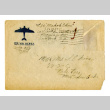
Letters from Makoto Okine to Mr. and Mrs. S. Okine, July 9, 1945 (ddr-csujad-5-84)
Contains an envelope and two letters sent from Makoto Okine to his parents, Seiichi and Tomeyo Okine. Makoto writes from Lecco, Italy, where he is deployed as a U.S. Army soldier to his parents who are incarcerated in the Rohwer incarceration camp, Arkansas. See this object in the California State Universities Japanese American Digitization project site: …
![Letter from Makoto Okine to Mr. S. Okine, December 11, 1945 [in Japanese] (ddr-csujad-5-111)](https://ddr.densho.org/media/cache/48/03/4803f3b66eae3dad58063bcc7e790bcf.jpg)
doc
Letter from Makoto Okine to Mr. S. Okine, December 11, 1945 [in Japanese] (ddr-csujad-5-111)
A letter from Makoto Okine who is stationed in Italy as a U.S. Army soldier to his father, Seiichi Okine in Hawthorne, California. He informs that he has received a letter from his sister, Hatsuno Hotty Okine, and writes about what he has learned from her. He is glad to learn that Seiichi Okine has returned …
![Letter from Makoto Okine to Mr. S. Okine, August 19, 1945 [in Japanese] (ddr-csujad-5-87)](https://ddr.densho.org/media/cache/be/62/be62fc01d4d70bb18471018f8a6f9ff8.jpg)
doc
Letter from Makoto Okine to Mr. S. Okine, August 19, 1945 [in Japanese] (ddr-csujad-5-87)
A letter from Makoto Okine to his father, Seiichi Okine. He writes probably from Italy where he is deployed as a US Army soldier. The letter is mailed via Army/Air Post Office, New York, by U.S. Army Postal Service. The letter was originally addressed to Bartlet Illinois, where Makoto assumes Seiichi stays and farms with Ayame …
doc
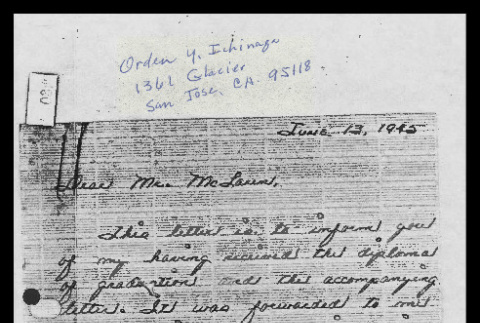
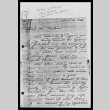
Letter from Orden Y. Ichinaga to Mr. Dallas C. McLaren, June 13, 1945 (ddr-csujad-55-1885)
Correspondence from Orden Ichinaga to Dallas McLaren regarding Ighinaga's receipt of his diploma and scholarship and expressing gratitude for McLaren's support. See this object in the California State Universities Japanese American Digitization project site: sac_jaac_1888
img
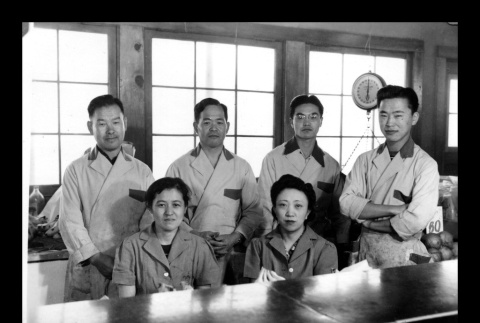
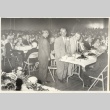
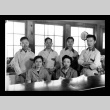
Mr. and Mrs. Nabeshima and H. Dairiki in the canteen, Amache Co-op (ddr-csujad-55-1557)
Black and white photograph of Mr. and Mrs. Nabeshima, H. Dairiki, and two incarcerees at the Amache Consumer Enterprises canteen at Amache incarceration camp. From the Amache Co-op Souvenir Album, page 23. See also see also sac_jaac_1530 through sac_jaac_1589. See this object in the California State Universities Japanese American Digitization project site: sac_jaac_1559
doc
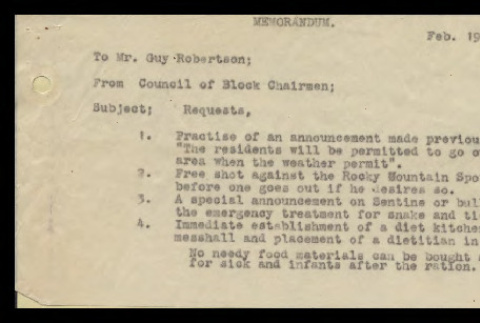
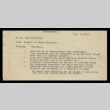
Memo from Heart Mountain Block Chairmen to Mr. Guy Robertson, February 19, 1943 (ddr-csujad-55-426)
Memorandum of understanding from Heart Mountain Block Chairmen to Guy Robertson, Project Director at Heart Mountain incarceration camp, regarding camp facilities and services. See this object in the California State Universities Japanese American Digitization project site: sac_jaac_0428
doc
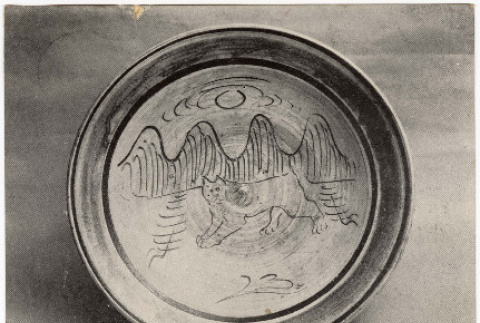
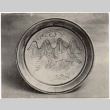
Postcard from Bernard Leach and Soetsu Yanagi To Mr. Takahashi, likely Henri Takahashi (ddr-densho-422-102)
Travelling in Japan, consider the crafts movement the most active of the day. Photo of ceramic plate or bowl.
doc
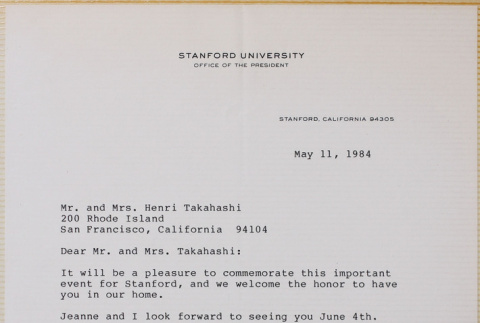
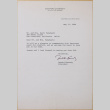
Letter from Donald Kennedy, President, Stanford University, to Mr. and Mrs. Henri Takahashi (ddr-densho-422-614)
Looking forward to seeing them at the celebration of the Takahashi Professorship in Japanese Studies