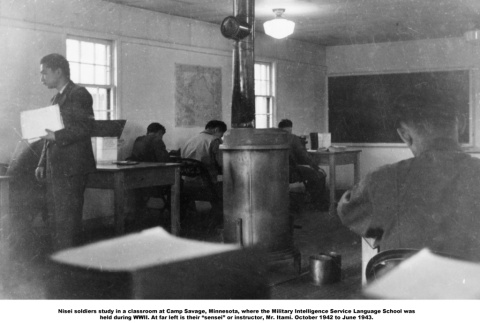
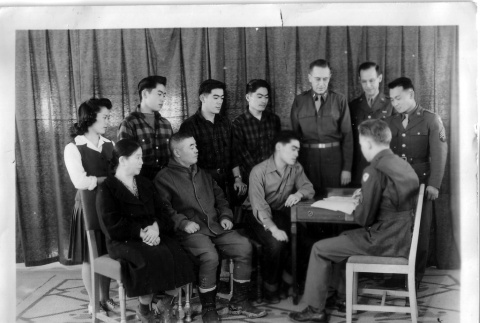
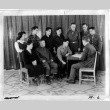
Caption: Nisei soldiers study in a classroom at Camp Savage, Minnesota, where the Military Intelligence Service Language School was held during WWII. At far left is their "sensei" or instructor, Mr. Itami. October 1942 to June 1943. Supplemental scan of ddr-ajah-2-429 with additional notes
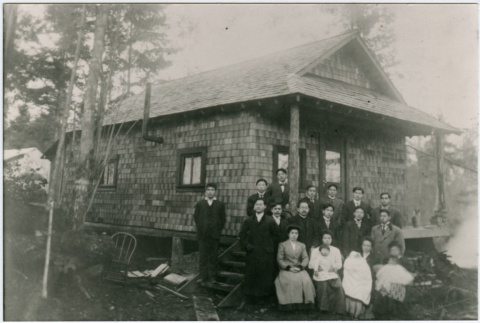
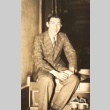
Shoichiro Katsuno at Pontiac (now the Windermere/Sand Point area) Written on back: "House built by Mr. Katsuno c.1913. Paid only for glass, nails, stovepipe, all the wood was free for clearing the land, knew how to make cedar shakes from work in sawmill earlier."
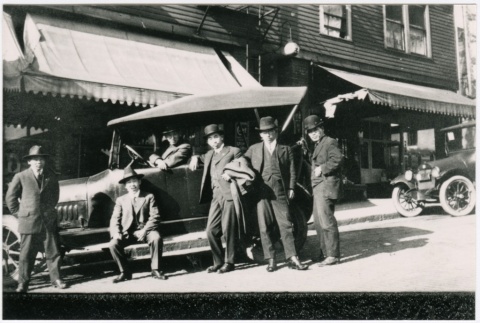
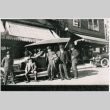
Okayama men on Main Street in front of the Mitsuwado. Note on back: " NW Nikkei caption 6-89: Mr. Yanagi (leaning against car) with friends, celebrates his graduation from the U of W's pharmacy school before returning to Japan." Another note says "set at 100, 2 sec"
4-page handwritten letter written on recto and verso from Fumiko Fukuda to Mr. and Mrs. Whitney on May 31, 1942. Fumiko writes about Mrs. Whitney's letter being the first contact she has had with the outside world, the weather, and lack of privacy in the bathrooms.
A photograph album gifted to Mr. Fujii who donated money to the Seventh-day Adventist Church in Gunma-ken, Japan to build a school (named in his honor, Fujii cottage) and another building. Loose inside the album are some additional miscellaneous items belonging to Kimi Fujii.
Original WRA caption: The three Onodera brothers volunteer for the Army while the entire family looks on. Front row: Mr. And Mrs. Toyosuke Onodera, Satoru, Sergeant Carl E. Teurk, Back Row: Fumi, Yutaka, Kaun, Ko, Lieut. Stanley D. Arnold, Sergeant Eugene F. Jenrick and Sergeant Akira Kato.
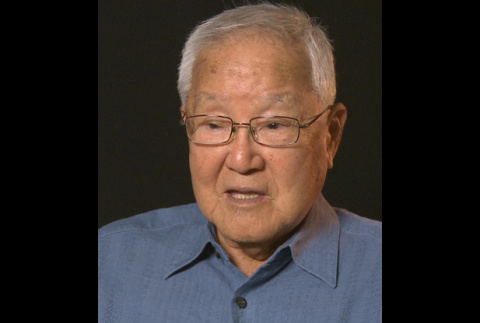
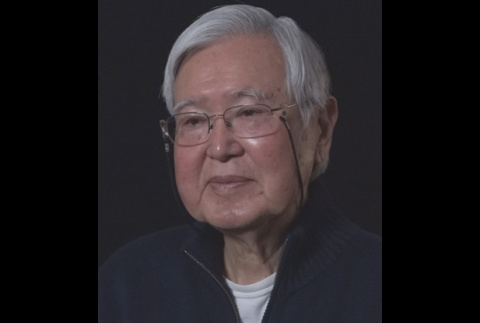
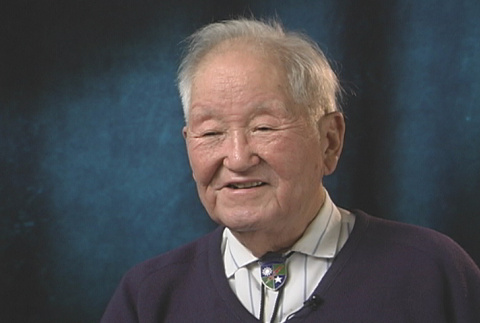
Nisei male. Born August 25, 1924, in Waipahu, Hawaii. Grew up on the Waipahu sugar plantation where parents worked. Was attending Mid-Pacific Institute in Honolulu when Japan bombed Pearl Harbor on December 7, 1941. Father was picked up by the FBI and eventually interned in the Honouliuli POW camp. Mr. Inokuchi got a job in the …
Nisei male. Born December 26, 1938, in Salem, Oregon. Family moved frequently before the war due to father's profession as a Methodist minister. During World War II, removed to Portland Assembly Center, Oregon, and the Heart Mountain concentration camp, Wyoming. After leaving camp, family moved to Boston, Massachusetts, where father could attend graduate seminary school. Eventually …
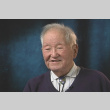
Although Mr. Matsumoto does not identify himself as a Kibei (American-born person of Japanese ancestry sent to Japan for formal education and socialization when young and later returned to the U.S.), some of his life experiences are similar to those who do identify themselves as such.
Although Mr. Matsumoto does not identify himself as a Kibei (American-born person of Japanese ancestry sent to Japan for formal education and socialization when young and later returned to the U.S.), some of his life experiences are similar to those who do identify themselves as such.
Although Mr. Matsumoto does not identify himself as a Kibei (American-born person of Japanese ancestry sent to Japan for formal education and socialization when young and later returned to the U.S.), some of his life experiences are similar to those who do identify themselves as such.
Although Mr. Matsumoto does not identify himself as a Kibei (American-born person of Japanese ancestry sent to Japan for formal education and socialization when young and later returned to the U.S.), some of his life experiences are similar to those who do identify themselves as such.
Although Mr. Matsumoto does not identify himself as a Kibei (American-born person of Japanese ancestry sent to Japan for formal education and socialization when young and later returned to the U.S.), some of his life experiences are similar to those who do identify themselves as such.
Although Mr. Matsumoto does not identify himself as a Kibei (American-born person of Japanese ancestry sent to Japan for formal education and socialization when young and later returned to the U.S.), some of his life experiences are similar to those who do identify themselves as such.
Although Mr. Matsumoto does not identify himself as a Kibei (American-born person of Japanese ancestry sent to Japan for formal education and socialization when young and later returned to the U.S.), some of his life experiences are similar to those who do identify themselves as such.
Although Mr. Matsumoto does not identify himself as a Kibei (American-born person of Japanese ancestry sent to Japan for formal education and socialization when young and later returned to the U.S.), some of his life experiences are similar to those who do identify themselves as such.
Although Mr. Matsumoto does not identify himself as a Kibei (American-born person of Japanese ancestry sent to Japan for formal education and socialization when young and later returned to the U.S.), some of his life experiences are similar to those who do identify themselves as such.
Caption on reverse [translation]: "Domei photo, National News, No. 416. Pole-vaulter Nishida called. (Tokyo) August 23, 1938. World-famous Nishida received a call, and he is going to join the army as an engineer, with a pickaxe instead of a pole. Mr. Nishida worked in a division at Hitachi. While he worked there he practiced everything for …
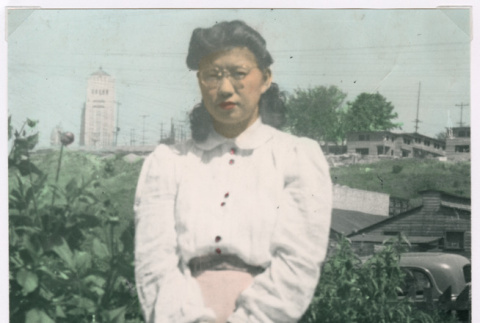
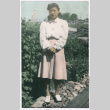
Colorized photograph of Mitsuko (Nakahara) Isoshima standing in front of a bush. Written on photo is "July 1941" in blue ink. Caption below photo is "1941" in black ink. Caption at the bottom of page is "MITSUKO'S EMPLOYMENT: *Governess for Mr. & Mrs. Yanase, New York, New York (8/38 to 10/39) *Governess for Mr. & Mrs. …
Original caption: Sacramento, California. Harvey Akio Itano, 21, 1942 graduate from the University of California where he received his Bachelor of Science [in] Chemistry degree. He was chosen by the faculty as University Medalist for 1942 and was a member of Phi Beta Kappa and Sigma Xi. Mr. Itano went to the Assembly center prior to …
Two letters from Sohei (John) Hohri & Valeria Engelbretson to Harold Landon and Thelma Jo Bruce, dated January 24, 2011 and June 26, 2011. The envelope is addressed to Mr. and Mrs. Harold Landon in Granada Hills, CA from Mr. and Mrs. Sohei Hohri in New York City, NY. Sohei writes to thank Harold and his …
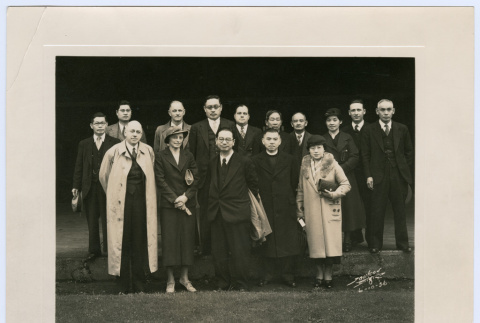
First row: Rev. Dr. J. Henry Carpenter, Miss April, Toyoshiko Kagura, Rev. Gennosuke Shoji; and Kane (Nagase) Shoji. Second Row: Unidentified, Mr. Arima, Rev. Ulysses Grant Murphy, Shuzo William Terazawa (also known as Shuzo or Akizo), Mr. Davis, unidentified, unidentified, Riku Hashiguchi, unidentified, and Chosuku Hashiguchi Rev. Gennosuke Shoji, Rector of St Peter’s Japanese Episcopal Mission …
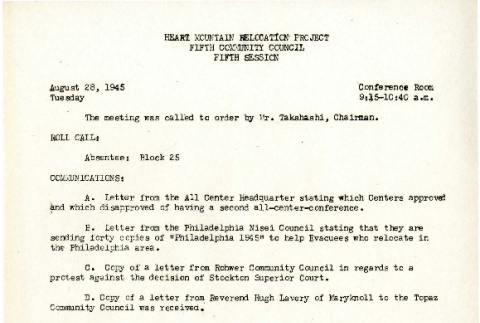
The council minutes feature a discussion by Mr. Guy Robertson on freight delivery and camp security operations. See this object in the California State Universities Japanese American Digitization project site: HMRC_01-01_085
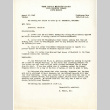
A thank you letter from Mr. Freitas to Seiichi and Tomeyo Okine for their visit and flowers. See this object in the California State Universities Japanese American Digitization project site: oki_03_15_001
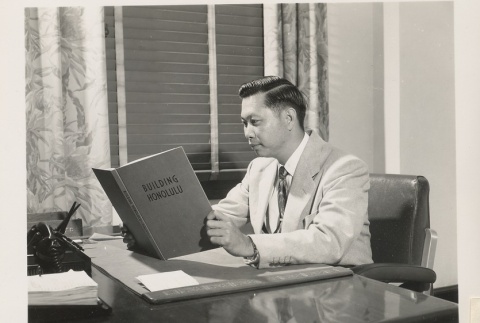
Caption on front: NEW CHAMBER TREASURER - James K. C. Doo, past president of Commerce, was elected chamber treasurer for 1955 by the b ... Directors at a meeting held Thursday. Mr. Doo, a partner ... Yat Loy Co., is shown reading Building Honolulu, official history of the chamber. (Camera Hawaii photo)."

![[ Letter to Mrs. Whitney from Fumiko Fukuda, May 31, 1942 ] (ddr-janm-22-6)](https://ddr.densho.org/media/cache/eb/41/eb416e2f938fd3f4df9fa9b3d2390ded.jpg)


![Letter from W. Freitas to Mr. and Mrs. Seiichi Okine, October 19, [1947?] (ddr-csujad-5-281)](https://ddr.densho.org/media/cache/cf/bc/cfbcb20795f54f65a8de631bbb1b5ab1.jpg)
![[ Letter to Mrs. Whitney from Fumiko Fukuda, May 31, 1942 ] (ddr-janm-22-6)](https://ddr.densho.org/media/cache/95/b7/95b7b9b9e5123e29901cec50f9659361.jpg)


![Letter from W. Freitas to Mr. and Mrs. Seiichi Okine, October 19, [1947?] (ddr-csujad-5-281)](https://ddr.densho.org/media/cache/b9/e9/b9e9e399d620befaa91eb75621876049.jpg)