Caption: Mess Hall, Camp Savage, Minnesota, October 1942 to October 1943. Joe Iwataki, of Alameda, CA., was there to learn better Japanese as part of the Military Intelligence Service (MIS), and all Japanese America unit during WWII. Supplemental scan of ddr-ajah-2-421 with additional notes
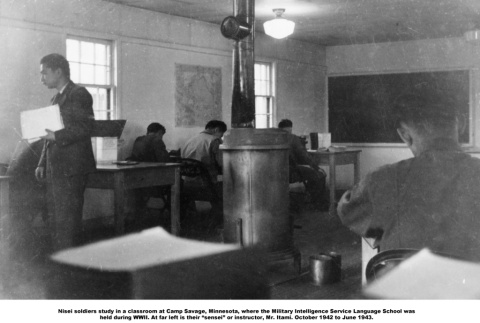
Caption: Nisei soldiers study in a classroom at Camp Savage, Minnesota, where the Military Intelligence Service Language School was held during WWII. At far left is their "sensei" or instructor, Mr. Itami. October 1942 to June 1943. Supplemental scan of ddr-ajah-2-429 with additional notes
Inscription on folder: To Mrs. Tsuchiya and Mary / Always Taniyo Alice / 12/15/1943. Caption: Alice Taniyo Iwataki, of Alameda, CA., was born in 1913 and died in 2016. She married Masaru "Roy" Iwata. She is Joe Iwataki's sister. Photo: December 15, 1943 in st. Paul Minnesota.
Essay by Gladys I. Stone describing the development of Japanese American communities in Minnesota from the early 1900s through the post-World War II period. It was published in the Hennepin County History, Quarterly Publication of the Hennepin County Historical Society, Volume 47, Number 1, Winter 1988.
Letter to Yuriko Domoto Tsukada from Tak Negi in which she tells about her struggles adapting to life in Minnesota and general updates about her family and inquires about Yuri's. Item tied together with all objects between ddr-densho-356-321 and ddr-densho-356-413.
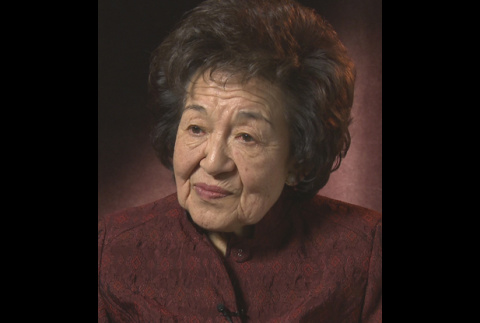
Nisei female. Born October 31, 1925, in Seattle, Washington. Family owned and operated a successful grocery store prior to World War II. After the bombing of Pearl Harbor, removed to the Puyallup Assembly Center, Washington, and the Minidoka concentration camp, Idaho. Left camp in 1944 to attend St. Mary's School of Nursing in Rochester, Minnesota. Worked …
Correspondence from Paul Takagi to Mrs. Waegell regarding Takagi's transfer to Fort Snelling, Minnesota during World War II. See this object in the California State Universities Japanese American Digitization project site: sac_jaac_2428
Transportation authorization for George Hideo Nakamura from Fort Sheridan, Illinois to St. Paul, Minnesota. Form TC 11-C. See this object in the California State Universities Japanese American Digitization project site: sac_jaac_2292
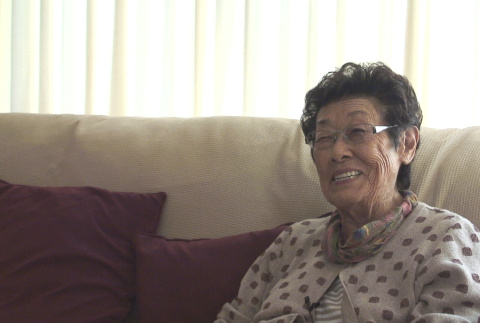
Nisei female. Born June 6, 1923, in Central Point, Oregon. While in elementary school, sent to live with a foster family in Medford, Oregon. Was attending college when World War II broke out, and was removed to the Tule Lake concentration camp, California. Left camp to work in St. Paul, Minnesota, as a housegirl. Finished college …
Newspaper clippings on Nisei WACs at Fort Snelling, Minnesota. Items from: pages 52-53 of the Sue Kato scrapbook (gfb_skc_001). See this object in the California State Universities Japanese American Digitization project site: 2019_002_001_037_07
Caption: Barracks 10, where some of the "Sensei" or instructors of Japanese language were housed at Camp Savage, Minnesota. They were there to teach Japanese American Niseis as part of the Military Intelligence Service Language School. October 1942-October 1943. Supplemental scan of ddr-ajah-2-431 with additional notes.
Furlough pass for Sue S. Ogata from Fort Snelling, Minnesota. An item from: pages 120-121 of the Sue Kato scrapbook (gfb_skc_001). See this object in the California State Universities Japanese American Digitization project site: 2019_002_001_075_03
Newspaper clippings on sports teams at Fort Snelling, Minnesota. An item from: pages 58-59 of the Sue Kato scrapbook (gfb_skc_001). See this object in the California State Universities Japanese American Digitization project site: 2019_002_001_041_02
Advertisement for Paul A. Schmitt Music Company in Minneapolis, Minnesota. An item from: pages 62-63 of the Sue Kato scrapbook (gfb_skc_001). See this object in the California State Universities Japanese American Digitization project site: 2019_002_001_043_02
Lily Pons Concert Program at the University of Minnesota. An item from: pages 68-69 of the Sue Kato scrapbook (gfb_skc_001). See this object in the California State Universities Japanese American Digitization project site: 2019_002_001_046_02
Nisei female. Born 1924 in Venice, California. Grew up in Lawndale, California, where parents farmed. During World War II, removed to the Santa Anita Assembly Center, California, and the Rohwer concentration camp, Arkansas. After leaving camp, married and moved to Bloomington, Minnesota, while husband served in the military. Eventually returned to California.
Caption: Sho Ishii and other Nisei Soldiers from the Military Intelligence Service at Camp Savage, Minnesota, find time to enjoy a game of pool at the St. Paul U.S.O. club. The club was located at 72 W. 7th Street, photo October 1942-June1943. Supplemental scan of ddr-ajah-2-555 with additional notes
White female. Born June 18, 1919, in Minneapolis, Minnesota. Grew up in Los Angeles, California, and attended UCLA. During World War II, recruited to teach at the Manzanar concentration camp.
Sansei male. Japanese Canadian playwright, stage director and taiko artist. He is a founder and currently the Artistic Director of the Minneapolis, Minnesota based Asian American theater company, Mu Performing Arts.
This material is based upon work assisted by a grant from the Department of the Interior, National Park Service. Any opinions, finding, and conclusions or recommendations expressed in this material are those of the author(s) and do not necessarily reflect the views of the Department of the Interior.
This material is based upon work assisted by a grant from the Department of the Interior, National Park Service. Any opinions, finding, and conclusions or recommendations expressed in this material are those of the author(s) and do not necessarily reflect the views of the Department of the Interior.
This material is based upon work assisted by a grant from the Department of the Interior, National Park Service. Any opinions, finding, and conclusions or recommendations expressed in this material are those of the author(s) and do not necessarily reflect the views of the Department of the Interior.
This material is based upon work assisted by a grant from the Department of the Interior, National Park Service. Any opinions, finding, and conclusions or recommendations expressed in this material are those of the author(s) and do not necessarily reflect the views of the Department of the Interior.
This material is based upon work assisted by a grant from the Department of the Interior, National Park Service. Any opinions, finding, and conclusions or recommendations expressed in this material are those of the author(s) and do not necessarily reflect the views of the Department of the Interior.
This material is based upon work assisted by a grant from the Department of the Interior, National Park Service. Any opinions, finding, and conclusions or recommendations expressed in this material are those of the author(s) and do not necessarily reflect the views of the Department of the Interior.