Topics
Facilities
Format
Genre
Usage

Use <Ctrl> or (⌘) keys to select multiple terms

1415 items
Laundry room (ddr-densho-15-71)
img Laundry room (ddr-densho-15-71)
The Minidoka concentration camp was divided into thirty-six blocks, each with its own communal laundry facility, like the one shown here.
Japanese Americans inside barracks (ddr-densho-15-123)
img Japanese Americans inside barracks (ddr-densho-15-123)
Left to right: Norio Mitsuoka, Bob Ikeda, and Tak Hori sit inside Yoneko Tanaka's barracks.
Two Japanese Americans in their barracks apartment (ddr-densho-15-58)
img Two Japanese Americans in their barracks apartment (ddr-densho-15-58)
Grandma Yorozu, who at eighty-four years of age was one of the oldest Japanese Americans at Minidoka, and Fusa Yorozu inside their barracks apartment.
Japanese American making furniture (ddr-densho-15-63)
img Japanese American making furniture (ddr-densho-15-63)
Barracks apartments were furnished only with a coal-burning stove and a cot. Consequently, many camp inmates made furniture from scrap lumber.
Japanese American shoveling coal into a heater (ddr-densho-15-72)
img Japanese American shoveling coal into a heater (ddr-densho-15-72)
Camp inmate shoveling coal into the block's central heater, which will warm water for the laundry and bath facilities.
North side of the Minidoka concentration camp (ddr-densho-15-45)
img North side of the Minidoka concentration camp (ddr-densho-15-45)
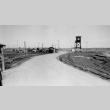
This is possibly Block 16 of the Minidoka concentration camp. The long building on the left was the recreational hall. The torii, or bird perch, on the right was made by camp inmates. A row of barracks is in the background.
Family in camp (ddr-densho-15-53)
img Family in camp (ddr-densho-15-53)
Ben Ikeda is second from left and his brother, Robert, is next to him. To the far right is their youngest brother, name unknown.
Japanese Americans carrying plywood (ddr-densho-15-55)
img Japanese Americans carrying plywood (ddr-densho-15-55)
Yoneko Tanaka (left) and Norio Mitsuoka carry away lumber to make furniture.
Two Japanese Americans inside barracks (ddr-densho-15-60)
img Two Japanese Americans inside barracks (ddr-densho-15-60)
Mrs. Shioshi (left) and Mrs. Odoi inside camp barracks. Both had sons in the military.
Two children outside barracks (ddr-densho-15-49)
img Two children outside barracks (ddr-densho-15-49)
Two of Hana Matsuo's children pose with the fire-station dog.
Japanese American preparing meal (ddr-densho-15-70)
img Japanese American preparing meal (ddr-densho-15-70)
Jim Shiga, well-known for his cooking skills, prepares a meal in the camp's warehouse kitchen.
Japanese Americans making furniture (ddr-densho-15-65)
img Japanese Americans making furniture (ddr-densho-15-65)
The barracks apartments that housed Japanese Americans contained cots and a coal-burning stove, but no other furniture. Camp inmates often made their own furniture and other accessories from scrap lumber.
Japanese Americans playing cards at the fire station (ddr-densho-15-59)
img Japanese Americans playing cards at the fire station (ddr-densho-15-59)
This is the interior of Fire Station Number 1. Left to right: (first name unknown) Hikida, unidentified, Yoshio Akada, and Mr. Sano. The fire station was one of the few buildings with a refrigerator. Mr. Sano owned the bathhouse underneath the Panama Hotel in Seattle, Washington, before World War II.
Japanese American family (ddr-densho-15-46)
img Japanese American family (ddr-densho-15-46)
Sam (left) and Fumie Taniguchi and their two daughters.
Two Japanese Americans sleeping (ddr-densho-15-79)
img Two Japanese Americans sleeping (ddr-densho-15-79)
Two Japanese Americans resting after the camp's farm picnic.
Honor roll (ddr-densho-15-82)
img Honor roll (ddr-densho-15-82)
Japanese Americans looking at the camp's honor roll, a listing of all the Japanese Americans from the Minidoka concentration camp who volunteered for military service. Minidoka had the highest number of volunteers from the mainland United States.
API