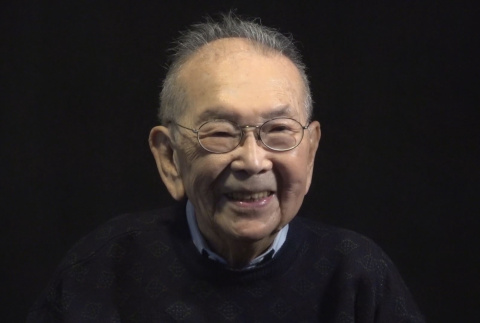
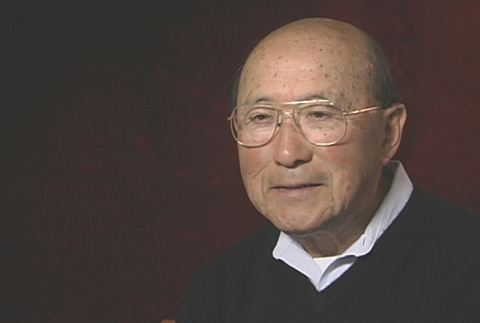
Nisei male. Born September 10, 1921, in Colusa, California. As a child, family moved to Stockton, California, where parents owned a hotel. Was attending the University of California at Berkeley when Japan bombed Pearl Harbor, and the family was sent to the Rohwer concentration camp, Arkansas. Left camp to live in Chicago, Illinois, where he became …
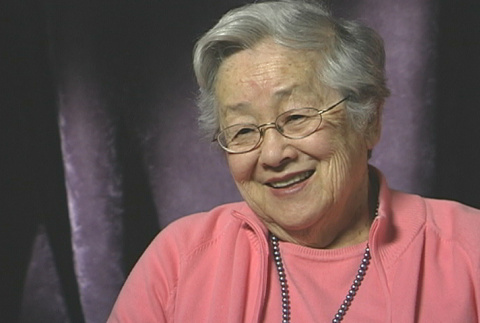
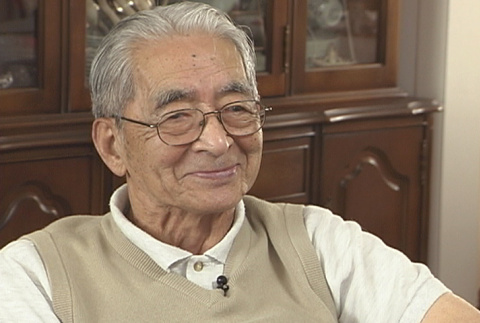
Nisei female. Born and raised in Seattle, Washington. After the bombing of Pearl Harbor, was removed to the Puyallup Assembly Center, Washington, and the Minidoka concentration camp, Idaho. Left Minidoka in 1943 to attend school in St. Paul, Minnesota. Married in 1945, and lived in Japan for sixteen months before returning to the United States and …
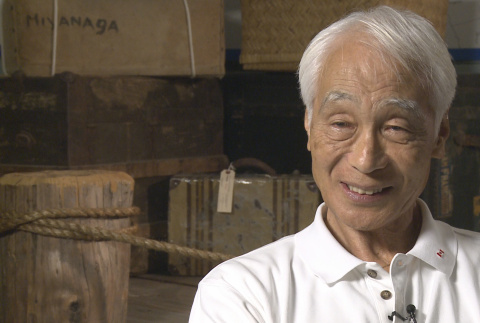
Sansei male. Born December 11, 1937, in San Francisco, California. Nearly age four when Japan bombed Pearl Harbor. Removed with family to the Tanforan Assembly Center, California, and the Topaz concentration camp, Utah. In this interview, Mr. Saito discusses many of the harmful psychological effects of the World War II experience on himself and other Japanese …
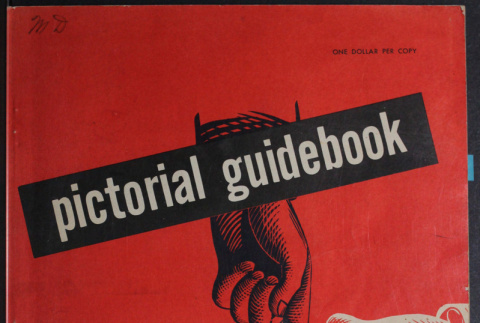
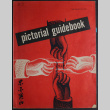
Select article titles: "Rare photographs capture beauties of Fuji" (pg 19-34); "The Issei Story" (pg. 35-58); "Pictures: San Francisco, Sacramento, Los Angeles, Twin Cities, New York, Chicago, Seattle, Japan" (pg. 59-112); "Organizations: Bird's-eye view of Nisei groups in the U.S." (pg. 113-138). Removed pages 140-167 from public website to protect personal information.
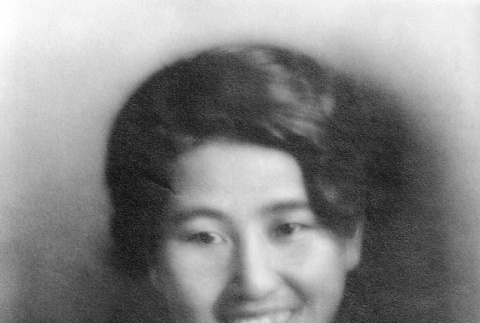
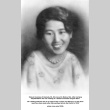
Caption below photo: Matusmi Iwamasa of Alameda, CA. She moved to Boston, MA., after marrying Taiji Mashihara. He was working as a dentist and dental surgeon there. Her clothing indicated she is not longer living in Japan, but America, so this photo must have been made after she journeyed across the Pacific in 1920. photo circa …
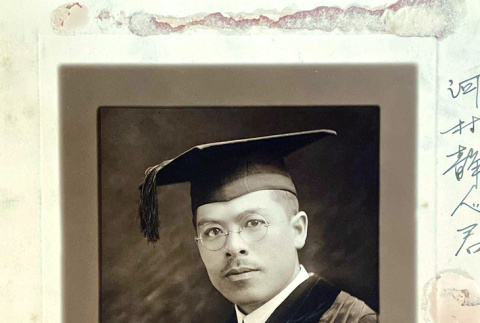
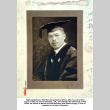
Caption below photo: Taiji Mashihara's 1920 Harvard graduation photo. After his arrival from Japan in 1907, he lived in Alameda., CA., and attended the University of California. He moved to Boston to study dentistry and dental surgery, a rare occupation for an Issei in America. Inscription on front: T. Mashihara 1920. Inscription in Japanese on side …
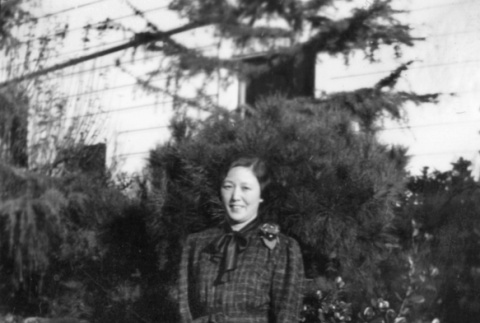
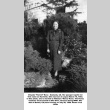
Caption below photo: Chiyoko "Harriet" Kono - Alameda, CA. Her passport spells her first name as Harriette. She was born in japan March 10, 1903. In this photo, she is married to Hikotaro "Harry" Kono. The Konos would be incarcerated in Gila River, Arizona during WWII. She died in Selma, CA (near Fresno) on July 26, …
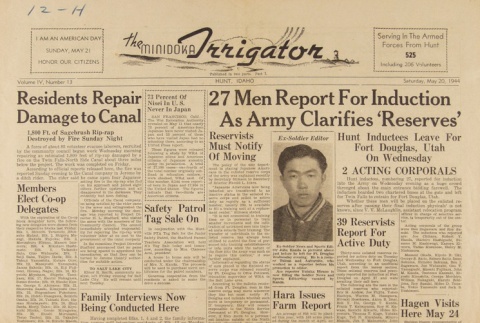
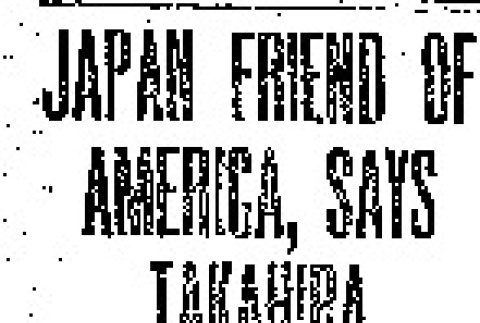
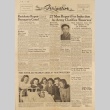
Selected article titles: "Residents Repair Damage to Canal. 1,800 Ft. of Sagebrush Rip-rap Destroyed by Fire Sunday Night" (p. 1), "Family Interviews Now Being Conducted Here" (p. 1), "73 Percent of Nisei in U.S. Never in Japan" (p. 1), "Reservists Must Notify of Moving" (p. 1), "Seattle Property Must Be Moved" (p. 1), "Americanization Classes Begin" …
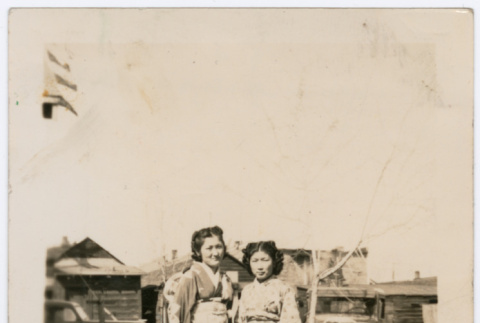
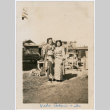
Yeko Sakai (left) and Kimi Kuwahara (right) pose in kimonos. The caption on the bottom of the photograph reads "Yoko Sakai + me". The caption on the back of the photograph reads "1937 Napoto Hana-Matsui".Yeko and Kimi are dressed to celebrate hanamatsui or Buddha's birthday. Napoto may refer to the Napoto Park in Nakagawa, Japan.
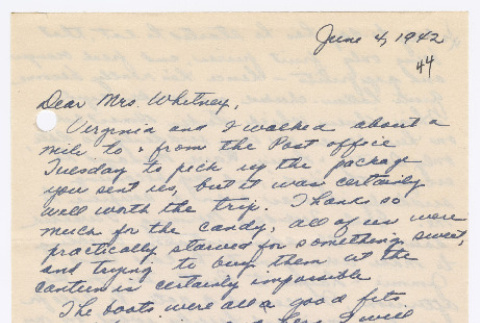
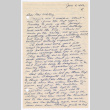
3-page handwritten letter written on recto and verso from Fumiko Fukuda to Mrs. Whitney dated June 4, 1942. Fumiko writes on June 4th about the candy that they received and her father being sick in bed, on June 5th, she writes about how it would be better to be in the Poston concentration camp than Japan.
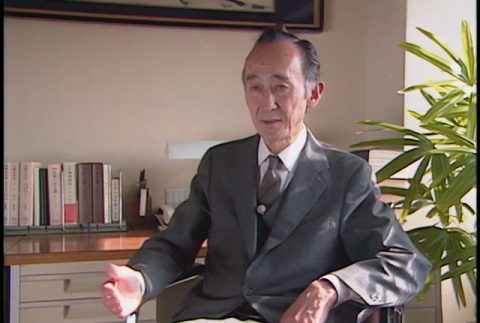
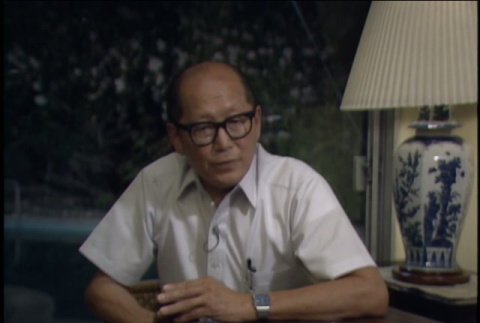
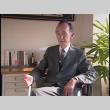
Nishiyama discusses the progress of civil rights in the US and the resulting impacts on Nisei and Japanese nationals, his experiences with occupation soldiers, the war crimes committed by Japanese soldiers, and the attitudes of Sansei towards Japan. Loni Ding can be heard asking questions behind the camera. Original title: II JA #8, Sen Nishiyama, Fri. …
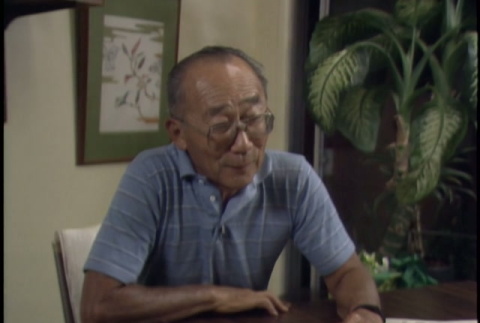
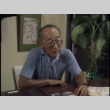
Fujikawa discusses the Japanese surrender, post-war Japan, returning from the war, and meeting his son upon return. Video starts at 0:29. Loni Ding can be heard asking questions behind the camera. Original title: II LA #11, Fujikawa III, 7-23-85. Interview continues at ddr.densho.org/ddr-densho-1007-1585/
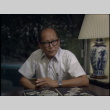
Nakayama discusses his time searching for downed planes with the Graves Registration team in occupied Japan. Video starts at 0:26. Loni Ding can be heard asking questions behind the camera. Original title: II LA #14, Y. Nakayama III, 7-23-85. Interview continues at ddr.densho.org/ddr-densho-1007-1588/
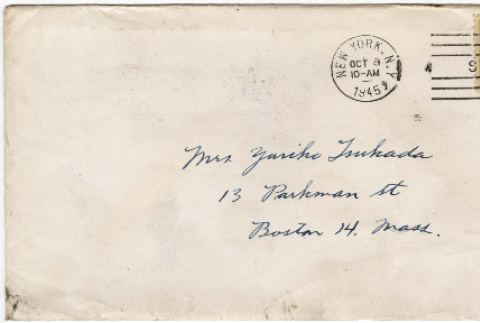
Letter to Yuriko Domoto Tsukada from her husband Richard "Dick" Tsukada. Dick writes about how his family is in Japan, his brother visiting over the weekend, his plans to try and transfer his job, and inquires about how Yuri's oral exam went. Item tied together with all objects between ddr-densho-356-457 and ddr-densho-540.
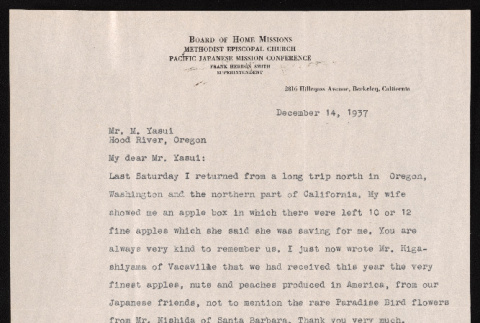
A typed letter on Pacific Japanese Mission Conference letterhead from Frank Herron Smith to Masuo Yasui, dated December 14, 1937. Smith writes about apples that Yasui had sent while Smith was away on a long trip. He expresses that he had intended to replace Reverend Isaac Inouye this year, but finding pastors from Japan had not …
The Seattle Nisei Veterans Committee collection includes photographs of Japanese American soldiers and linguists during World War II and the postwar occupation of Japan. These WWII photographs are from the U.S. Army and contain original captions. The collection also consists of postwar memorial services and activities of the Seattle Nisei Veterans Committee (NVC). The Seattle NVC …
The Jerome T. Light Collections consists of two bound volumes containing the dissertation of Jerome T. Light entitled "The Development of a Junior-Senior High School Program in a Relocation Center for People of Japanese Ancestry during the War with Japan" submitted to the School of Education of Leland Stanford Junior University for his degree of Doctor …
Kibei male. Born December 29, 1928, in Pendleton, Oregon. Father passed away at an early age, and Henry was taken by mother with several siblings to Katsuura, Japan. Attended school in Japan and worked in factories to support the war effort during World War II. Left Japan after the war, and was drafted by the U.S. …
Brother's history as a U.S. citizen caught in Japan during World War II
This interview was conducted as part of a project to capture stories of the Japanese American community of Spokane, Washington. Densho worked in collaboration with the Northwest Museum of Arts and Culture.
Having a difficult time attending school in Japan because of the language barrier
This interview was conducted as part of a project to capture stories of the Japanese American community of Spokane, Washington. Densho worked in collaboration with the Northwest Museum of Arts and Culture.
Moving to Japan as a child: "It was kind of exciting in a way"
This interview was conducted as part of a project to capture stories of the Japanese American community of Spokane, Washington. Densho worked in collaboration with the Northwest Museum of Arts and Culture.
Family background: parents' immigration from Japan
This interview was conducted by the Japanese American Museum of San Jose, and is part of a project entitled "Lasting Stories: The Resettlement of San Jose Japantown," a collaborative project between the Japanese American Museum of San Jose and Densho.
Nisei male. Born June 9, 1924, in Brawley, California. Grew up in Brawley until the age of eleven, when family decided to send him to Japan to be adopted by an uncle and aunt. Attended school in Japan and was conscripted into the Japanese military. After Japan surrendered, was captured as a prisoner of war and …