Topics
Facilities
Format
Genre
Usage

Use <Ctrl> or (⌘) keys to select multiple terms

31 items
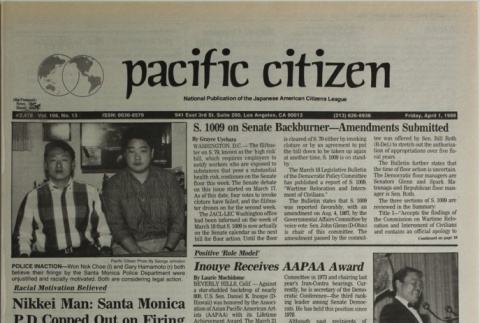
Pacific Citizen, Vol. 106, No. 13 (April 1, 1988) (ddr-pc-60-13)
doc Pacific Citizen, Vol. 106, No. 13 (April 1, 1988) (ddr-pc-60-13)
Selected article titles: "S.1009 on Senate Backburner--Amendments Submitted" (pp. 1, 10), "Positive 'Role Model': Inouye Receives AAPAA Award" (pp. 1-2), "Matsueda Not Just in It for the Laughs" (pp. 1-2), "Reparations Legislation Is Racist" (p. 5), and "Survivor's Mission: We Can't Afford Another Hiroshima" (pp. 6-7).
Kuni Itabashi passport (ddr-densho-493-8)
doc Kuni Itabashi passport (ddr-densho-493-8)
Passport of Kuni Itabashi, "Returning Emigrant," permitting her to pass from Japan to the U.S.A. Page 1 is entirely in Japanese, page 2 features a passport photo stamped by the Imperial Japanese Government and stamps reading "SEEN at the American Consulate at Kobe, Japan, March 24, 1920" "U.S. Immigration Service SEATTLE, WASH. ADMITTED Date APR 15, …
Tadashi Sakuma Interview (ddr-densho-1001-34)
vh Tadashi Sakuma Interview (ddr-densho-1001-34)
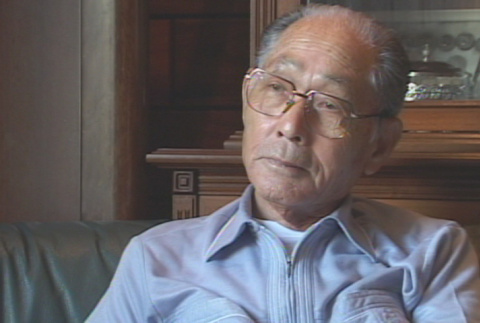
Nisei male. Born May 20, 1913, in Hiroshima, Japan, and immigrated to the United States at the age of eleven. Lived on Bainbridge Island, Washington. During World War II, removed to the Manzanar concentration camp, California, later transferring to the Minidoka concentration camp, Idaho. After leaving camp, lived in Moses Lake, Washington, for a time before …
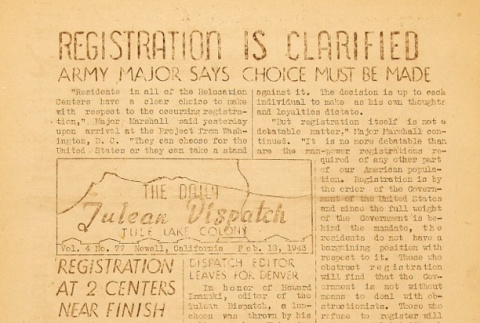
Tulean Dispatch Vol. 4 No. 77 (February 18, 1943) (ddr-densho-65-162)
doc Tulean Dispatch Vol. 4 No. 77 (February 18, 1943) (ddr-densho-65-162)
Selected article titles: "Registration is Clarified: Army Major Says Choice Must Be Made" (p. 1), "Registration at 2 Centers Near Finish" (p. 1), "Higher Education Economic Class" (p. 1), "Dispatch Editor Leaves For Denver" (p. 1), "U. & I. Sugar Co. Agents Here" (p. 1), "Farm Labor Recruitment" (p. 1), "Registration For Friday Released" (p. 1), …
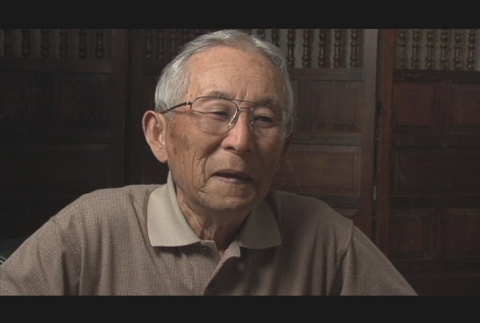
Jack Dairiki Interview (ddr-densho-1000-325)
vh Jack Dairiki Interview (ddr-densho-1000-325)
Kibei male. Born December 25, 1930 in Sacramento, California. Grew up in Sacramento where parents ran a hotel. In 1941, traveled to Japan with father to Japan, then could not return to the United States because of impending war. Was living in Hiroshima when the United States dropped the atomic bomb in 1945. Returned to the …
Steve Yamamoto Interview Segment 6 (ddr-densho-1004-15-6)
vh Steve Yamamoto Interview Segment 6 (ddr-densho-1004-15-6)
Witnessing the devastation of Hiroshima

This material is based upon work assisted by a grant from the Department of the Interior, National Park Service. Any opinions, finding, and conclusions or recommendations expressed in this material are those of the author(s) and do not necessarily reflect the views of the Department of the Interior.
Izumi Hirano Interview (ddr-densho-1000-317)
vh Izumi Hirano Interview (ddr-densho-1000-317)
Kibei male. Born February 25, 1929, in Hilo, Hawaii. At the age of four, moved to Japan, where family operated a farm. Attended school in Japan during World War II. Was in school in Hiroshima when the United States dropped the atomic bomb in 1945. Survived the bombing along with mother and brother. In 1949, returned …
Peggy S. Furukawa Interview Segment 12 (ddr-densho-1000-399-12)
vh Peggy S. Furukawa Interview Segment 12 (ddr-densho-1000-399-12)
Hearing about the atomic bombing of Hiroshima

This material is based upon work assisted by a grant from the Department of the Interior, National Park Service. Any opinions, finding, and conclusions or recommendations expressed in this material are those of the author(s) and do not necessarily reflect the views of the Department of the Interior.

Jack Dairiki Interview Segment 21 (ddr-densho-1000-325-21)
vh Jack Dairiki Interview Segment 21 (ddr-densho-1000-325-21)
Talking to people about experiences in Hiroshima

This material is based upon work assisted by a grant from the Department of the Interior, National Park Service. Any opinions, finding, and conclusions or recommendations expressed in this material are those of the author(s) and do not necessarily reflect the views of the Department of the Interior.

Jack Dairiki Interview Segment 12 (ddr-densho-1000-325-12)
vh Jack Dairiki Interview Segment 12 (ddr-densho-1000-325-12)
Living in Hiroshima when the atomic bomb was dropped

This material is based upon work assisted by a grant from the Department of the Interior, National Park Service. Any opinions, finding, and conclusions or recommendations expressed in this material are those of the author(s) and do not necessarily reflect the views of the Department of the …
James Yamazaki Interview Segment 37 (ddr-densho-1000-175-37)
vh James Yamazaki Interview Segment 37 (ddr-densho-1000-175-37)
Encountering resistance by British armed forces in Hiroshima

This material is based upon work assisted by a grant from the Department of the Interior, National Park Service. Any opinions, finding, and conclusions or recommendations expressed in this material are those of the author(s) and do not necessarily reflect the views of the Department of the Interior.
Minoru Tajii Interview Segment 28 (ddr-densho-1000-394-28)
vh Minoru Tajii Interview Segment 28 (ddr-densho-1000-394-28)
Impressions of Hiroshima right after the atomic bombing

This material is based upon work assisted by a grant from the Department of the Interior, National Park Service. Any opinions, finding, and conclusions or recommendations expressed in this material are those of the author(s) and do not necessarily reflect the views of the Department of the Interior.
Kenjiro Akune Interview Segment 1 (ddr-densho-1004-13-1)
vh Kenjiro Akune Interview Segment 1 (ddr-densho-1004-13-1)
Hearing about the atomic bombing of Hiroshima

This material is based upon work assisted by a grant from the Department of the Interior, National Park Service. Any opinions, finding, and conclusions or recommendations expressed in this material are those of the author(s) and do not necessarily reflect the views of the Department of the Interior.
Frank Fukuhara Interview Segment 12 (ddr-densho-1004-1-12)
vh Frank Fukuhara Interview Segment 12 (ddr-densho-1004-1-12)
Seeing the devastation in Hiroshima after the atomic bombing

This material is based upon work assisted by a grant from the Department of the Interior, National Park Service. Any opinions, finding, and conclusions or recommendations expressed in this material are those of the author(s) and do not necessarily reflect the views of the Department of the …
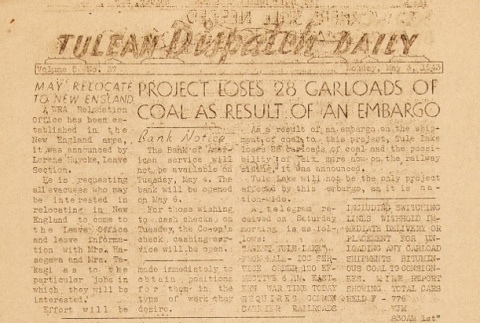
Tulean Dispatch Vol. 5 No. 37 (May 3, 1943) (ddr-densho-65-217)
doc Tulean Dispatch Vol. 5 No. 37 (May 3, 1943) (ddr-densho-65-217)
Selected article titles: "May Relocate to New England" (p. 1), "Project Loses 28 Carloads of Coal As Result of An Embargo" (p. 1), "Families of Soldiers May Get Aid" (p. 1), "Call Made For Persons With Pay Due From WCCA" (p. 1), "500 Workers Still Needed by Amalgamated Sugar Co." (p. 2), "Brownie Scouts Elect Officers" …
Izumi Hirano Interview Segment 7 (ddr-densho-1000-317-7)
vh Izumi Hirano Interview Segment 7 (ddr-densho-1000-317-7)
Surviving the atomic bombing of Hiroshima from a classroom near the epicenter

This material is based upon work assisted by a grant from the Department of the Interior, National Park Service. Any opinions, finding, and conclusions or recommendations expressed in this material are those of the author(s) and do not necessarily reflect the views of the …
Nori Masuda Interview Segment 28 (ddr-densho-1010-10-28)
vh Nori Masuda Interview Segment 28 (ddr-densho-1010-10-28)
Visiting relatives in Hiroshima, deciding to stay and work in Japan

This material is based upon work assisted by a grant from the Department of the Interior, National Park Service. Any opinions, finding, and conclusions or recommendations expressed in this material are those of the author(s) and do not necessarily reflect the views of the Department …

Frank Fukuhara Interview Segment 7 (ddr-densho-1004-1-7)
vh Frank Fukuhara Interview Segment 7 (ddr-densho-1004-1-7)
Hearing from family members who had survived the atomic bombing of Hiroshima

This material is based upon work assisted by a grant from the Department of the Interior, National Park Service. Any opinions, finding, and conclusions or recommendations expressed in this material are those of the author(s) and do not necessarily reflect the views of the …
James Yamazaki Interview (ddr-densho-1000-175)
vh James Yamazaki Interview (ddr-densho-1000-175)
Nisei male. Born July 6, 1916. Grew up in the Los Angeles area, where father was a Buddhist minister. Attended medical school before World War II. During the war, served in the U.S. Army as a doctor with the 106th Infantry Division in Europe. Captured during the Battle of the Bulge and was held in several …
Jim Tsujimura Interview Segment 14 (ddr-one-7-23-14)
vh Jim Tsujimura Interview Segment 14 (ddr-one-7-23-14)
Work with the Hiroshima Medical Team to help atomic bomb survivors in the U.S.

This material is based upon work assisted by a grant from the Department of the Interior, National Park Service. Any opinions, finding, and conclusions or recommendations expressed in this material are those of the author(s) and do not necessarily reflect the views …

James Yamazaki Interview Segment 36 (ddr-densho-1000-175-36)
vh James Yamazaki Interview Segment 36 (ddr-densho-1000-175-36)
Being asked to go to Japan to conduct a research study after the atomic bombings of Hiroshima and Nagasaki

This material is based upon work assisted by a grant from the Department of the Interior, National Park Service. Any opinions, finding, and conclusions or recommendations expressed in this material are those of the author(s) and do …

Letter from Masao Okine to Mr. and Mrs. S. Okine, May 19, 1946 [in Japanese] (ddr-csujad-5-186)
doc Letter from Masao Okine to Mr. and Mrs. S. Okine, May 19, 1946 [in Japanese] (ddr-csujad-5-186)
A letter from Masao Okine to his parents, Seiichi and Tomeyo Okine. He writes from Japan where he is stationed as a Nisei solder. The letter is mailed via San Francisco by the U. S. Army Postal Service. In the letter, he informs that he has received letters from his sister, Hatsuno, his wife, Ayame, and …
Tokio Yamane Interview Segment 30 (ddr-densho-1000-432-30)
vh Tokio Yamane Interview Segment 30 (ddr-densho-1000-432-30)
Hearing about the atomic bombing of Hiroshima (Japanese language)

This interview was conducted in Japanese. The transcript is a translation of the original interview. This material is based upon work assisted by a grant from the Department of the Interior, National Park Service. Any opinions, finding, and conclusions or recommendations expressed in this material are those …
Tulean Dispatch Vol. 4 No. 47 (January 14, 1943) (ddr-densho-65-134)
doc Tulean Dispatch Vol. 4 No. 47 (January 14, 1943) (ddr-densho-65-134)
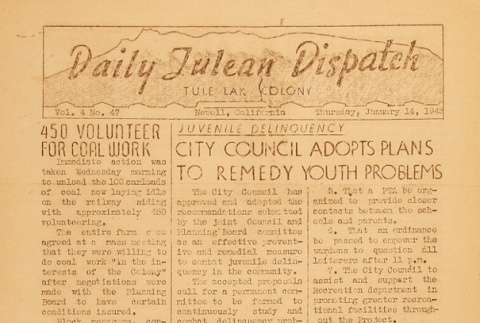
Selected article titles: 450 Volunteer For Coal Work" (p. 1), "Inquiries Received From Red Cross" (p. 1), "College Bound: Two Leave on Scholarship" (p. 1), "Writers Donate to the Dispatch" (p. 1), "Juvenile Delinquency: City Council Adopts Plans to Remedy Youth Problems" (p. 1), "'Government By Assassination'" (p. 2), "Council to Pass Regulations On Private Enterprises …
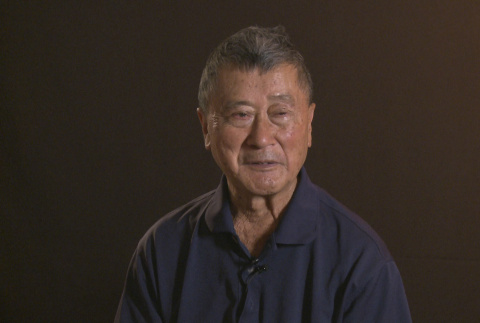
Tokio Yamane Interview (ddr-densho-1000-432)
vh Tokio Yamane Interview (ddr-densho-1000-432)
Kibei male. Born September 2, 1922, in Hawaii. Moved with family to Hiroshima at age three, then returned to the Fresno area of the U.S. for high school. During World War II, was sent to the Fresno Assembly Center, California, and the Jerome concentration camp, Arkansas. While at Jerome, refused to answer the so-called "loyalty questions" …
API