
87 items
87 items
img
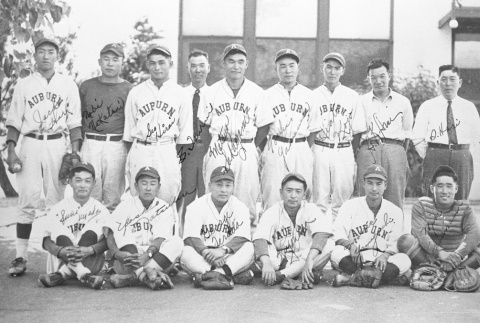
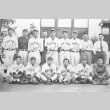
Auburn baseball team (ddr-densho-18-55)
Front (left to right): Susie Uyeda, Yoshi Natsuhara, George Terada, Ray Kiyohara, Morrie Yamaguchi, and Mike Tokumatsu. Back: Jack Hori, Nobu Nakatani, George Hirai, Mr. Tsurui, Matsu Sakagami, Toshi Yamanaka, Hiato Kojo, Mr. Arai, and Mr. Hori.
img
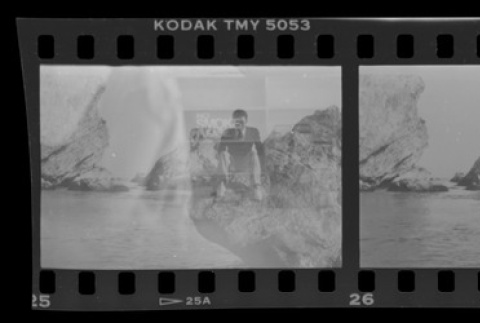
Negative strip (ddr-densho-356-32)
Negative strip of four images of Richard Tsukada's trip to Japan c. 1939. Print copies of the negatives visible at ddr-densho-356-24, ddr-densho-356-29, and ddr-densho-356-21. Images 1 & 2: Negatives of Richard Tsukada sitting a on a rock above water. Image 3: Negative of a group of 12 people on the deck of the …
img
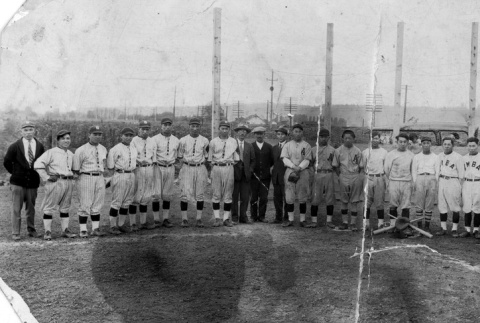
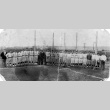
Baseball team (ddr-densho-25-5)
Baseball teams from different Buddhist churches competed against one another during the early 1930s. The teams were often created by the Young Buddhist Association (YBA). The team on the left is from Tacoma; the team on the right is from the White River Valley. Left to right (starting with the ninth man from the left): Reverend …
doc
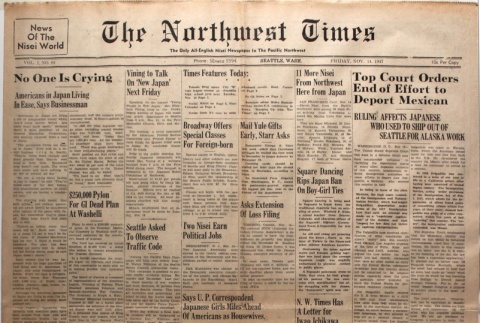
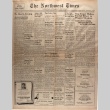
The Northwest Times Vol. 1 No. 84 (November 14, 1947) (ddr-densho-229-71)
"No One is Crying. Americans in Japan Living in Ease, Says Businessman" (p. 1), "Top Court Orders End of Effort to Deport Mexican. Ruling Affects Japanese Who Used to Ship Out of Seattle" (p. 1), "Obituaries: Manki Matsuno. Jiro Hirai" (p. 4).
vh
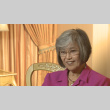
Alice Setsuko Sekino Hirai Interview Segment 14 (ddr-densho-1013-1-14)
Experiences in high school
vh
Alice Setsuko Sekino Hirai Interview Segment 12 (ddr-densho-1013-1-12)
Postwar effects of incarceration: observing bitterness in some
vh
Alice Setsuko Sekino Hirai Interview Segment 11 (ddr-densho-1013-1-11)
Description of Salt Lake City's Japanese American community following World War II
vh
Alice Setsuko Sekino Hirai Interview Segment 10 (ddr-densho-1013-1-10)
Moving with family back to Salt Lake City
vh
Alice Setsuko Sekino Hirai Interview Segment 1 (ddr-densho-1013-1-1)
Family background: father an Issei and mother a Nisei
vh
Alice Setsuko Sekino Hirai Interview Segment 16 (ddr-densho-1013-1-16)
Getting married, having children
vh
Alice Setsuko Sekino Hirai Interview Segment 18 (ddr-densho-1013-1-18)
Advances in programming for handicapped children
vh
Alice Setsuko Sekino Hirai Interview Segment 13 (ddr-densho-1013-1-13)
Learning Japanese cultural values during upbringing
vh
Alice Setsuko Sekino Hirai Interview Segment 6 (ddr-densho-1013-1-6)
Hearing about social ills: molestation and domestic violence
vh
Alice Setsuko Sekino Hirai Interview Segment 4 (ddr-densho-1013-1-4)
Feeling nurtured by supportive family
vh
Alice Setsuko Sekino Hirai Interview Segment 9 (ddr-densho-1013-1-9)
Returning to San Francisco, attending elementary school
vh
Alice Setsuko Sekino Hirai Interview Segment 17 (ddr-densho-1013-1-17)
Postwar activism: programs supporting handicapped children in the school system
vh
Alice Setsuko Sekino Hirai Interview Segment 15 (ddr-densho-1013-1-15)
Attending the University of Utah
vh
Alice Setsuko Sekino Hirai Interview Segment 19 (ddr-densho-1013-1-19)
Speaking out: presenting in classrooms
vh
Alice Setsuko Sekino Hirai Interview Segment 3 (ddr-densho-1013-1-3)
Learning Obon dances in camp
vh
Alice Setsuko Sekino Hirai Interview Segment 7 (ddr-densho-1013-1-7)
Leaving camp for Salt Lake City
av
Ritsuo Takeuchi oral history interview (ddr-csujad-31-16)
Oral history of Ritsuo Takeuchi, recorded as part of Asian American Studies 390, California State University, Northridge. See this object in the California State Universities Japanese American Digitization project site: JSFVOH_01-20