
80 items
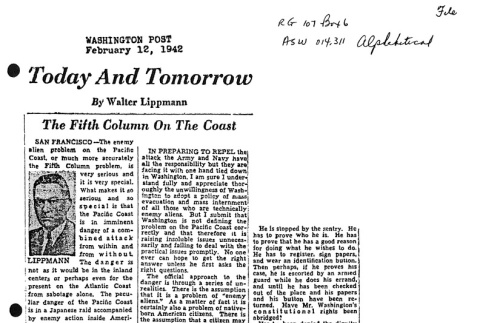
80 items
doc
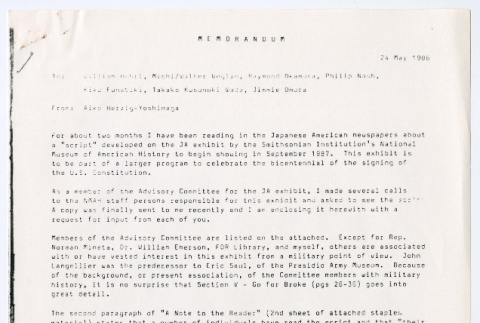
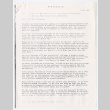
Memorandum for Exhibit Planning (ddr-densho-1007-1858)
Memorandum from Aiko Herzig-Yoshinaga who was a member of the Advisory Committee for the Japanese American exhibit at the Smithsonian Institution's National Museum of American History for the 1987 bicentennial of the U.S. Constitution. The memorandum provided suggestions for improvements to the exhibit and was addressed to other members of the Advisory Committee including Michi and …

vh
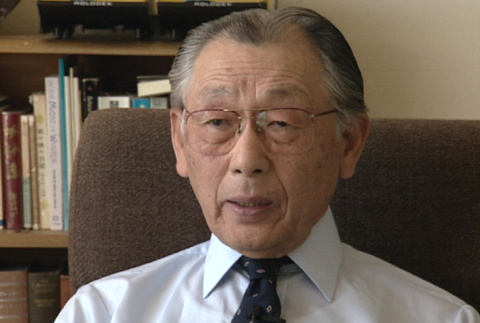
Clifford Uyeda Interview Segment 11 (ddr-densho-122-19-11)
Thoughts on some of those who wrote about the incarceration and/or resistance issue: Michi Weglyn, Aiko Herzig and James Omura
This interview was conducted by filmmaker Frank Abe for his 2000 documentary, Conscience and the Constitution, about the World War II resisters of conscience at the Heart Mountain incarceration camp. As a result, the interviews …
vh
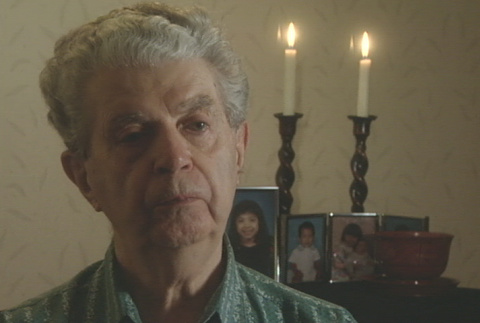
John "Jack" Herzig Interview (ddr-densho-1004-10)
White male. Served in the U.S. Army during World War II and worked with Japanese American interpreters during the U.S. occupation of Japan. Husband of Nisei Aiko Herzig-Yoshinaga, and the couple was instrumental in helping to obtain redress and reparations for Japanese Americans in the 1980s.
(This material is based upon work assisted by a grant …
av
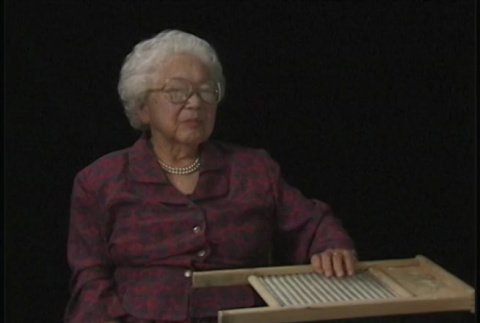
Relics from Camp: A Video Journey (ddr-densho-1024-67)
Companion film to art installation of the same name produced and directed by artist Kristine Yuko Aono and narrated in her first-person voice. Aono explains the origins of the projects and includes footage of her and her family visiting various former concentration camp sites to collect dirt and artifacts as well as installation of the exhibition …
Collection
Commission on Wartime Relocation and Internment of Civilians Collection (ddr-densho-67)
This collection consists of selected papers collected by the Commission on Wartime Relocation and Internment of Civilians (CWRIC), which was created on July 30, 1980 by an act of Congress. Formed mainly to investigate matters surrounding the incarceration and to recommend appropriate remedies, the CWRIC had no power to correct grievances and was viewed as a …