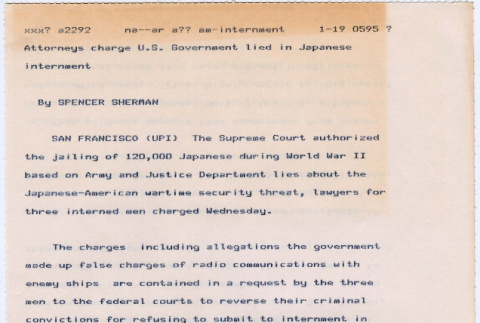
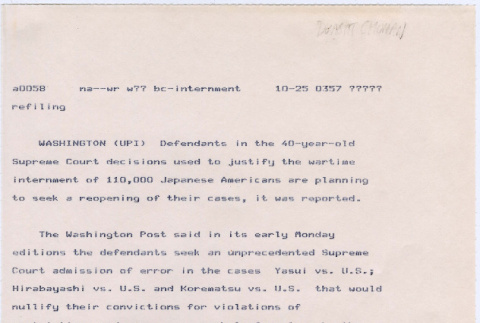
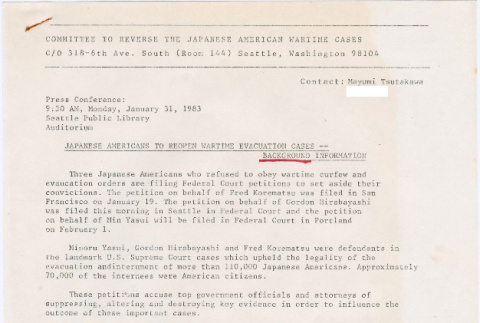
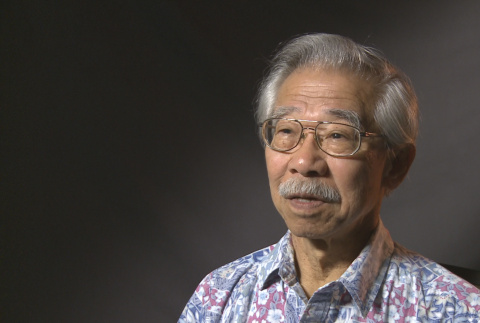
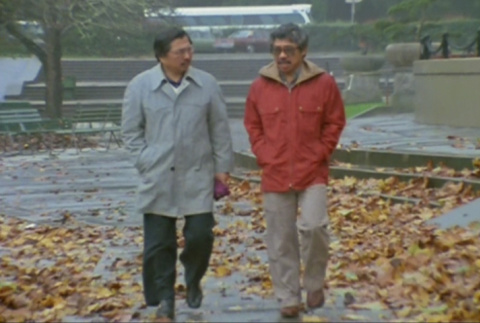
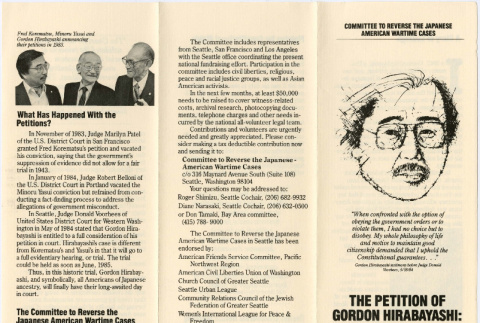
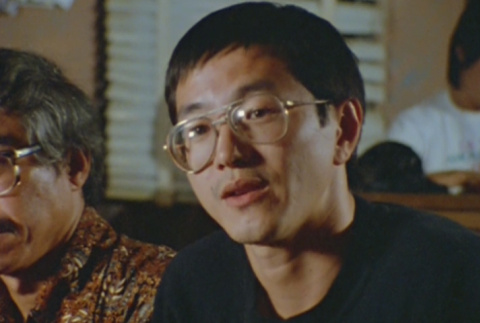
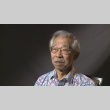
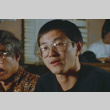
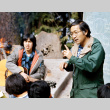
Nisei male. Born October 30, 1926, in small town of Thomas, Washington, on family farm. Attended school in Auburn, Washington, before being removed to the Pinedale Assembly Center and Tule Lake concentration camp, California. Left camp to work in Idaho, and was subsequently joined by family. Postwar, became a social anthropologist, and later became only the …
Gordon Hirabayashi's decision to reopen his case (audio only)
This interview is audio-only. It contains raw footage used by Steven Okazaki in his 1985 film Unfinished Business.
This material is based upon work assisted by a grant from the Department of the Interior, National Park Service. Any opinions, finding, and conclusions or recommendations expressed in …
Support of parents in Gordon's initial case (audio only)
This interview is audio-only. It contains raw footage used by Steven Okazaki in his 1985 film Unfinished Business.
This material is based upon work assisted by a grant from the Department of the Interior, National Park Service. Any opinions, finding, and conclusions or recommendations expressed in …
The lessons of Gordon Hirabayashi's case (audio only)
This interview is audio-only. It contains raw footage used by Steven Okazaki in his 1985 film Unfinished Business.
This material is based upon work assisted by a grant from the Department of the Interior, National Park Service. Any opinions, finding, and conclusions or recommendations expressed in this …
The importance of the redress movement (audio only)
This interview is audio-only. It contains raw footage used by Steven Okazaki in his 1985 film Unfinished Business.
This material is based upon work assisted by a grant from the Department of the Interior, National Park Service. Any opinions, finding, and conclusions or recommendations expressed in this …
Thoughts on being seen as a culture hero (audio only)
This interview is audio-only. It contains raw footage used by Steven Okazaki in his 1985 film Unfinished Business.
This material is based upon work assisted by a grant from the Department of the Interior, National Park Service. Any opinions, finding, and conclusions or recommendations expressed …
The conservatism of Japanese Americans in the immediate postwar era (audio only)
This interview is audio-only. It contains raw footage used by Steven Okazaki in his 1985 film Unfinished Business.
This material is based upon work assisted by a grant from the Department of the Interior, National Park Service. Any opinions, finding, and conclusions or …
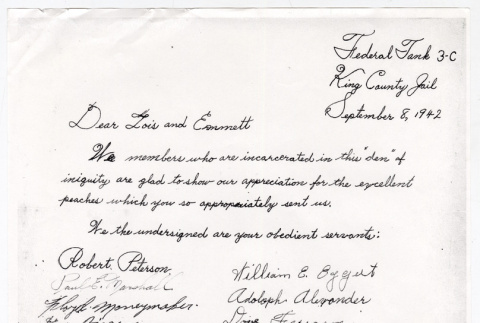
A letter addressed to Lois Bennett and Emmett Bennett from jailed persons at the King County Jail, thanking them for delivering peaches. Among the signatories is Gordon Hirabayashi, whose refusal to comply with Japanese American incarceration orders led to the landmark case Hirabayashi v. United States.
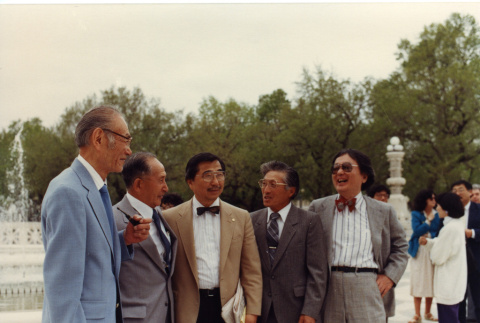
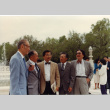
Members of the National Council for Japanese American Redress at the Supreme Court. Photograph titled: "Fred Korematsu, Harry Ueno, Gordon Hirabayashi, George Ikeda, and William Hohri." See this object in the California State Universities Japanese American Digitization project site: P241
This interview is with Japanese Canadian playwright Rick Shiomi and Jim Hirabayashi, brother of Gordon Hirabayashi, who defied the curfew and removal orders in 1942, and was arrested, convicted, and imprisoned. Gordon Hirabayashi's conviction was vacated in 1986.
(This interview is audio-only. It contains raw footage used by Steven Okazaki in his 1985 film Unfinished Business …