Encounters with racism: discrimination at railroad company
This interview was conducted as part of a project to capture stories of the Japanese American community of Spokane, Washington. Densho worked in collaboration with the Northwest Museum of Arts and Culture.
Description of family hotel: housed transitional workers
This interview was conducted as part of a project to capture stories of the Japanese American community of Spokane, Washington. Densho worked in collaboration with the Northwest Museum of Arts and Culture.
This interview was conducted as part of a project to capture stories of the Japanese American community of Spokane, Washington. Densho worked in collaboration with the Northwest Museum of Arts and Culture.
This interview was conducted as part of a project to capture stories of the Japanese American community of Spokane, Washington. Densho worked in collaboration with the Northwest Museum of Arts and Culture.
Visiting Minneapolis while serving at Fort Snelling
This interview was conducted as part of a project to capture stories of the Japanese American community of Spokane, Washington. Densho worked in collaboration with the Northwest Museum of Arts and Culture.
Visiting Minidoka concentration camp, Idaho, during the war
This interview was conducted as part of a project to capture stories of the Japanese American community of Spokane, Washington. Densho worked in collaboration with the Northwest Museum of Arts and Culture.
A discriminatory encounter involving the ROTC in college
This interview was conducted as part of a project to capture stories of the Japanese American community of Spokane, Washington. Densho worked in collaboration with the Northwest Museum of Arts and Culture.
This interview was conducted as part of a project to capture stories of the Japanese American community of Spokane, Washington. Densho worked in collaboration with the Northwest Museum of Arts and Culture.
Keige Kaku was a U.S.-born citizen who served in the U.S. Army. After the bombing of Pearl Harbor, he was abruptly discharged and sent to Poston. Outraged by the betrayal, Keige refused to answer the infamous “loyalty questionnaire” and was sent to Tule Lake. He ultimately renounced his citizenship and was deported to Japan, where Henry …
From left to right: Minerich, Nomiyama, Kataoka, Hayakawa. Nomiyama discusses waiting for an opportunity to take part in the war effort, joining company C at FortMcClellan in Alabama, wanting to be court martialed to have an opportunity to speak his mind, why he didn't want to serve in the Pacific, what he thought the war was …
Daniels discusses what may have happened if the Japanese American community resisted evacuation en masse, how Japanese Americans were placed under 4C (enemy alien, undraftable) status and the military's eventual interest in Japanese Americans (particularly Kibei) for intelligence work, the importance of the 100th Battalion and the 442nd Regimental Combat Team, the loyalty questionnaire, the persecution …
From left to right: Minerich, Nomiyama, Kataoka, Hayakawa. Kataoka discusses being a soldier when evacuation started, the interment of his wife, and the relationship between Kibei and Nisei soldiers. Kataoka and Nomiyama discuss how they met. Nomiyama discusses when he decided to refuse to serve, being called a traitor when he left Japan, returning to the …
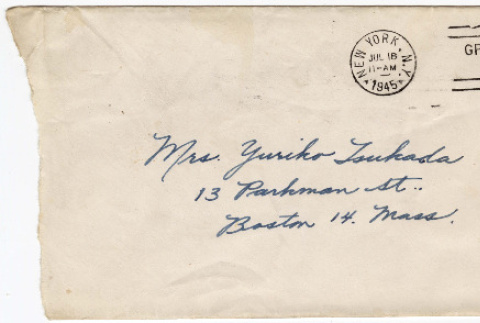
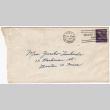
Letter and four photographs to Yuriko Domoto Tsukada from her husband Richard "Dick" Tsukada. Dick writes asking Yuri to focus on her studies, about delaying starting a family, additional news about how he plans to keep his job even through the head office is worried about having him on staff, and details about the enclosed photographs. …
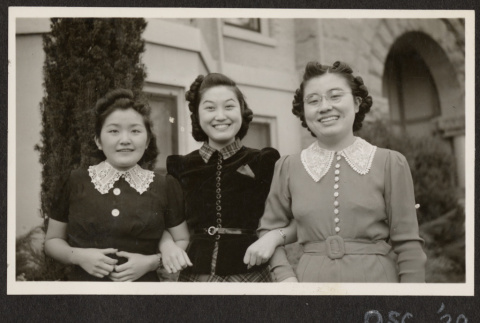
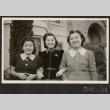
Photograph of three young women locking arms and smiling in front of a building on Oregon State College's campus (currently known as Oregon State University). On the far left is Molly (Kageyama) Maeda, in the center is Lena, and on the far right is Emi. Written on the album page below the bottom right corner is …
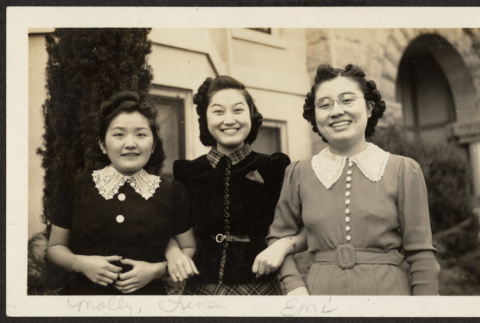
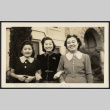
Photograph of three young women locking arms and smiling in front of a building on Oregon State College's campus (currently known as Oregon State University). On the far left is Molly (Kageyama) Maeda, in the center is Lena, and on the far right is Emi. Written on the boarder of the photograph is "Molly, Lena Emi" …
Written on verso: Left to right - Top Row - Lawerence Fernandez, Helen Gomez, Cecilia Mondera, Marie Sauza, Christopher Perriera, Rosie Cosmos, Second Row - Geno Rouderequious, Frances Cortez, Allen, Adeline Fernandez, Ida Motes, Carnation Gonsaloes, Tony Romeo, Third Row - Josephine Malan, Leno Agusta, Edward Lanerne, Evelyn George, Frank Romeo, First Row - Kimiko Fujii, …
Written on verso: Left to right - Top Row - Lawerence Fernandez, Helen Gomez, Cecilia Mondera, Marie Sauza, Christopher Perriera, Rosie Cosmos, Second Row - Geno Rouderequious, Frances Cortez, Allen, Adeline Fernandez, Ida Motes, Carnation Gonsaloes, Tony Romeo, Third Row - Josephine Malan, Leno Agusta, Edward Lanerne, Evelyn George, Frank Romeo, First Row - Kimiko Fujii, …
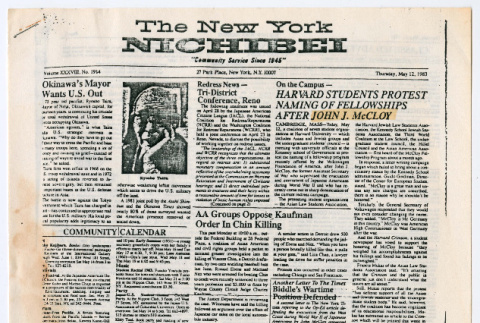
This material includes various news articles which highlight student protests at Harvard University opposing the naming of a scholarship program after former Assistant Secretary of War John J. McCloy. To learn more about McCloy, who is criticized for his role in the forced removal of Japanese Americans during World War II, see his Densho Encyclopedia page: …
Kaneko discusses the reasons some Japanese Americans joined the military and his father's decision to bury or burn all their family's Japanese possessions. Audio only. Loni Ding can be heard asking questions. Seems to be the fourth part of the interview started in ddr-densho-1007-1759, but the third portion is missing. Original title: 407, John Kaneko IV, …
Being reviewed by General George C. Marshall before going overseas
This interview was conducted as part of a project to capture stories of the Japanese American community of Spokane, Washington. Densho worked in collaboration with the Northwest Museum of Arts and Culture.
Attending lectures in Florence while waiting to return to U.S.
This interview was conducted as part of a project to capture stories of the Japanese American community of Spokane, Washington. Densho worked in collaboration with the Northwest Museum of Arts and Culture.
Feeling uncomfortable upon returning to school; hearing of FBI arrests
This interview was conducted as part of a project to capture stories of the Japanese American community of Spokane, Washington. Densho worked in collaboration with the Northwest Museum of Arts and Culture.
Growing up in a Japanese labor community in Hillyard
This interview was conducted as part of a project to capture stories of the Japanese American community of Spokane, Washington. Densho worked in collaboration with the Northwest Museum of Arts and Culture.
Being singled out as Japanese Americans during swearing-in ceremony
This interview was conducted as part of a project to capture stories of the Japanese American community of Spokane, Washington. Densho worked in collaboration with the Northwest Museum of Arts and Culture.
Not realizing the 442nd's accomplishments until after the war
This interview was conducted as part of a project to capture stories of the Japanese American community of Spokane, Washington. Densho worked in collaboration with the Northwest Museum of Arts and Culture.