
309 items









309 items

doc
Letter from Kaz Oka, President, Japanese American Citizens League Monterey Peninsula Chapter to Mrs. E. Hill, U.S. Employment Department, February 26, 1942 (ddr-csujad-44-4)
Letter from Kaz Oka, President of the Japanese American Citizens League (JACL) Monterey Peninsula Chapter to Mrs. E. Hill at the United States Employment Department thanking her for her assistance with "the Japanese aliens in the recent evacuation." The letter also thanks Mrs. Hill for assistance with the "special problems" of Mrs. Hasegawa and Mr. Tani. …

doc
Race Tension: Second Phase (ddr-csujad-19-80)
This is an article from the magazine "Common Ground," vol. IV, no. 1, autumn 1943, which describes about the growing race tensions in the United States. It also talks about a technique of cultural analysis that can be applied to the problem of race tension from which some further important perspectives can be acquired. See this …

doc
Restricted Citizen (ddr-csujad-19-47)
This article, "The Restricted Citizen," from "Annals of the American Academy of Political and Social Science," by Everett V. Stonequist discusses the difference between democratic constitutional theory and democratic social practice in the treatment of minorities. The article also describes the social structure of the United States and the early process of migration to America. See …

doc
Declaration: declaration of eligibility by persons identified by the Office of Redress Administration (ddr-csujad-42-151)
Attachment pages 1-3, "Declaration: declaration of eligibility by persons identified by the Office of Redress Administration," completed by Yoneko Takano. The documents were presumably attached to the letter sent from Robert K. Bratt, Administrator for Redress, Office of Redress Administration, Civil Rights Division, United States Department of Justice, which is found in item: csudh_tak_0150. See this …

doc
Racism and reason: an address to be delivered by Dillion S. Myer, Director of the War Relocation Authority (ddr-csujad-55-1646)
Transcription of a speech given by Dillon Myer to an interfaith meeting sponsored by the Pacific Coast Committee on American Principles and Fair Play. Speech covers racism against individuals of Japanese ancestry, the 100th Infantry Battalion, Japanese American soldiers, and opinions about the future of individuals of Japanese ancestry in the United States. See this object …

doc
Japanese American internment in World War II--the issue of redress IPO158 (ddr-csujad-55-157)
Packet of information prepared by the Library of Congress in order to provide basic information on the "World War II internment, the Commission, its findings, and pro/con material on the complex issue of redress." Includes an analysis of, "the internment of German and Italian Aliens Compared with the Internment of Japanese Aliens in the United States …

Narrator Bill Braye
Male of Spanish and Irish descent. Born March 31, 1917, in Santa Monica, California. Moved to Salinas, California, as a teenager, and enlisted in the military. Stationed in the Philippines when the Japanese bombed Pearl Harbor, and was captured by the Japanese military. Forced on the infamous Bataan Death March in 1942 and held as a …
Narrator Mutsu Homma
Issei female. Born June 19, 1911, in Tono City, Iwate-ken, Japan. Immigrated to the United States in 1929. Incarcerated at the Santa Anita Assembly Center, California, and Amache concentration camp, Colorado. Father established and ministered the first Western-style Christian church in Tono City. Husband was assigned to the Santa Anita Assembly Center as the official head …

Narrator Donald K. Tamaki
Sansei male. Born May 26, 1951, in Oakland, California. Received law degree from UC Berkeley. In the 1980s, served as a member of the pro bono legal team for Korematsu v. United States, a lawsuit to overturn a 40 year old conviction for refusal to obey exclusion orders aimed at Japanese Americans during World War II, …

Narrator Julie Otsuka
Sansei female. Born May 15, 1962, in Palo Alto, California. Mother was a Nisei who was incarcerated during World War II, and father was a Japanese immigrant who came to the United States in 1950. Grew up in Palo Alto, California, before studing art at Yale University. Later moved to New York, giving up art and …
Narrator Ruth Y. Okimoto
Nisei female. Born April 15, 1936, in Tokyo, Japan. Brought to the United States with parents at the age of one, and grew up in San Diego, California, where father was a minister. During World War II, removed to the Santa Anita Assembly Center, California, and the Poston concentration camp, Arizona. After the war, forged connections …
Narrator Robert A. Nakamura
Nisei/Sansei male. Born July 5, 1936, in Venice, California. During World War II, removed to the Manzanar concentration camp, California. After leaving camp, lived for a time in Denver before returning to Los Angeles. After the war, became a pioneering filmmaker. Founder of Visual Communications, the oldest community-based media arts center in the United States. Along …
vh
Barbara Reiko Mikami Keimi Interview (ddr-densho-1000-459)
Sansei female. Born December 4, 1935, in Sawtelle, California. Grew up in Huntington Beach, California, where father worked as a chauffeur. After the bombing of Pearl Harbor, father was picked up by the FBI and taken to the Tuna Canyon Detention Station. He rejoined the family at the Merced Assembly Center, California, and the family was …
Narrator Kanji Sahara
Issei male. Born April 4, 1934, in Hiroshima, Japan, while mother and older siblings were visiting Japan for an extended period. Came to the United States at a few months old, and grew up in the Uptown area of Los Angeles, California. During World War II, removed to the Santa Anita Assembly Center, California, and the …
doc
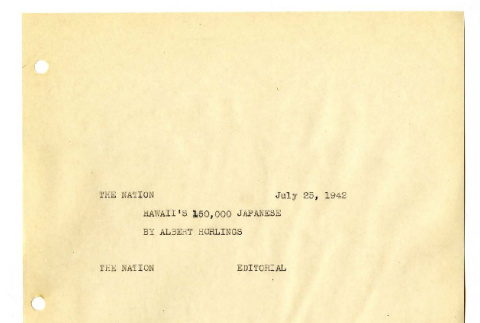
Hawaii's 150,00 Japanese (ddr-csujad-19-84)
An article from "The nation," vol. 155, no. 4 (July 25, 1942). It is written by Albert Horlings and describes the historic gamble by the United States government in Hawaii by trusting the loyalty of 150,000 Japanese Americans and Japanese, 40,000 of whom were aliens and and majority of those who cannot read or speak English. …
img
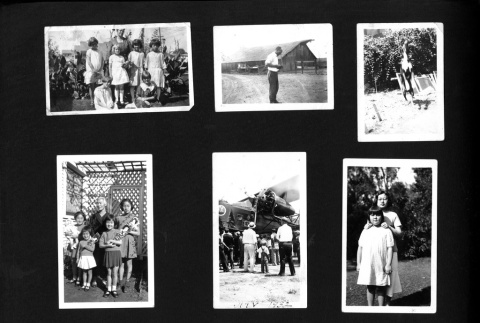
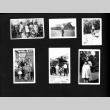
Japanese family, female children (ddr-csujad-25-300)
A page from a photo album including Japanese family photographs. Six photographs are pasted on the page. Includes: Japanese or Japanese American female children along with Caucasian female children. In one of the photographs, Japanese female children pose holding "hagoita." Another photograph captures a United States Army Air Corps aircraft taken in July 1932, most likely …

doc
Letter from Robert K. Bratt, Administrator for Redress, Office of Redress Administration, Civil Rights Division, U.S. Department of Justice to recipient (ddr-csujad-42-153)
A copy of a letter from Robert K. Bratt, Administrator for Redress, Office of Redress Administration, Civil Rights Division, United States Department of Justice, addressing a recipient, who is presumably Yoneko or Mariko Takano. It notifies that their review of the documents has been completed and determined that the requester is eligible for a redress payment …

doc
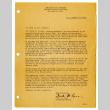
Letter from W. S. Hislop, Associate Construction Superintendent, Gila River Project, War Relocation Authority, April 23, 1945 (ddr-csujad-42-110)
A letter from W. S. Hislop, Associate Construction Superintendent, Gila River Project, War Relocation Authority, United States Department of the Interior. It appears that the shipment from Tom Nakashima in Reno Nevada has arrived at the Gila River incarceration camp and been inspected. The letter certifies that the shipment contains mechanic hand tools which belong to …
doc
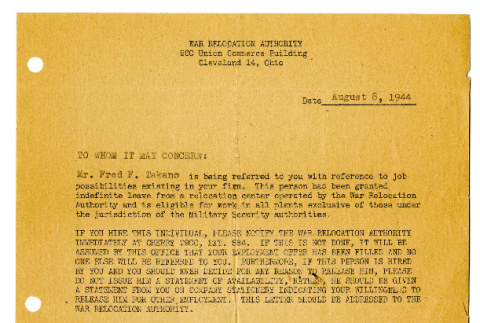
Letter from Fred W. Ross, Relocation Officer, War Relocation Authority, August 8, 1944 (ddr-csujad-42-105)
A letter from Fred W. Ross, Relocation Officer, War Relocation Authority, United States Department of the Interior, to the employer who is hiring Fumio Fred Takano. It confirms that Fumio has been granted indefinite leave from the camp and is eligible for work. It also includes the requirements in hiring/releasing him and describes the resettlement program. …

doc
Daily work pass, WRA-139 rev., Fred Takano (ddr-csujad-42-103)
A daily work pass issued by War Relocation Authority, United States Department of the Interior, on July 5, 1944. It certifies that Fumio Fred Takano is authorized to leave the Gila River incarceration camp on workdays and specifies the times when he is allowed to leave and when he needs to return. The pass is valid …

doc
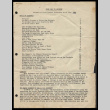
Letter from Robert K. Bratt, Administrator for Redress, Office of Redress Administration, Civil Rights Division, U.S. Department of Justice to recipient, November 6, 1990 (ddr-csujad-42-152)
A copy of a letter from Robert K. Bratt, Administrator for Redress, Office of Redress Administration, Civil Rights Division, United States Department of Justice, addressing a recipient, who is presumably Yoneko or Mariko Takano. It notifies that the recipient's eligibility for a redress payment has been finalized and a check will be sent to the recipient …
doc
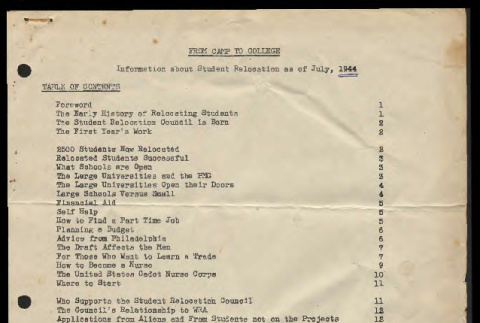
From camp to college: information about student relocation as of July, 1944 (ddr-csujad-55-1823)
Report on the relocation of students at incarceration camps. Covers the history of relocating students, the student relocation council, student success, schools, large universities and the PMG, financial aid, part-time jobs, budget, the draft, trade schools, nursing, the United States cadet nurse corps, student relocation council and the WRA, applications from aliens, high school undergraduates, travel, …
doc
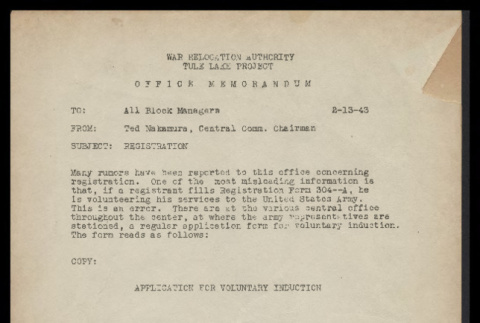
Memo from Ted Nakamura, Central Comm. Chairman, to all block managers, DSS form 165, February 13, 1943 (ddr-csujad-55-188)
Memorandum of understanding from Ted Nakamura to Block Managers at Tule Lake regarding registration form WRA 304a (also known as the "loyalty questionnaire") and whether or not an individual is volunteering his services for the United States Army when filling out the form. Memo also includes a copy of the Application for Voluntary Induction, DSS Form …

doc
Our 110,000 new boarders (ddr-csujad-55-180)
Opinion article by J.P. McEvoy on the Japanese incarceration during World War II. Includes the author's perspective on implications of the incarceration for American taxpayers and armed forces, history of Japanese labor in the United States, and opinion on the incarceration. Condensed from the Baltimore Sunday Sun. A version of this article also appeared in Reader's …

vh
Eric K. Yamamoto Interview (ddr-densho-1000-235)
Sansei male. Born 1952 in Honolulu, Hawaii. Attended law school at UC Berkeley, California and became involved with the Asian Law Caucus. After graduating, returned to Hawaii. In the 1980s, left job in Hawaii and moved to the Bay Area to become a member of the pro bono legal team for Korematsu v. United States, …