
398 items
398 items
vh
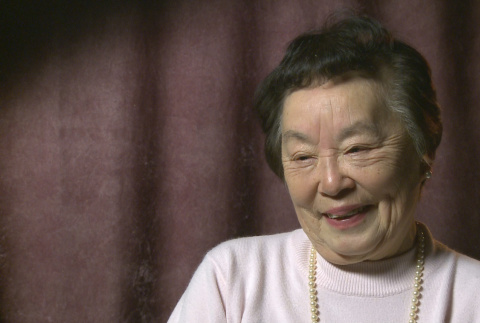
Aiko Tengan Tokunaga Interview Segment 10 (ddr-densho-1000-293-10)
Coping with devastation in Okinawa
vh
Aiko Tengan Tokunaga Interview Segment 4 (ddr-densho-1000-293-4)
Mother's move to Tokyo, marriage
vh
Aiko Tengan Tokunaga Interview Segment 11 (ddr-densho-1000-293-11)
Mother's decision to return to Hawaii
vh
Aiko Tengan Tokunaga Interview Segment 6 (ddr-densho-1000-293-6)
Father's death while serving in the medical corps in Okinawa
vh
Aiko Tengan Tokunaga Interview Segment 8 (ddr-densho-1000-293-8)
Family's struggles to survive in Okinawa during the war
vh
Aiko Tengan Tokunaga Interview Segment 2 (ddr-densho-1000-293-2)
Mother's adoption, move to Okinawa
vh
Aiko Tengan Tokunaga Interview Segment 23 (ddr-densho-1000-293-23)
Reflections: The importance of the Okinawan community in the United States
img
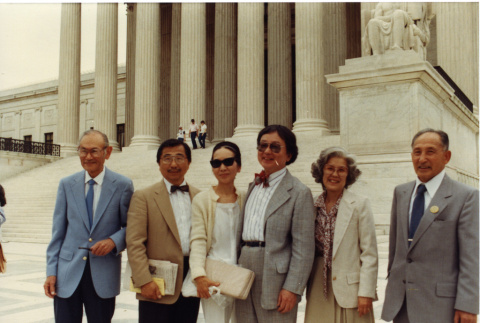
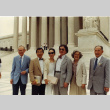
Fred Korematsu, Gordon Hirabayashi, Michi Weglyn, William Hohri, Aiko Herzig, and Harry Ueno (ddr-csujad-29-297)
Group photograph of National Council for Japanese American Redress members at Supreme Court. Photograph titled: "Fred Korematsu, Gordon Hirabayashi, Michi Weglyn, William Hohri, Aiko Herzig, and Harry Ueno." See this object in the California State Universities Japanese American Digitization project site: P240
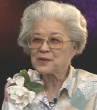
Narrator Aiko Herzig-Yoshinaga
Nisei female. Born August 5, 1924, in Sacramento, California. Grew up in Sacramento and Los Angeles. During World War II, removed to the Manzanar concentration camp, California, and transferred to the Jerome concentration camp, Arkansas. Washington representative and researcher for National Council for Japanese American Redress (NCJAR) and primary archival researcher for the Commission on Wartime …
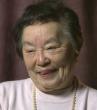
Narrator Kay Aiko Abe
Nisei female. Born May 9, 1927, in Selleck, Washington. Spent much of childhood in Beaverton, Oregon, where father owned a farm. Influenced at an early age by parents' conversion to Christianity. During World War II, removed to the Portland Assembly Center, Oregon, and the Minidoka concentration camp, Idaho. After the war, worked to establish a successful …
doc
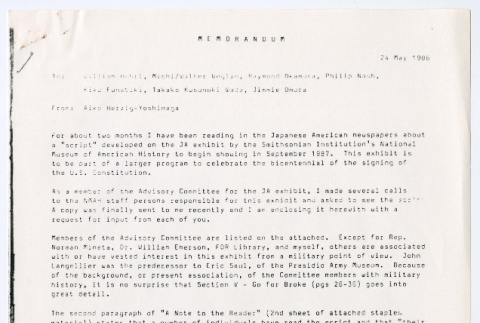
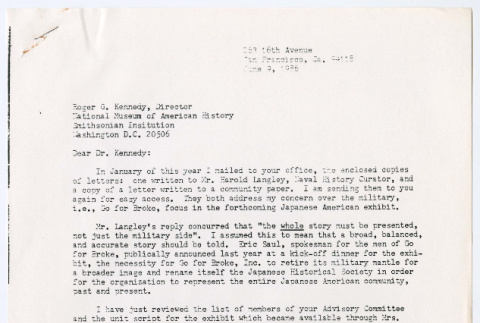
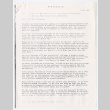
Memorandum for Exhibit Planning (ddr-densho-1007-1858)
Memorandum from Aiko Herzig-Yoshinaga who was a member of the Advisory Committee for the Japanese American exhibit at the Smithsonian Institution's National Museum of American History for the 1987 bicentennial of the U.S. Constitution. The memorandum provided suggestions for improvements to the exhibit and was addressed to other members of the Advisory Committee including Michi and …
doc
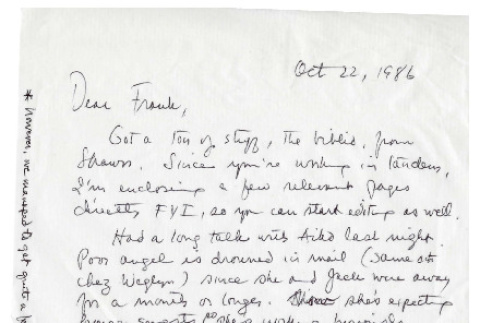
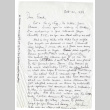
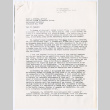
Letter from Michi Weglyn to Frank Chin, October 22, 1986 (ddr-csujad-24-49)
A letter from Michi Weglyn to Frank Chin in which she describes a conversation she had with Aiko Herzig-Yoshinaga. See this object in the California State Universities Japanese American Digitization project site: chi_02_008
img
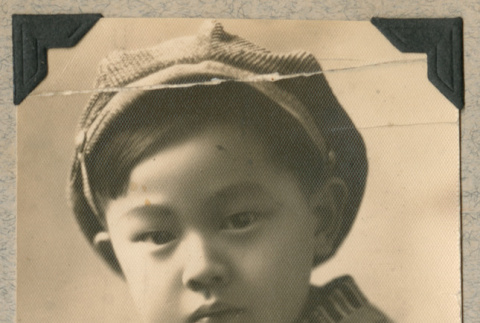
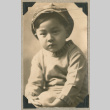
Portrait of Masateru Fukuhara as young boy (ddr-densho-383-213)
The Fukuharas were neighbors of the Tokuda family in Seattle in the 1930s. The Fukuhara family included Shigesaburo and Yasuko Fukuhara (c. 1905-1938) and their children Ruth Aiko Fukuhara (1921-1986), Francis Masateru Fukuhara (1925-2016), and Henry Kiyotaka Fukuhara (1928-1977). Written on album page below photograph: "Masateru Fukuhara".
img
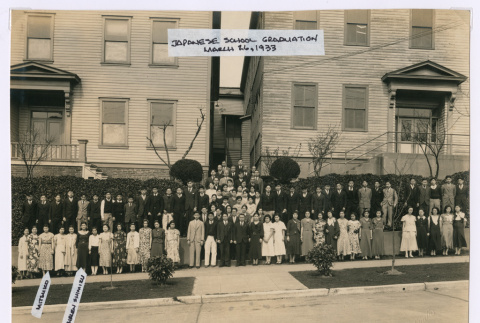
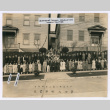
Seattle Japanese Language School 1933 Graduation (ddr-densho-477-67)
Photograph of the 1933 graduating class from the Seattle Japanese Language School. The caption on the top of the photograph reads "Japanese School Graduation / March 26, 1933" in black ink, written on a piece of paper or tape. There are paper flags pointing out Mitsuko (Nakahara) Isoshima and Helen Shimizu. Their is a caption along …
vh
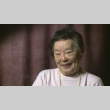
Kay Aiko Abe Interview Segment 9 (ddr-densho-1000-232-9)
World War II experiences: memories of Portland Assembly Center
vh
Kay Aiko Abe Interview Segment 5 (ddr-densho-1000-232-5)
Father has a powerful experience, converts to Christianity
vh
Kay Aiko Abe Interview Segment 8 (ddr-densho-1000-232-8)
Father finds a caretaker for family farm with the help of religion
vh
Kay Aiko Abe Interview Segment 14 (ddr-densho-1000-232-14)
First getting involved with a homeless feeding program
vh
Kay Aiko Abe Interview Segment 10 (ddr-densho-1000-232-10)
Leaving camp and living in a hostel in Seattle