
5890 items
5890 items
doc
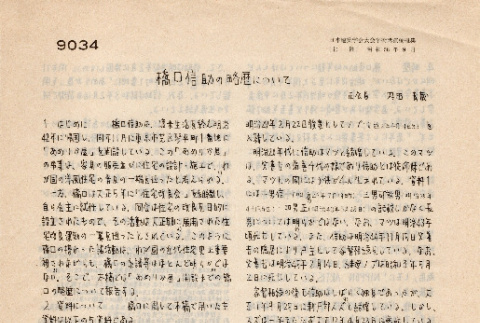
Image of paper, in Japanese, by Seizo Uchida (ddr-densho-474-182)
Presented to the September 1981 Conference of the Architectural Institute of Japan. The subject of the paper is Shinsuke Hashiguchi. Includes translation by donor
img
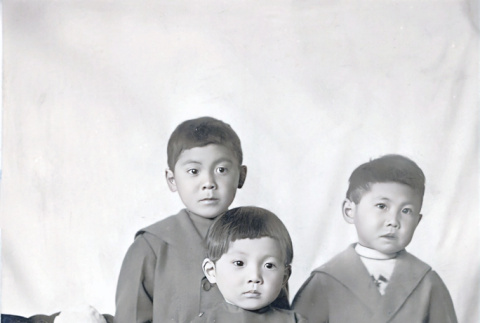
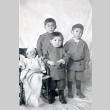
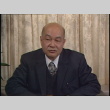
Portrait of four boys (ddr-densho-474-207)
Front row left to right: Mutsuo Hashiguchi, Shugo Hashiguchi, Shiro Hashiguchi. Back: Hiroshi Hashiguchi
av
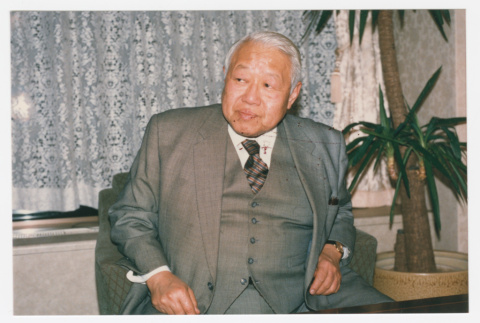
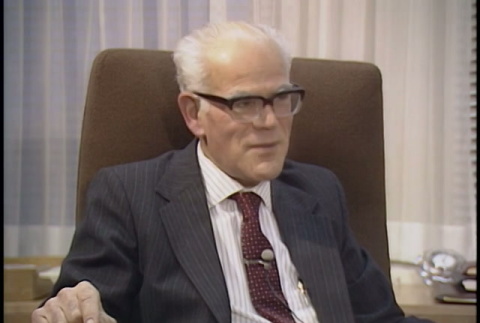
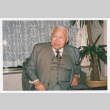
Interview with Hugh Nozawa, part 2 of 3 (ddr-densho-1007-1714)
Nozawa discusses the mistreatment of the Nisei during Roosevelt's visit to Fort Riley, a complaint he wrote to John J. McCloy afterwards, being punished for writing the letter without permission, the differences between Kibei and US-educated Nisei, growing up in Japan, being drafted while in Santa Monica, and being court martialed. Loni Ding can be heard …
av
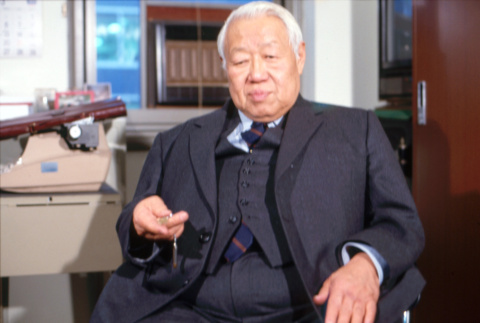
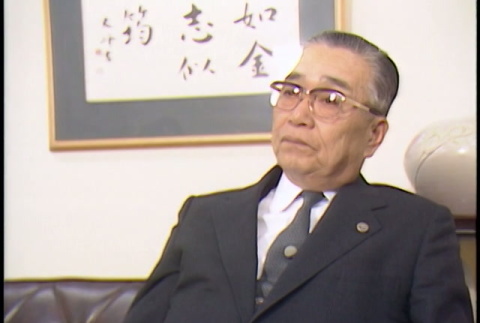
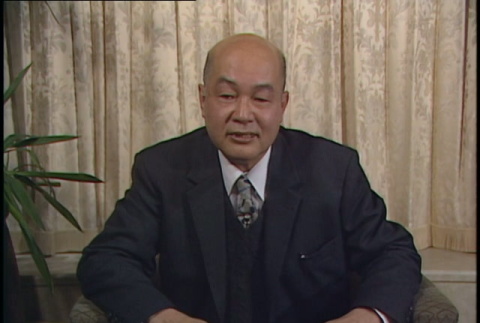
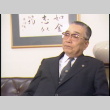
Interview with Yoshio Miwa, part 4 of 4 (ddr-densho-1007-1670)
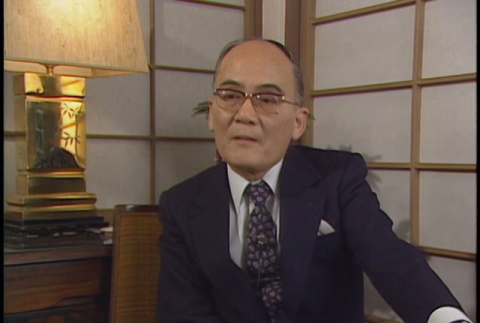
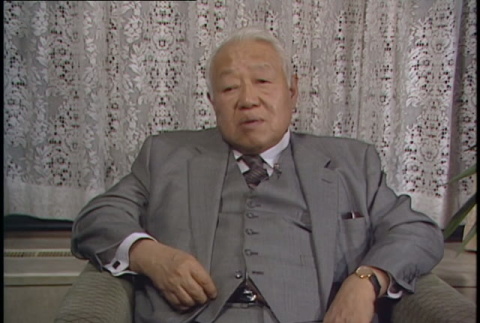
Miwa discusses Japanese impressions of Nisei soldiers and the relationships between Nisei families and Japanese families after the war. Interview conducted mostly in Japanese with the aid of an interpreter. Loni Ding can be heard asking questions behind the camera. Original title: 191, II JA #4, Yoshio Miwa, Fri. Jan. 31, 1986
av
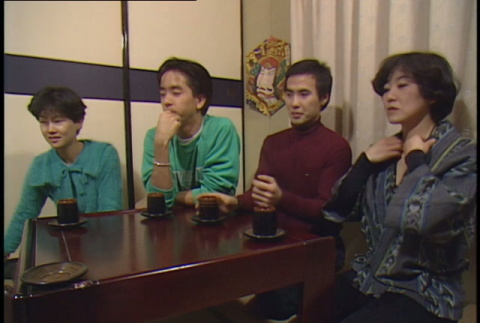
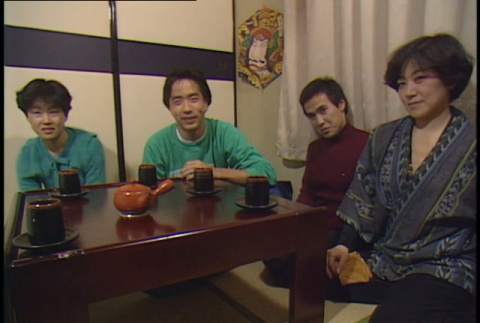
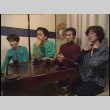
Interview with Akiko, Brian Yamakoshi, Kenny and Chizuko, part 1 of 4 (ddr-densho-1007-1717)
In order of left to right: Akiko, Brian Yamakoshi, Kenny, and Chizuko. Aside from Brian, last names unknown; Kenny and Chizuko are married. This tape focuses mainly on Chizuko, who discusses her relationship with her grandfather, her reasons for coming to Japan, and making Noh masks. Loni Ding can be heard asking questions behind the camera. …
av
Interview with Hugh Nozawa, part 3 of 3 (ddr-densho-1007-1715)
Nozawa discusses being court-martialed for refusing to serve in the military while the internment camps were operating, the long fight for honorable discharge after the fact, and his reasons for trying to hard to reverse the dishonorable discharge given to Nisei who refused to serve. Original title: 222, II JA #54, Hugh Nozawa, Sun. Feb. 2
av
Interview with Bill Dizer, part 3 of 3 (ddr-densho-1007-1678)
Dizer discusses the differences between Nisei and Japanese nationals, his thoughts on Japanese/Nisei "ethnocentrism", his experience with Japanese work and social life, his advice for his Japanese and American peers, and his views on racial discrimination. Loni Ding can be heard asking questions in the background. Original title: 195, II JA #12, Bill Dizer, Fri. Jan. …
av
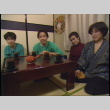
Interview with Akiko, Brian Yamakoshi, Kenny and Chizuko, part 4 of 4 (ddr-densho-1007-1720)
Akiko and Brian Yamakoshi discuss the differences between Japanese Americans and Japanese nationals. Chizuko discusses the unique opportunity afforded to Sansei to pursue Japanese arts and culture. Interview ends around 10:30; rest of tape is reaction shots. Original title: 227, II JA #59, Brian Yamakoshi, Fri. Feb. 7
av
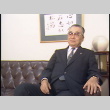
Interview with Yoshio Miwa, part 2 of 4 (ddr-densho-1007-1668)
Miwa discusses meeting American soldiers for the first time, the start of the occupation of Japan, and the role of Nisei in the occupation. Interview conducted mostly in Japanese with the aid of an interpreter. Loni Ding can be heard asking questions behind the camera. Original title: II JA #2, Yoshio Miwa, Fri. Jan. 31, 1986. …
img
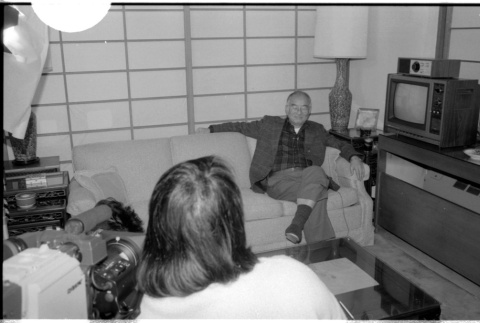
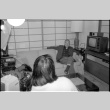
Behind the scenes shot of interview with John Fujii (ddr-densho-1007-1176)
Negative. Taken during an interview for The Color of Honor.
av
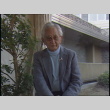
Interview with Harry Fukuhara, part 3 of 5 (ddr-densho-1007-1699)
Fukuhara discusses how he approached interviewing prisoners of war, his relationship with Caucasian soldiers in the military, and the risk of being captured by the Japanese military. Video starts at 0:25. Loni Ding can be heard asking questions behind the camera. Original title: 214, II JA #38, Harry Fukuhara, Sun. Feb. 2. Interview continues at ddr.densho.org/ddr-densho-1007-1700/
av
Interview with Kiyofumi Kojima, part 3 of 4 (ddr-densho-1007-1695)
Interview conducted in Japanese. Original title: 210, II JA #34, Kiyofumi Kojima, Feb. 1, 1986. Interview continues at ddr.densho.org/ddr-densho-1007-1696/
av
Interview with Masaru Ogawa, part 3 of 3 (ddr-densho-1007-1712)
Ogawa discusses being the last person to surrender from his interpreter school, working with American soldiers in Japan after the war, trusting an American soldier to take his personal belongings back to Tokyo, and his thoughts on post-war Japan. Loni Ding can be heard asking questions behind the camera. Original title: II JA #51, Masaru Ogawa, …
av
Interview with Harry Fukuhara, part 4 of 5 (ddr-densho-1007-1700)
Fukuhara discusses the possibility of meeting his brother (who was in the Japanese army) on the battlefield, the mental struggles soldiers faced in Japan, and his thoughts on draft resisters. Loni Ding can be heard asking questions behind the camera. Original title: 215, II JA #39, Harry Fukuhara, Sun. Feb. 2. Interview continues at ddr.densho.org/ddr-densho-1007-1701/
av
Interview with Barry Saiki, part 1 of 5 (ddr-densho-1007-1702)
Saiki discusses growing up in Stockton, CA, attending UC Berkeley, Pearl Harbor, the start of evacuation and negative press about Nisei during that time, graduating from Berkeley in 1942, entering Stockton Assembly Center, and the arrest and incarceration of his father. Loni Ding can be heard asking questions behind the camera. Original title: II JA #41, …
av
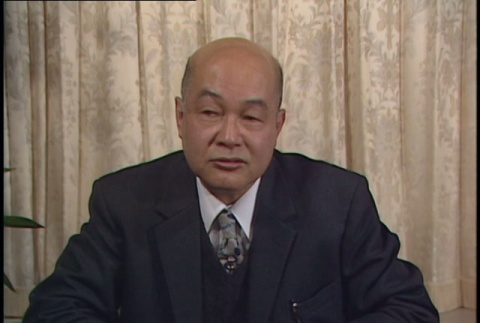
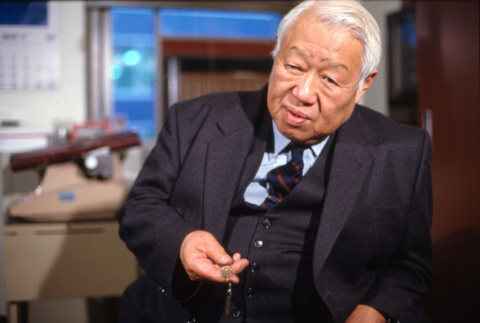
Interview with Sen Nishiyama, part 2 of 5 (ddr-densho-1007-1672)
Nishiyama discusses working with the occupation govnerment, rebuilding telecommunications infrastructure after the war, advocating against the romanization of written Japanese, the laws imposed by the occupation government, and his reaction to Pearl Harbor. Loni Ding can be heard asking questions behind the camera. Original title: II JA #6, Sen Nishiyama, Fri. Jan. 31, 1986. Interview continues …
av
Interview with Masaru Ogawa, part 1 of 3 (ddr-densho-1007-1710)
Ogawa discusses growing up in Hollywood, spending a year in Japan as a child, his experiences with discrimination in high school, attending Japanese classes, being denied from universities for being Japanese, working in Tokyo when the war started, and convincing his parents to move back to Japan in 1941. Loni Ding can be heard asking questions …