Redress and reparations

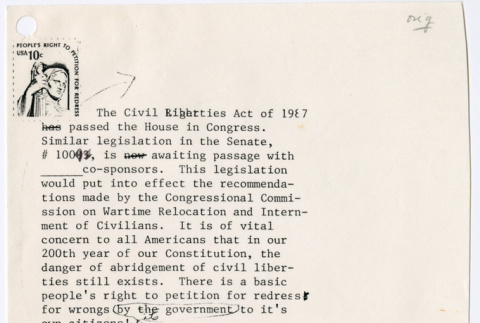
In the late 1960s, Japanese Americans began to revisit the history of the exclusion and incarceration period in order to seek justice for their suffering and ensure that no such wrong would ever be committed again. Years of effort by community activists, politicians, academics, and other supporters culminated on August 10, 1988, with the signing of the Civil Liberties Act by President Ronald Reagan. This Act rescinded Executive Order 9066, and mandated an official apology from the federal government, monetary reparations payments to individuals excluded and incarcerated, and the creation of a federal fund for research and education about the incarceration.

Redress and reparations (1801)

Related articles from the Densho Encyclopedia :
Civil Liberties Act of 1988, Civil Liberties Public Education Fund, Emergency Detention Act, Title II of the Internal Security Act of 1950, Aiko Herzig-Yoshinaga, William Hohri, Bill Hosokawa, Japanese American Evacuation Claims Act, Yuri Kochiyama, Magic cables, Kazuo Masuda, Robert Matsui, Spark Matsunaga, Norman Mineta, National Coalition for Redress/Reparations, National Council for Japanese American Redress, James Omura, Redress movement, Termination of Executive Order 9066, Mary Tsukamoto, Edison Uno, Clifford Uyeda
Facilities
Format
Genre
Usage

Use <Ctrl> or (⌘) keys to select multiple terms

1801 items
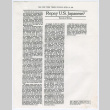
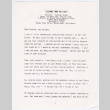
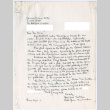
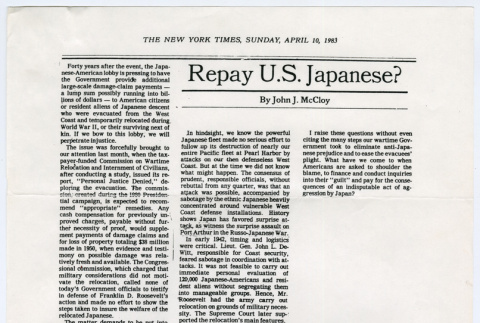
Anti-reparation article written by John J. McCloy (ddr-densho-1007-1111)
doc Anti-reparation article written by John J. McCloy (ddr-densho-1007-1111)
Photocopy. Published in the New York Times. McCloy was FDR's Assistant Secretary of War.
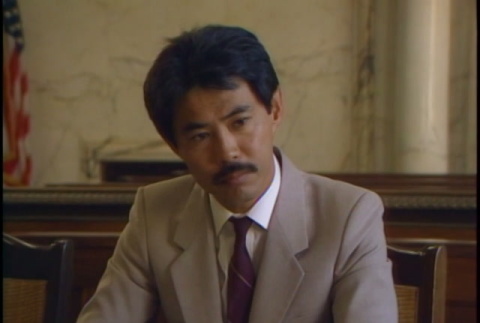
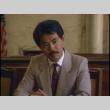
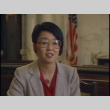
San Francisco Courthouse footage, part 8 of 10 ; interview with Dale Minami and Karen Kai, part 4 of 5 (ddr-densho-1007-1629)
av San Francisco Courthouse footage, part 8 of 10 ; interview with Dale Minami and Karen Kai, part 4 of 5 (ddr-densho-1007-1629)
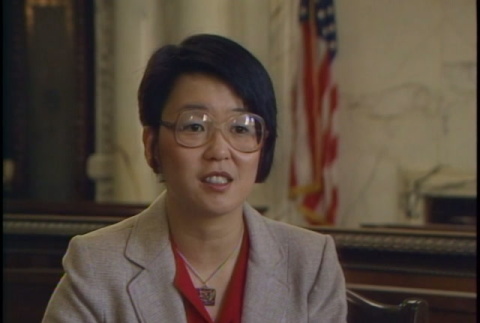
Sansei lawyers Karen Kai and Dale Minami discuss the importance of redress, the reactions to winning the Korematsu case, and their thoughts on their work. Video starts at 0:43. Loni Ding can be heard asking questions behind the camera. Original title: 108, II SF CT #8, 8-9-85, SF Court. Interview continues at ddr.densho.org/ddr-densho-1007-1630/
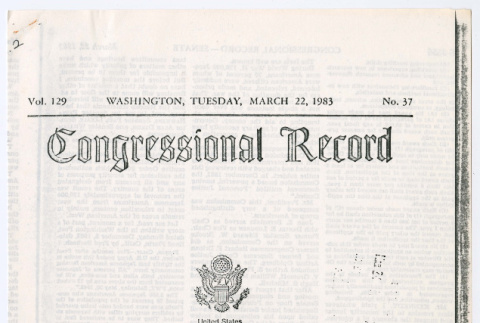
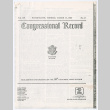
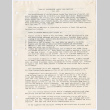
Congressional Record, vol. 129, no. 37: Proceedings and Debates of the 98th Congress, First Session (ddr-densho-1007-1863)
doc Congressional Record, vol. 129, no. 37: Proceedings and Debates of the 98th Congress, First Session (ddr-densho-1007-1863)
This Congressional Record excerpt includes the statement of Senator Howard Metzenbaum titled "Internment of Japanese Americans during World War II" given on March 22, 1983. In his statement Metzenbaum criticizes the motives of Executive Order 9066, describes impacts of incarceration, and argues for the need for redress.
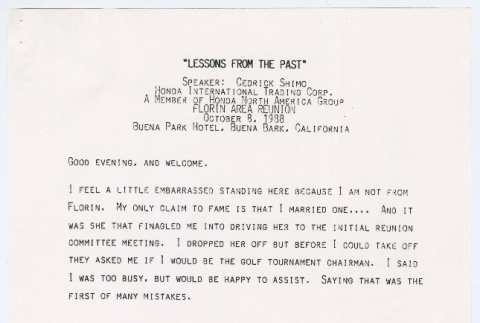
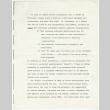
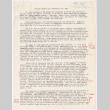
Speech: Lessons from the Past (ddr-densho-1007-1826)
doc Speech: Lessons from the Past (ddr-densho-1007-1826)
Speech by Cedrick Shimo at the Florin Area Reunion on October 8, 1988 in Buena Park, California discussing the impact of incarceration in Japanese American communities and calls for support for redress. Object also contains an article from the Los Angeles Japanese Daily News on September 3, 1988 titled Bert Nakano Delivers Speech on Redress.
San Francisco Courthouse footage, part 6 of 10; interview with Dale Minami and Karen Kai, part 2 of 5 (ddr-densho-1007-1627)
av San Francisco Courthouse footage, part 6 of 10; interview with Dale Minami and Karen Kai, part 2 of 5 (ddr-densho-1007-1627)
Sansei lawyers Karen Kai and Dale Minami discuss their family's reluctance to talk about the war, redress legislation, working on the Korematsu case, the coram nobis petition, and the Gordon Hirabayashi and Minoru Yasui cases. Video starts at 0:49. Loni Ding can be heard asking questions behind the camera. Original title: 106, II SF CT #6, …
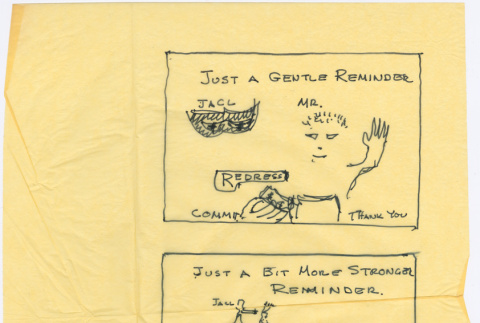
Cartoon (ddr-densho-377-364)
doc Cartoon (ddr-densho-377-364)
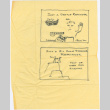
A cartoon about the JACL's involvement in the Redress Movement
API